Add it to your home screen and it opens full screen: no browser bars, one tap away, and everything stays signed in. Free, nothing to download from an app store.
- Tap the Share button in your browser
- Scroll down and choose “Add to Home Screen”
- Open GrowSomeFood from your home screen
- Open your browser’s menu
- Choose “Add to Home screen” or “Install app”
- Open GrowSomeFood from your home screen
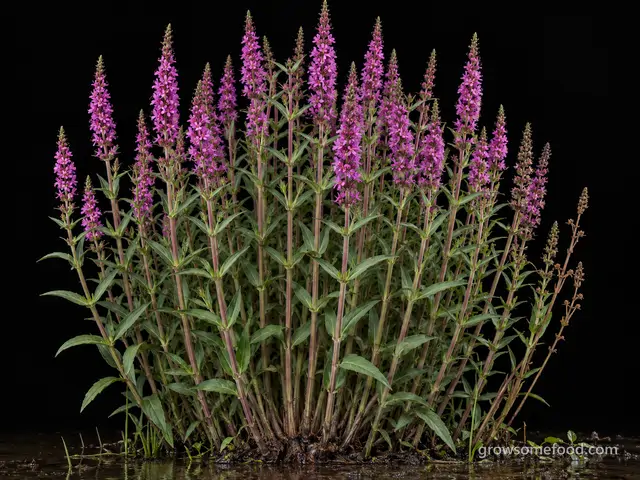
Purple Loosestrife
Purple loosestrife is not poisonous - the hazards here are legal and ecological. It is a listed noxious weed in most states, where planting, selling or transporting it (including cultivars) is illegal, and one plant can seed a whole marsh. Because it grows in and beside water, any herbicide use needs a product whose label lists aquatic sites, and most states also require a permit or a licensed applicator to treat at the water's edge. Check your state rules first.
Overview
The magenta spikes that take over a wet meadow. One mature plant sheds two to three million seeds a year, the seed moves on water, mud and waterfowl, and it is a listed noxious weed in most states. The garden cultivars sold as sterile are not sterile.
Purple loosestrife (Lythrum salicaria) is the plant behind those blocks of solid magenta in roadside ditches, marshes and pond edges from July onward. It is genuinely beautiful, which is how it got here — and it is a listed noxious weed in most US states, where selling, planting or transporting it is illegal.
The reason for that regulation is arithmetic. A single mature plant carries thirty to fifty flowering stems from one woody crown and produces on the order of two to three million seeds in a season. The seed is dust-fine, it stays viable in wet sediment for years, and it travels on flowing water, in mud on a boot or a tire, on boat trailers, and in the feathers and feet of waterfowl. A stand does not so much spread as detonate. Where it takes hold it replaces the cattail, sedge, bulrush and wet-meadow communities outright, and the muskrats, marsh birds and waterfowl that depended on that structure go with them.
Two things every reader should know before going further. First, the garden cultivars — 'Morden Pink', 'Dropmore Purple', 'Morden Gleam' and the ones sold as Lythrum virgatum — were marketed as sterile and are not: they cross-pollinate readily with wild plants and with each other and set abundant viable seed, which is why most states ban the whole genus rather than the species. Second, for anything larger than a garden patch, the realistic control is not you with a spade. It is the Galerucella leaf beetles, a biological control program that has genuinely turned back infestations across the northern states. That story is in the Care section, and it is the most hopeful thing on this page.
At a glance
- Sun
- Full sun · Part sun
- Water
- High
- Spacing
- 18–60 in (typ. 36)
- Mature height
- 36–96 in (typ. 60)
- Start by
- —
- Frost
- Hardy
- Spread
- 18–60 in (typ. 36)
- Soil
- Tolerates wet soil
- Temperature
- Damaged below -40°F · struggles above 95°F
- Self-sows
- Yes — expect volunteers
When to plant
No planting window on record for this zone.
Life stages
- Spring regrowth from the woody crown (Apr-Jun) Apr, May, Jun (yearly)
-
Recognize it before it flowers: square stems, paired stalkless leavesEach spring a mature crown throws up thirty to fifty stiff stems from one woody base. Roll a stem between your fingers - it is distinctly four- to six-sided, not round. The leaves are lance-shaped, stalkless, and set in opposite pairs or whorls of three, with a rounded or heart-shaped base that clasps the stem, and each pair turns ninety degrees from the one below. Nothing native in a wet meadow has that exact combination.
-
Dig small infestations NOW, before there is any seedSpring is the only cheap moment. On a handful of plants, dig out the entire woody root crown with a spade before flowering, taking the crown intact rather than pulling the tops off. Disturb the surrounding soil as little as you can, because bare wet mud is a perfect seedbed for whatever seed is already banked there. Bag the crowns for the trash - never compost them, and never leave them lying on damp ground.
Dense clumps of stiff four- to six-sided stems rising from one woody baseStalkless lance-shaped leaves in opposite pairs or whorls, clasping the stemNew plants in wet ditches, pond margins and roadside swales where water stood over winter -
Recognize it before it flowers: square stems, paired stalkless leaves
- Magenta spikes (Jun-Sep) - unmistakable, and nearly too late Jun, Jul, Aug, Sep (yearly)
-
Dense magenta spikes on every stem tipFrom midsummer each stem carries a dense terminal spike of magenta-purple flowers, six to eighteen inches long, each flower with five to seven crinkled petals. A stand in bloom is a solid block of magenta across a marsh, visible from a road at speed. This is the stage at which almost everyone identifies it, and also the stage at which it is a week or two from setting seed by the million.
-
If you can only do one thing, cut and bag the flower spikesCutting the spikes off does not kill the plant, but it stops that plant contributing to the seed bank this year, and the seed bank is what makes this species almost unbeatable. Clip spikes into a bag as you go rather than dropping them, bag them for the trash, and rinse mud off boots and tools before you walk anywhere else. Plan the real control - crown removal, an on-label aquatic treatment, or a biocontrol release - for later in the season.
A solid block of magenta across a wet meadow, ditch or pond edgeSpikes six to eighteen inches long on every stem tipCattail, sedge and bulrush stands thinning out where the loosestrife has closed in -
Dense magenta spikes on every stem tip
- Seed capsules (Aug-Oct) - two million seeds per plant Aug, Sep, Oct (yearly)
-
The capsules are the whole problemBehind the fading flowers, small hard capsules split and release seed like dust - a single mature plant produces on the order of two to three million seeds in a season, and they stay viable in wet sediment for years. The seed is small enough to move on water, in mud on a boot or a tire, on a boat trailer and in the feathers and feet of waterfowl. This is why an infestation ten miles upstream is your problem too.
-
Late summer is the standard treatment window - and the highest-risk season for spreading itLate summer is when the plant is moving resources to the root, which makes it the usual timing for herbicide treatment. It is also when every pass through a stand carries seed out on your gear. Work from clean ground toward infested ground, never the reverse; bag all cut material; and hose down boots, tools, tires and trailers before leaving. If you are treating in or over water, you need an aquatic-labelled product and, in most states, a permit or a licensed applicator.
Hard capsules splitting along the spent spikesSeed washing along a shoreline or ditch line and germinating in fresh mudNew satellite patches downstream of an existing stand -
The capsules are the whole problem
- Winter: dead stems mark every plant Jan, Feb, Mar, Oct, Nov, Dec (yearly)
-
Map the stand while the skeletons are standingThe stems die but stand through winter as stiff reddish-brown skeletons topped by the spent spikes, and they hold their shape in ice and snow. This is the easiest season to map the true extent of a stand, to count crowns, to find outlying plants along a ditch line, and to photograph the boundary so you can measure next year's change. Flag what you find - it will be invisible again by June.
-
Plan the year, and get in the queue for beetlesWinter is planning time. If the stand is bigger than a few dozen plants, contact your state natural-resources agency, county weed board or extension office now about the Galerucella biocontrol program - releases are made in early summer and demand outstrips supply. Also confirm what your state requires for any herbicide work at a water's edge, since permits and licensed-applicator rules take time to arrange.
Stiff reddish-brown dead stems with spent spikes standing above snowOutlying plants along ditches and shorelines, easy to spot and flag nowThe stand boundary, worth photographing as a baseline for next year -
Map the stand while the skeletons are standing
Watch out for
Two Million Seeds Per Plant High
The reason this species is so hard to beat. One mature crown produces on the order of two to three million dust-fine seeds in a season. They float on flowing water, stick in mud on boots, tires, waders and boat trailers, and ride in the feathers and feet of waterfowl between wetlands that share no watercourse. In wet sediment they remain viable for years. Control is therefore measured in years after the last visible plant is gone, and an infestation upstream reseeds everything cleared below it.
Watch for: Hard capsules splitting along spent spikes from late summer; new satellite patches downstream of a known stand or in freshly exposed mud; seedlings appearing in a site you cleared the previous year.
Prevent: Cut and bag flower spikes before capsules form, even if you can do nothing else that year; work upstream first; hose boots, tools, tires and trailers before leaving a stand, and always move from clean ground toward infested ground rather than the reverse.
Treat: Re-check any cleared site every year for at least five years and remove seedlings before they flower; avoid unnecessary soil disturbance in wet ground, which exposes banked seed to light and creates an ideal seedbed.
Wetland Community Replacement High
The core ecological harm. Dense loosestrife stands overtop and replace cattail, bulrush, sedge and wet-meadow plant communities outright, converting structurally complex marsh into a single-species block. Muskrats will not use it for food or lodges, marsh wrens, bitterns, rails and waterfowl lose nesting structure, and the specialist insects that feed nestlings largely cannot use it. Stands also trap sediment and reduce open water and channel flow, degrading habitat further and clogging irrigation and drainage ditches.
Watch for: Cattail, sedge and bulrush thinning where loosestrife has closed in; open water shrinking; a marsh reduced to a solid magenta block in midsummer; irrigation and drainage ditches slowing.
Prevent: Never plant it or any Lythrum cultivar; report and remove isolated new plants immediately, since early detection on a handful of plants is vastly cheaper than any later option; maintain healthy competitive native cover.
Treat: Dig whole crowns on small infestations before flowering; request a Galerucella biocontrol release for anything larger through your state natural-resources agency, county weed board or extension office; use spot treatment with an aquatic-labelled product only where permitted, and replant with native wetland perennials.
Woody Crown & Fragment Regrowth High
Why pulling the tops off fails. Each plant grows from a hard woody root crown that enlarges every year and carries thirty to fifty stems; cutting or pulling the stems leaves the crown intact and it simply regrows. Worse, the crown can be broken into pieces that each re-establish, and cut stems left on saturated ground can root at the nodes - so mowing a stand, or working a wet site with heavy machinery, can multiply plants rather than reduce them.
Watch for: Vigorous regrowth from a clump that was cut or pulled; new plants along a mown line or a machinery track; stems rooting where cut material was left lying on wet ground.
Prevent: Do not mow or brush-cut a loosestrife stand, particularly once it is seeding; keep machinery out of infested wet ground where possible, and clean it thoroughly before it leaves.
Treat: Dig the entire woody crown intact with a spade before flowering and bag it for the trash - never compost crowns or cut stems and never leave them on damp ground. Re-check the same spot for several seasons.
Noxious-Weed Listing & Control Duties High
The legal dimension, which is unusually strong for a garden plant. Purple loosestrife is a listed noxious weed in most US states, where planting, selling, transporting or distributing it is prohibited - and most statutes list the entire Lythrum genus, so the named garden cultivars and L. virgatum are covered too. In many western and plains states listing also creates a mandatory landowner control duty enforceable by the county weed board. Separately, herbicide use at a water's edge is regulated in its own right.
Watch for: Loosestrife on land you own, rent or manage; nursery or online listings still offering Lythrum cultivars; county weed-board notices in western and plains states.
Prevent: Do not buy, plant, move or give away any Lythrum; check your state noxious-weed list before assuming a cultivar is exempt; report new infestations to your state agriculture or natural-resources department, especially in regions where the plant is still scattered.
Treat: Where your state imposes a control duty, follow its required method and keep records. Before any herbicide work in, over or beside water, confirm what your state requires - an aquatic-labelled product is the minimum, and a permit or licensed applicator is commonly required as well.
Galerucella Leaf Beetles (the biological control) High
The plant's main enemy in North America, and deliberately so. Four European insects were screened for years against native plants and approved for US release from 1992: the leaf-feeding beetles Galerucella calmariensis and G. pusilla, the root-boring weevil Hylobius transversovittatus, and the flower-feeding weevil Nanophyes marmoratus. The Galerucella beetles are the workhorses, defoliating plants repeatedly; across many northern wetlands they have cut loosestrife cover dramatically over roughly three to ten years, allowing cattail, sedge and native forbs to return.
Watch for: For the land manager, this is what success looks like: shot-holed and skeletonized loosestrife leaves, browning stands in early summer, shorter plants flowering poorly, and native marsh vegetation reappearing between them.
Prevent: Nothing to prevent - this is the outcome you want. Avoid broadcast insecticide anywhere near an established release site, and avoid herbicide treatment of a stand under successful beetle attack unless a professional advises otherwise.
Treat: Request a release through your state natural-resources agency, county weed board or extension office; many run rearing programs that supply beetles free and welcome volunteers. Ask in winter, since releases are made in early summer and demand exceeds supply. Expect suppression to a mixed marsh rather than eradication, over three to ten years.
Framed as a threat TO the plant, in the same way crabgrass.json treats dense turf as its own main control. Severity High means highly effective against purple loosestrife - it is the single most useful thing on this page for anyone facing more than a few dozen plants.
Varieties · 4
Smaller, thinner or branched flower spikes in blue-violet or rose; alternate leaves or stalked toothed leaves rather than clasping opposite pairs.
Natives that get pulled by mistake. Winged loosestrife (Lythrum alatum) is a genuine native Lythrum: two to three feet, upper leaves ALTERNATE, flowers borne singly in the leaf axils rather than in a dense spike. Blue vervain (Verbena hastata) has a branched candelabra of pencil-thin spikes with small blue-violet flowers opening in a ring, and stalked toothed leaves. Swamp loosestrife or water-willow (Decodon verticillatus) is native, with arching stems that root where the tips reach water. Fireweed has alternate leaves and four petals. Yellow and gooseneck loosestrife are Lysimachia, a different family entirely.
Varies by species - native wetland perennials in pink, purple, blue and white across a midsummer to fall bloom window.
Plant these instead, in a rain garden, pond edge or wet meadow: swamp milkweed, Joe Pye weed, blue vervain, cardinal flower, ironweed, blazing star, boneset, buttonbush, and native sedges and rushes. Between them they cover the same midsummer-to-fall bloom window and feed the same bees, and they additionally host the specialist insects, monarch caterpillars and hummingbirds that purple loosestrife does not. Ask a local native-plant nursery which suit your water regime and region.
Solid blocks of magenta-purple spikes six to eighteen inches long across wet meadows, ditches and pond margins; stiff reddish-brown dead stems standing through winter.
The invasive species: a three- to seven-foot wetland perennial with four- to six-sided stems from a hard woody crown, stalkless lance-shaped leaves in opposite pairs or whorls clasping the stem, and dense magenta terminal spikes from June to September. A single plant produces two to three million seeds a year, viable in wet sediment for years and carried by water, mud and waterfowl. A listed noxious weed in most US states, where selling, planting or transporting it is illegal - identify and control, never plant.
Similar magenta to rose-pink spikes on slightly tidier plants; indistinguishable in the landscape once escaped.
The named garden selections sold for decades as sterile, along with material offered as the separate species Lythrum virgatum. Controlled crossing work showed they are self-incompatible rather than sterile: alone they set little seed, but pollinated by another cultivar or by any wild plant within bee range - which in practice is always - they set abundant viable seed, and their offspring are fully fertile. This is why most state noxious-weed statutes list the entire genus rather than L. salicaria alone. A nursery tag reading sterile is not a reassurance here.
Grow
How to identify it and separate it from the natives it resembles. Square stems, stalkless paired leaves clasping the stem, and a dense magenta terminal spike - and a native Lythrum, winged loosestrife, that looks similar and should be left alone.
You must not plant purple loosestrife, and in most states you may not. What matters is recognizing it, and recognizing what it is not, because native wetland plants get pulled by mistake every summer.
The plant itself: a stout perennial three to seven feet tall, growing from a hard woody root crown that throws up thirty to fifty stiff stems. The stems are distinctly four- to six-sided, not round — roll one between your fingers. The leaves are lance-shaped and stalkless, set in opposite pairs or whorls of three, with a rounded or heart-shaped base that clasps the stem, each pair rotated ninety degrees from the pair below. From June to September every stem tip carries a dense magenta-purple spike six to eighteen inches long, the individual flowers with five to seven crinkled petals. In winter the dead stems stand as stiff reddish-brown skeletons.
Now the lookalikes. Winged loosestrife (Lythrum alatum) is a genuine native Lythrum and the one most often destroyed by mistake: it is small, two to three feet, its upper leaves are alternate rather than opposite, and its flowers sit singly in the leaf axils instead of forming a dense spike. Leave it. Blue vervain (Verbena hastata) has a branched candelabra of pencil-thin spikes with small blue-violet flowers opening in a moving ring, and stalked, toothed leaves. Fireweed (Chamerion angustifolium) has alternate leaves and four petals. Swamp loosestrife or water-willow (Decodon verticillatus) is native, with arching stems that root where the tips touch water. And the yellow and gooseneck “loosestrifes” sold in garden centers are Lysimachia, a different family entirely — some of those are aggressive too, but they are not this plant.
Why it wins: it tolerates a huge range of wet conditions from saturated muck to merely moist roadside soil, it is hardy to about zone 3, it starts growing early, it grows tall enough to overtop native wet-meadow plants, and it has essentially no North American herbivores or diseases that check it — which is exactly the gap the biocontrol beetles were imported to fill.
Propagation & seed saving
Seed, on an almost unreasonable scale: two to three million per plant per year, viable in wet sediment for years, moved by water, mud, waterfowl, boots and boat trailers. The crown also regrows from fragments, and the sterile cultivars are not sterile.
Everything hard about this plant follows from its seed. One mature crown produces on the order of two to three million seeds per season. Each seed is roughly the size of a grain of dust, which means it moves in ways larger seed cannot: it floats and drifts on flowing water, it sticks in mud on boots, tires, waders, boat trailers and hooves, and it rides in the feathers and feet of waterfowl between wetlands that share no watercourse at all. In wet sediment it stays viable for several years, and often much longer. That is why control is measured in years after the last visible plant is gone, and why an infestation upstream is your problem regardless of what you do on your own bank.
Vegetative spread matters less but is not zero. The woody root crown enlarges each year and can be broken apart into pieces that re-establish, and cut stems left lying on saturated ground can root at the nodes. This is why crowns and cut material get bagged rather than left, and why heavy machinery working a wet site can seed a whole ditch line with fragments.
Then there is the cultivar problem, which is worth stating plainly because it is still repeated in catalog copy. The named garden selections — 'Morden Pink', 'Morden Gleam', 'Dropmore Purple' and material sold as Lythrum virgatum — were introduced and marketed as sterile. Controlled crossing studies showed they are self-incompatible, not sterile: they set little seed alone, and abundant viable seed when pollinated by another cultivar or by any wild plant within bee range, which in practice is always. Their offspring are fully fertile. This is why most state noxious-weed statutes list the whole genus rather than L. salicaria alone, and why a nursery tag reading “sterile” should be treated as a warning label rather than a reassurance.
Care
Control, not care. A few plants: dig the whole crown before flowering and bag it. A wet meadow: the Galerucella leaf beetles, a biocontrol program that has actually worked. Any herbicide near water needs an aquatic-labelled product and usually a permit or a licensed applicator.
Scale decides the method. For a handful of plants — a garden clump, a few escapes along a ditch — dig out the entire woody root crown with a spade before it flowers, taking the crown intact rather than snapping the tops off. Disturb the surrounding soil as little as possible, because bare wet mud is an ideal seedbed for seed already banked there. Bag the crowns and any cut stems for the trash. Do not compost them, do not leave them on damp ground, and check the same spot for the next several years.
For anything larger, the honest answer is that hand removal does not scale, and the tool that does is biological control. Four European insects were screened and approved for release in the US from 1992: two leaf-feeding beetles, Galerucella calmariensis and G. pusilla, a root-boring weevil, Hylobius transversovittatus, and a flower-feeding weevil, Nanophyes marmoratus. The Galerucella beetles are the workhorses: they defoliate the plant repeatedly, and across many northern wetlands they have reduced loosestrife cover dramatically over roughly three to ten years, letting cattail, sedge and native forbs return. Biocontrol does not eradicate the plant — beetle and loosestrife populations settle into a cycle — but it converts a monoculture back into a mixed marsh, which is the actual goal. Releases are coordinated through state natural-resource agencies, county weed boards and extension offices, which often supply beetles free or run rearing programs volunteers can join. Ask in winter; summer release slots fill.
If you use herbicide, the rules near water are not optional. Use a product whose label lists aquatic sites — ordinary garden formulations are not legal to apply to or over water, and their surfactants are toxic to aquatic life. In most states, application in, over or immediately adjacent to water also requires a permit, a licensed applicator, or both; check with your state environmental or natural-resources agency before you buy anything. Follow the label rates, buffers, protective equipment and re-entry intervals exactly: the label is legally binding. Practically, treatment is usually spot application at bud to early bloom or in late summer as the plant moves resources downward, applied to individual plants with a wick or a targeted spray so the surrounding native vegetation survives — broadcast spraying a marsh just clears ground for the seed bank.
Whatever method you use, replant and re-check. Native wetland perennials that fill the same niche and the same visual role include blue vervain, swamp milkweed, Joe Pye weed, cardinal flower, ironweed, blazing star, boneset, buttonbush and native sedges and rushes. And clean your gear: hose boots, tools, tires and trailers before leaving a stand, and always work from clean ground toward infested ground rather than the reverse.
Nutrition
Not a food. The honest counterargument to removing it is that bees work it heavily - and it is worth answering directly, because the wildlife accounting overall is strongly negative: it replaces the marsh structure that muskrats, marsh birds and waterfowl actually depend on.
Purple loosestrife is not grown or gathered for food. The wildlife question is more interesting, because there is a real argument on the other side and it deserves a straight answer rather than dismissal.
The argument is that bees love it. They do. It is a heavy nectar producer over a long midsummer bloom, and nineteenth-century beekeepers deliberately planted it — loosestrife honey was a recognized crop. If your only measure is pounds of nectar per acre, it looks good.
The accounting that matters is broader. What loosestrife replaces is not bare ground; it is cattail, bulrush, sedge and wet-meadow plant communities, and those communities are the physical structure a marsh runs on. Muskrats eat and build with cattail and bulrush and largely will not use loosestrife. Marsh wrens, bitterns, rails and waterfowl nest in that structure. Native wetland forbs support specialist insects that in turn feed nestlings, and loosestrife supports very few — its own herbivores had to be imported deliberately. A dense loosestrife stand also traps sediment and reduces open water and channel flow, degrading habitat further and clogging irrigation ditches and drainage. So the trade is a long nectar flow for generalist pollinators against the loss of nearly everything else the wetland did.
If the nectar is what you value, the replacement list is easy and better: swamp milkweed, Joe Pye weed, boneset, blue vervain, ironweed, blazing star, buttonbush and cardinal flower bloom across the same window, feed the same bees, and additionally host the specialist insects and hummingbirds that loosestrife does not.
Troubleshooting
Answers for the reader with magenta spikes in a ditch: is this the noxious one or a native, is my garden cultivar really sterile, can I spray next to the pond, where do I get the beetles, and how long does this take.
Is this purple loosestrife? Square-ish four- to six-sided stems, stalkless lance-shaped leaves in opposite pairs or whorls clasping the stem, and a dense magenta terminal spike six to eighteen inches long from June to September, on a plant three to seven feet tall in wet ground. How do I know it is not a native? The one to be careful with is winged loosestrife (Lythrum alatum), a native: it is smaller, its upper leaves are alternate, and its flowers sit singly in the leaf axils rather than in a dense spike. Blue vervain has a branched candelabra of thin spikes and stalked toothed leaves. Fireweed has alternate leaves and four petals. Yellow and gooseneck loosestrife are Lysimachia and unrelated. Mine is a named garden variety sold as sterile: it is not sterile. 'Morden Pink', 'Dropmore Purple', 'Morden Gleam' and Lythrum virgatum are self-incompatible, not sterile, and set abundant viable seed when pollinated by any other cultivar or wild plant nearby. Most states list the whole genus for exactly this reason. Is it actually illegal? In most states, yes — planting, selling and transporting it are prohibited under the state noxious-weed law, and some states also require landowners to control it. Check your state's noxious-weed list. Can I spray it next to my pond? Only with a product whose label lists aquatic sites, and in most states only with a permit, a licensed applicator, or both. Garden herbicide formulations are not legal for application to or over water and their surfactants harm aquatic life. Call your state environmental or natural-resources agency first. Can I just pull it? For a few plants, dig the whole woody crown before it flowers and bag it; pulling the tops off achieves nothing. For a marsh, no — ask about beetles. Where do I get the beetles? Through your state natural-resources agency, county weed board or extension office; many run Galerucella rearing and release programs, often free, with releases in early summer. Ask in winter. Mowing? Do not mow a seeding stand — it scatters seed and chops crowns into propagules. How long does this take? Years. The seed bank persists in wet sediment long after the last plant is gone, so plan on re-checking a cleared site each year for at least five, and on biocontrol taking three to ten years to turn a large stand. What should I plant instead? Swamp milkweed, Joe Pye weed, blue vervain, cardinal flower, ironweed, blazing star, boneset, buttonbush, or native sedges and rushes.
History
Arrived in northeastern ports in the early 1800s in ship ballast and as a garden and bee plant, spread inland along canals and railways, exploded through the twentieth century, and became the subject of one of the largest and most successful biological control programs in North America.
Purple loosestrife reached the northeastern United States in the early 1800s by two routes at once: as seed in the soil and sand ballast dumped by European ships, and deliberately, as a hardy ornamental and a bee plant — loosestrife honey was a recognized crop and beekeepers planted it on purpose. It also travelled as a medicinal herb; European herbals had used it as an astringent for centuries.
From the coastal marshes it moved inland along exactly the corridors nineteenth-century America was building: canals, and then railways, both of which created continuous wet, disturbed ground and moved soil and water between watersheds. It was established across the Northeast by the 1830s, through the Great Lakes by the early twentieth century, and after mid-century it expanded explosively — helped by wetland drainage and disturbance, by roadside ditching, and by continued sale as a garden perennial.
By the 1980s it was one of the most-cited invasive plants in North America, and the response became a landmark. Rather than accept permanent chemical management of thousands of wetlands, agencies funded a long biological control program: European insects that feed on loosestrife were collected, screened for years against native plants to make sure they would not switch hosts, and the first releases were approved in 1992. The Galerucella leaf beetles established widely and, over the following decades, reduced loosestrife across large areas of the northern states and Canada while native marsh vegetation returned. It is one of the clearest successes in weed biocontrol — and a reminder that the reason the plant needed it at all is that a beautiful, tough, generous garden perennial from one continent can be a catastrophe on another.
Growing across climates
Established in nearly every state and hardy to about zone 3, with the heaviest impacts across the northern tier - the Northeast, Great Lakes, upper Midwest and Pacific Northwest. In the arid West it concentrates in irrigation ditches and river corridors, where it is regulated hardest.
Purple loosestrife is hardy to roughly zone 3 and grows through about zone 9, and it is recorded in nearly every US state and much of Canada. Its heaviest impacts fall across the northern tier: New England and the mid-Atlantic, the Great Lakes basin, the upper Midwest, the northern plains and the Pacific Northwest, where cool summers, abundant wetlands and a long history of introduction line up. Minnesota, Wisconsin, Michigan, New York and Washington all run long-standing control and biocontrol programs against it.
In the arid West and Intermountain states it behaves differently but is treated even more severely. Water there is confined to river corridors, irrigation canals, ditches and reservoir margins, so the plant concentrates in exactly the infrastructure that agriculture depends on, where dense stands slow flow and clog delivery. Western and plains states generally list it as a noxious weed with mandatory landowner control duties, and county weed boards actively enforce it.
Two practical consequences. First, work upstream: seed moves with water, so a stand at the top of a drainage reseeds everything cleared below it, and coordinating along a whole watercourse beats working one bank. Second, in the far south and southwest, where it is scattered rather than dominant, a new plant is a genuine emergency worth reporting to the state agriculture or natural-resources department — early detection and rapid response on a handful of plants is a hundred times cheaper than anything available once a stand establishes.
No grower tips for Purple Loosestrife yet — yours could be the first.
Sign in to share what works in your garden.