Add it to your home screen and it opens full screen: no browser bars, one tap away, and everything stays signed in. Free, nothing to download from an app store.
- Tap the Share button in your browser
- Scroll down and choose “Add to Home Screen”
- Open GrowSomeFood from your home screen
- Open your browser’s menu
- Choose “Add to Home screen” or “Install app”
- Open GrowSomeFood from your home screen

Purple Dead-Nettle
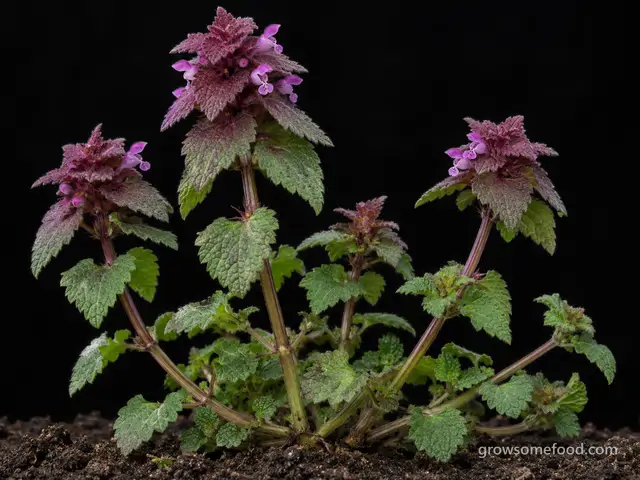
Purple dead-nettle is a safe, mild, non-toxic edible - the fuzzy purple-tinged upper leaves, tender stems, and pink-purple flowers are all edible raw or cooked. Despite the name it is NOT a stinging nettle; 'dead-nettle' means nettle-shaped leaves with no sting. No deadly look-alikes, but see the look-alike note: henbit is equally edible (dead-nettle's upper leaves are stalked, henbit's clasp the stem), while creeping, strongly minty ground ivy is not. Only forage from herbicide-free ground.
Overview
The fuzzy purple-topped 'weed' that reddens fields and gardens in early spring - a mild edible green and gentle herbal plant that, despite its name, does not sting at all.
Purple dead-nettle (Lamium purpureum) is the low, fuzzy plant whose purple-flushed upper leaves and small pink-purple flowers turn fields, gardens, and roadsides reddish-purple in late winter and early spring, usually mixed in with its cousin henbit. The name puts people off, but it is reassuring: 'dead-nettle' means the leaves merely look like a stinging nettle's - it is actually a mint-family plant with no sting at all and is a mild, safe edible green.
The young purple tops, tender stems, and flowers are all edible raw or cooked, with a mild, faintly earthy taste and a slightly fuzzy texture that all but disappears when cooked or blended. Beyond food, it has a gentle herbal tradition (as a mild poultice and tea) and is one of the earliest and most valuable nectar sources for spring bees. A cool-season winter annual, it fills the lean early-spring window and then fades in summer heat. It self-sows freely and is almost always a volunteer, but a welcome one - free early greens, edible flowers, and easy identification once you learn to tell it from the equally edible henbit.
At a glance
- Sun
- Full sun · Part sun · Part shade
- Water
- Medium
- Spacing
- 4–12 in (typ. 8)
- Mature height
- 4–12 in (typ. 8)
- Start by
- Direct sow
- Frost
- Hardy
- Germination
- 7–21 days (typ. 12) @ 50–70 °F (typ. 60)
- Spread
- 4–12 in (typ. 8)
- Soil
- Well-drained
- Temperature
- Damaged below -20°F · struggles above 85°F
- Seed ready
- 45–80 days (typ. 60) (for saving)
- Self-sows
- Yes — expect volunteers
When to plant
Zone 7a typical frost: last Apr 10 · first Oct 25 (spring frost runs Mar 27–Apr 24 in a typical spread of years)
Life stages
- Cool-season sprouting day 0–14 from sowing
-
Comes up in cool, moist weatherPurple dead-nettle germinates in the cool, moist conditions of fall and early spring - a winter annual that sprouts in autumn, overwinters small, and blooms early in spring. Keep a sowing damp; it needs almost no help.
Fast, easy germination in cool weatherFall-sprouted plants overwintering as small purple-topped clumps -
Comes up in cool, moist weather
- Leafy growth (harvest)
-
Snip the tender purple tops for greensevery 10 dHarvest the young purple-flushed upper leaves, tender stems, and flowers with scissors while the plant is lush in the cool season and before it gets stringy with warmth. Cut-and-come-again: it regrows from the cut stems for repeated picking. Mild, faintly earthy, and slightly fuzzy - good raw or lightly cooked.
-
A purple-topped cool-season carpetPurple dead-nettle forms low mounds whose upper leaves flush purple and overlap into a fuzzy 'steeple,' often carpeting bare fields and beds reddish-purple in early spring. It fades fast once summer heat arrives.
Stringy, tough growth as it bolts and flowers in warmth (harvest young)Prolific self-seeding -
Snip the tender purple tops for greensevery 10 d
- Pink-purple flowers
-
Pick the little flowers; still edible in bloomThe small pink-purple two-lipped flowers tucked among the purple upper leaves are edible and pretty on salads. The whole plant stays edible through bloom, but it sets and drops copious seed quickly - harvest or pull it before it seeds to limit next season's crop.
-
An early nectar sourcePurple dead-nettle blooms very early and heavily, feeding early bees (including bumblebees) and other pollinators when little else is in flower - a strong reason to welcome a patch even as it self-sows.
Heavy seed drop (pull before seeding to reduce spread)Early bees and bumblebees working the flowers -
Pick the little flowers; still edible in bloom
Harvest
- Style
- Cut and come again
- First production
- 1–1 yrs (typ. 1)
- Lush, tender purple-topped growth in the cool season (fall, and late winter through spring)
- Harvest before warm weather makes it stringy and before heavy seeding
Watch out for
Herbicide / Pollution Contamination Medium
A risk to the forager rather than to the plant. This species grows in lawns, gardens, pastures, croplands, field margins, paths and roadsides - exactly the places that get sprayed with herbicides and lawn chemicals, or that collect road pollution and runoff. The plant itself is harmless; what can make it unsafe to eat is where it has been growing.
Watch for: Plants growing in treated lawns, sprayed beds, pastures or croplands, along busy or polluted roadsides, or anywhere the ground around them looks suspiciously weed-free. Yellowed, twisted or distorted growth on neighboring plants is a sign something has been sprayed recently.
Prevent: Only forage from ground you know has not been treated with herbicides or pesticides, and stay well back from busy roadsides. Ask before harvesting on land you do not manage. If you are not sure, grow your own patch, or gather only from a clean site you have watched across a full season.
Treat: Do not harvest a contaminated plant - there is no washing this off, and no way to tell by looking. The plant itself is fine, so the answer is simply to choose a different site.
Purple dead-nettle is a cropland and lawn weed, and both settings are commonly sprayed. Early spring, when it is at its best, is also when lawn herbicides go down.
Aggressive Self-Seeding & Spread Low
Not a pest but a management issue. This plant sets and sheds seed prolifically, so anything left to ripen builds a persistent seed bank in the soil and returns as a heavy flush of volunteers the following season. Much of that seed stays viable for years, which is why one season of letting it go can take several seasons to undo.
Watch for: Ripe seed heads or stalks shedding onto the ground, and a flush of volunteer seedlings coming up well beyond where the parent plant stood - most obvious in the first weeks of the plant's growing season.
Prevent: Cut, deadhead or harvest the seed heads before they ripen and shatter, which is far easier than dealing with what they drop. Where the plant is grown deliberately, keep it in defined rows or a contained bed so that volunteers are obvious, and site it only where naturalizing is welcome.
Treat: Hoe or hand-pull volunteers while they are small and before they set seed - the existing seed bank will keep germinating for several seasons either way, so this is an ongoing job rather than a single fix. Where the volunteers are themselves edible, harvesting them is the easiest control, but only ever eat or grow on a seedling you can positively identify.
Purple dead-nettle completes its cycle fast and reseeds prolifically as a cool-season weed. It is shallow-rooted and easy to pull, and harvesting it is the pleasant version of weeding it.
Look-Alike Confusion Low
Purple dead-nettle is routinely confused with henbit (harmless - henbit is equally edible), mistaken by name for a stinging nettle (it has no sting), and, most often in practice, mixed up with ground ivy (Glechoma hederacea), which shares its lawns, its February-to-May window, its square stems, its small purple two-lipped flowers, and its scalloped fuzzy leaves. Ground ivy is the one look-alike here worth avoiding: it contains pulegone, it is a strong seasoning herb rather than a salad green, and it should not be eaten in quantity, during pregnancy, or by anyone with liver or kidney trouble.
Watch for: Henbit has STALKLESS clasping upper leaves and a greener look. Ground ivy CREEPS along the ground on runners that root as they go, with round, long-stalked scalloped leaves and a strong minty smell when crushed. Dead-nettle stands upright, with stalked, triangular, purple-flushed upper leaves and little scent. True stinging nettle has coarse serrated leaves and stinging hairs.
Prevent: Crush a leaf and look at how the plant grows before you pick: strongly minty and creeping on rooting runners means ground ivy - leave it. For dead-nettle, check the square stem (mint family), the stalked purple upper leaves, and the lack of any sting; it and henbit are both edible, so confusing those two is harmless.
Treat: A dead-nettle and henbit mix-up needs nothing - both are edible. Throw out any picking with ground ivy in it rather than sorting it at the sink; a stray leaf is not an emergency, but it is not food. Purple dead-nettle never stings, so a stinging plant is something else. If in doubt about any plant, do not eat it.
Ground ivy is the only look-alike here that is not edible; the two harmless confusions - henbit, and the stinging-nettle name - are the ones people ask about most.
Good & bad neighbors
Varieties · 1
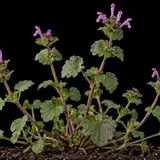
Low mounds of fuzzy purple-tinged triangular upper leaves on square stems, topped with small pink-purple two-lipped flowers.
The common purple dead-nettle: a low cool-season winter annual with square stems, fuzzy purple-flushed stalked triangular upper leaves forming a 'steeple,' and small pink-purple flowers. A mild, edible early-spring green, gentle herbal plant, and heavy early bee nectar source. Not a stinging nettle.
Grow
A cool-season self-sower of moist, disturbed ground; you rarely plant it - it volunteers - and it thrives with no care, fading when summer heat arrives.
Purple dead-nettle grows itself in the cool, moist part of the year, thriving in the rich, disturbed soil of garden beds, croplands, lawns, and roadsides in full sun to part shade. It is a cool-season winter annual: it germinates in fall, overwinters as a low clump, blooms early in spring, and dies off as summer heat arrives - shrugging off frost and filling the off-season.
You almost never plant it; it volunteers abundantly from self-sown seed and is one of the first plants to green up disturbed ground. If you want it deliberately as an early salad or smoothie green, surface-sow the seed in fall or earliest spring into cool, moist soil and it comes up on its own with no care. Far more often the 'growing' question is whether to welcome it as free greens and an early bee plant or to pull it (it is shallow-rooted and easy to remove) before it seeds. Either way it needs nothing from you but harvesting - and a little management if you want it out of a tidy bed.
Harvest
Snip the tender purple tops and flowers with scissors through the cool season - it is cut-and-come-again - and eat them raw, blended, or lightly cooked; harvest young before it bolts.
Harvesting purple dead-nettle is easy: gather the young purple-flushed upper leaves, tender stems, and flowers with scissors while the plant is lush and cool-season fresh. It is cut-and-come-again - snip the tops and it regrows for repeated pickings through fall and, especially, late winter into spring. Take it young, before warm weather makes the stems stringy and before it sets heavy seed.
Its slight fuzziness is most noticeable raw, so many foragers favor it blended or cooked: it shines in green smoothies and pesto, and wilts nicely into eggs, soups, and sautes, though the tender young tops are also fine chopped into a mixed salad. The little flowers make a pretty edible garnish, and dried leaves make a mild tea. Only forage from ground free of herbicides and lawn chemicals, and confirm the ID: the square stem marks it as a mint-family plant, and its stalked, triangular, purple upper leaves distinguish it from henbit's stalkless clasping leaves - though both are edible, so a mix-up is harmless.
Nutrition
A nutritious free green carrying iron, vitamins, fiber, and antioxidants, best enjoyed as an early-spring tonic green and blended into smoothies and pesto.
Purple dead-nettle is a surprisingly nutritious little green. Its tender leaves and stems supply iron, fiber, vitamins, and antioxidants along with beneficial plant compounds, and the purple pigment reflects anthocyanins similar to those in other richly colored plants - all in a mild, low-calorie package. As a fresh green available through the cool season when garden vegetables are scarce, it is a genuinely useful free food, especially blended into smoothies where its slight fuzziness disappears.
It also carries a gentle, well-regarded herbal tradition: dead-nettle has been used as a mild poultice for minor scrapes and irritated skin and brewed as a mild tea, with mild anti-inflammatory and astringent properties (it is sometimes noted in folk use for seasonal allergy relief, though this is traditional rather than proven). Ecologically it is important as one of the earliest and heaviest nectar and pollen sources for spring bees and bumblebees. Nutritious, gentle, and free, it rewards a second look from anyone who only ever weeds it out.
Traditional & historical uses
Purple dead-nettle has a gentle herbal folk tradition to match its use as an edible green. The leaves are used as a mild poultice for cuts, scrapes, and insect bites (they are mildly astringent and anti-inflammatory) and brewed as a tea traditionally taken for seasonal allergies. These uses are gentle and largely traditional, with little formal evidence. Educational only, not medical advice.
This section records how people have traditionally used this plant, and what is known about the risks. It is history and general information — not medical advice, and not a recommendation to treat anything. Plants are not dosed like medicines, some interact with prescriptions, and some are harmful in ways that are not obvious. Talk to a clinician before using any plant medicinally.
Alongside its role as a mild edible green, purple dead-nettle (a stingless mint-family plant, not a true nettle) carries a gentle folk-medicine tradition based on its astringent and anti-inflammatory character.
Traditional uses: the fresh leaves are used as a simple poultice on minor cuts, scrapes, insect bites, and irritated skin, where their mild astringent and anti-inflammatory action (from tannins and flavonoids) can soothe and help stanch small bleeds. A leaf tea is a traditional gentle remedy, sometimes taken for seasonal allergies and as a mild wellness tonic, and the plant is regarded as gently astringent and diuretic.
Honest caveats: purple dead-nettle is very mild and safe (it is, after all, eaten as a salad and smoothie green), but its medicinal reputation is largely traditional and unsupported by clinical trials - the allergy-relief use in particular is folklore rather than proven. Use only clean, unsprayed plants, keep any topical use to minor complaints, and don't rely on it for real medical problems. Educational information, not medical advice.
In the kitchen
Best blended into smoothies and pesto (which hides its fuzz); also good wilted into eggs, soups, and sautes, with tender young tops fine raw in salads.
Purple dead-nettle's mild, faintly earthy flavor is easy to cook with; the only quirk is a slight fuzzy texture raw, which is why many foragers reach first for the blender or the pan. It is a favorite green-smoothie ingredient and makes an excellent pesto (its gentle taste plays well with garlic, nuts, oil, and cheese, and blending erases the fuzz entirely). The purple tops also give a pretty color to a smoothie or a swirled soup.
Cooked, treat it like a delicate green: wilt it into scrambled eggs and omelets, stir it into soups and broths at the end, fold it into a saute, or add it to savory pancakes, fritters, and quiches. It needs only brief heat. The tender young upper leaves and flowers are also fine raw in a mixed salad or scattered as a garnish. Because it is so mild, dead-nettle is a way to add free, fresh, seasonal greens rather than a bold flavor - pick it young and cool-season for the best texture, since older warm-weather growth turns stringy.
History
A Eurasian plant carried worldwide with agriculture, long used as a folk green and mild herbal remedy, and named for its harmless nettle-shaped-but-stingless leaves.
Purple dead-nettle is native to Europe and Asia and has traveled with people and agriculture across the world, becoming one of the most common cool-season weeds of croplands, gardens, and roadsides in North America. Its name is a small lesson in reassurance: 'dead-nettle' distinguishes the Lamium genus - whose leaves resemble a stinging nettle's but carry no sting ('dead' in the old sense of harmless) - from the true nettles, and it has long been gathered as a safe folk green and mild medicinal herb where true nettles would bite.
As a member of the useful mint family (Lamiaceae), it appears in the European tradition of eating early-spring wild greens as a fresh tonic after winter, and in folk herbalism as a gentle poultice and tea for minor wounds and irritation. For most of its modern North American history it has simply been an overlooked purple carpet of the cool season. The recent revival of foraging and interest in wild greens has restored some of its reputation, reminding gardeners that the reddish-purple haze over early-spring fields is free, mild, nutritious food - and a crucial early meal for the bees.
Troubleshooting
Confirm the easy mint-family ID (and that it is henbit, not a stinging nettle, that it resembles), blend or cook away the slight fuzz, harvest young, and pull it easily where unwanted.
Does it sting? No - despite 'nettle' in the name, purple dead-nettle is a mint-family plant with no sting at all; the name only means its leaves are nettle-shaped. Is this dead-nettle or henbit? Both are edible, so a mix-up is harmless, but to tell them apart: dead-nettle's upper leaves are stalked, triangular, and flushed purple, forming a fuzzy purple 'steeple'; henbit's upper leaves are stalkless and clasp the square stem in scalloped whorls and look greener. Could it be ground ivy? This is the mix-up that matters: ground ivy (Glechoma hederacea) grows in the same lawns at the same time with the same square stems and small purple flowers, but it creeps on runners that root as they go, its leaves are round, long-stalked and scalloped, and it smells strongly minty when crushed. Dead-nettle stands upright and has almost no scent. Ground ivy contains pulegone and is a seasoning herb, not a salad green — leave it out of the basket. It feels fuzzy raw: normal - blend it into smoothies or pesto, or cook it, and the fuzz disappears; use only the tender young tops raw. It is tough and stringy: you harvested it late or in warm weather - take it young in the cool season. It is everywhere in my beds and fields: it self-sows prolifically each cool season - pull it (shallow-rooted and easy) before it seeds, or harvest and eat it. It disappeared in summer: normal - a cool-season winter annual that returns from seed in fall. Pests and diseases: essentially none.
Growing across climates
A cool-season weed adapted across the country (zones 3-10); it shifts its season by climate - winter-growing in the South, fall and spring in the North - and always fades in summer heat.
Purple dead-nettle is naturalized across essentially all temperate North America, zones 3-10, and adapts by shifting when it grows rather than where. Cold northern zones (3-6): it germinates in fall or very early spring and blooms as soon as the weather softens, giving early-spring greens and one of the first heavy nectar flows of the year before summer heat ends it. Mild and southern zones (7-10): it behaves as a true winter plant, carpeting fields, gardens, and roadsides reddish-purple through the cool months and dying out as heat arrives. Everywhere, its requirement is cool, moist conditions; it bolts and fades quickly in heat and drought.
Because it is so widely adapted, purple dead-nettle turns up as a foraged early-spring green almost anywhere people live - you simply look for it in the cool part of the year. In the North that means early spring; in the South, the depths of winter. Either way it is a dependable, mild, free green in the season when garden vegetables are scarce, and one of the most important early nectar plants for pollinators across the whole country.
Cook it
All 1 recipe →Grower tips
No grower tips for Purple Dead-Nettle yet. Yours could be the first.
Sign in to share what works in your garden.