Add it to your home screen and it opens full screen: no browser bars, one tap away, and everything stays signed in. Free, nothing to download from an app store.
- Tap the Share button in your browser
- Scroll down and choose “Add to Home Screen”
- Open GrowSomeFood from your home screen
- Open your browser’s menu
- Choose “Add to Home screen” or “Install app”
- Open GrowSomeFood from your home screen
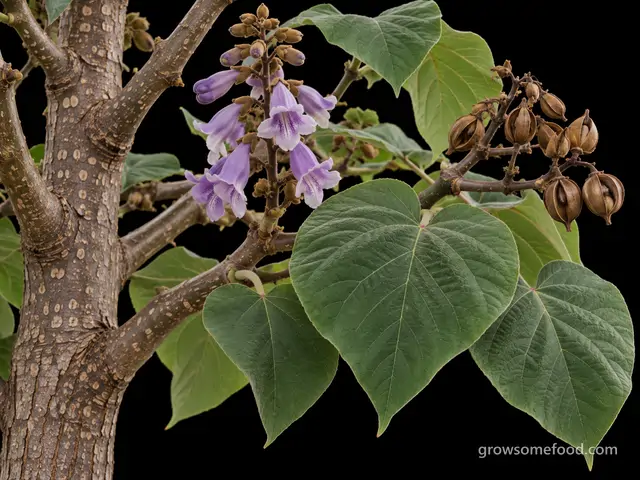
Princess Tree
Princess tree is not poisonous and is safe to handle; the fuzzy leaves are sticky rather than irritant, though the fine hairs can bother sensitive skin and fallen flowers get slippery on paving. The genuine hazards are structural and ecological. The wood is light and brittle, so mature trees shed limbs in wind, ice, and wet snow and are poor choices near a house, driveway, or power line. And a single tree seeds a whole watershed. Do not plant it - not even the clones sold as fast timber.
Overview
The lavender-flowered tree from the 'fastest growing tree in the world' ads. One mature princess tree sheds millions of tiny wind- and water-borne seeds onto cliffs, riverbanks and burned ground, and cut stumps sprout back. Connecticut prohibits its sale.
Princess tree, or empress tree (Paulownia tomentosa), is the tree behind a hundred online ads promising the fastest-growing tree in the world and a fortune in timber. The claims about speed are not even exaggerated — a young paulownia really can put on ten or fifteen feet in a season, with leaves two feet across — and in April it covers itself in upright spikes of fragrant lavender flowers before a single leaf opens, which is genuinely beautiful. That is the whole sales pitch, and it leaves out the part that matters.
A mature princess tree produces capsules by the thousand, each holding a couple of thousand seeds so small and so finely winged that they travel on wind and float on water — the number often quoted is up to twenty million seeds from one tree in a year. They germinate on bare mineral ground, which in practice means roadcuts, gravel, scoured riverbanks, landslides, burned forest, and bare rock outcrops, including the cliff and bluff habitats that carry some of the rarest plants in the Appalachians. Cut it down and the roots answer with a ring of sprouts. Connecticut prohibits its sale, and state agencies across the mid-Atlantic, Appalachians, and Southeast list it as invasive — check your own state's list. This entry is here to help you recognize it, understand what it is doing, and remove it properly.
At a glance
- Sun
- Full sun · Part sun
- Water
- Medium
- Spacing
- 180–600 in (typ. 360)
- Mature height
- 300–720 in (typ. 480)
- Start by
- Direct sow
- Frost
- Hardy
- Spread
- 240–600 in (typ. 420)
- Soil
- Well-drained
- Temperature
- Damaged below -15°F · struggles above 105°F
- Self-sows
- Yes — expect volunteers
When to plant
No planting window on record for this zone.
Life stages
- Lavender foxglove bloom before the leaves (identify) Apr, May (yearly)
-
Recognize it: upright spikes of lavender foxglove flowers on a bare treeIn mid spring, before any leaves appear, princess tree covers itself in upright clusters of pale purple, trumpet-shaped, fragrant flowers about two inches long - unmistakably foxglove-like, which is where the name comes from. A big bare tree flowering solid lavender in April is princess tree, not catalpa: catalpa flowers are WHITE with yellow and purple spotting and appear in June, well after the leaves.
-
Flowering means seed is coming - deal with it nowA tree in bloom is a seed factory about to run. If you are going to remove it, this is the year to do it: capsules set within weeks of bloom and release seed the following winter, and each mature tree can put out millions. Cutting alone will not do it - plan a cut-stump or basal-bark treatment, or hire an arborist for anything large, before the seed goes out.
Upright lavender trumpet flowers on a leafless tree in AprilHeavy sweet fragrance and a carpet of dropped purple flowersTrees blooming on cliff faces, roadcuts, and river bluffs - the invasion front -
Recognize it: upright spikes of lavender foxglove flowers on a bare tree
- Huge fuzzy leaves & explosive growth (identify & control) May, Jun, Jul, Aug, Sep (yearly)
-
Enormous opposite heart-shaped leaves, velvety on both sidesThe leaves are huge - typically 6 to 12 inches, and up to two feet across on stump sprouts and young saplings - broadly heart-shaped, held in OPPOSITE pairs, and densely fuzzy on both surfaces, often faintly sticky. The twigs are stout with big raised dots and a hollow or chambered pith. Catalpa leaves are similar in outline but nearly hairless and often in whorls of three; northern catalpa also lacks the fuzz.
-
Pull seedlings while they are smallSeedlings appear on bare mineral soil - gravel, roadcuts, washed riverbank, burned ground, cracks in rock, and the edges of a graded lot. Pull them when the soil is moist and they are under a foot, taking the whole root; a first-year seedling can already be waist high, so check monthly through summer rather than once a season. Anything bigger has a taproot and will need cutting and stump treatment instead.
Opposite, heart-shaped leaves 6 inches to 2 feet across, fuzzy both sidesShoots putting on 8 to 15 feet in a single seasonSeedlings colonizing gravel, roadcuts, burned ground, and scoured riverbanks -
Enormous opposite heart-shaped leaves, velvety on both sides
- Woody capsules & the seed load Jun, Jul, Aug, Sep, Oct (yearly)
-
Clusters of green pecan-shaped capsules turning brownThrough summer the flower clusters become tight bunches of pointed, pecan-shaped capsules, green and sticky at first and drying to hard brown husks. Each capsule holds a couple of thousand tiny winged seeds, and a mature tree carries thousands of capsules - the often-quoted figure is up to twenty million seeds in a year from one tree. The capsules split over winter and stay on the twigs long after.
-
Prioritize seed-bearing trees for removalWhen you have several to deal with, take out the capsule-bearing trees first: they are the seed source for everything downwind and downstream. Cutting a fruiting tree in late summer still leaves the capsules to dry and open, so bag and bin the cut tops rather than leaving them in a brush pile, and never chip fruiting material onto a trail or a bank.
Clusters of pointed pecan-shaped capsules, green then brownSplit husks staying on the twigs into the next seasonSeedling flushes downwind and downstream of a fruiting tree -
Clusters of green pecan-shaped capsules turning brown
- Winter ID & the control window Jan, Feb, Mar, Nov, Dec (yearly)
-
Fuzzy brown flower buds and last year's capsulesPrincess tree is easiest to name in winter. It forms its flower buds the previous fall and carries them all winter as clusters of small, velvety, tan-brown balls at the twig tips, alongside the split brown capsules of last year's crop. No other tree in eastern North America shows that combination. Stout twigs, hollow pith, and big pale lenticels confirm it.
-
Treat stems in the dormant season - and never just cutDormant-season basal-bark treatment on stems under about six inches, and cut-stump treatment on larger ones, are the standard approaches; late summer to early fall foliar work is the other window. Whatever you use, choose a product whose LABEL lists the site you are treating and follow that label exactly, including buffers near water and wells. Cutting alone is the one thing guaranteed to fail: the roots answer with a ring of sprouts.
Clusters of velvety tan flower buds held through winterOld split capsules persisting on the twigsRings of root sprouts around a stump cut in a previous year -
Fuzzy brown flower buds and last year's capsules
Watch out for
Millions of Wind- and Water-Borne Seeds High
The core hazard: each woody capsule holds roughly two thousand dust-fine winged seeds and a mature tree carries thousands of capsules, so a single princess tree can release on the order of twenty million seeds in a year. They travel on wind and float on water, and they germinate on any bare, sunny mineral surface - roadcuts, gravel, burned forest, landslides, flood-scoured riverbanks, and the rock outcrops and cliffs that hold some of the rarest plants in the Appalachians.
Watch for: Clusters of pointed pecan-shaped capsules on the tree; split husks persisting through winter; flushes of fast fuzzy-leaved seedlings on graded ground, gravel, burn scars, and river banks downwind or downstream.
Prevent: Never plant it; remove capsule-bearing trees first to shut off the seed; bag and bin fruiting cut tops rather than piling or chipping them near trails and streams.
Treat: Kill the parent trees by cut-stump or basal-bark treatment on-label, then keep pulling seedlings for at least three seasons - the seedbank keeps germinating after the tree is gone.
The seed load is why a single ornamental in a yard becomes a regional problem: nothing about removing your tree is urgent to you, and everything about it is urgent to the riverbank downstream.
Root Sprouting After Cutting High
Why casual removal backfires: princess tree responds to cutting, fire, or damage by sending up a dense ring of vigorous sprouts from the stump and shallow roots, converting one trunk into a multi-stemmed clump that flowers and fruits again within a few years. Each cutting without root control makes the stand denser rather than smaller.
Watch for: Rings of fast, huge-leaved sprouts around an old stump; new stems appearing several feet out from where a tree was felled; clumps of multiple trunks where a single tree once stood.
Prevent: Do not fell a princess tree without a plan for the stump; pull seedlings while they are small enough that the whole root comes out.
Treat: Cut low and treat the fresh cut surface with herbicide immediately, or basal-bark stems under about six inches during the dormant season, or treat regrowth foliage in late summer - always with a product whose label lists your site, following the label. Expect to re-treat sprouts for two or three years.
This is the single most common failure people report on this species: the tree comes down, and next summer there are twenty of it.
Brittle Wood & Limb Failure Medium
A direct property hazard and the reason fast growth is a poor argument for this tree: paulownia wood is exceptionally light and weak, the crown is heavy with oversized leaves, and the tree is short-lived. Limbs break in wind, ice, and wet snow, and mature trees decline and fail decades sooner than the natives they were planted to outpace.
Watch for: Torn limb stubs and split crotches after storms; large branches down after wet snow; heavy litter of flowers, capsules, and big leaves on paths, gutters, and roofs; hollowing or decline in trees past thirty or forty years.
Prevent: Do not plant it, and never near a house, driveway, parking area, or power line; pruning cannot make brittle wood strong.
Treat: Have an arborist assess and remove failing or hazardous trees - and take the removal as the moment to replace it with a sounder native rather than replanting speed.
Worth weighing against the ad copy: the same growth rate that sells the tree is what produces the weak wood.
Varieties · 3
Varies by species - native trees with sounder wood, longer lives, and food value for native insects and birds.
Plant these instead. For fast native shade: tulip tree, sycamore, river birch, or hackberry - all quick, all with real wildlife value. For the big tropical-leaf effect: northern catalpa or bigleaf magnolia. For spring flowers on a tree that fits a yard: serviceberry, eastern redbud, or fringetree. A local native-plant source or extension office can tell you which suit your soil and space, which matters more here than speed.
Marketed as faster, straighter, and cold-hardier than the species; in the yard they look like ordinary paulownia - same huge fuzzy leaves, same brittle limbs.
The trees sold through timber-investment and fast-shade advertising, including hybrid clones marketed as sterile, seedless, or low-seed. Treat the sterility claim with the skepticism the Callery pear earned for everyone: cultivars sold as sterile are exactly how that invasion began, since compatible relatives nearby restore fertility. Even where a clone genuinely sets little seed, it keeps the brittle wood, the heavy litter, and the root sprouting, and it normalizes planting a species that is prohibited or listed across much of its US range.
Fast open-crowned tree with stout, big-lenticelled twigs; heart-shaped fuzzy leaves 6 inches to 2 feet across in opposite pairs; lavender trumpet flowers in April before leaf-out; pecan-shaped woody capsules; velvety tan flower buds held all winter.
The species behind the fastest-growing-tree ads: a short-lived, brittle, extremely fast tree with huge fuzzy opposite leaves and upright lavender foxglove flowers on bare April branches. It produces up to twenty million dust-fine seeds a year, carried by wind and water onto roadcuts, burned ground, riverbanks, and rock outcrops, and it sprouts hard from roots and cut stumps. Connecticut prohibits its sale and mid-Atlantic and Southeastern states list it as invasive - identify and control, never plant.
Grow
How to recognize it and why never to plant it: lavender foxglove flowers on bare April branches, huge opposite fuzzy heart-shaped leaves, pecan-shaped capsules, and velvety tan flower buds held all winter - on a fast, brittle, seed-throwing tree.
You should not plant princess tree — recognizing it is the useful skill, and it is one of the easier trees to name in any season. In spring, upright clusters of pale purple, trumpet-shaped, sweetly fragrant flowers open on completely bare branches in April, before the leaves. In summer, it carries enormous opposite, heart-shaped leaves, typically 6 to 12 inches and up to two feet on sprouts, densely fuzzy on both sides and slightly sticky, on stout twigs with hollow or chambered pith. In fall, tight clusters of pointed, pecan-shaped woody capsules dry from green to brown. In winter, the clincher: clusters of small velvety tan flower buds, formed the previous fall and held all winter, alongside last year's split capsules. Nothing else in eastern North America looks like that.
The usual confusion is with catalpa, which also has big heart-shaped leaves and showy flowers. Catalpa's flowers are white with yellow and purple markings and open in June, after the leaves; its leaves are nearly hairless and often held in whorls of three; and its fruit is a long, slender bean-like pod, not a hard capsule. Paulownia's biology is what makes it a landscape problem rather than a garden nuisance: extremely fast growth, high light demand, tolerance of poor and raw soils, prolific tiny seed carried by wind and water, and vigorous sprouting from roots and cut stumps. It is also short-lived and brittle. Fast, showy, and brittle is a bad trade in a yard; fast, showy, and seeding twenty million times a year is a bad trade for the region.
Propagation & seed saving
How it spreads: dust-fine winged seed carried by wind and water onto any bare mineral ground - roadcuts, riverbanks, burned forest, rock outcrops - plus vigorous sprouting from roots and stumps whenever the tree is cut or damaged.
Princess tree spreads by seed, in quantities that are hard to picture. Each woody capsule holds on the order of two thousand seeds; a mature tree carries thousands of capsules; the seeds are tiny, dry, and finely winged, so they ride the wind for long distances and float on water, which is why river corridors and flood-scoured banks fill with them. They need bare mineral soil and full light to germinate, so they colonize exactly the places disturbance creates: highway roadcuts and shoulders, gravel and rail beds, landslides and slips, recently burned forest, timber-harvest openings, riverbanks after a flood, and the thin soils of cliffs and rock outcrops. Seedlings grow so fast that they are competing with native regeneration within one season.
It also spreads and persists vegetatively. Cut a princess tree and it answers with a dense ring of sprouts from the stump and roots — the classic reason a single removal turns into a multi-stemmed clump that flowers and fruits again in a few years. Fire and cutting both stimulate it. This is why control has to reach the root system rather than just the trunk, and why the seedbank has to be watched for several seasons after the parent is gone. Clones marketed as sterile or low-seed hybrids show up periodically in the timber-plantation pitches; the Callery pear story — cultivars sold as sterile that cross-pollinated and seeded a continent — is the reason to treat any such claim with real skepticism.
Care
Control and replacement, not care: pull seedlings, never simply cut a tree (the roots sprout), use cut-stump or basal-bark treatment on-label in the dormant season, take out seed-bearing trees first, and follow up for three years.
Control scales with size. Seedlings pull by hand in moist soil — get the whole root, and check monthly through summer, because a first-year seedling can be waist high by August. Saplings and trees need the roots killed, because the one thing that reliably fails is cutting: a cut princess tree sends up a ring of vigorous sprouts and comes back as a thicket. The standard approaches are a cut-stump treatment, with herbicide applied to the fresh cut surface within minutes, a basal-bark application on stems under about six inches during the dormant season, or a foliar treatment on regrowth in late summer to early fall. Whichever you use, choose a product whose label lists the site you are treating — woodland, non-crop, right-of-way, home landscape — and follow that label exactly, including protective equipment, buffers near wells and open water, and any grazing or replanting intervals. The label is legally binding, and it is also the only reliable instruction sheet for the product in your hand.
Sequence the work: take out the capsule-bearing trees first, because they are the seed source, then work through the saplings, then keep after the seedlings and sprouts for at least three years. Bag and bin fruiting cut tops rather than piling or chipping them, especially near a trail or a stream bank. Large trees near buildings are arborist work — the wood is brittle and the crown is heavy. Then plant something better in the gap: for fast native shade, tulip tree, sycamore, river birch, or hackberry; for the big-leaf, tropical look, northern catalpa or bigleaf magnolia; for spring flowers on a small tree, serviceberry, eastern redbud, or fringetree. Your extension office or a native-plant society can narrow that to your soil.
Nutrition
Not a food. Its timber is genuinely prized in East Asia - the hook in every grow-it-for-profit pitch - but the US plantation math rarely works, and ecologically it is a net loss that colonizes exactly the rare cliff and riverbank habitats.
Princess tree is not a food plant, and this catalog does not treat any part of it as edible. It has a real economic story instead: kiri wood is genuinely prized in Japan and China — extremely light, stable, and slow to burn, traditionally used for chests, sandals, and the sound boards of instruments, and traditionally a tree planted at a daughter's birth to be made into her wedding chest. That is the fact every grow-paulownia-for-profit pitch is built on. What the pitch leaves out is that the premium sits in East Asian markets and grading standards, that US smallholder plantations have a long record of disappointing returns, and that in the meantime the trees are seeding the countryside around them.
Ecologically it is a clear net loss. It supports very few native insects compared with the oaks, hickories, and birches whose seedlings it outraces, so a stand of paulownia is close to empty as far as the local food web is concerned. Its favored ground is what makes it worse than an ordinary weed tree: it specializes in bare, raw, sunny surfaces, which includes the cliff faces, rock outcrops, shale barrens, and scoured riverbanks of the Appalachians — some of the most botanically distinctive and least replaceable habitats in the eastern United States, where rare plants persist precisely because those sites are harsh and open. A fast tree that colonizes them is not filling an empty niche; it is closing one.
History
Introduced from China in the 1840s as an ornamental, and famously spread along rail lines when its seed was used as packing material in crates of Chinese porcelain - then revived by twentieth-century timber speculation.
Princess tree reached North America from China in the 1840s, an ornamental prized for its spring bloom and its extraordinary speed. Its most-repeated origin story is also its best: nineteenth-century shippers packed crates of Chinese porcelain in paulownia seed, which is dust-fine and springy, and as the crates were opened and dumped along wharves and rail sidings, the seed spilled out and took root. Whether or not that accounts for every early population, the pattern it describes — paulownia running along rail corridors, road cuts, and disturbed ground — is exactly how it still moves.
The second wave was economic. Beginning in the 1970s, high prices for kiri logs in Japan set off a run of paulownia plantation ventures in the United States, complete with investment pitches, and the tree was planted deliberately across the mid-Atlantic and Southeast. Most of those ventures disappointed; the trees did not. Today princess tree is on invasive-plant lists throughout the region, Connecticut prohibits its sale, and land managers in the Appalachians spend real money pulling it off cliffs and riverbanks. The lesson is a familiar one in this catalog: a tree sold on speed, beauty, and a promised payout, whose bill arrives as seed spread over an entire watershed.
Troubleshooting
Confirm it (lavender April flowers on bare wood, huge fuzzy opposite leaves, pecan-shaped capsules, velvety winter buds), never just cut it, treat stumps on-label, prioritize fruiting trees, and replant natives.
Is this princess tree or catalpa? Princess tree flowers lavender in April on bare branches and fruits in hard, pointed, pecan-shaped capsules; catalpa flowers white with yellow and purple spots in June, after the leaves, and fruits in long slender bean-like pods. Paulownia leaves are fuzzy on both sides and opposite; catalpa's are nearly hairless and often whorled in threes. How do I identify it in winter? Clusters of small velvety tan flower buds held on the twig tips all winter, alongside split brown capsules — unique in eastern North America. I cut it down and now there are twenty of them. That is root sprouting, and it is what cutting alone always produces. Cut low and treat the fresh stump immediately, or basal-bark small stems in the dormant season, using a product whose label lists your site and following that label. Which trees do I take first? The ones carrying capsules; they are the seed source. Is it poisonous? No — it is safe to handle and to have around children and pets. The hazards are brittle limbs and seed spread. Should I grow it for timber? No. The wood is genuinely valuable in East Asia, but the US plantation pitches rarely pencil out and you would be seeding an invasive across your region. The ad says the clone is sterile. Treat that claim the way the Callery pear taught us to: cultivars sold as sterile are how that invasion started. What should I plant instead? Tulip tree, sycamore, river birch, or hackberry for fast shade; northern catalpa or bigleaf magnolia for the big-leaf look; serviceberry, redbud, or fringetree for spring flowers.
Growing across climates
Hardy through roughly zones 5-9 and worst in the mid-Atlantic, Appalachians and Southeast, where it colonizes roadcuts, burned forest, floodplains and rock outcrops; cold winters kill it back in the north and it needs bare, sunny ground everywhere.
Princess tree is hardy through roughly zones 5 to 9, and its invasion is concentrated in the mid-Atlantic, the Appalachians, and the Southeast — Pennsylvania and Maryland south through Virginia, West Virginia, Kentucky, Tennessee, and the Carolinas — with expanding populations in the Northeast, the lower Midwest, and parts of the Pacific Northwest. In the coldest part of that range, hard winters kill young stems back and slow it down, so it behaves more like a scrappy sprouting shrub than a timber tree; in the warm center of its range it grows without check.
What it really tracks is not temperature but disturbance and light. Its seed needs bare mineral soil and full sun, so its map is essentially a map of raw surfaces: highway construction, logging openings, burns, floods, landslides, and the natural rock outcrops and river scour that mimic all of those. That means it arrives fastest wherever land is being cut, cleared, or flooded — and that more frequent wildfire and heavier storm flooding both hand it new ground. Wherever you are in its range, the guidance holds: do not plant it, learn the winter buds and the lavender April bloom so you can spot it early, take out fruiting trees first, and treat the roots rather than simply cutting.
No grower tips for Princess Tree yet — yours could be the first.
Sign in to share what works in your garden.