Add it to your home screen and it opens full screen: no browser bars, one tap away, and everything stays signed in. Free, nothing to download from an app store.
- Tap the Share button in your browser
- Scroll down and choose “Add to Home Screen”
- Open GrowSomeFood from your home screen
- Open your browser’s menu
- Choose “Add to Home screen” or “Install app”
- Open GrowSomeFood from your home screen
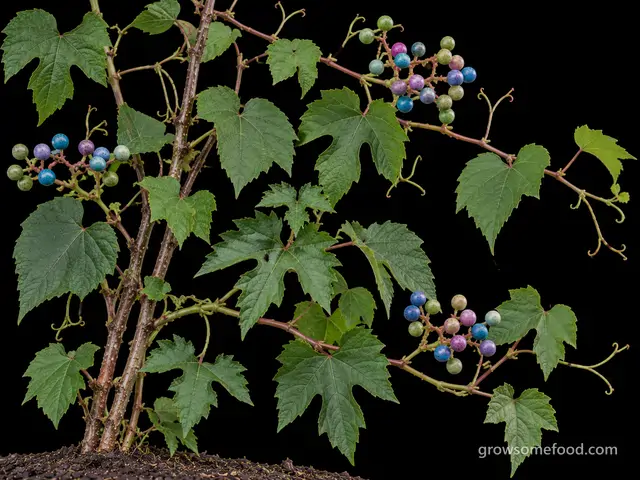
Porcelain Berry
Porcelain berry is not a food. The berries are not known to be poisonous, but they are bitter and mealy, and the real hazard is confusion: this vine grows exactly where wild grapes do. Never eat fruit from an unidentified grape-like vine - moonseed, which is genuinely deadly, shares the same fencerows. The candy-colored berries also tempt children, so cut and bag fruiting clusters where kids play. Wear gloves when pulling mature vines out of trees.
Overview
The ornamental vine with the turquoise, lilac and blue berries all in one cluster - and one of the fastest-moving invaders of the mid-Atlantic. It climbs over shrubs and young trees, closes above them, and collapses them under its own weight. Birds move the seed for miles.
Porcelain berry (Ampelopsis glandulosa var. brevipedunculata) is easy to love for about ten minutes. In late summer its fruit clusters carry pale green, cream, lilac, pink, turquoise and hard bright blue berries all at the same time, glazed like a broken teacup, and nothing else in an American hedgerow looks remotely like it. That is precisely why nurseries sold it — and still sell it in much of the country, usually as the pink-and-white variegated cultivar 'Elegans'.
What it does next is less charming. It is a woody vine in the grape family that climbs by tendrils at a rate of ten to fifteen feet in a season, and it does not stop at the top of what it is climbing. It runs over shrubs and young trees, closes a solid leafy blanket above them, shades them out, and eventually brings them down under the accumulated weight. Along the rivers and forest edges of the mid-Atlantic it has smothered hundreds of acres of shrub layer. Birds, raccoons and foxes eat the berries and drop the seed miles away, so a single garden vine seeds an entire catchment.
Most people reach this page holding a stem and asking whether it is a wild grape. That question has a clean answer, and it matters in both directions: the native grapes and the native raccoon grape are worth keeping, and there is a genuinely poisonous vine, moonseed, in the same fencerows. The stem test in the Grow section below settles it in about five seconds.
At a glance
- Sun
- Full sun · Part sun · Part shade
- Water
- Medium
- Spacing
- 24–600 in (typ. 120)
- Mature height
- 60–300 in (typ. 240)
- Start by
- —
- Frost
- Hardy
- Spread
- 60–600 in (typ. 240)
- Soil
- Well-drained
- Temperature
- Damaged below -25°F · struggles above 100°F
- Self-sows
- Yes — expect volunteers
When to plant
No planting window on record for this zone.
Life stages
- Explosive summer growth (identify & control) Apr, May, Jun, Jul, Aug, Sep (yearly)
-
Recognize it: variable grape-like leaves, forked tendrils, and a stem that does not shredPorcelain berry climbs by forked tendrils opposite the leaves, exactly as a grape does. Leaves are the confusing part: on one plant they range from barely lobed and heart-shaped to deeply cut into three or five lobes, all coarsely toothed. The reliable check is the stem. Snap one: porcelain berry has WHITE pith and tight bark with raised dots, while true wild grape has BROWN pith with a woody partition at each node and bark peeling in long shreddy strips.
-
Pull young vines now, while the root is still smallA first-year seedling comes up with one taproot and pulls cleanly out of moist soil; a three-year-old vine has a woody root crown that will resprout from anything you leave. Walk the fence lines, hedge bottoms and shrub bases in late spring and pull every seedling you find. This is by far the cheapest control there is, and it is the only stage at which hand-pulling alone actually finishes the job.
A fast vine climbing over shrubs, fences and small trees and closing above themWildly variable leaf shapes on one plant, from heart-shaped to deeply three- or five-lobedForked tendrils opposite the leaves and stems with tight, dotted bark rather than shreddy strips -
Recognize it: variable grape-like leaves, forked tendrils, and a stem that does not shred
- Inconspicuous green flowers (Jun-Aug) Jun, Jul, Aug (yearly)
-
Flat greenish flower clusters, nothing like a grape bloomIn midsummer porcelain berry produces small greenish-white flowers in flat-topped, branched clusters held out from the stem on stiff stalks - not the dangling cone of a grape. They are easy to miss, and bees and wasps work them heavily. Noticing flowers is your warning that this plant is now old enough to fruit, which is the point at which one vine in your yard becomes a seed source for the whole neighborhood.
-
Last chance to act before there is seedEverything is cheaper before fruit set. If you are only going to do one job on this plant all year, cut the flowering vines back hard now and bag the clippings, or cut the climbing stems at the base so the crown above dies before it can ripen fruit. A vine you stop in July costs you an afternoon; the same vine allowed to fruit costs you years of pulling seedlings.
Small greenish flowers in flat branched clusters held stiffly outwardHeavy bee and wasp activity on a vine you had not noticedVines old enough to flower - the threshold at which control gets much more expensive -
Flat greenish flower clusters, nothing like a grape bloom
- Porcelain berries (Aug-Oct) - the unmistakable stage Aug, Sep, Oct (yearly)
-
The one feature nothing else has: every color at once in a single clusterThis is where identification stops being difficult. Porcelain berries ripen unevenly, so a single cluster carries pale green, cream, lilac, pink, turquoise and a hard bright porcelain blue all at the same moment, on a stiff branched cluster held outward or upward. No wild grape does this - grapes ripen a hanging bunch uniformly to dark purple-black. Cut a berry open and you will find two to four hard, pitted seeds.
-
Cut and BAG the fruit clusters before birds move themBirds, raccoons and foxes eat the berries and carry the seed for miles, which is how a garden vine becomes a river-corridor infestation. Clip whole clusters into a bag before they are stripped, and put the bag in the trash - not the compost, not the brush pile, not over the bank. If you do nothing else this fall, do this: it does not kill the vine, but it stops that vine seeding anywhere else.
Clusters carrying green, lilac, turquoise and bright blue berries simultaneouslyBirds and mammals feeding on the clustersSeedlings appearing next spring under perches, fence lines and hedge bottoms -
The one feature nothing else has: every color at once in a single cluster
- Winter: the best season for removal Jan, Feb, Mar, Nov, Dec (yearly)
-
Bare stems make the whole infestation visibleWith the leaves down you can finally see how far the vine has run, which trees carry it into the canopy, and where the root crowns actually sit. The stem test is also easiest now: white pith and tight dotted bark for porcelain berry, brown pith with a partition at the nodes and shreddy peeling bark for a native grape. Flag every root crown you find before the leaves come back and hide them again.
-
Cut climbing stems now and treat the stumpsSever each climbing stem at the base and again at chest height, and remove the section between so the top cannot re-root; the growth left in the canopy dies where it hangs. Do not haul it down and strip bark off the host tree. If you are treating stumps, apply within minutes of the cut, using a product whose label lists your site, at the label rate. Late fall and winter thaws are effective windows in most of its range.
Bare vines revealing the true extent of the infestation and every host treeRoot crowns at the base of shrubs and fence posts, easy to flag nowOld fruit stalks still standing, marking the vines that seeded this year -
Bare stems make the whole infestation visible
Watch out for
Blanketing & Collapse of Shrubs and Young Trees High
The core ecological hazard. Porcelain berry does not simply climb a support - it runs over the top of shrubs and young trees at ten to fifteen feet a season and closes a continuous leafy blanket above them, shading them out and then bringing them down under the accumulated weight of the vine. Along mid-Atlantic rivers and forest edges it has replaced the entire native shrub layer across hundreds of acres, converting structurally diverse thicket into a single-species drape that supports far less wildlife.
Watch for: A leafy sheet closing over the top of shrubs, hedges and saplings; hosts thinning, dying back or leaning under the weight; the shrub layer along a streambank or forest edge reduced to one vine.
Prevent: Never plant it, including variegated cultivars; pull seedlings each spring while they still have a single taproot; cut vines before they are old enough to flower and fruit.
Treat: Cut climbing stems at the base and again at chest height, remove the section between, and leave the canopy growth to die and drop rather than pulling it down and stripping host bark; deal with the root crown by repeated cutting over several years or by an on-label cut-stump treatment; replant cleared edges with native vines and shrubs.
Bird- and Mammal-Spread Seed High
Why one garden vine becomes a regional problem. Each berry holds two to four hard seeds, and birds, raccoons, foxes and opossums strip the clusters and deposit viable seed for miles - under perches, along fence lines, in hedge bottoms and above all down river corridors, which is why the vine appears in places nobody planted anything. Seed remains viable in the soil for several years, so removing the parent plant starts the seedling problem rather than ending it.
Watch for: Birds and mammals feeding heavily on fruit clusters in late summer; seedlings appearing the following spring under perches, fences and hedge bottoms and along watercourses well away from any planting.
Prevent: Clip and bag whole fruit clusters before they are stripped, and put the bag in the trash - never compost fruiting material, tip it over a bank or add it to a brush pile; remove fruiting vines upstream first, since they reseed everything cleared below them.
Treat: Walk cleared ground every spring for three to five years and pull seedlings while they still have a single taproot; clean seed off boots, tools and mower decks before moving from an infested area to clean ground.
Resprouting from the Root Crown High
Why cutting alone disappoints. An established porcelain berry has a woody root crown with a root system already built; cut the top and it throws several new shoots within weeks, often growing faster than the original vine. Stems lying on damp ground can also layer, and cut sections left on the soil sometimes re-root. Hand control therefore means cutting every regrowth flush three or four times a season for several consecutive years, and one missed season undoes the progress.
Watch for: Multiple vigorous shoots erupting from a cut stump within weeks; regrowth outpacing the original vine; new plants where cut stems were left lying on damp ground.
Prevent: Pull plants in their first year, while the root is still a single taproot - this is the only stage at which hand-pulling alone finishes the job.
Treat: Either cut every regrowth flush repeatedly for several consecutive seasons, or cut low and apply a concentrated triclopyr or glyphosate cut-stump treatment within minutes of the cut, in late summer, fall or a mild winter spell, using a product whose label lists your site and following the label rates and protective equipment exactly - the label is legally binding. Bag cut stems rather than leaving them on the ground.
Grape Lookalike Confusion (both directions) Medium
A misidentification hazard that cuts two ways. Native wild grapes and native raccoon grape are routinely destroyed in porcelain berry removals because leaf shape alone cannot separate them, and porcelain berry is left standing in gardens because it was assumed to be a wild grape. Worse, the same fencerows carry moonseed, which produces dark grape-like fruit and is genuinely poisonous, so any foraging based on a casual grape identification is dangerous. Leaf shape is unreliable - the stem and the fruit cluster are not.
Watch for: Any grape-like vine being identified from leaves alone; fruit being picked from an unlabelled vine; native grape or raccoon grape being cut in the course of a removal.
Prevent: Use the stem test before you cut or eat anything: white pith with tight dotted bark is porcelain berry or raccoon grape, brown pith with a woody partition at each node and shreddy peeling bark is a true grape. Never eat fruit from an unidentified vine - moonseed has no tendrils and a single flat crescent seed per berry.
Treat: If a native grape or raccoon grape has been cut in error it will usually resprout - leave it, and mark it so it is not cut again. If anyone has eaten fruit from an unidentified grape-like vine, contact poison control immediately with a sample of the plant.
The catalog carries separate entries for grape and moonseed; check both before foraging in a hedgerow that also holds porcelain berry.
Varieties · 4
As the species, with leaves heavily marbled and splashed in white and pink; same multicolored berry clusters.
The pink-and-white marbled cultivar still widely sold as an ornamental vine, and the form most gardeners actually buy. Variegation makes it slightly less vigorous and changes nothing else: it is the same species, it fruits, birds spread the seed, and seedlings from it revert to plain green. Marketing that presents it as a tamer plant is wrong. Remove and control it exactly as the plain form.
Wild grape: shreddy peeling bark, brown partitioned pith, uniform dark hanging bunches. Raccoon grape: unlobed heart-shaped leaves, uniformly blue berries.
Two natives get destroyed by mistake in porcelain berry removals. Wild grape (Vitis species) has brown pith with a woody partition at each node and bark peeling in shreddy strips, and ripens a hanging bunch uniformly to purple-black. Raccoon grape (Ampelopsis cordata) is a native relative with white pith like porcelain berry, but its leaves are consistently unlobed and heart-shaped and its berries turn green to a uniform blue rather than a mixed cluster. Both feed wildlife and belong where they are. Separately, moonseed has no tendrils, one flat crescent seed per berry, and is genuinely poisonous - never eat fruit from an unidentified vine.
Varies by species - native climbing vines suited to arbors, fences and banks in your region.
Plant these instead of porcelain berry for cover on an arbor, fence or bank: Virginia creeper (fast, brilliant fall color, berries for birds), a native grape, trumpet honeysuckle for hummingbirds, American wisteria (not the Asian species), crossvine, Dutchman's pipe as a pipevine swallowtail host, and Carolina jessamine in the South. Ask a local native-plant nursery which suit your region, soil and light.
Vigorous tendrilled vine with variably lobed grape-like leaves; stiff branched clusters of berries in green, cream, lilac, pink, turquoise and porcelain blue simultaneously.
The invasive species: a fast woody vine in the grape family climbing by forked tendrils, with wildly variable coarsely toothed leaves, greenish summer flowers, and the unmistakable late-summer clusters carrying green, lilac, turquoise and bright blue berries at once. White pith and tight dotted bark separate it from true wild grape. Blankets and collapses shrubs and young trees; seed carried for miles by birds and mammals. Prohibited from sale in Connecticut and Massachusetts and regulated in several other states - identify and control, never plant.
Grow
How to tell it from a wild grape and why never to plant it. Snap a stem: porcelain berry has white pith and tight dotted bark, while true grape has brown pith with a partition at each node and bark that peels in long shreddy strips. That test is faster and far more reliable than leaf shape.
You should never plant porcelain berry, so what matters is telling it apart from the native vines you should leave alone. Leaf shape will not do it. A single porcelain berry plant carries leaves ranging from barely lobed and heart-shaped to deeply cut into three or five lobes, all coarsely toothed, all superficially grape-like, with fine hairs along the veins on the underside. It climbs by forked tendrils set opposite the leaves — exactly as a grape does.
The reliable test is the stem, and it takes five seconds. Snap a pencil-thick stem and look at the cut end. Porcelain berry has white pith, no partition at the nodes, and bark that stays tight and smooth with raised dots (lenticels). A true wild grape (Vitis) has brown pith interrupted by a woody diaphragm at every node, and mature bark that peels away in long shreddy strips. In late summer the fruit confirms it: porcelain berry ripens a stiff, branched, outward-held cluster in every color at once; a grape ripens a hanging bunch uniformly to dark purple-black.
Two more vines belong in this comparison. The native raccoon grape (Ampelopsis cordata) is a close relative with white pith too, but its leaves are consistently unlobed and heart-shaped and its berries turn from green to a uniform blue — it is native and should be left alone. And moonseed (Menispermum canadense) produces dark grape-like fruit and is genuinely poisonous; it has no tendrils at all, its leaf stalk joins the underside of the leaf rather than the notch, and each berry holds a single flat crescent-shaped seed instead of several pear-shaped ones. Never eat fruit off an unidentified vine.
As for why it wins: it tolerates sun to part shade, almost any soil, drought once established, and hard cutting; it grows ten to fifteen feet a season; it resprouts vigorously from the root crown; and its seed is carried by birds and mammals into every hedge, riverbank and forest edge in range. There is no site condition that disadvantages it.
Propagation & seed saving
It spreads by seed, and the seed travels. Each berry holds two to four hard seeds, birds and mammals disperse them for miles, and they persist in the soil for several years - so removing a vine is only half the job, and the seedling patrol is the other half.
Porcelain berry reproduces overwhelmingly by seed, which is what separates it from a creeping invasive you can simply outwork. Each berry contains two to four hard, pitted seeds, and a mature vine fruits heavily every year once it starts. Birds — catbirds, robins, mockingbirds, waxwings — strip the clusters, and raccoons, foxes and opossums take them too, depositing viable seed under perches, along fence lines, in hedge bottoms and, above all, down river corridors. This is why the vine appears in places nobody planted anything, and why a single ornamental in a suburban yard is a landscape-scale problem rather than a private one.
Seed remains viable in the soil for several years, so the year you kill the parent vine is the year the seedling patrol starts, not the year it ends. It also spreads locally by resprouting: cut a mature vine and the woody root crown throws multiple new shoots within weeks, often growing faster than the original because the root system is already built. Stems can layer where they lie on damp ground, and cut sections left on the soil sometimes re-root.
Two practical consequences follow. First, stopping fruit is worth more than killing vines if you have to choose — clipping and bagging the clusters in September prevents an entire generation. Second, plan on three to five years of spring walk-throughs pulling seedlings after the last mature vine is gone, and do not treat bare ground as finished ground.
Care
Control, not care: pull seedlings while the root is a taproot, cut climbing stems at the base and at chest height so the canopy growth dies in place, treat the cut stump immediately with an on-label product because the crown resprouts hard, bag every fruit cluster, and patrol for seedlings for years.
Match the method to the age of the vine. Seedlings and first-year plants have a single taproot and pull cleanly out of moist soil — a spring walk along fences, hedge bottoms and shrub bases, pulling everything you find, is the highest-return work on this plant and the only stage where pulling alone finishes the job. Established vines have a woody root crown that resprouts hard, so pulling turns into a multi-year war of attrition unless you deal with the crown.
For a vine that has climbed, cut it at the base and again at chest height and remove the section between. The growth up in the canopy dies where it hangs and drops over a season or two. Do not haul it down: ripping a woody vine out of a tree strips bark and does more damage than the vine was doing. Then handle the stump. Repeated cutting alone can exhaust a crown, but realistically it means cutting every regrowth flush three or four times a season for several consecutive years, and one missed season resets it. The standard alternative is a cut-stump herbicide treatment: cut low, then apply a concentrated triclopyr or glyphosate product within a few minutes of the cut, before the surface seals. Use a product whose label lists your site, at the label rate, with the label's protective equipment — the label is legally binding. Late summer through fall, and mild spells in winter, are the effective windows in most of its range; avoid spring, when sap is moving upward.
Alongside whatever you do to the stems, stop the fruit. Clip whole clusters into a bag in late summer before birds strip them and put the bag in the trash. Never compost fruiting material, never tip it over a bank, and clean seed off boots and mower decks before moving to clean ground. Then replant, because bare ground on a river edge or hedge bottom will not stay bare: native alternatives that fill the same role include Virginia creeper, native grapes, trumpet honeysuckle, American wisteria, crossvine, Dutchman's pipe, and Carolina jessamine in the South. Finally, walk the ground each spring for three to five years and pull seedlings. That patrol, not the day you cut the big vine, is what actually ends the infestation.
Nutrition
Not a food and not worth trying. The berries are bitter, mealy and full of hard seed, and eating fruit from an unidentified grape-like vine is a real hazard because moonseed grows in the same hedgerows. Ecologically the vine is a net loss: it replaces the shrub layer that actually feeds wildlife.
Porcelain berry is not a food. The berries are not known to be poisonous, and they are eaten heavily by birds and mammals, but for a person they are bitter, mealy and mostly hard seed, and there is no traditional food use worth the risk of the confusion around them. The genuine hazard is that the fruit looks like a candy-colored wild grape to a child and like a foraging opportunity to an adult, in exactly the hedgerows where moonseed — which is genuinely poisonous and has killed people who mistook it for grapes — also grows. The rule is unambiguous: never eat fruit from a grape-like vine you have not positively identified, and cut and bag porcelain berry clusters where children play.
Ecologically the accounting is worse than it first looks. Its berries do feed birds, which is sometimes offered as a defense of the plant, but that feeding is the dispersal mechanism of the invasion, and what the vine replaces is the entire native shrub layer — viburnums, dogwoods, spicebush, elderberry, native grapes — which supports far more insect life, feeds far more species across far more of the year, and provides the nesting structure that a smothered thicket does not. A porcelain berry blanket is a monoculture that produces one pulse of fruit and, for the rest of the year, feeds almost nothing. Removing it and replanting natives is a straightforward ecological upgrade.
Troubleshooting
Answers for the reader holding a stem: is this a wild grape, is it legal, why did it come back twice as thick after I cut it, what do I do about the berries, and how many years does this take.
Is this porcelain berry or a wild grape? Snap a stem. White pith, no partition at the nodes, tight dotted bark that does not peel: porcelain berry. Brown pith, a woody partition at every node, bark peeling in long shreddy strips: a native grape, which you should keep. In late summer the fruit is decisive — every color at once in a stiff outward-held cluster is porcelain berry; a hanging bunch ripening uniformly to purple-black is a grape. What about the vine with plain heart-shaped leaves and blue berries? Most likely native raccoon grape (Ampelopsis cordata): unlobed leaves and berries that go green to uniform blue, not a mixed cluster. Leave it. Can I eat the berries? No. They are bitter and mealy, and more importantly moonseed grows in the same fencerows, is genuinely poisonous, and fruits at the same time — moonseed has no tendrils and one flat crescent seed per berry. Never eat fruit from an unidentified vine. I cut it and it came back twice as thick: that is the root crown doing what root crowns do. Either commit to cutting every regrowth flush three or four times a season for several consecutive years, or cut low and treat the stump within minutes using a product whose label lists your site. Should I pull it out of the tree? No — cut it at the base and again at chest height and leave the canopy growth to die and drop. Ripping it down strips bark off the host. Is it legal to buy? Not everywhere. Connecticut and Massachusetts prohibit selling, importing or transplanting it, and several other northeastern and midwestern states carry it on regulated invasive-species lists. It is still sold in much of the country, often as the variegated 'Elegans' — which is the same species and behaves the same way. Check your own state's list. Do I have to use herbicide? No, but hand control means repeated cutting over several years plus a rigorous seedling patrol. Herbicide earns its place on established crowns. Either way, read and follow the label. New plants keep appearing where I cleared: expected — the seed bank persists several years and birds keep adding to it. Walk the ground each spring for three to five years. What should I plant instead? Virginia creeper, a native grape, trumpet honeysuckle, American wisteria, crossvine, Dutchman's pipe, or Carolina jessamine in the South.
History
Brought from northeastern Asia in the 1870s as a hardy ornamental vine for its extraordinary fruit, it escaped through the twentieth century into the mid-Atlantic river corridors. The variegated form is still sold today, which is the reason the invasion has not stopped.
Porcelain berry arrived in North America around the 1870s as a landscape ornamental, and its selling point was exactly the thing that makes it identifiable: a hardy, fast, trouble-free vine that produced a fruit display no native could match. It was planted on arbors, porches and fences from New England to the Carolinas for the better part of a century, and the variegated selection 'Elegans', with pink-and-white marbled leaves, became a nursery staple.
The escape was slow and then sudden. Scattered naturalized records accumulated through the mid-twentieth century, and by the 1980s and 1990s land managers in the mid-Atlantic were describing river-corridor infestations measured in hundreds of acres, with the shrub layer of whole floodplain forests replaced by a single vine blanket. Northeastern states began adding it to regulated invasive lists in the 2000s.
What makes its history unusual among invasive ornamentals is that the sales pipeline is still open in most of the country. Callery pear at least became notorious; porcelain berry is still described in catalogs as an unusual and desirable vine, and 'Elegans' is often marketed as though variegation made it tame. It does not — variegated plants are slightly less vigorous and identical in every way that matters. The lesson is the one this catalog keeps repeating: a plant that is genuinely beautiful, genuinely tough and genuinely easy is not thereby a good idea outside its native range, and 'still for sale' has never been the same thing as 'safe to plant'.
Growing across climates
Hardy roughly zones 4-9 and invasive across the mid-Atlantic and Northeast, worst along rivers and forest edges from Virginia to southern New England, and spreading into the Midwest and upper South. It needs some sun, so intact closed-canopy forest resists it - edges and floodplains do not.
Porcelain berry is cold-hardy to roughly zone 4 and grows through about zone 9, but its invasive weight is concentrated in the mid-Atlantic and Northeast: the Potomac, Delaware, Hudson and Connecticut river systems and their tributaries, from Virginia and Maryland north through New Jersey, New York and southern New England. It is established and expanding in Pennsylvania, Ohio, Michigan, Wisconsin, Illinois, Kentucky, Tennessee and the Carolinas, and it turns up as scattered escapes well beyond that.
Its habitat preferences tell you where to look and where to worry. It needs at least partial sun, so a closed-canopy interior forest resists it fairly well — but it is devastating on everything with an edge: streambanks, floodplains, forest margins, powerline cuts, roadsides, old fields, fencerows and suburban hedge bottoms. Flowing water is its highway, both because birds and mammals follow the corridors and because the moist, disturbed, sunlit ground of a river edge is ideal for germination. If you are prioritizing work in a landscape, start upstream: a fruiting vine at the top of a drainage reseeds everything you clear below it.
Because its northern limit is cold and its distribution is still expanding, gardeners in the upper Midwest and northern New England are seeing it arrive now rather than living with an old infestation. That is the cheapest moment there will ever be to deal with it: one afternoon pulling seedlings in a place it has just reached is worth more than a decade of work in a place where it has already blanketed the shrub layer.
No grower tips for Porcelain Berry yet — yours could be the first.
Sign in to share what works in your garden.