Poison Hemlock

Conium maculatum · Apiaceae
Other Biennial Herb Other
Introduced - native to Europe, North Africa, and western Asia; now a widespread invasive weed across North America
For identification only — don't plant. One of the deadliest plants in North America - IDENTIFY AND AVOID, never plant or eat. All parts are lethally poisonous if ingested, and it dangerously resembles edible carrot-family plants. When foraging any wild carrot-family plant, ruling out poison hemlock can be life or death.

DEADLY POISON - never eat, taste, or plant any part. Poison hemlock's coniine alkaloids attack the nervous system, and even a small amount can cause paralysis and death (no antidote). Its greatest danger is being MISTAKEN for edible carrot-family plants like Queen Anne's lace, wild parsnip, and parsley - never forage a wild carrot-family plant unless you have 100% ruled out poison hemlock. Never burn it, keep it from children and pets, and if ingestion is suspected call emergency services.

Overview

One of the deadliest plants in North America - the poison that killed Socrates - and a dangerous look-alike for edible carrot-family plants. Learn it, never touch it, and never confuse it with wild carrot or parsley.

Poison hemlock (Conium maculatum) is among the most lethally poisonous plants on the continent, and one every forager and parent should be able to identify. Every part contains coniine and related alkaloids that attack the nervous system; ingesting even a small amount can cause paralysis and death, with no antidote. It is, famously, the poison used to execute the philosopher Socrates in ancient Athens.

Introduced from Europe, it's now a widespread invasive weed across North America, growing tall (6-10 feet) along roadsides, ditches, fields, and stream banks. Its greatest danger is that it belongs to the carrot family (Apiaceae) and closely resembles edible relatives - wild carrot (Queen Anne's lace), wild parsnip, parsley, chervil - so foragers have been poisoned mistaking it for food. This entry is an identification and safety guide with one overriding message: learn its distinguishing marks (purple-spotted smooth stems, a musty smell), never eat any wild carrot-family plant you can't rule it out from, and keep it away from children, pets, and livestock. Knowing poison hemlock can save a life.

At a glance

Sun
Full sun · Part sun · Part shade
Water
Medium
Spacing
12–48 in (typ. 24)
Mature height
36–120 in (typ. 84)
Start by
Direct sow
Frost
Hardy

When to plant

No planting window on record for this zone.

Life stages

  1. Year 1 rosette (identify & avoid) day 0–200 from sowing
    • First-year rosette - fern-like, parsley-like leaves
      In its first year, poison hemlock is a ground rosette of finely divided, glossy, fern-like or parsley-like leaves - which is exactly when it's most often confused with edible plants. Even at this stage, look for the tell-tale PURPLE SPOTS/BLOTCHES on the smooth, hairless stems, and note the musty, unpleasant 'mousy' smell when crushed. Do not touch or taste it.
    Purple-spotted smooth stems (the key ID)Musty, mousy, unpleasant smell (NOT carrot/parsley scent)Fern-like glossy leaves in a ground rosette
  2. Year 2 - tall stalk & white umbels
    • Tall (6-10 ft), purple-spotted stems, umbels of white flowers
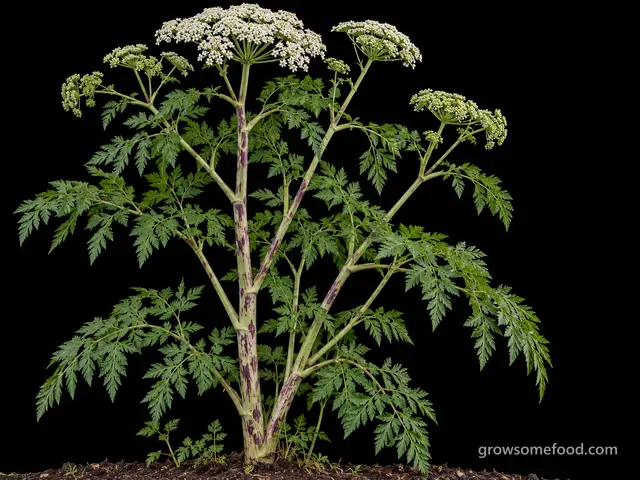
      In its second year it bolts into a tall (6-10 foot) plant with hollow, ridged, hairless, PURPLE-BLOTCHED stems and flat-topped umbels of tiny white flowers (like a giant Queen Anne's lace, but much taller and spotted). This is when it's most conspicuous - and most dangerous, as it sets seed. Do not cut it without full protection, and never burn it.
    • Distinguish it from edible carrot-family plants
      Critical ID vs edibles: poison hemlock has SMOOTH, HAIRLESS, PURPLE-SPOTTED stems and a MUSTY smell. Wild carrot/Queen Anne's lace is shorter, HAIRY-stemmed, smells of carrot, and often has one dark central floret. Never rely on flowers alone - check stems, hairs, spots, and smell, and when in any doubt, do not eat it.
    Tall purple-spotted hairless stems (the definitive sign)Flat white flower umbelsSetting massive amounts of seed
  3. Seed & die-back
    • Dead stalks and seeds remain toxic
      As a biennial, the plant dies after setting seed, but the DEAD stalks and SEEDS remain poisonous. Seeds spread widely and persist in soil, so it reappears. Remove plants (with full protection, before they seed) to control it; bag the material - never compost, and never burn it (toxic smoke).
    Toxic dead stalks and seedsProlific self-seeding for future years

Watch out for

Poisoning by Ingestion (deadly) Disorder Highyear-round

The hazard is lethal poisoning of people or animals: all parts contain coniine alkaloids that cause nervous-system failure, paralysis, and death if eaten, with no antidote. The greatest risk is mistaking it for an edible carrot-family plant.

Watch for: Any ingestion of the plant (or of a misidentified 'wild carrot/parsley'); symptoms can include trembling, weakness, dilated pupils, slowed breathing, and paralysis - a medical emergency.

Prevent: Never eat any part; never forage a carrot-family plant without ruling out poison hemlock (purple-spotted hairless stems, musty smell); keep it from children, pets, and livestock; remove it from accessible areas.

Treat: Suspected ingestion is an EMERGENCY - call poison control / emergency services immediately; do not induce anything or wait for symptoms. There is no antidote; treatment is supportive medical care.

Sap & Handling Hazard Disorder MediumApr, May, Jun, Jul, Aug

Beyond ingestion, pokeweed's sap can irritate skin and may allow compounds to enter through cuts, and the berry juice heavily stains skin, cloth, and surfaces.

Watch for: Skin irritation from sap contact, especially through cuts or broken skin, and deep magenta staining from crushed berries.

Prevent: Wear gloves and cover skin when handling or removing pokeweed, especially the root and berries; keep the staining juice off cloth and surfaces.

Treat: Wash exposed skin promptly; avoid sap contact with cuts and eyes. Staining from the berries is largely permanent on fabric.

Invasive Self-Seeding Disorder MediumJul, Aug, Sep, Oct

Not a health hazard directly but why it persists and spreads: each plant produces huge numbers of seeds that spread and survive years in the soil, so poison hemlock reappears and colonizes new ground.

Watch for: Seed-laden second-year plants and expanding stands along roadsides, ditches, and field edges.

Prevent: Remove plants (safely) before they set seed; monitor and pull new rosettes; persistent multi-year control is needed.

Treat: Repeated safe removal before seeding, plus targeted herbicide on larger stands, over several seasons to exhaust the seed bank.

Varieties · 2

Poison Hemlock (Conium maculatum)
speciesinvasivedeadly-poisonbiennialpurple-spotted-stemscarrot-family

The deadly biennial weed: a first-year rosette of fern-like leaves, then a tall (6-10 ft) purple-spotted, hairless-stemmed plant with white flower umbels and a musty smell. All parts are lethally poisonous. Not to be confused with edible carrot-family plants - identify and avoid.

Water Hemlock (Cicuta species) - related deadly plant
relateddeadly-poisonnativewetlandcarrot-family

A separate but equally (or more) deadly carrot-family plant of wet areas, sometimes confused with poison hemlock and also with edible plants. Different genus, same lesson: several carrot-family plants are lethal, so never forage the family without expert certainty. Identify and avoid.

Grow

How to recognize it - and tell it from edible look-alikes: purple-blotched smooth hairless stems, fern-like leaves, a musty smell, and tall white flower umbels (unlike shorter, hairy-stemmed, carrot-scented wild carrot).

You must never grow or gather poison hemlock - the point is to recognize and avoid it, and to distinguish it from edible carrot-family plants, which is a life-safety skill. Its defining features: smooth, hairless stems marked with distinctive PURPLE SPOTS or blotches (the species name maculatum means 'spotted'); finely divided, glossy, fern-like or parsley-like leaves; a tall (6-10 foot in year two), hollow, ridged stem; flat-topped umbels of tiny white flowers; and an unpleasant musty, 'mousy' smell when any part is crushed (not the pleasant carrot/parsley scent of edible relatives).

The critical contrasts with edible look-alikes: wild carrot / Queen Anne's lace is much shorter, has HAIRY stems (poison hemlock is hairless), smells of carrot, and often has a single dark reddish floret in the center of its flower umbel; parsley and chervil are low and smell pleasant. Poison hemlock's combination of great height, purple-spotted hairless stems, and musty odor is diagnostic. But the safest rule of all is simple: never eat any wild plant in the carrot family unless an expert has confirmed it and poison hemlock is 100% ruled out - the family contains several deadly members and the mistakes are fatal.

Care

If you must remove it: never touch it bare-handed, never eat or burn it, cover skin and wear gloves and a mask, dig or pull it out before it seeds, bag everything, and wash - or hire a professional for large stands.

The only 'care' is careful removal, and poison hemlock demands respect. It's dangerous mainly by ingestion, but the sap can irritate skin and cutting or clearing large stands can release toxins, so protect yourself: wear gloves, cover your skin, and use a mask when working with it, and never burn it (the smoke is toxic to inhale). For small amounts, dig or pull it out (getting the taproot) before it flowers and seeds, ideally in the rosette or early-bolt stage; for larger infestations, targeted herbicide on the growing plant is used - and for big stands, or if you're unsure, hire a professional.

Bag and dispose of all material as directed for hazardous plant waste - never compost it, never burn it, and keep the cut plants away from animals (it's deadly to livestock too). Wash your gloves, tools, and skin afterward. Because it's a prolific self-seeder with a persistent seed bank, control usually takes several seasons of removing plants before they set seed. Above all, keep children, pets, and grazing animals away from it entirely - and if anyone or any animal may have eaten it, treat it as a medical emergency.

Nutrition

Not food - it is lethally poisonous and never eaten. Its 'nutritional' relevance is purely cautionary: knowing it is how you avoid fatally mistaking it for an edible carrot-family plant.

Poison hemlock is not food in any sense - it's one of the deadliest plants you can ingest, and there is no safe amount. It's included here not as a plant to eat but as the essential cautionary counterpart to foraging the edible carrot family. Wild carrot, wild parsnip, and other Apiaceae are foraged foods, and poison hemlock is their most dangerous impostor - so the 'nutritional' lesson is entirely about avoiding a fatal mistake.

Historically the plant had a place in medicine as a sedative and poison in tiny, dangerous doses, but this is of purely historical interest and must never be attempted. Ecologically, poison hemlock is an invasive weed, not a valued native, and it's toxic to livestock and wildlife that graze it. The single practical takeaway: it offers nothing to eat, it can kill, and the most useful thing you can do with it is learn to recognize it so that you - and anyone foraging near you - never mistake it for the carrots, parsley, or Queen Anne's lace it so dangerously resembles.

History

The most storied poison plant in history - the state poison of ancient Athens that executed Socrates - and a Eurasian weed that has since spread across the world.

Poison hemlock holds a unique place in history as perhaps the most famous poison plant of all. In ancient Athens it was the state method of execution, and in 399 BCE the philosopher Socrates was put to death by drinking a preparation of it - Plato's account of his gradual paralysis is one of the most-quoted death scenes in Western literature. The Greeks and Romans understood its lethality well, and it appears throughout ancient and medieval accounts as both a poison and, in perilous doses, a medicine.

Native to Europe, North Africa, and western Asia, poison hemlock traveled with people around the globe and became a widespread weed of disturbed ground across North America, where it's now a common (and increasingly noticed) roadside and field invader. Its long, dark reputation is a reminder of why plant identification matters: for most of history, the difference between a wild carrot and this plant - a difference of purple spots, hairless stems, and a musty smell - was, quite literally, the difference between dinner and death. That remains true today.

Troubleshooting

The vital skills: confirm it by purple-spotted hairless stems and musty smell, never eat a carrot-family plant you can't rule it out from, remove it safely, and treat any suspected ingestion as an emergency.

Is this poison hemlock or an edible carrot-family plant? Check for SMOOTH, HAIRLESS stems with distinctive PURPLE spots/blotches, great height (6-10 ft in year two), fern-like leaves, white flower umbels, and a MUSTY, unpleasant smell. Edible wild carrot/Queen Anne's lace is shorter, HAIRY-stemmed, carrot-scented, and often has a dark central floret. If a wild carrot-family plant has purple-spotted hairless stems or a musty smell - or if you have any doubt at all - do NOT eat it. Someone (or an animal) may have eaten it: this is a medical emergency - call poison control / emergency services immediately; do not wait for symptoms. How do I get rid of it? Wear gloves and cover skin, dig/pull it out (get the taproot) before it seeds, bag it, never compost or burn it, and wash up; hire a pro for large stands. It keeps coming back: it self-seeds heavily with a persistent seed bank - remove plants before seeding for several years. Can I get a rash from it? The main danger is ingestion, but the sap can irritate skin - handle only with protection. Is it safe to have on my property at all? Not around children, pets, or livestock - remove it from any area they can access.

Growing across climates

A widespread invasive weed across nearly the entire U.S. (zones 4-9) in moist, disturbed ground - roadsides, ditches, fields, stream banks - so it can turn up almost anywhere people forage or farm.

Poison hemlock is naturalized and invasive across most of North America, zones 4-9, thriving in the moist, disturbed, fertile ground it favors - roadsides, ditches, fence lines, field edges, pastures, vacant lots, and stream banks - in sun to part shade. It's especially common in temperate regions with moist soils, and it has been spreading and gaining attention in recent years as it colonizes new areas. Because it grows in exactly the disturbed, edge habitats where people walk, forage, and graze animals, it can appear almost anywhere.

This wide distribution is precisely why recognizing it matters everywhere: poison hemlock isn't confined to one region, and it grows alongside the edible carrot-family plants (wild carrot, wild parsnip) that foragers seek, in the same kinds of places. Wherever you live and forage, assume it could be present, learn its purple-spotted, musty-smelling, hairless-stemmed profile, teach children and anyone who forages with you to recognize it, and keep it away from livestock and pets. It's a plant whose danger is matched only by how important - and how achievable - it is to identify.

No grower tips for Poison Hemlock yet — yours could be the first.

Sign in to share what works in your garden.

Connection interrupted

Reconnecting to GrowSomeFood

Keep this page open. We are trying to restore your garden session.

Attempt of . Retrying automatically.

Still offline

Could not reconnect

Your phone may have switched networks or gone to sleep. Try again when the signal is steady.

Session expired

Reload to continue

This garden session is no longer available on the server. Reloading will start a fresh session.