
Add it to your home screen and it opens full screen: no browser bars, one tap away, and everything stays signed in. Free, nothing to download from an app store.
- Tap the Share button in your browser
- Scroll down and choose “Add to Home Screen”
- Open GrowSomeFood from your home screen
- Open your browser’s menu
- Choose “Add to Home screen” or “Install app”
- Open GrowSomeFood from your home screen

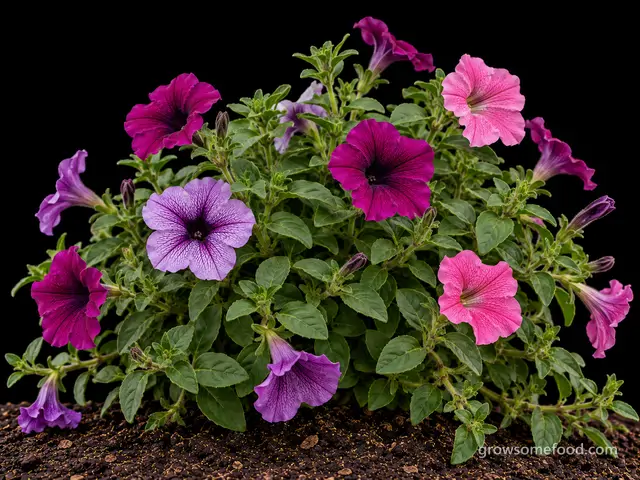
Petunia
The heat-loving workhorse of summer color: trumpet blooms by the hundred in beds, pots, and hanging baskets, from tidy mounding types to four-foot spreading Waves.
Safety notes Grown as an ornamental, not a food plant - petunia is not eaten. Despite being a nightshade relative (Solanaceae), it is one of the few in the family with no toxicity listing: the ASPCA lists petunia as non-toxic to dogs, cats and horses. Grown as a warm-season annual (a tender perennial in frost-free climates).
Overview
Petunias are the flower that carries the summer container and bedding show. Fast, floriferous, and heat-loving, they smother themselves in trumpet-shaped blooms in nearly every color - and every pattern, from solids to stripes, stars, veins, and picotee edges - from late spring until frost. Whether they're mounding in a bed, cascading from a basket, or spreading four feet across a slope, they deliver more bloom for the money than almost anything, which is why they're one of the most popular annuals in the world.
The one thing to knowGrandifloras (Daddy, Ultra) have the biggest single blooms but sulk in heat and rain.
Quick facts
- Sprouts in
- 12 daysRange: 7–21 days
- Soil temperature
- 76 °FRange: 70–85 °F
- Start indoors
- 10 weeks before transplantRange: 8–12 weeks
- Height
- 12 inRange: 6–18 in
- Spread
- 24 inRange: 12–48 in
- Cold
- Killed by frostdamaged below 32°F
- Heat
- Struggles above 95°F
- Life cycle
- Grown as an annualBotanically a perennial
- Save seeds
- About 110 days after plantingRange: 90–130 days
- Soil
- Well-drained
- Water
- Medium
- Plant spacing
- 12 inRange: 8–18 in
When to plant
Nothing is open today. Winter indoor sowing opens 3 months, Jan 16 to Feb 6.
- Start indoors Jan 16 – Feb 6 Opens in 89 daysAbout 12 weeks before to 9 weeks before your last frost (Apr 10 here)Slow from seed: start 10-12 weeks before last frost under lights (surface-sow, needs light). Most gardeners buy transplants instead, especially for vegetative Wave/Supertunia types.
- Transplant Apr 10 – May 8 Opens in 173 daysAbout at to 4 weeks after your last frost (Apr 10 here)Set out transplants after all frost danger passes and soil has warmed - petunias are frost-tender and want warmth to take off.
Frost here: last around Apr 10 (Mar 27 to Apr 24 most years), first around Oct 25. Zone averages, your own yard may run a week or two either way.
Life stages
From the first start to harvest
Follow the growing sequence. Choose a stage to see its care and signs to watch for.
Stage 1 of 4 · The growing sequence
Germination
Day 0 to 12 from sowing
Care at this stage
-
Surface-sow the dust-fine seed - it needs light
Petunia seed is extremely tiny and needs light to germinate. Press it onto the surface of the mix, don't cover it, keep warm (75°F+) and humid, and be patient - it's slow.
-
Start very early indoors (or buy plants)
Petunias are slow from seed - start 10-12 weeks before your last frost under lights, or, much easier, buy transplants (vegetative types like Wave and Supertunia are only sold as plants).
Stages can overlap; weather, variety, and growing conditions change the pace.
Watch out for
4 to know. 1 is high-risk: Tobacco Budworm (Geranium Budworm). None are active in October.
Tobacco Budworm (Geranium Budworm)Severity High PestSeason: Jun–SepRound holes chewed in buds and petals, buds that fail to open or open shredded, dark pinhead frass (droppings) around the buds, small green-to-brown striped caterpillars feeding at dusk.
Tobacco budworm (a.k.a. geranium budworm) is the single most damaging and characteristic petunia pest - a plant that keeps forming buds that never open is almost always budworm.
Round holes chewed in buds and petals, buds that fail to open or open shredded, dark pinhead frass (droppings) around the buds, small green-to-brown striped caterpillars feeding at dusk.
Act at the FIRST sign of small caterpillars or fresh chewing on bud tips, not once buds are hollowed. Btk (Bacillus thuringiensis var. kurstaki) is a stomach poison that only works on small larvae eating treated surfaces - a budworm already inside a bud will never touch it, and Btk is weak on this species even when well timed. Spinosad is the more reliable choice here: apply it only at dusk and let it dry overnight, because it is highly toxic to bees while wet and petunia flowers are actively foraged by bees and hummingbirds. Whatever you spray, pick off and destroy every already-holed bud - no spray reaches the larva inside.
Inspect buds by flashlight after dark when the larvae feed, remove and destroy affected buds, and clean up debris where pupae overwinter; the caterpillars often match the flower color.
The classic petunia pest: caterpillars of the tobacco budworm moth (Chloridea/Heliothis virescens) that bore into unopened flower buds and eat the developing petals, leaving hollowed, holed buds that never open properly. Also attacks geraniums and nicotiana.
AphidsSeverity Medium PestSeason: May–AugDense clusters of tiny insects packed onto shoot tips, flower buds, and the undersides of young leaves.
Petunias are worth watching mainly because aphids transmit viruses between bedding plants; the feeding itself is rarely serious.
Dense clusters of tiny insects packed onto shoot tips, flower buds, and the undersides of young leaves. Curled, cupped, or distorted new growth that never opens properly. A sticky shine on the leaves - and on whatever sits under the plant - that later goes black with sooty mold. Tiny white cast skins left behind where a colony has been feeding. Ants running steadily up and down the stems, which is often the first thing you notice. Mottled, streaked, or misshapen leaves that do not grow out can mean a virus the aphids brought with them rather than the feeding itself.
Knock the colonies off with a hard jet of water and repeat every few days - on most plants that alone ends it. Pinch out or prune off the worst-infested tips rather than treating the whole plant. If colonies keep rebuilding, spray insecticidal soap or horticultural oil directly onto the insects, covering leaf undersides, and repeat weekly until they are gone; treat early or late in the day, and never spray a wilted or heat-stressed plant. Avoid broad-spectrum insecticides - they kill the ladybugs, lacewings, and parasitic wasps that were about to solve the problem for you, and aphid numbers usually come back worse afterward. Anything you spray must be labeled for the plant you are treating; follow that label and observe its pre-harvest interval. On anything you eat, wash leaves, heads, and buds well before use, since aphids hide down in crowns, folds, and tight growth.
Go easy on nitrogen: the soft, lush growth that heavy feeding produces is exactly what aphids breed on. Check new growth once a week through spring and early summer so you catch colonies while they are still small, and rub the first few out with your fingers. Leave flowering plants nearby and skip broad-spectrum sprays - ladybugs, lacewings, hoverflies, and parasitic wasps do most of this work for free, and they only stay if there is something for them to eat. Keep ants off the plant where you can, since they protect aphids from those predators. Water steadily so plants are not stressed, and check any new plant over before you bring it home or move it indoors, since aphids usually arrive on something else.
Aphids are small soft-bodied sap-suckers - green, black, gray, pink, or waxy white, and mostly wingless - that gather in dense colonies on the tenderest new growth: shoot tips, buds, and the undersides of young leaves. They breed extremely fast in mild weather, so a few can become hundreds inside a week. Their feeding curls and distorts soft growth, and the sticky honeydew they excrete coats everything below and turns black with sooty mold. Ants often farm and defend the colonies for that honeydew. A few aphids are normal on almost any plant and a healthy plant shrugs them off; only dense, persistent colonies do real damage, and some aphids also spread plant viruses as they feed.
Gray Mold (Botrytis)Severity Medium DiseaseSeason: Jun–SepBrowned, collapsed flowers and buds; soft, water-soaked brown patches on leaves, stems or fruit; and a dusty gray-brown fuzz over the dead tissue.
Petunia blooms, especially the large grandiflora types, collapse into gray mush after rain. Deadhead the battered flowers, and shear a rain-wrecked plant back to refresh it.
Browned, collapsed flowers and buds; soft, water-soaked brown patches on leaves, stems or fruit; and a dusty gray-brown fuzz over the dead tissue. Rot jumping between two pieces of fruit or two petals that touch is the signature, and it often shows up again in the fridge or the storage box days later.
Cut out and destroy infected tissue as soon as it appears, and bag it rather than composting it. Harvest ahead of a prolonged wet spell and store the crop dry and cold. Protective fungicides help through long damp weather, but airflow and sanitation do most of the work.
Space and prune for airflow, water at the base rather than over the top, and go easy on nitrogen, which produces the soft growth it prefers. Clear dead leaves, spent flowers and rotting fruit at every pass, since that debris is where it overwinters. Handle fruit, buds and bulbs gently, because it enters through bruises, and cure and store anything you keep dry and well ventilated.
Botrytis cinerea and its relatives - the fuzzy gray-brown mold of cool, wet, humid weather. It blights flowers and buds, rots ripening fruit, and moves into soft, aging, bruised or frost-damaged tissue through the smallest wound, coating whatever it kills in dusty gray spores. It overwinters on dead plant debris, spreads on air currents and by direct contact between touching tissue, and keeps working after harvest, which is why it also ruins fruit and bulbs in storage.
WhitefliesSeverity Medium PestSeason: Jun–SepClouds of tiny white insects rising when you shake the plant, flat scale-like nymphs stuck to the leaf undersides, a sticky shine on the leaves below them, black sooty mold over that, and yellowing, weakened growth.
Common on petunias in warm weather and under glass. The dense growth of a well-fed hanging basket suits them perfectly, so check the leaf undersides while you deadhead.
Clouds of tiny white insects rising when you shake the plant, flat scale-like nymphs stuck to the leaf undersides, a sticky shine on the leaves below them, black sooty mold over that, and yellowing, weakened growth.
Hose off light infestations, then spray insecticidal soap or horticultural oil onto the leaf undersides where they actually sit. Sprays do not kill the eggs, so repeat every few days for two or three weeks or the population simply rebuilds. Yellow sticky traps knock back the adults, and outdoors natural enemies usually finish the job.
Inspect the undersides of any new plant before it joins the others, and quarantine anything you are bringing under cover or indoors for winter. Avoid crowding and heavy nitrogen feeding, which produce the soft growth they prefer. Hang yellow sticky traps early to catch the build-up while it is still small, and encourage lacewings, ladybugs and parasitic wasps outdoors.
Tiny white sap-sucking insects that cluster on leaf undersides and lift off in a cloud when the foliage is brushed. They weaken growth, and the honeydew they excrete coats the leaves below in a sticky film that blackens with sooty mold. Some species also transmit plant viruses. They breed fast in warm, still, sheltered air, which is why they are far more trouble under cover and on plants overwintered indoors than on the same plant outside.
Good & bad neighbors
All of these are traditional pairings. The evidence is thin, so treat them as a nudge, not a rule.
Plant nearby
-
Sweet alyssum's low honey-scented carpet fills the base of a petunia container or bed and draws hoverflies and other beneficials that help with aphids.
-
A classic warm-season container and bedding pairing - both love full sun and heat and provide complementary color; marigolds draw beneficial insects to the planting.
-
A warm-season pot pairing that shares sun, heat, and water needs; basil's aromatic foliage is a pleasant contrast to the petunia's bloom.
-
Ornamental sweet-potato vine is the classic 'spiller' foliage partner to petunias in the 'thriller-filler-spiller' container recipe, sharing sun and heat needs.
-
Both heat-loving warm-season flowers; zinnias add height and pollinator draw behind mounding or spreading petunias in a sunny bed.



Varieties · 8
You pick one when you add Petunia to your garden. Its days to maturity set your harvest window.
Grandiflora 1 variety
Grandiflora
The big-bloom classic: 3-4 inch trumpet flowers, the largest of any petunia, in a huge color range - stunning in mild weather but the first to flag in heat, humidity, and heavy rain, which batter the large blooms.
Variety details for Grandiflora
Very large 3-4 inch single or ruffled blooms on mounding plants.
large-floweredheat-sensitiveBest where summers are moderate. Includes the Daddy and Ultra series.
Multiflora 2 varieties
Multiflora
More, smaller (2 inch) flowers than grandifloras, and much tougher: multiflora petunias shrug off heat and rain and bloom prolifically, making them the reliable bedding choice for hot, humid, or wet climates.
Variety details for Multiflora
Masses of 2-inch blooms on compact, weather-resistant mounding plants.
weather-toughprolificbeddingIncludes the Carpet series.
Madness
A popular, floriferous multiflora series in a very wide color and pattern range (including veined and star patterns), bred for weather tolerance and heavy, uniform bloom in beds and containers.
Variety details for Madness
Abundant medium blooms in solids, veins, and stars across many colors.
seriesweather-toughprolific
Milliflora 1 variety
Milliflora (Picobella)
The miniature petunia: tiny 1-1.
Variety details for Milliflora (Picobella)
Small 1-1.5 inch blooms densely covering neat compact plants.
dwarfself-cleaningcontainer5 inch blooms on compact, tidy, self-cleaning plants that never need deadheading - perfect for small pots, edging, and mixed containers where full-size petunias would sprawl. Picobella and Baby types.
Spreading (Wave and vegetative types) 4 varieties
Wave
The original spreading petunia and a genre-defining All-America Selections winner: vigorous seed-grown plants that spread 2-4 feet, bloom along their whole length, shrug off heat and rain, and never need deadheading.
Variety details for Wave
Low spreading mounds and cascades covered in medium blooms in many colors.
seed-grownself-cleaningweather-toughground-coverThe go-to for baskets, containers, and mass ground color. Includes Easy Wave and Shock Wave sub-series.
Supertunia
A leading vegetative (cutting-grown, not seed) brand of spreading petunias, sold only as plants: exceptionally vigorous, self-cleaning, and floriferous, with premium colors like Vista Bubblegum and Black Cherry.
Variety details for Supertunia
Robust trailing/mounding plants smothered in blooms, in designer colors.
vegetativecutting-grownself-cleaningvigorousThe high-performance basket and container petunia.
Grower tips
Notes from growers, tagged with the zone they grow in. A person reads every post before it appears.
Nobody has posted about Petunia yet. The first one usually saves someone a season.
Free account. Your post shows your grower name and zone, never your email.