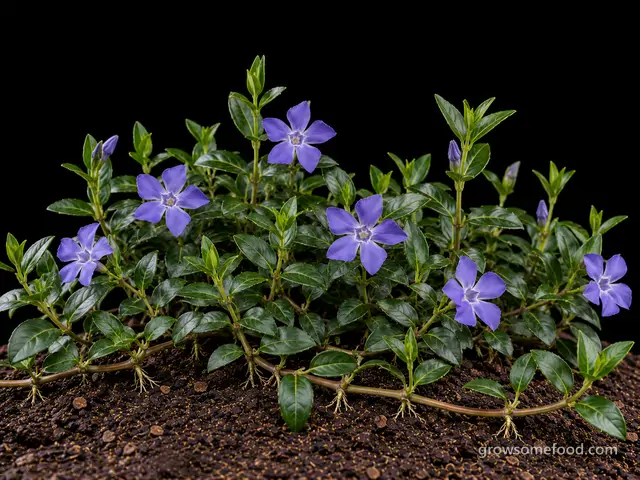
Periwinkle

Vinca minor · Apocynaceae
Other Perennial GroundCover Ornamental
Introduced - Vinca minor is native to central and southern Europe, Vinca major to the western Mediterranean; both are naturalized invaders across much of North America
Not recommended to plant. Still sold everywhere as an easy evergreen groundcover, but do NOT plant it. Its mats smother the spring wildflower layer, every rooted node regrows, and almost every infestation began as one small planting. Identification, control and native alternatives.

Periwinkle is not food. All parts carry vinca alkaloids: a mouthful of leaves causes vomiting and cramps, and large amounts can drop blood pressure. It is listed as toxic to dogs, cats and horses, and the milky sap irritates some skin, so wear gloves when clearing it. Do not confuse it with Madagascar periwinkle (Catharanthus roseus), the annual bedding plant, which is far more toxic. The main hazard is ecological: dense mats smother the native ground flora.

Overview

The evergreen groundcover sold as creeping myrtle, and one of the most stubborn things in an American woodland. Its mats stop the spring wildflower layer cold. The useful news: it barely sets seed here, so it advances in a slow visible front you can actually beat.

Periwinkle (Vinca minor) is the glossy evergreen groundcover sold in every garden center as creeping myrtle — low, tidy, shade-tolerant, deer-proof and almost impossible to kill. Those last two qualities are the problem. Once a planting establishes it creeps outward from rooting stem nodes into a continuous evergreen mat three to six inches deep, and effectively nothing germinates through it. Where it reaches a woodland it erases the spring layer: trillium, bloodroot, trout lily, spring beauty, mayapple and violets simply stop coming back, and with them go the early-season insects and the tree seedlings that would have replaced the canopy.

You have most likely arrived here because you inherited a patch, or because one has crossed a line into your woods. The genuinely useful news is that periwinkle in North America barely sets viable seed. It spreads by creeping, by rooting where it touches down, and by gardeners moving it. That means it advances slowly, in a visible front you can measure and flag, and that almost every wild infestation began either as a deliberate planting or as a dumped load of yard waste. It also means that a cleared patch does not rain back in from the sky the way a bird-spread invasive does. Periwinkle is slow, physical, winnable work — which is more than can be said for most of the plants in this part of the catalog.

At a glance

Sun
Part sun · Part shade · Shade
Water
Medium
Spacing
12–1200 in (typ. 18)
Mature height
3–12 in (typ. 6)
Start by
Frost
Hardy
Spread
24–1200 in (typ. 240)
Soil
Well-drained
Temperature
Damaged below -30°F · struggles above 95°F

When to plant

No planting window on record for this zone.

Life stages

  1. Evergreen creeping mat (identify & control) year-round (yearly)
    • Recognize it: glossy paired leaves on trailing stems that root as they go
      Periwinkle is a low evergreen trailer, 3-6 inches deep, with small glossy dark-green leaves in opposite PAIRS on wiry, arching stems. The stems run along the ground and root wherever a node touches soil, so the patch advances as a solid mat with a visible outer edge. Broken stems bleed a little milky sap. Bigleaf periwinkle (Vinca major) is the same plant scaled up: leaves 2-3 inches long with hairy margins, stems arching a foot or more.
    • Work the edge first, not the middle
      The mat expands from its perimeter, so the highest-value work is clearing a clean band around the outside and holding that line each year. Cut, rake and lift the mat like carpet when soil is moist, pulling the rooted nodes rather than snapping the stems. Bag everything - do not compost it and never tip it over a bank or into the woods, which is how most wild infestations started.
    A solid evergreen mat with a creeping outer front advancing into beds or woodsStems rooting at every node where they touch soilBare ground under the mat with no seedlings of anything else coming through
  2. Spring flowers (Mar-May) Mar, Apr, May (yearly)
    • Blue-violet pinwheel flowers confirm it
      In spring the mat throws single flowers on short upright shoots: five blunt petals set at a slight twist, like a pinwheel, about an inch across, in a soft blue-violet (white and deep purple forms are sold too). They rarely set viable seed in North America. If you are trying to tell periwinkle from a native groundcover, the pinwheel flower over opposite glossy leaves is decisive.
    • Spring is when the harm is visible
      This is the month to see what the mat costs you. Compare the ground inside the periwinkle with clean woodland soil a few yards away: the spring ephemerals - trillium, bloodroot, trout lily, spring beauty, mayapple, violets - are absent inside it and present outside. Photograph the edge now; it is the clearest evidence for how far the front has moved by next spring.
    Blue-violet pinwheel flowers over the matNo spring ephemerals emerging inside the matThe front line advancing a foot or two per year into new ground
  3. Winter: still green, still spreading Jan, Feb, Nov, Dec (yearly)
    • Winter is when you can see the whole infestation
      Periwinkle never goes dormant. Once the natives have died back and the leaves are off the trees, the mat is the only green thing on the forest floor, and you can map its true extent, its outlying satellites and the paths it is following. Mark the edges with flags now; you will not see them this clearly again until next winter.
    • The cold-season treatment window
      Because it stays green and active while natives are dormant, late fall through mild winter spells is the safest time to treat a patch: desirable plants around it are asleep and cannot be harmed by overspray or drift. Work only when the plants are actively growing above roughly 50F, and use a product whose label lists your site - read and follow the label.
    An evergreen carpet standing out on a bare winter forest floorOutlying patches you never noticed in summerStems creeping under fences and across property lines

Watch out for

Evergreen Mat Smothering (ecological harm) High Disorderyear-round

The core hazard is ecological. A periwinkle mat is evergreen, three to six inches deep and continuous, so it holds the soil surface year-round and effectively nothing germinates through it. Woodland spring ephemerals - trillium, bloodroot, trout lily, spring beauty, mayapple, violets - disappear inside it, tree and shrub seedlings fail, and with them go the early-season pollinators and the next generation of canopy. Because periwinkle is strongly deer-resistant, heavy deer browsing on everything around it accelerates the takeover.

Watch for: A continuous evergreen carpet with bare soil beneath it and no seedlings of anything else; spring ephemerals present outside the mat and absent inside it; an advancing front creeping a foot or two per year into beds, lawn edges or woods.

Prevent: Never plant it, in any cultivar; clear and hold a maintained band around any patch you have inherited; replant cleared ground with native shade groundcovers so bare soil is not left open.

Treat: Cut the mat short, then rake and roll it up like carpet with the rooted nodes attached while soil is moist; smother what cannot be lifted with cardboard and four to six inches of mulch for one to two full growing seasons; follow up on regrowth for two or three years and replant with natives.

Regrowth from Rooted Nodes & Fragments High DisorderMar, Apr, May, Jun, Jul, Aug, Sep, Oct, Nov

Why cutting fails and why disposal matters. Every stem node that touches soil roots independently, so a mat is hundreds of separately rooted plants rather than one; mowing or cutting removes leaves and nothing else. Any fragment carrying a node will re-root, including pieces spread by a mower deck, a tiller, or a load of moved soil. Almost every wild infestation in North America began as dumped garden waste or a divided clump given away, because the plant rarely sets viable seed here.

Watch for: Vigorous regrowth within weeks of cutting; new plants appearing where clippings or soil were tipped; stems running sideways out from under mulch or cardboard.

Prevent: Never tip clippings over a bank, into woods or onto a brush pile; bag material for trash or hot municipal composting; clean tools, mower decks and boot treads before moving from an infested area to clean ground; do not give divisions away.

Treat: Lift rooted nodes rather than cutting stems; re-inspect cleared ground two or three times over the following year and pull what regrows; check and re-mulch the perimeter of any smothered area monthly through the growing season.

Vinca Alkaloids (people, pets and livestock) Medium Disorderyear-round

A direct hazard to people and animals. All parts of the plant contain vinca alkaloids including vincamine. Eating leaves causes vomiting, abdominal cramps and diarrhea, and larger quantities can cause a marked drop in blood pressure. The plant is listed as toxic to dogs, cats and horses, and the milky sap causes contact irritation in some people. Because it is evergreen, it is one of the few green things available to a curious pet or a browsing animal in midwinter.

Watch for: Children or pets chewing the glossy leaves, particularly in winter when nothing else is green; skin irritation after clearing a patch bare-handed; grazing animals with access to a mat.

Prevent: Wear gloves and long sleeves when clearing it; keep pets and small children away from established mats; fence livestock off any patch; do not attempt home teas or tinctures from the plant.

Treat: For ingestion by a person or pet, contact poison control or a veterinarian with the plant name to hand. For skin contact, wash the area with soap and water and treat as contact dermatitis.

Vinca Stem Blight (Phomopsis dieback) Medium DiseaseApr, May, Jun, Jul, Aug, Sep

The fungal dieback that makes established periwinkle plantings collapse in patches. Phomopsis and related fungi infect stems at or near the soil line, girdling them; shoots wilt suddenly, turn dark brown or black from the base, and die, leaving expanding bare circles in an otherwise dense mat. It is worst in humid weather, in overwatered or poorly drained ground, and where the mat is dense enough to stay wet. It is one of the few things that reliably damages this plant.

Watch for: Sudden wilting of individual shoots, dark lesions and blackening at the base of stems, and enlarging dead patches in an established mat during humid weather.

Prevent: Not something to encourage where you want the plant gone - but note that thinning, improved drainage and avoiding overhead watering are what limit it, and that dense unmanaged mats are the most susceptible.

Treat: Where periwinkle is being removed anyway, treat blighted patches as a head start: cut and lift the dead area, bag the debris rather than composting it, and replant the gap with a native groundcover before the surrounding periwinkle closes back over it.

For a reader trying to REMOVE periwinkle, this disease is an opportunity rather than a problem. Dieback circles are the easiest places to break into a mat, and replanting them with natives immediately is far more effective than clearing healthy mat of the same area.

Varieties · 4

Bigleaf Periwinkle (Vinca major)

Mounding evergreen groundcover with glossy leaves 2-3 inches long, hairy leaf margins, and larger blue-violet pinwheel flowers.

speciesinvasivedo-not-plantlargerriparian-invaderwarm-climate

The larger, warm-climate species: leaves 2-3 inches long with hairy margins, stems arching a foot or more before rooting, hardy roughly zones 7-10. Its damage is concentrated in California, the Southwest under irrigation and the coastal Southeast, where it invades creek banks and canyon bottoms and travels downstream as broken fragments. Control needs to work a whole drainage from the top down, not patch by patch.

Common Periwinkle (Vinca minor)

Low evergreen carpet of small glossy dark-green leaves in opposite pairs; solitary blue-violet pinwheel flowers about an inch across in spring.

speciesinvasivedo-not-plantevergreen-groundcovershade-tolerantdeer-resistantmildly-toxic

The standard creeping myrtle of American gardens and the main invasive form in the temperate East and Midwest: a 3-6 inch evergreen mat of small glossy paired leaves on wiry rooting stems, with blue-violet pinwheel flowers in spring. Rarely sets viable seed here, spreading instead by creeping stems and by dumped garden waste. Smothers the spring wildflower layer wherever it reaches woodland.

Named and variegated cultivars (Bowles, Atropurpurea, Illumination, Ralph Shugert)

As common periwinkle, with white or plum flowers or gold- and cream-marked leaves.

cultivarinvasivedo-not-plantvariegated

The white-flowered, plum-purple, gold-edged and cream-variegated selections sold as better-behaved garden forms. They are the same species and they creep and root at the nodes exactly the same way; variegation slows a plant slightly but does not make it safe to plant near woodland. Treat and remove them identically to the plain green form.

Native shade-groundcover alternatives

Varies by species - low native groundcovers, ferns and sedges suited to shade in your region.

alternativenativegroundcovernon-invasiverecommended-instead

Plant these instead of periwinkle for dry or moist shade: wild ginger, foamflower, green-and-gold, creeping phlox, golden ragwort, Allegheny spurge (Pachysandra procumbens, the native one), partridgeberry, Christmas fern, and woodland sedges such as Pennsylvania sedge. None of them make quite as impenetrable a mat, which is the point - they cover ground while still letting a woodland function. Ask a local native-plant nursery which suit your soil and light.

Grow

How it takes ground rather than how to plant it: small glossy leaves in opposite pairs on wiry stems that root at every node, blue-violet pinwheel flowers in spring, and an evergreen mat that holds the soil surface against everything else in shade or sun.

You should not plant periwinkle, so what matters is recognizing it and understanding why it wins. It is a low evergreen trailing subshrub: wiry arching stems carrying small, leathery, glossy dark-green leaves in opposite pairs, forming a dense carpet three to six inches deep. Broken stems bleed a thin milky sap. In spring it produces solitary blue-violet pinwheel flowers about an inch across, five blunt petals set at a twist, on short upright shoots — white and plum-purple selections are also sold. Bigleaf periwinkle (Vinca major) is the same plant at larger scale, with leaves two to three inches long, hairy leaf margins and stems that arch a foot or more before touching down.

Its advantages over native ground flora are worth spelling out, because they explain why hand-waving control fails. It is evergreen, so it photosynthesizes through the winter and early spring while native perennials are dormant, and it shades the soil surface in every season. It roots at the nodes, so the colony is one connected organism with no seedling stage to fail. It is strongly deer-resistant because of its alkaloids, so in the over-browsed eastern woods deer eat everything around it and leave it alone. And it tolerates deep shade, drought, poor soil and total neglect. There is no site condition you can impose that disadvantages it, which is exactly why control has to be physical and repeated rather than clever.

Propagation & seed saving

It spreads by creeping and by people, not by seed. Every node that touches soil roots, a fragment left lying on the ground restarts the patch, and most wild infestations trace directly to dumped garden waste or an abandoned homestead planting.

Understanding how periwinkle moves is the whole control strategy, because it moves in only two ways and you can shut down both. The first is vegetative creep: the arching stems touch soil, root at the node, and the new crown sends out its own stems. A patch typically advances one to two feet a year in every direction, faster downhill and along moist edges. Because the colony is connected and each node is independently rooted, cutting the mat does nothing — you have removed leaves from a plant with hundreds of separate root systems underneath.

The second is people. Periwinkle rarely produces viable seed in North America, so it does not arrive on the wind or in a bird. It arrives in a wheelbarrow. The classic origin of a woodland infestation is a pile of garden clippings tipped over a bank, a load of divided groundcover given to a neighbor, or soil moved from a bed that contained it. Any fragment with a node will root, including pieces churned up by a tiller or dragged along by a mower deck. That is why the disposal rule is absolute: bag it, and put it in the trash or municipal green waste that is genuinely composted at heat. Do not compost it in a backyard pile, do not tip it over a bank, and clean tools and boot treads before you walk from an infested patch into clean woods.

Care

Control, not care: cut the mat short so you can see the ground, roll and lift it like carpet with the rooted nodes attached, smother what you cannot lift for a full season or two, treat regrowth in the cold-season window with an on-label product, and hold the cleared edge every year.

Start by cutting the mat short with a string trimmer or a mower on its highest setting. This is not control on its own — periwinkle regrows readily — but it lets you see the ground and the rooted nodes, and it strips off the waxy evergreen leaf surface that otherwise sheds anything you spray. Then, while the soil is moist, rake and lift the mat like carpet: get a garden fork or a stiff rake under the edge and roll it back, pulling the rooted nodes up with it rather than snapping the stems off at the soil line. On small and medium patches this is the whole job. Follow with two or three passes over the next year to catch the nodes you missed, because you will miss some.

Where lifting is impractical — a big patch, or one laced through tree roots you should not disturb — smother it: cut it short, lay overlapping cardboard or several sheets of newspaper, and cover with four to six inches of wood chips. Give it a full growing season at minimum, and expect to need two, checking the perimeter monthly for stems escaping sideways. For herbicide, the practical extension recommendation reflects the waxy leaf: mow or trim first, wait three to six weeks for tender regrowth, then treat that flush while the plant is actively growing, using a product whose label lists your site — typically a glyphosate or triclopyr formulation — and following the label rates, protective equipment and restrictions exactly. The late fall to mild winter window is the good one: periwinkle is still green and active while nearby natives are dormant and cannot be harmed by drift. Plan on repeating the following year.

Finally, replant what you clear. Bare ground under trees invites the periwinkle back, or invites something worse. Good native replacements for shade include wild ginger, foamflower, green-and-gold, creeping phlox, golden ragwort, Allegheny spurge, partridgeberry, Christmas fern and woodland sedges. Ask a local native-plant nursery which of those suit your soil and light.

Troubleshooting

Answers for the reader who already has it: how to be sure it is periwinkle, why cutting fails, whether to spray, what to do about the neighbor's patch, and how many years this actually takes.

Is this periwinkle? A low evergreen carpet of small glossy dark-green leaves in opposite pairs on wiry trailing stems that root where they touch, with solitary blue-violet pinwheel flowers in spring and a little milky sap in a broken stem. In winter it is often the only green thing on the forest floor, which is the easiest confirmation of all. Is this the same as the periwinkle in the flower flats? No, and the distinction matters. The bedding annual sold as periwinkle or vinca in summer is Madagascar periwinkle, Catharanthus roseus, a different genus, a tender annual with pink or white five-petalled flowers and no creeping habit — it is not invasive in most of the country but it is considerably more toxic. I cut it back and it came straight back: expected. Every node under the mat is separately rooted, so cutting removes leaves from hundreds of intact plants. Cutting is a preparation step, not a control. Can I just smother it? Yes, with cardboard and four to six inches of mulch, but give it a full growing season and usually two, and watch the perimeter for stems running out sideways under the edge. Do I have to use herbicide? No. On a garden-sized patch, lifting the mat by hand and following up for two seasons works. Herbicide earns its place on large areas and on ground you cannot dig; if you use it, mow first, treat the regrowth, pick a product whose label lists your site, and follow the label. It is coming from next door: clear and hold a band a few feet wide on your side, check it twice a year, and talk to the neighbor — periwinkle only moves by creeping, so a maintained edge genuinely holds. How long will this take? Two to four years of decreasing effort for a typical yard patch, and you will win, because it cannot reseed itself back in. Is it dangerous to handle? Wear gloves: the sap irritates some skin, and the plant is toxic to pets and children if eaten. What do I plant instead? Wild ginger, foamflower, green-and-gold, creeping phlox, golden ragwort, Allegheny spurge, partridgeberry, Christmas fern or woodland sedges.

Traditional & historical uses

Vinca minor is the botanical source of vincamine, from which the supplement vinpocetine is made - but the cancer drugs people associate with the name come from a different genus entirely. There is no safe home preparation of this plant. Educational, not medical advice.

This section records how people have traditionally used this plant, and what is known about the risks. It is history and general information — not medical advice, and not a recommendation to treat anything. Plants are not dosed like medicines, some interact with prescriptions, and some are harmful in ways that are not obvious. Talk to a clinician before using any plant medicinally.

Two separate medicinal stories get tangled under the name periwinkle, and it is worth untangling them. Vinca minor contains vincamine, an alkaloid from which the semi-synthetic compound vinpocetine is manufactured; vinpocetine is prescribed as a drug in parts of Europe and sold in the United States as a nootropic supplement for memory and cerebral blood flow. The evidence for those claims is thin, and in 2019 the US Food and Drug Administration warned that vinpocetine should not be taken by women who are pregnant or who could become pregnant, citing reproductive-harm findings.

The other story belongs to a different plant. The chemotherapy agents vincristine and vinblastine come from Catharanthus roseus, Madagascar periwinkle — a separate genus that only shares the common name. Neither drug comes from the groundcover in your yard.

The practical point for a gardener is simple: there is no safe home preparation of periwinkle. The alkaloid content of the fresh plant varies wildly with age, season and growing conditions, the compounds are cardioactive and can lower blood pressure sharply, and there is no traditional dose you can trust. Do not make tea from it, do not tincture it, and keep it out of reach of children and pets. If vinpocetine interests you, that is a conversation for a clinician about a standardized product, not a reason to keep an invasive groundcover. This is educational information, not medical advice.

History

A Mediterranean plant carried across Europe for a thousand years as a symbol of remembrance, planted on graves and doorsteps, and brought to North America in the 1700s. A patch of periwinkle in the woods is very often the marker of a house or a burial ground that is otherwise gone.

Periwinkle has been travelling with people for a very long time. It was grown across medieval Europe as a garden and medicinal herb, wound into garlands, and associated so strongly with death and remembrance that it acquired names like flower of death and, in English, graveyard weed. It was planted on graves, at doorsteps and along the paths of old homesteads, and it outlived nearly all of them. Colonists carried it to North America in the 1700s for exactly those purposes, and nurseries have sold it continuously ever since as the reliable answer to dry shade.

That history has left a curious legacy for anyone walking in eastern woodland. Periwinkle almost never seeds itself, so a patch far from any road is not a natural occurrence — it is a record of habitation. Archaeologists and land trusts routinely use periwinkle, along with daffodils, yucca and old lilacs, as a surface indicator of a vanished farmstead, cabin site or family burial ground. If you find a mat of it deep in the trees, look nearby for a foundation depression, a chimney fall, a lilac, or the flat stones of unmarked graves. It is worth knowing before you start clearing, both out of respect and because it changes what you may want to disturb.

Growing across climates

Vinca minor is invasive across the temperate East, Midwest and Pacific Northwest, roughly zones 4-8. Vinca major is the warm-climate problem, worst in California and the coastal Southeast, where it invades stream corridors rather than dry woodland.

Vinca minor is hardy roughly from zone 4 to zone 8 and escapes across the whole temperate East and Midwest, with heavy pressure in the Appalachians, the Ohio and Mississippi valleys, the mid-Atlantic and the Pacific Northwest. It appears on state invasive-plant lists in a long list of eastern and midwestern states — but those are mostly advisory lists maintained by invasive-plant councils and natural-resource agencies rather than regulatory ones, which is why it remains perfectly legal to buy in almost every state. Legality here is not a guide to consequences; check your own state and county list, and then decline to plant it regardless.

Vinca major is the warm-climate counterpart, hardy from about zone 7 to zone 10, and its damage is concentrated in California, the desert Southwest under irrigation, and the coastal Southeast. It behaves differently: rather than carpeting dry woodland, it invades riparian corridors — creek banks, canyon bottoms, irrigation ditches, damp shaded slopes — where it forms head-high mounded thickets, and where stem fragments broken loose by winter flows are carried downstream to found new colonies. In California it is a well-known problem in coastal canyons and along urban creeks. If you are in the West and you have periwinkle, check which species you have first, because a riparian V. major infestation spreads by water and needs the whole drainage worked from the top down rather than patch by patch.

No grower tips for Periwinkle yet — yours could be the first.

Sign in to share what works in your garden.

Connection interrupted

Reconnecting to GrowSomeFood

Keep this page open. We are trying to restore your garden session.

Attempt of . Retrying automatically.

Still offline

Could not reconnect

Your phone may have switched networks or gone to sleep. Try again when the signal is steady.

Session expired

Reload to continue

This garden session is no longer available on the server. Reloading will start a fresh session.