Add it to your home screen and it opens full screen: no browser bars, one tap away, and everything stays signed in. Free, nothing to download from an app store.
- Tap the Share button in your browser
- Scroll down and choose “Add to Home Screen”
- Open GrowSomeFood from your home screen
- Open your browser’s menu
- Choose “Add to Home screen” or “Install app”
- Open GrowSomeFood from your home screen
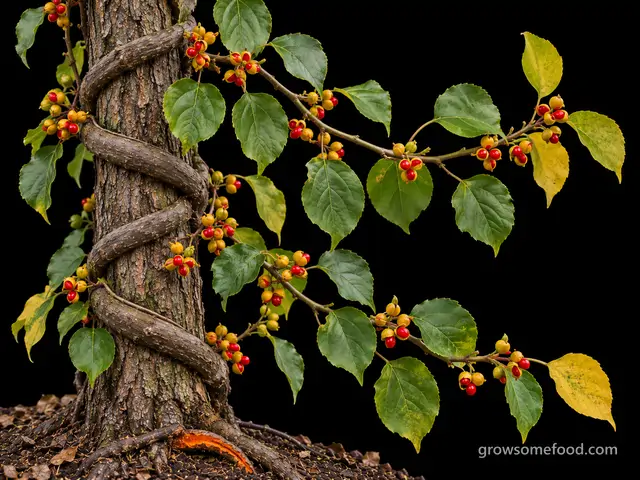
Oriental Bittersweet
The orange-and-scarlet wreath vine - a woody strangler that girdles and topples mature trees, escapes from every dried arrangement, and is hybridizing the native American bittersweet away. Never plant it; this entry is for identifying it, telling it from the native, and getting it out.
Oriental bittersweet is not a food. Its scarlet-arilled fruits are toxic if eaten, causing vomiting and diarrhea, and most exposures happen indoors: the fruiting vines are cut for fall wreaths within reach of children and pets. Physical hazards matter too - vine-loaded trees drop limbs and blow over in wind and ice, so look up before you cut, and wear gloves and eye protection in a tangle. Never buy, hang, or compost a bittersweet wreath; that is how it travels.
Overview
Oriental bittersweet (Celastrus orbiculatus) is the vine behind the orange-and-red fall wreaths - and one of the most damaging woody invasives in the eastern United States. It is a twining woody vine that spirals up trunks and does not stop: as the stem thickens it girdles the tree it is climbing, constricting the trunk into an hourglass, and the accumulated weight of vine in the crown acts like a sail, so heavily infested trees are the ones that snap or blow over in the next ice storm. On the ground it forms dense thickets that shade out everything beneath.
Two things make it worse than an ordinary weed. First, it spreads by bird-dropped seed and by root suckers at the same time, so a single female vine seeds the neighborhood while colonizing outward underground. Second, it hybridizes with the native American bittersweet (C. scandens), which is now uncommon across much of its former range - the invader is not merely crowding the native out, it is breeding it out. This entry exists to help you recognize it, tell it from the native, and remove it. Never plant it, and never bring a fruiting stem home for the mantelpiece.
Quick facts
For identification. Not a growing guide.
- Life cycle
- Perennial, lives about 40 years
- Where it grows
- Full sun · Part sun · Part shade, well-drained soil
- Height
- 60 ft20 to 120
- Spread
- 40 ft10 to 100
- Cold
- Takes hard frostdamaged below -30°F
- Heat
- Struggles above 100°F
- Self-sows
- Yes. Never let it set seed.
Through the year
How to recognize it in each season.
Leaf-out & climbing growth (identify & control)
Apr to Oct, every year- Recognize it: round, finely toothed alternate leaves on a twining woody vineOriental bittersweet is a fast woody vine that twines clockwise up anything vertical. Leaves are ALTERNATE, glossy, nearly round to broadly oval with a short abrupt tip and fine rounded teeth. Older stems become grey-brown and corky with pale raised lenticels, and can reach the thickness of your wrist. It has no tendrils, no thorns, and no aerial rootlets - it climbs by wrapping. A wrist-thick woody spiral wound around a trunk is the signature.
- Cut the climbing stems and treat the stump the same daySever every climbing stem at the base and again at chest height so you can see what you have treated, then treat each rooted cut stump immediately - within minutes, before the cut seals. Cutting alone makes it worse: it resprouts from the stump and suckers from lateral roots. Leave the severed upper vine in the canopy to die and fall on its own; hauling on it brings down dead limbs.
- Pull seedlings and root suckers while the soil is moistSeedlings and pencil-thick suckers pull cleanly from moist soil if you get the bright ORANGE root - the roots are unmistakably orange, and a snapped-off piece will resprout. Work outward from the parent vine; a single old plant sends suckers many feet in every direction. Do this every spring for several years, because the seed bank keeps germinating.
Key signs- Woody spirals wound tightly around trunks and saplings
- Round, glossy, finely toothed alternate leaves
- Bright orange roots when you pull a seedling
- Suckers appearing several feet from the parent vine
Small greenish flowers (the ID moment)
May to Jun, every year- Flowers in the leaf axils, not at the branch tipsThis is the discriminator that matters. Oriental bittersweet carries its small greenish-white flowers in short clusters at the LEAF AXILS, scattered all along the stem. The native American bittersweet (Celastrus scandens) carries them only in a single showy cluster at the TIP of each stem. The plants are otherwise easy to confuse, and the native is worth keeping - so check where the flowers sit before you cut anything.
- Flag every flowering vine for removalFlowering means fruit is coming, and fruit means birds. Plants are usually either male or female, so only some vines fruit - but flag them all now while the flowers are visible, and prioritize the female (fruiting) vines for removal before fall.
Key signs- Greenish flower clusters in the leaf axils along the stem (Oriental)
- A single flower cluster at the stem tip (the native American bittersweet)
- Which vines are female and will fruit
Yellow capsules split to scarlet fruit
Sep to Dec, every year- Yellow capsules opening on a scarlet arilIn fall, pea-sized capsules ripen YELLOW and split into three parts to expose a glossy scarlet aril around the seed. They line the stem at every leaf axil, which is why an Oriental bittersweet vine looks beaded from end to end while the native fruits only in a cluster at the tip. The native's capsules ripen ORANGE, not yellow. Fruit persists into winter and is what birds carry off.
- Cut fruiting vines first, and bag every berryFruiting female vines are seed factories - take them out first. Cut and bag the fruiting stems into the household trash. Do not compost them, do not burn a brush pile with them in it, and do not leave clippings on the ground: the seed ripens on cut stems and germinates readily. This is also the season when the vines get cut for decoration - do not.
Key signs- Yellow capsules splitting to scarlet arils all along the stem
- Birds stripping fruit in late fall and winter
- Cut fruiting stems left on the ground or in a brush pile
Bare vines & the winter control window
Dec to Mar, every year- Winter is when you can finally see the damageWith the leaves down, the vines show plainly: grey corky spirals biting into bark, trunks visibly constricted and swollen above and below the coils, and whole crowns held together by vine. Look up. Trees carrying a heavy vine load catch snow and ice like a sail and are the ones that come down in the next storm - which is a reason to hire an arborist rather than climb.
- Cut-stump treatment works through the cold monthsLate fall through winter is a good working window: you can see the stems, the ground is firm, and cut-stump herbicide treatment still works on woody plants while the ground is unfrozen and the plant is moving reserves downward. Use a product whose label lists your site and follow that label - it is the legally binding instruction. Flag treated stumps so you can check them for resprouts in spring.
Key signs- Constricted, swollen trunks where vines have girdled
- Crowns held up by vine rather than by their own limbs
- Persistent orange-red fruit on bare stems
- Resprouts from stumps cut in a previous season
Hazards
Strangling & Tree FailureSeverity High DisordernowTrunks visibly constricted and swollen above and below a spiral of vine; crowns held together by vine rather than by their own limbs; storm-thrown trees with vine still wrapped around them; bare ground under dense vine mats.
Trunks visibly constricted and swollen above and below a spiral of vine; crowns held together by vine rather than by their own limbs; storm-thrown trees with vine still wrapped around them; bare ground under dense vine mats.
Sever each climbing stem at the base and again at chest height and treat the rooted stump the same day; leave the severed upper vine in the canopy to die and fall rather than pulling it down, which brings dead limbs with it. Bring in an arborist for large vine-loaded trees.
Never plant it. Cut vines off valuable trees while the stems are still thin, and check woodlot interiors as well as edges, since seedlings establish under an intact canopy and wait for a gap.
The core hazard is physical as well as ecological: the twining woody stem thickens against the trunk it is climbing and girdles it, constricting the tree into an hourglass, while the accumulated vine mass in the crown catches wind, snow and ice like a sail. Heavily loaded trees snap, drop large limbs, or blow over, and the ground layer beneath a bittersweet thicket is shaded out entirely.
Root Suckers, Seed & ResproutingSeverity High DisordernowNew shoots erupting several feet out from an old vine; a ring of stems around a stump cut in a previous season; seedlings with bright orange roots appearing far from any parent plant.
New shoots erupting several feet out from an old vine; a ring of stems around a stump cut in a previous season; seedlings with bright orange roots appearing far from any parent plant.
Cut-stump herbicide treatment applied to the fresh cut within minutes, late summer through winter, using a product whose label lists the site - follow the label, which is legally binding. Re-walk the site each spring for at least five years.
Remove fruiting female vines first to cut off the seed supply; pull seedlings and suckers by the whole orange root while the soil is moist; never leave root fragments in worked soil.
Why cutting alone makes it worse: the plant spreads by lateral roots that sucker up many feet from the parent, by bird-dropped seed that germinates in sun or shade, and by vigorous resprouting from any cut stump or root fragment left behind. One severed vine typically comes back as a dozen stems.
Wreath & Craft-Trade DispersalSeverity Medium DisordernowBittersweet wreaths and swags for sale in fall; fruiting stems cut and carried home; berry-laden decorations composted or dumped at the end of the season.
Bittersweet wreaths and swags for sale in fall; fruiting stems cut and carried home; berry-laden decorations composted or dumped at the end of the season.
Bag all fruiting material into the household trash - never compost it, never add it to a brush pile, and never leave clippings on the ground, where the seed ripens on the cut stem and germinates.
Do not buy, make, hang, or accept bittersweet decorations, and say why when you decline one. Cut fruiting stems only as removal work, never as harvest.
A dispersal route unique to this plant: fruiting stems are cut every autumn for wreaths, swags and dried arrangements and sold at farm stands and craft stores, sometimes across state lines and into states where planting the vine is illegal. Each decoration is a bundle of viable seed - birds strip berries from wreaths hung outdoors, and the arrangement is usually thrown on a compost heap or brush pile in November, which amounts to a planting.
Hybridization with Native BittersweetSeverity Medium DisorderVines with an ambiguous fruiting pattern - some fruit at the tip and some in the axils - especially where a known native population sits near an infestation.
Vines with an ambiguous fruiting pattern - some fruit at the tip and some in the axils - especially where a known native population sits near an infestation.
Treat ambiguous vines as invasive - the axillary fruiting pattern is the deciding evidence - and protect confirmed native plants by clearing the invader out of the surrounding area.
Remove the invader from around any surviving native bittersweet before flowering, and buy native bittersweet only from a source that can vouch for its identity, since nursery stock is sometimes mislabelled.
A quieter form of loss: Oriental bittersweet interbreeds with the native American bittersweet (Celastrus scandens), producing fertile hybrids. Where the invader is abundant the native's pollen is swamped, so the native is displaced genetically as well as physically, and intermediate plants blur the field marks people rely on to tell the two apart.
Toxic Fruit (indoor exposure)Severity Low DisordernowBright orange-and-scarlet fruit on decorations, dropped berries beneath a hanging wreath, and children or pets with access to either.
Bright orange-and-scarlet fruit on decorations, dropped berries beneath a hanging wreath, and children or pets with access to either.
If a child eats the fruit, contact Poison Control; if a pet does, contact a veterinarian. Remove the source rather than relying on supervision.
Do not bring fruiting stems indoors at all. Keep decorations that already contain them well out of reach, and sweep up dropped berries.
A direct but minor hazard, with an unusual exposure route: the scarlet-arilled fruits are toxic if eaten and cause vomiting and diarrhea, and because fruiting stems are made into wreaths and dried arrangements, the berries commonly end up indoors on a table or door within reach of small children and pets.
Grower tips
Notes from growers, tagged with the zone they grow in. A person reads every post before it appears.
Nobody has posted about Oriental Bittersweet yet.
Free account. Your post shows your grower name and zone, never your email.