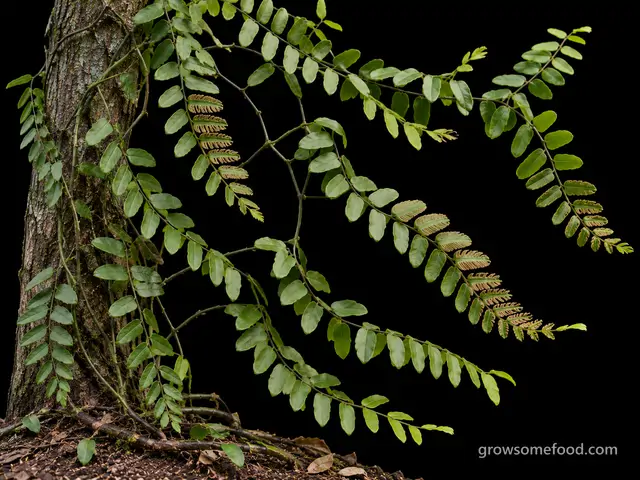
Old World Climbing Fern

Lygodium microphyllum · Lygodiaceae
Other Perennial Fern Other
Introduced - native to the wet tropics and subtropics of Africa, Asia, Australia and the Pacific islands; in the US it has overrun much of south and central Florida
For identification only — don't plant. A federal noxious weed and on the Florida Noxious Weed List - illegal to introduce, possess, move, or release. It blankets whole tree islands, topples trees, and carries fire into the canopy, spreading by spores that travel for miles. Identification and control only.

Not a food and not poisonous, but a genuine fire hazard: its mats form an unbroken fuel ladder from the ground into the treetops, and burning fronds lift on the wind to start spot fires ahead of the flame front. It spreads by clouds of near-invisible spores, so avoid cutting fertile fronds in dry, windy weather and clean tools, boots, and clothing afterward. Confirm the species before treating any climbing fern - the native Hartford fern is rare and protected.

Overview

A federally listed invasive fern that climbs 100 feet into the canopy, blankets whole tree islands, and carries ground fire into the treetops. It is illegal to move or possess in Florida. This entry is for identifying and controlling it.

Old World climbing fern (Lygodium microphyllum) is the most damaging invasive plant in south Florida’s wetlands, and one of the strangest: a fern that climbs like a vine. A single frond never stops growing at the tip, so the wiry stalk twines up trunks and shrubs 90 to 100 feet, branching as it goes, until the whole canopy is roofed in a lacy blanket. Underneath, the mat smothers everything — and its weight collapses and topples mature trees. On Everglades tree islands and in cypress domes it has converted diverse habitat into a single fern.

Two things make it worse than an ordinary weed. It builds a continuous fire ladder: a ground fire that would have burned harmlessly through the understory climbs the fern into the crowns instead, and burning fern fragments lift on the wind and start spot fires well ahead of the flame front. And it spreads by dust-fine spores that travel for miles, so it appears in places nothing carried it. It is a federal noxious weed and on the Florida Noxious Weed List — illegal to introduce, possess, move, or release. You are here to identify it and get rid of it. Never plant it, and never move plant material out of an infested site.

At a glance

Sun
Full sun · Part sun · Part shade · Shade
Water
High
Spacing
24–600 in (typ. 120)
Mature height
60–1200 in (typ. 360)
Frost
Tender
Spread
36–1200 in (typ. 240)
Soil
Tolerates wet soil
Temperature
Damaged below 28°F · struggles above 105°F
Self-sows
Yes — expect volunteers

When to plant

No planting window on record for this zone.

Life stages

  1. Climbing fronds & smothering mats (identify & control) year-round (yearly)
    • Recognize it: a fern that climbs, with small oblong leaflets
      What looks like a wiry twining vine is one fern frond that never stops elongating - the rachis twines up trunks 90 to 100 ft, hung with SMALL (1-2.5 in) oblong, blunt, smooth-edged leaflets, jointed so they snap off leaving stubs on the wire. Fertile leaflets carry a fringe of tiny finger-like lobes. Small unlobed leaflets in Florida is this fern; large, deeply cut, lacy triangular leaflets is Japanese climbing fern; hand-shaped palmate leaflets is the NATIVE Hartford fern - leave that alone.
    • Cut a skirt, then treat the ground mat
      The standard Florida method: cut every climbing frond in a band around the trunk at about waist height (the 'hula skirt' cut). That severs the canopy mat, which browns and drops over the following weeks and immediately breaks the fire ladder - but it does not kill the plant, which regrows from a tough surface rhizome. Follow up by treating the ground-level mat and the regrowth with a foliar herbicide whose label lists your site, and expect to come back for several years.
    • Do not disturb fertile fronds on a dry, windy day
      The fringed, spore-bearing leaflets release millions of dust-fine spores that ride the wind for miles. Cut and treat when the air is still and the foliage is damp where you can, bag any material you carry out, and wash tools, gloves, boots, and vehicle tires before you go anywhere else. Sanitation is a real part of control here, not a formality.
    Wiry fern fronds twining up trunks and shrubs into the canopyDense mats blanketing shrubs, cypress domes, and tree islandsFringed fertile leaflets - the spore sourceSmall oblong leaflets that snap off at a joint, leaving stubs on the wire
  2. Dry season & cold snaps (cured fuel, not control) Jan, Feb, Mar, Apr, Dec (yearly)
    • Brown mats are more dangerous, not less
      A hard cold snap or the Florida dry season browns the outer fronds, and the mat cures into a light, dry, extremely flammable blanket draped from the ground into the treetops. The rhizome underneath is unharmed and pushes new fronds as soon as the weather turns. Brown fern is not dead fern, and it burns far more readily than green.
    • Treat cured mats near structures as wildfire fuel
      Dry-season mats near homes, fence lines, and pine or cypress stands are a wildfire problem before they are a plant problem. Cut skirts to break the vertical fuel continuity, clear cured material away from structures, and coordinate with your county or the Florida Forest Service before any prescribed burn - fire alone does not control this fern and can push it into the canopy.
    Tan, cured, highly flammable mats hanging from ground to canopyNew green fronds pushing from the surviving rhizomeFuel continuity from ground level into pine and cypress crowns

Watch out for

Wind-Borne Spore Spread High Disorderyear-round

Why it spreads so far and resists containment: it produces vast numbers of tiny wind-borne spores that travel long distances to found new infestations, and they cling to clothing, equipment, and machinery (and can contaminate harvested pine straw), while a tough rhizome resprouts after cutting.

Watch for: Fertile (spore-bearing) fronds, new infestations far from existing patches, and spread following equipment or pine-straw movement.

Prevent: Avoid disturbing fertile fronds in dry, windy weather; clean tools, clothing, and equipment; don't move contaminated material.

Treat: Limit spore spread through sanitation and timing, kill the rhizome with repeated herbicide, and follow up for several seasons.

This fern's spores are the reason a cleared property gets re-infested from miles away. Its fertile leaflets are the fringed ones, and in south Florida they are produced year-round, so there is no safe season - work in still, damp conditions, bag what you carry out, and wash boots, tools, and tires before leaving the site.

Fire Ladder & Wind-Borne Embers High Disorderyear-round

The fern's mats form unbroken fuel from ground level into the crowns, so a surface fire that would have burned harmlessly through the understory climbs into the canopy instead and becomes a destructive crown fire. Worse, burning fern fragments are light enough to lift on the wind and start spot fires well ahead of the flame front, which makes fires on infested land far harder to predict and contain. Cured dry-season mats are the most dangerous state.

Watch for: Continuous fern fuel from the ground into the treetops, tan cured mats draped over shrubs and trunks, and infestations next to homes, fence lines, and pine or cypress stands.

Prevent: Never plant or move it; cut skirts around trunks to break the vertical fuel continuity before the mat reaches the canopy; keep cured mats clear of structures.

Treat: Cut every climbing frond in a band at waist height so the canopy mat dies and drops, then treat the ground mat with a labelled herbicide over several seasons. Do not attempt to burn it out - fire does not control it and can carry it into the crowns. Coordinate any prescribed burn on infested land with your county or state forestry service.

In Florida this is the reason the 'hula skirt' cut comes first in any control plan: it breaks the fire ladder the same day, even though it does nothing to the rhizome.

Canopy Smothering & Tree Collapse High Disorderyear-round

The ecological hazard, and it is unusually severe: the fern roofs whole stands in a lacy blanket that shades out the understory, and its accumulated weight bends, breaks, and topples mature trees. Where it takes an Everglades tree island or a cypress dome, it can flatten the forest structure entirely and leave a single-species fern mat behind.

Watch for: Shrubs and young trees buried under fern, mats spanning from one crown to the next, bent or leaning trunks, and dead standing trees inside a solid fern blanket.

Prevent: Never plant or move it; find and treat small patches before the fern reaches the canopy, which is the point at which control gets expensive.

Treat: Cut climbing fronds at waist height to release the trees, treat the ground mat with a labelled herbicide, repeat for three to five years, then replant with native ferns, shrubs, and wetland plants.

Everglades tree islands and cypress domes are the classic case - the same mats that smother the understory eventually pull the canopy down.

Mistaken Identity (the native Hartford fern) Medium DisorderApr, May, Jun, Jul, Aug, Sep, Oct

Not every climbing fern is an invader. The United States has one native climbing fern, the Hartford fern (Lygodium palmatum), which is uncommon and legally protected in several states, and it is easy to cut or spray by mistake if 'climbing fern' is treated as diagnostic on its own.

Watch for: Hand-shaped, palmately five- to seven-lobed leaflets like small maple leaves, on acidic, moist, sandy ground in the Appalachians and Northeast - that is the native, not the invader.

Prevent: Identify by leaflet before any cutting or spraying: small smooth-edged oblong leaflets in Florida is the invader; large lacy triangular leaflets across the Gulf South is Japanese climbing fern; hand-shaped lobed leaflets is the protected native.

Treat: If the leaflets are palmately lobed, stop and leave the plant alone; report the find to your state natural heritage program if you like, and check your state's protected-plant rules before touching it.

Range is the quick filter: Old World climbing fern is a central-and-south-Florida plant, and the native Hartford fern grows far to the north of it. Where the two cannot overlap, geography settles the question - but check the leaflet anyway.

Varieties · 4

American Climbing Fern / Hartford Fern (Lygodium palmatum) - NATIVE, leave it alone

Slender twining fern with hand-shaped, palmately lobed leaflets like small maple leaves; fertile leaflets clustered toward the frond tip.

relatednativeprotectedidentificationdo-not-treat

The only climbing fern native to the United States, and an uncommon, legally protected plant in several states - the Connecticut law passed to protect it in 1869 is often cited as the first plant-protection statute in the country. Its leaflets are hand-shaped and palmately five- to seven-lobed, quite unlike the small oblong leaflets of the invader, and it grows on acidic, moist, sandy ground in the Appalachians and Northeast, far outside the invasive's range. If the leaflets look like little maple leaves, stop: this is the native, and it should never be cut or sprayed.

Japanese Climbing Fern (Lygodium japonicum) - the other invasive

Wiry climbing fern with large, lacy, deeply divided triangular leaflets.

relatedinvasivedo-not-plantidentification

The cold-hardier cousin, spread across the Gulf South and into the Carolinas and Arkansas. Told apart by its much larger, deeply cut, lacy triangular leaflets. Also invasive, also a fire ladder, and controlled the same way - it has its own guide in this catalog.

Native fern alternatives

Varies by species - clump- or colony-forming native ferns, none with the climbing, smothering, fire-ladder habit.

alternativenativenon-invasiverecommended-instead

There is no reason to plant a climbing fern in Florida. For fern texture on wet ground, choose natives - swamp fern, royal fern, cinnamon fern, leather fern, or netted chain fern - plus native wetland shrubs. A Florida native-plant nursery can match species to your county and water level.

Old World Climbing Fern (Lygodium microphyllum)

A wiry twining fern climbing into the treetops, hung with small (1-2.5 in) oblong, blunt, smooth-edged leaflets; dense lacy mats over shrubs and canopy; browns to a flammable tan blanket in the dry season.

speciesinvasivedo-not-plantnoxious-weedinvasive-fernfire-hazardspore-spreadclimbing

The federally listed invasive: a climbing fern whose single endlessly-elongating frond twines 90-100 ft into the canopy, hung with small, smooth-edged, oblong leaflets that snap off at a joint. Fertile leaflets carry a fringe of tiny finger-like lobes. It blankets and topples trees, builds a ground-to-canopy fire ladder, and spreads by dust-fine wind-borne spores. Illegal to introduce, possess, move, or release in Florida - identify, report, and control, never plant.

Grow

How to recognize it: small oblong leaflets on a wiry, endlessly twining frond that climbs into the canopy, with fringed fertile leaflets. The ID matters - the native Hartford fern is rare and protected.

You will never plant this, so what counts is telling it apart from the two other climbing ferns you might meet. All three look like a wire hung with fern leaflets; the leaflets decide it.

Old World climbing fern (L. microphyllum) has small leaflets, 1 to 2½ inches, oblong to slightly heart-shaped at the base, blunt-tipped, with smooth, unlobed edges. They are jointed where they meet the wire, so they snap off cleanly and leave a line of tiny stalk stubs behind. Fertile leaflets are the same shape but carry a fringe of small finger-like lobes along the margin, each one hooding the spore cases. In the US it is essentially a central and south Florida plant.

Japanese climbing fern (L. japonicum) has much larger, deeply cut, lacy triangular leaflets, and it is the one spread across the Gulf South and up into the Carolinas and Arkansas. It has its own entry here; it is also invasive and controlled much the same way.

American climbing fern, or Hartford fern (L. palmatum), is native, uncommon, and legally protected in several states. Its leaflets are unmistakable once you see them: hand-shaped, palmately five- to seven-lobed, like a small maple leaf on the wire. It grows on acidic, moist, sandy ground in the Appalachians and the Northeast — far outside microphyllum’s range. If you are north of Florida and the leaflets are hand-shaped, stop and leave it alone.

The habitat is the other clue. Old World climbing fern favours wet ground: cypress swamps, wet flatwoods, sawgrass edges, tree islands, marsh margins, canal and roadside ditches. It grows in full sun and in shade, which is why it invades both open marsh and closed forest, and it climbs anything — shrubs, cabbage palms, pines, cypress, fence lines.

Propagation & seed saving

How it spreads and why containment fails: millions of dust-fine spores ride the wind for miles and cling to gear, mulch, and vehicles, while a tough surface rhizome rebuilds every mat you cut.

This fern has no seeds and no flowers. It reproduces by spores — and it makes them in staggering numbers, on the fringed fertile leaflets, more or less year-round in south Florida. The spores are dust-fine and wind-borne, drifting for miles, which is why new infestations appear in places no one has driven, walked, or dumped. They also cling to clothing, boots, gloves, chainsaws, mowers, ATVs, and truck tires, and they travel in mulch, fill, and harvested pine straw. Every one of those is a route you can close.

Locally, the plant rebuilds from a tough, shallow, wiry rhizome at the base of the mat. Cutting the climbing fronds is the right first move and it does real good — it breaks the fire ladder and releases the smothered trees — but the rhizome resprouts, so cutting alone is never control. It also creeps outward, so a patch expands at the edges even when nothing new arrives.

The practical consequence: control has to do two separate jobs. Kill the rhizome, with repeated foliar treatment over several seasons, and stop the spores, by timing your work for still, damp conditions, bagging what you carry out, and cleaning everything that touched the plant. In heavily infested parts of Florida, land managers treat by helicopter over thousands of acres and still return on a cycle — that is the scale of the seed-free spread you are up against.

Care

Control, not care: cut a skirt around each trunk to break the fire ladder, treat the ground mat with a labelled herbicide over several seasons, use only aquatic-labelled products at or near water, and clean every tool.

The Florida standard is the ‘hula skirt’ cut. Working around the trunk at about waist height, cut through every climbing frond so the canopy mat is severed from its roots. It browns and drops over the following weeks; the tree is released and the fire ladder is broken immediately. Then treat the ground-level mat and the regrowth. Do it in that order — spraying a canopy mat you cannot reach wastes product and drenches everything below it.

Herbicide, honestly. This fern is not controlled by cutting, and hand-pulling only works on seedlings and small new patches. In Florida the standard actives are glyphosate and metsulfuron-methyl, usually with a surfactant, applied to green foliage. Three rules are not optional. Use a product whose label lists your site — the label is the law, and a lawn-and-garden product is not licensed for a wetland edge. Read and follow that label for rate, surfactant, protective equipment, and re-entry. And because this plant lives on wet ground — swamps, ditches, canal banks, marsh margins — anything applied in, over, or near water requires an aquatic-labelled formulation, and in many situations a permit and a licensed applicator. If your infestation is at the water’s edge, call your county extension office or water management district before you buy anything.

Then keep coming back. Expect to re-treat regrowth for three to five years, and to check the site annually after that. Time your cutting for still, damp weather to limit spore release, bag anything you haul out (never compost it, never dump it), and wash tools, boots, and tires before leaving. In Florida two host-specific biocontrol agents — the Lygodium defoliating moth (Neomusotima conspurcatalis) and the Lygodium mite (Floracarus perrepae) — have been released and provide some area-wide suppression, but they will not clear your property. Finally: report it. New infestations, especially outside the known range, are worth reporting to your county extension office or state invasive-species program. Where you clear it, replant natives — swamp fern, royal fern, cinnamon fern, and native shrubs suited to your site.

Troubleshooting

The practical questions: is this it, is it the native one, why did cutting not work, why is it back, and what to do about the fire risk.

Is this Old World climbing fern? A wiry, twining, vine-like plant that is unmistakably a fern, climbing into shrubs and trees on wet ground in central or south Florida, with small oblong leaflets under about 2½ inches, smooth-edged, jointed so they snap off leaving stubs. Fertile leaflets have a fringed margin.

Could it be the native one? Yes, and this matters. Hand-shaped, palmately lobed leaflets mean the native Hartford fern (L. palmatum) — rare, protected in several states, and found in the Appalachians and Northeast, not Florida. Large, lacy, deeply cut triangular leaflets across the Gulf South mean Japanese climbing fern — also invasive, also controlled. Check the leaflet before you cut or spray anything.

I cut it down and it came back. Expected. Cutting severs the canopy mat and breaks the fire ladder, which is worth doing on its own, but the plant regrows from a surface rhizome. Cutting has to be paired with foliar treatment of the ground mat, repeated over several seasons.

It reappeared where I had cleared it. Either the rhizome survived, or spores arrived on the wind — they travel for miles, so a clean site can be re-infested from a neighbour’s property. Annual checks are part of the job.

How dangerous is the fire risk? Real and specific. The mat is continuous fuel from the ground into the crowns, so a survivable surface fire becomes a crown fire, and burning fragments lift and start spot fires downwind. Brown dry-season mats are the worst case. Break the vertical continuity with skirt cuts, keep cured mats away from structures, and talk to your county or the Florida Forest Service before burning anything on an infested site.

Can I burn it out? No. Fire does not control it, and it can move the fern and the fire into the canopy.

Is it legal to have on my property? It is a federal noxious weed and on the Florida Noxious Weed List; introducing, moving, selling, or releasing it is prohibited. Having it arrive on your land is not an offence — moving it is. Do not transport plant material, mulch, or fill off an infested site.

What should I plant instead? Native ferns and wetland plants: swamp fern, royal fern, cinnamon fern, leather fern, and native shrubs for your county. Ask a Florida native-plant nursery.

Growing across climates

Frost is the only thing holding it back. It is at home from roughly zone 9 south - central and south Florida - and its northern edge has been creeping upward as freezes get rarer.

Old World climbing fern is a wet-tropical plant, and cold is the only real brake on it. Its US stronghold is central and south Florida, roughly zones 9 through 11, where it grows and produces spores year-round. Hard freezes brown the fronds and can kill outlying plants, which is why it has not spread across the Gulf South the way its Japanese cousin has.

Within that range it is remarkably unfussy: it grows in full sun and in deep shade, on seasonally flooded to permanently wet ground, and it climbs anything vertical. That combination lets it invade cypress domes, wet flatwoods, sawgrass marsh edges, Everglades tree islands, and canal and roadside ditches alike, and it is the reason it has become a central problem for Everglades restoration.

Its northern edge has been creeping upward as hard freezes become less frequent, and its spores are perfectly capable of arriving well north of where it can currently survive. If you garden in north Florida or the Gulf South, the useful habits are the same ones that matter in its core range: learn the leaflet, check any climbing fern you find, and report anything that looks like microphyllum outside its known range — early detection is the only cheap stage of this problem.

History

An ornamental curiosity in the Florida nursery trade in the late 1950s, naturalized by the mid-1960s, and by the 2000s the single largest invasive-plant problem in the Everglades - now fought with helicopters and two imported insects.

Old World climbing fern reached Florida the usual way: as an ornamental oddity, a lacy climbing fern sold and traded in the south Florida nursery world by the late 1950s. It was collected growing wild in Martin County in 1965, and for a while it looked like a minor escapee.

Then it found the wetlands. With no natural enemies, year-round growth, wind-borne spores, and a habit of climbing anything, it moved through cypress domes, wet flatwoods, and Everglades tree islands, and by the early 2000s it covered well over a hundred thousand acres of south Florida. Land managers watched it do something few invasives do: flatten the forest structure entirely, roofing tree islands in fern until the trees died and fell.

It was added to the federal noxious weed list and the Florida Noxious Weed List, and it became a line item in Everglades restoration budgets — treated by helicopter across thousands of acres, on a repeating cycle, because it always comes back. In 2008 two host-specific insects from its native range, the Lygodium defoliating moth and the Lygodium mite, were released as biological control and have established with patchy but real effect. The lesson is the ordinary one, at an extraordinary scale: a decorative import with no local enemies, sold for a few years, is still being fought sixty years later with aircraft.

No grower tips for Old World Climbing Fern yet — yours could be the first.

Sign in to share what works in your garden.

Connection interrupted

Reconnecting to GrowSomeFood

Keep this page open. We are trying to restore your garden session.

Attempt of . Retrying automatically.

Still offline

Could not reconnect

Your phone may have switched networks or gone to sleep. Try again when the signal is steady.

Session expired

Reload to continue

This garden session is no longer available on the server. Reloading will start a fresh session.