Add it to your home screen and it opens full screen: no browser bars, one tap away, and everything stays signed in. Free, nothing to download from an app store.
- Tap the Share button in your browser
- Scroll down and choose “Add to Home Screen”
- Open GrowSomeFood from your home screen
- Open your browser’s menu
- Choose “Add to Home screen” or “Install app”
- Open GrowSomeFood from your home screen
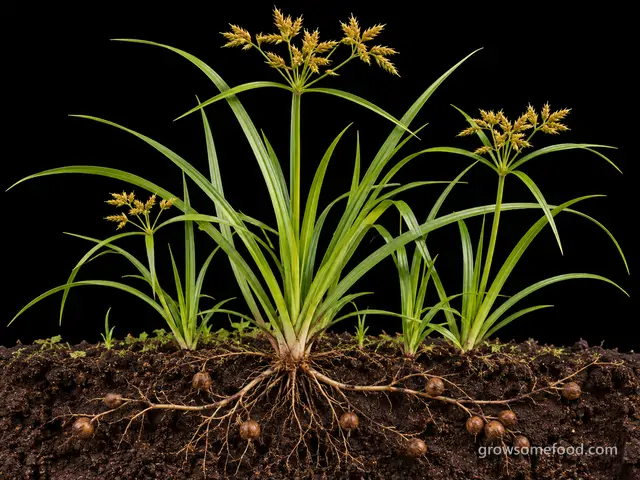
Nutsedge
Nutsedge is not toxic - a nuisance, not a hazard. Yellow nutsedge tubers are genuinely edible: the chufa or tiger nut of Spanish horchata, and a cultivated form is grown as a crop. Purple nutsedge tubers are bitter and not eaten. Do not eat tubers from a lawn or verge that may have been treated, and note that eating them does nothing to control the plant. The real caution is the control: use only a herbicide whose label lists the site you are treating, and follow that label exactly.
Overview
Not a grass - a sedge, with triangular stems, that grows visibly faster than the lawn and regrows from hundreds of underground tubers. Pulling a mature plant makes it worse. This entry is about getting rid of it.
Nutsedge is the weed that stands a hand taller than the lawn three days after you mowed it. It looks like a coarse, glossy, yellow-green grass, but it is not a grass at all — it is a sedge, and the difference is not academic: it is why the weedkiller you already own did nothing.
Two species cause almost all the trouble. Yellow nutsedge (Cyperus esculentus) is the widespread one, found in lawns and gardens across nearly the whole country. Purple nutsedge (C. rotundus) is a warm-climate weed of the Deep South, Texas, California, and the Southwest, and it is considerably worse — it is routinely called the world’s worst weed.
Both live or die by their tubers: small hard ‘nuts’ strung on underground stems, hundreds per plant in a single season, viable in the soil for several years, and sprouting a few at a time rather than all at once. That is the entire problem in one sentence. It is why the patch comes back, why pre-emergents do not help, why landscape fabric fails, and — the counter-intuitive one — why pulling a mature plant makes the patch denser.
The good news is that nutsedge has clear rules, and they work if you follow them: remove young shoots relentlessly, fix the wet spot that favoured it, and if you treat, treat the foliage in midsummer with something actually made for sedges. Give it two or three seasons.
At a glance
- Sun
- Full sun · Part sun · Part shade
- Water
- High
- Spacing
- 4–36 in (typ. 12)
- Mature height
- 6–36 in (typ. 18)
- Frost
- Hardy
- Spread
- 6–60 in (typ. 18)
- Soil
- Consistently moist
- Temperature
- Damaged below -20°F · struggles above 110°F
- Self-sows
- Yes — expect volunteers
When to plant
No planting window on record for this zone.
Life stages
- Emergence (the removal window) Apr, May, Jun (yearly)
-
Recognize it: sedges have edgesRoll a stem between your fingers. Nutsedge stems are solid and TRIANGULAR in cross-section - grass stems are round and hollow. The leaves come off the stem in THREE ranks rather than two, they are stiff, glossy, and V-shaped in section with a waxy sheen, and they are a lighter yellow-green than the lawn. The giveaway most people notice first: it grows so fast it stands a hand taller than the turf two or three days after mowing.
-
Pull SMALL plants only - this is the whole windowA shoot with fewer than about five or six leaves has not yet made tubers, and pulling it now genuinely removes a plant. Go over the area every two to three weeks from emergence and take every young shoot. Do this all season, for two or three seasons, and you can exhaust a patch by hand - but the timing is not optional, because once the plant is bigger, pulling makes things worse (see below).
-
Fix the wet spot that invited itNutsedge is a classic indicator of soil that stays wet - a low spot, a leaking irrigation head, a downspout outfall, compacted soil that will not drain. It out-competes lawn grass there. Fixing the drainage will not kill established tubers, but it stops the site favouring nutsedge over everything else, and without that fix you will be treating the same patch indefinitely.
Yellow-green shoots standing taller than the lawn days after mowingTriangular stems and leaves in three ranksEmergence concentrated in low, wet, or over-irrigated spots -
Recognize it: sedges have edges
- Tuber production (the point of no return) Jun, Jul, Aug, Sep (yearly)
-
Understand what is happening undergroundFrom roughly midsummer each plant sends out rhizomes that swell into TUBERS - the 'nuts'. Yellow nutsedge bears them singly at rhizome tips; purple nutsedge strings them in chains, connected, which is why it is far harder to control. A single plant can make hundreds of tubers in one season, and they stay viable in the soil for several years. Everything you do from here is about the tubers, not the leaves you can see.
-
Stop pulling mature plantsOnce tubers have formed, pulling snaps the shoot off the rhizome and removes the hormonal signal that was keeping the other tubers dormant - so several of them sprout to replace the one plant you took. Pulling a mature nutsedge patch reliably makes it denser. Either dig the whole plant out with a trowel-full of soil around it, tubers and all, or leave it standing and treat the foliage.
-
If you treat, treat now and treat the foliageMidsummer, on actively growing plants and before tubers finish filling, is the window: the product must move down the leaves into the tubers. Halosulfuron and sulfentrazone are the common sedge actives and work far better than a general weedkiller; glyphosate burns the tops off and the tubers resprout. Use only a product whose label lists your site - lawn, bed, and vegetable garden differ - and follow that label for rate, repeat interval, and any wait before planting or harvest.
Plants standing well above the turf and spreading outwardSmall round tubers at rhizome tips when you dig one upChains of connected tubers - that means purple nutsedgeTwo or three new shoots appearing where you pulled one plant -
Understand what is happening underground
- Seed heads Jul, Aug, Sep (yearly)
-
The colour that names the speciesBoth species throw a spray of narrow spikelets on a triangular stalk, with a whorl of leaf-like bracts beneath it. Yellow nutsedge's is straw-yellow to golden; purple nutsedge's is reddish-purple to dark brown. This is the easiest way to tell which one you have - and it matters, because purple nutsedge's connected tuber chains make it substantially harder to control.
-
Mow off the heads, but do not expect muchSeed contributes little to nutsedge spread compared to tubers, so removing seed heads is tidy rather than decisive. Keep mowing anyway - it stops the plant photosynthesising freely, which slows tuber filling a little, and it keeps the patch visible.
Straw-yellow seed sprays (yellow nutsedge)Reddish-purple to brown seed sprays (purple nutsedge)Whorl of leaf-like bracts beneath the flower spray -
The colour that names the species
- Winter (the tubers are waiting) Jan, Feb, Mar, Oct, Nov, Dec (yearly)
-
Top growth dies, the tuber bank does notFrost kills the leaves and the patch disappears, which is why people think they have won. Underground, hundreds of tubers per plant are sitting in the top few inches of soil, most within about six inches, and they will sprout over the next several springs - not all at once. That staggered sprouting is why one good season of control never finishes the job.
-
Winter is for the drainage fix, not for sprayingNothing sprayed on bare ground now will reach a dormant tuber, and pre-emergent products aimed at seed do not stop tubers either. Use the off-season for the structural work instead: regrade the low spot, fix the leaking head or downspout, aerate the compaction, and plan next season's removal schedule.
Bare patches where the sedge stoodTubers in the top 6 in of soil when you digFresh shoots appearing in the same footprint next spring -
Top growth dies, the tuber bank does not
Watch out for
Tuber Bank (why it always comes back) High
The whole problem in one organ. From midsummer, each nutsedge plant produces hundreds of small underground tubers on spreading rhizomes, most sitting in the top six inches of soil. They stay viable for several years and sprout a few at a time rather than all at once, so the infestation meters itself out over multiple seasons and a single clean year proves nothing. Yellow nutsedge bears tubers singly; purple nutsedge strings them in connected chains, which makes it substantially harder to clear.
Watch for: Small round tubers at rhizome tips when you dig a plant up, chains of connected tubers on purple nutsedge, and fresh shoots reappearing in the same footprint each spring for years.
Prevent: Keep contaminated topsoil, sod, and nursery pots out of clean ground - tubers travel in soil. Remove young shoots before they can form tubers, and keep turf and beds dense enough to shade the soil.
Treat: Plan for two to three seasons. Remove young shoots every two to three weeks all season, dig mature plants out with their surrounding soil rather than snapping them off, and treat actively growing foliage in midsummer with a sedge-specific product whose label lists the site you are treating, following that label for rate and repeat interval. Pre-emergent herbicides do not affect tubers.
Solarization under clear plastic through a hot summer kills tubers in the top inch or two and misses the rest - useful reduction, not a fix.
Pulling Multiplies It High
The counter-intuitive hazard that defeats most gardeners: once a nutsedge plant has produced tubers, snapping the shoot off its rhizome removes the dormancy signal that was suppressing the neighbouring tubers, and several of them sprout to replace the plant you removed. Hand-pulling an established patch reliably makes it denser rather than thinner, which is why so many people report the weed getting worse the harder they work at it.
Watch for: Two or three new shoots appearing within a few weeks exactly where one plant was pulled, and a patch that thickens over a season of diligent weeding.
Prevent: Pull only YOUNG shoots - fewer than about five or six leaves, before any tubers have formed - and do it every two to three weeks from spring emergence through fall.
Treat: For mature plants, dig them out with a trowel-full of surrounding soil and sift out the tubers, or leave them standing and treat the foliage in midsummer with a sedge-specific herbicide labelled for the site. Do not snap them off.
This single fact reframes the whole job: early and often on small shoots, and hands off the big ones.
Wet Soil & Overwatering Medium
Nutsedge is one of the most reliable indicator weeds there is: a patch of it usually means soil that stays wet - a low spot, a leaking or misaimed irrigation head, a downspout outfall, or compaction that will not drain. In those conditions it easily outcompetes lawn grass. Once established it tolerates ordinary and even dry soil, so fixing the water stops the site favouring nutsedge without evicting the plants already there.
Watch for: Nutsedge confined to one patch of lawn or bed, standing water or slow drainage after rain, a sprinkler head soaking one zone, and turf thinning in the same footprint.
Prevent: Correct grading on low spots, repair leaking or misaimed irrigation, extend downspouts away from turf, aerate compacted ground, and water deeply but less often.
Treat: Do the drainage work in the off-season, then run the removal and treatment programme through the growing season - the two together are what stops the patch recurring. Neither alone is enough.
In arid climates where nutsedge appears only under irrigation, correcting an overwatered zone can do more than any herbicide.
Pierces Landscape Fabric & Plastic Mulch Medium
Nutsedge shoots are stiff and sharply pointed enough to push straight through woven landscape fabric and plastic mulch, which most weeds cannot do. Beds that were mulched and covered specifically to suppress weeds come up dotted with sedge, and the punctures then let other weeds through as well - so the barrier that was supposed to solve the problem quietly makes the bed harder to manage.
Watch for: Sedge shoots emerging through intact fabric or plastic, small tears and puncture holes across a covered bed, and sedge appearing right through a thick mulch layer.
Prevent: Do not rely on fabric or plastic where nutsedge is present; clear the tubers first, and use dense planting and depth of mulch for the ordinary weeds instead.
Treat: Remove the fabric rather than patching it, deal with the tuber bank directly through repeated removal of young shoots and midsummer foliar treatment, and re-cover only once the sedge is genuinely gone.
Solarization is different from mulching - clear plastic sealed down through a hot summer is a heat treatment, not a barrier, and it does kill shallow tubers even though the sedge can pierce the sheet.
Varieties · 4
Identical to yellow nutsedge above ground; larger, sweeter, more uniform tubers below.
The domesticated form of yellow nutsedge, grown in Valencia for horchata de chufa and in West Africa as a food crop, and sold in the US as a wildlife food-plot seed for turkey and duck. Larger and sweeter tubers than the wild type, and the same plant in every other respect - which is the point. Planting chufa in a garden bed introduces a tuber bank that will still be sprouting in a decade. If you want tiger nuts, buy them; if you want a food plot, understand what you are committing the ground to.
Low creeping mats of fine bright-green sedge with round green flower heads, sitting below mowing height rather than shooting above it.
Not everything triangular in the lawn is nutsedge. Green kyllinga (Kyllinga brevifolia) is a low, dense, mat-forming sedge with a distinctive round green flower head, spreading by rhizomes rather than tubers, and it is controlled somewhat differently. Annual sedges and rushes also turn up in damp lawns and mostly need nothing more than better drainage. If it is triangular and low and mat-forming with a round green head, look up kyllinga before treating it as nutsedge.
Dark green sedge with a reddish-purple to brown seed spray; digging reveals chains of small scaly tubers strung along wiry rhizomes.
The warm-climate species, found from about zone 8 south - Florida and the Gulf, Texas, southern California, the desert Southwest - and routinely called the world's worst weed. Darker green than yellow nutsedge, with abruptly pointed leaf tips and reddish-purple to dark-brown seed sprays. Its tubers form in connected CHAINS along the rhizomes rather than singly, so the plant behaves as a network and regrows after treatments that would clear yellow nutsedge. Bitter tubers, not eaten. Expect more repeat applications and a longer campaign.
Upright yellow-green sedge standing taller than the surrounding lawn, with a golden spray of narrow spikelets above a whorl of leafy bracts.
The common one, found in lawns and gardens across nearly the whole country. Light yellow-green, glossy, stiff leaves in three ranks, triangular solid stems, straw-yellow to golden seed sprays, and leaf tips that taper gradually to a fine point. Its tubers form singly at the ends of rhizomes - round, brown, faintly sweet, and edible as chufa. Easier to control than purple nutsedge, which is a relative statement: it still means two to three seasons of removing young shoots and treating foliage in midsummer.
Grow
How to identify it and how it invades: triangular solid stems, leaves in three ranks, faster growth than turf, wet soil as the invitation, and tubers as the engine of everything.
Sedges have edges. Roll a stem between finger and thumb: nutsedge stems are solid and triangular, and grass stems are round and hollow at the nodes. It is a two-second test and it settles the question.
The rest of the identification: leaves emerge in three ranks around the stem rather than the two of a grass; they are stiff, glossy, waxy, V-shaped in cross-section, and taper to a long fine point; the colour is a distinctly lighter yellow-green than most turf. And it grows faster than the lawn, so a mown lawn sprouts a scatter of tall shoots within days.
Which species? The seed head answers it. Yellow nutsedge has a straw-yellow to golden spray and leaf tips that taper gradually to a fine point; its tubers sit singly at the ends of rhizomes, are round, brown, and faintly sweet. Purple nutsedge has a reddish-purple to dark-brown spray, abruptly-pointed leaf tips, and tubers in chains along the rhizome, connected one to the next, bitter, with a scaly coat. The chain is why purple is so much harder: kill one tuber and its neighbours on the chain are still there.
Why it turned up. Nutsedge is a reliable indicator of soil that stays wet — a low spot, a leaking irrigation head, a downspout outfall, compaction that will not drain. In those conditions it outgrows lawn grass easily. Once established, though, it copes with normal and even dry soil perfectly well, so fixing the drainage stops the site inviting it but does not evict what is already there.
How it arrives. Mostly in contaminated topsoil, sod, and nursery pots, and on equipment — tubers move readily in soil. Seed matters comparatively little.
Propagation & seed saving
Tubers, tubers, tubers: hundreds per plant in a season, viable for years, sprouting a few at a time, and released from dormancy when the shoot above them is snapped off.
Nutsedge reproduces by seed a little and by tubers overwhelmingly, and the tuber biology explains every frustration people have with this weed.
From midsummer, each plant pushes rhizomes outward that swell into tubers — hundreds per plant in a single season under good conditions. Most sit in the top six inches of soil, though some go deeper. They remain viable for several years, and crucially they sprout a few at a time rather than all together: the tuber bank meters itself out over multiple seasons.
That staggered sprouting is enforced by a dormancy signal from the growing shoot. Which produces the single most useful and least intuitive fact about this weed: snapping the top off a mature plant releases that signal, and several dormant tubers sprout in its place. Hand-pulling an established patch does not thin it, it multiplies it. The exception is the young shoot — under about five or six leaves, before it has made any tubers — where pulling genuinely removes a plant, and where a determined person can win by attrition.
Purple nutsedge adds one more wrinkle: its tubers form connected chains, so the plant is a network rather than a set of individuals, and a treatment that kills one link often leaves the rest intact. Yellow nutsedge’s single tubers are the easier of the two, which is a relative statement.
Care
Control, not care: fix the wet spot, pull only young shoots and pull them every two to three weeks, dig mature plants out with their tubers rather than snapping them, and treat foliage in midsummer with a sedge-specific product. Two to three seasons.
Fix the drainage first. A low spot, a leaking irrigation head, a downspout dumping onto turf, compacted soil — whatever is keeping that patch wet is why nutsedge beat the grass there. Correcting it will not kill a single tuber, but without it you are treating the same square yard forever.
Then thicken what is competing with it. Dense, tall-mown turf and closely planted beds shade the soil and slow nutsedge measurably. A thin lawn is an open invitation.
Hand removal, done properly. Two rules. Take young shoots — under five or six leaves, before tubers form — and go over the area every two to three weeks from spring emergence to fall, all season, for two or three seasons. That schedule genuinely exhausts a patch. Never snap off a mature plant: it releases dormant tubers and you get several plants back. If you want a big one gone, dig it out with a trowel-full of soil and sift the tubers out, or leave it and treat it.
Herbicide, honestly. Ordinary broadleaf lawn weedkillers do nothing to sedges, and glyphosate burns the tops off while the tubers resprout. The products that work are sedge-specific: halosulfuron and sulfentrazone are the common active ingredients, applied to actively growing foliage in midsummer so they translocate down into the tubers, and repeated according to the label. Purple nutsedge usually needs more applications than yellow. Three rules that are not optional: the label must list the site you are treating — a lawn product is not licensed for a vegetable bed, and the label is legally binding, not advisory; follow that label on rate, repeat interval, protective equipment, and any wait before planting or harvest; and treat green, actively growing plants, because nothing works on dormant tubers. Pre-emergent products do not control nutsedge — they target germinating seed, and the tubers are not seed.
In a vegetable garden, very few products are labelled, so the work is physical: relentless removal of young shoots, digging mature plants out whole, and improved drainage. Solarizing under clear plastic through a hot summer kills tubers in the top couple of inches and misses the deeper ones, so treat it as a helpful reduction rather than a fix. Do not lay landscape fabric or plastic mulch and expect protection — nutsedge shoots are stiff enough to pierce straight through both.
Expect two to three seasons. The tuber bank meters itself out, so a season with no nutsedge is not the end — keep checking that spot for a couple of years.
In the kitchen
Yellow nutsedge tubers are chufa, the tiger nut of Spanish horchata, and a real crop in Valencia and West Africa - genuinely worth trying if you have a patch, and not in any way a method of control.
The tubers of yellow nutsedge are chufa, or tiger nuts — small, round, brown, wrinkled things about the size of a pea, faintly sweet with a flavour between almond and coconut. Soaked and blended with water and sugar they make horchata de chufa, the Valencian drink, and a cultivated form of the same species (C. esculentus var. sativus) is farmed for exactly that purpose in Spain and across West Africa. They are also planted as a wildlife food, in turkey and duck plots, which is a decision people sometimes regret later.
If you have a patch, digging tubers in fall and trying them is a perfectly good idea. Wash them well, soak them overnight, and eat them raw, roasted, or blended. A few practical notes: only yellow nutsedge — purple nutsedge tubers are bitter and scaly and are not eaten. Do not dig tubers from lawns, verges, or anywhere that may have been treated with herbicide or fertilizer. And they are small and fiddly, which is why the cultivated form exists.
The important caveat: this is not control. Digging tubers for the kitchen disturbs the soil, snaps rhizomes, breaks tuber dormancy, and leaves plenty behind — a nutsedge patch you harvest is a nutsedge patch you keep. Eat what you dig if you like the idea, but keep it clearly separate from the job of removing the plant, and never deliberately plant chufa in a garden bed. What goes in as a crop stays as a weed for a decade.
Troubleshooting
Is it a grass or a sedge, why the weedkiller did nothing, why pulling made it worse, why it came through the fabric, and how long this really takes.
Is this nutsedge or a grass? Roll the stem. Triangular and solid is a sedge; round and hollow is a grass. Sedge leaves also come off in three ranks instead of two, are glossy and stiff, and are a lighter yellow-green than turf. And it grows faster than the lawn, so it is the thing standing tall two days after mowing.
Which nutsedge do I have? Yellow nutsedge: straw-yellow seed spray, gradually tapering leaf tips, single round tubers at rhizome tips. Purple nutsedge: reddish-purple or brown seed spray, abruptly pointed leaf tips, tubers in connected chains, and a warm-climate distribution. Purple is harder and needs more repeat treatment.
My weedkiller did nothing. Broadleaf lawn weedkillers do not touch sedges, and glyphosate takes the tops off and leaves the tubers. You need a sedge-specific product — halosulfuron or sulfentrazone — on actively growing foliage in midsummer, labelled for the site you are treating.
I pulled it all and now there is more of it. That is the defining behaviour of this weed. Snapping a mature plant off its rhizome releases the dormancy signal holding neighbouring tubers back, and several sprout to replace it. Only pull young shoots (under five or six leaves); dig mature plants out with their soil instead.
My pre-emergent did not stop it. Pre-emergents work on germinating seed. Nutsedge comes from tubers, which are not seed and are unaffected.
It came up through my landscape fabric. It does. The shoots are stiff enough to pierce woven fabric and plastic mulch, which is one of the few weeds that reliably does this.
It is only in one patch of the lawn. Look at that patch: low ground, a leaking sprinkler head, a downspout, compaction. Nutsedge is a wet-soil indicator, and the patch is telling you something about drainage.
It vanished over winter — is it gone? No. Frost kills the leaves; the tubers sit in the top six inches and sprout over the next several springs, a few at a time.
Can I eat it? Yellow nutsedge tubers are chufa and genuinely edible — see Culinary — but harvesting them is not a control method and they should not come from treated ground.
How long does this take? Two to three seasons of consistent work, and a check on the same spot for a couple of years after that.
Growing across climates
Yellow nutsedge turns up almost everywhere in the US; purple nutsedge is a warm-climate weed of roughly zone 8 and south. Irrigation extends both into dry regions, and their season is the warm half of the year.
Yellow nutsedge is close to nationwide, from the Deep South to southern Canada — roughly zones 3 through 11. In the north the tubers overwinter easily and the plant emerges late spring, giving it a shorter but perfectly effective season; in the south it runs from spring into fall and builds tuber banks faster.
Purple nutsedge is limited by cold and is essentially a zone 8 and south problem — Florida and the Gulf states, Texas, southern California and the desert Southwest. Its tubers are less cold-hardy, which is the only kindness it offers. Where it does occur it is worse than yellow in every respect, and its chained tubers make it the harder of the two to clear.
Irrigation changes the map. Both species need moisture to establish, so in the arid West they appear where people water — lawns, beds, drip lines, leaks — and are essentially absent from unirrigated ground nearby. In those climates the drainage-and-irrigation fix is unusually powerful: correcting an overwatered zone can do more than any spray.
Season everywhere: emergence in spring as soil warms, hardest growth and tuber filling through midsummer, seed heads in mid to late summer, top growth killed by frost, tubers waiting. That timing is fixed, and it puts your removal window in spring and your treatment window in midsummer, wherever you garden.
History
One of the oldest weeds of cultivation and one of the oldest crops - chufa was farmed in ancient Egypt and drunk as horchata in Valencia for centuries, while purple nutsedge has been called the world's worst weed of agriculture.
Nutsedge has been following agriculture for as long as there has been agriculture. Chufa — the tuber of yellow nutsedge — was cultivated in ancient Egypt, where tubers have been recovered from tombs, and it travelled with Arab agriculture to Valencia, where it is still farmed for horchata de chufa. In parts of West Africa it remains a food crop. Yellow nutsedge is also native across much of North America, so unlike most weeds in this catalog it did not arrive from anywhere.
Purple nutsedge came from the Old World tropics and went everywhere warm, and it holds a genuine title: in a much-cited survey of world agriculture it was ranked the worst weed in the world, on the strength of the number of crops and countries it damages. Its tuber chains, its indifference to most herbicides, and its capacity to reduce yields in everything from cotton to sugarcane earned it that.
The interesting thing about the pair is the symmetry. One of them was domesticated for the very tubers that make the other a global agricultural disaster, and they are close relatives doing the same thing with the same organ. It is a useful reminder for a home gardener that a plant is not good or bad in itself — but also that a tuber bank in your vegetable bed does not care about the distinction.
No grower tips for Nutsedge yet — yours could be the first.
Sign in to share what works in your garden.