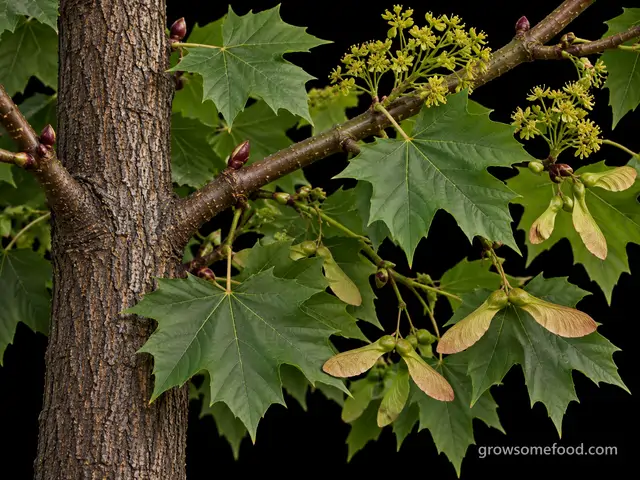
Norway Maple

Acer platanoides · Sapindaceae
Other Perennial Tree Other
Introduced - native to Europe and western Asia; invasive across the Northeast, the upper Midwest, and the Pacific Northwest
Not recommended to plant. Do NOT plant this. Massachusetts and New Hampshire prohibit its sale and other states are restricting it. Dense shade, a shallow surface root mat, and shade-tolerant seedling carpets shut down lawns, garden beds, and native woodland regeneration.

Norway maple is not poisonous to people and is safe to handle - the milky sap that beads from a broken leaf stalk is the ID test, not a hazard, though it stains. The real risks are practical: shallow surface roots lift sidewalks and foul mowers, and the heavy limbs of old street trees drop in storms. Horses are the one animal caution - wilted leaves of several maple species have caused red-blood-cell damage in horses, so keep prunings and raked leaves out of horse pasture. Do not plant it.

Overview

The dense, dark street tree most of us grew up under - and the parent of the purple 'Crimson King'. It shades out lawns, mats the soil with surface roots, and carpets nearby woods with shade-tolerant seedlings. Banned from sale in Massachusetts and New Hampshire.

Norway maple (Acer platanoides) is the tree a great many Americans have without knowing what it is: the tidy, heavy-shading maple planted by the million along streets and driveways from the 1950s onward, and the species behind the familiar purple-leaved “Crimson King.” In much of the Northeast, the upper Midwest, and the Pacific Northwest it is also a recognized invasive species. It leafs out earlier and holds its leaves later than the natives around it, and its canopy is so dense that grass thins to moss and bare dirt underneath while a shallow mat of surface roots takes the water.

What lifts it from “difficult yard tree” to landscape problem is seed. A mature Norway maple sheds thousands of wide-winged samaras every fall, and — unusually — its seedlings germinate and grow in deep shade, so they carpet flower beds, hedge bottoms, and the floor of nearby woodland, taking the place of the sugar maples, oaks, and hickories that would otherwise come up. Massachusetts and New Hampshire prohibit its sale and importation, it appears on invasive-plant lists across the Northeast and the Pacific Northwest, and other states have restricted or are phasing out its sale — check your own state's list before you buy or move one. Nobody is going to make you cut down a healthy tree you already have. This entry is here to help you tell it from a sugar maple, understand what it is doing to the ground beneath it, and decide what comes next.

At a glance

Sun
Full sun · Part sun · Part shade · Shade
Water
Medium
Spacing
240–600 in (typ. 360)
Mature height
420–900 in (typ. 660)
Start by
Direct sow
Frost
Hardy
Spread
300–720 in (typ. 540)
Soil
Well-drained
Temperature
Damaged below -30°F · struggles above 100°F
Self-sows
Yes — expect volunteers

When to plant

No planting window on record for this zone.

Life stages

  1. Early-spring yellow-green bloom (identify) Apr, May (yearly)
    • Recognize it: upright yellow-green flower clusters before the leaves
      Norway maple flowers early, before or as the leaves open, in upright flat-topped clusters of small yellow-green flowers that give the whole crown a soft chartreuse glow from a block away - noticeably showier and yellower than the small reddish-green tassels of a sugar maple. Red maple blooms earlier still and is red, not yellow-green. A big street maple that looks like it is blooming lime-green in April is almost always Acer platanoides.
    Upright yellow-green flower clusters before leaf-outA chartreuse glow to the whole crown in AprilNeighborhood street trees all blooming at once - a sign of mass planting
  2. Milky sap & the dead zone underneath (identify & control) May, Jun, Jul, Aug, Sep (yearly)
    • The milky-sap test settles it
      Snap a leaf off at the stalk and watch the broken end. Norway maple oozes MILKY WHITE sap within a few seconds; sugar maple, red maple, and silver maple run clear. Back it up with the leaf shape - Norway maple leaves are broader than long with lobes drawn out to long slender points and only a few coarse teeth, while sugar maple leaves are about as long as broad with rounded notches between the lobes.
    • Pull the seedlings every spring
      Seedlings come up by the hundreds in beds, lawn edges, and hedge bottoms, and they germinate in deep shade where most trees cannot. Pull them while the soil is moist and they are under a foot tall, taking the whole taproot - a two-year seedling already resists pulling. Do this every spring and you keep a single tree from seeding a neighborhood; skip a few years and you are cutting saplings instead.
    • Look at the ground under the canopy
      The signature of a mature Norway maple is bare, dry, root-bound soil beneath it. Its leaves come out early, drop late, and overlap so tightly that little light reaches the ground, and a dense mat of surface roots takes the water. Grass thins to moss and dirt, shrubs sulk, and woodland wildflowers disappear. That dead zone is the reason to plan a replacement rather than keep feeding a losing lawn.
    Milky white sap from a broken leaf stalkBare, root-matted ground under the canopySeedlings carpeting beds, lawn edges, and nearby woods
  3. Wide-winged samaras & seed rain Aug, Sep, Oct (yearly)
    • Samaras spread almost in a straight line
      Norway maple keys hang in pairs whose wings spread out nearly flat, close to a 180-degree line, and the seed cases are noticeably flattened. Sugar maple and red maple keys hang in a narrow V, closer to 60-90 degrees. It is the fastest ID at the end of summer, and the wings are what carry the seed - the samaras spin well clear of the canopy on any wind.
    • Rake and bag the seed before it germinates
      One mature tree drops thousands of samaras. Rake or blow them off beds, gravel, and lawn edges before spring and put them in yard waste rather than compost, and clear the gutters and downspout beds where they collect and sprout. It will not stop seed already blown into the neighbors' yards or the woods behind you, but it cuts the flush you will otherwise be weeding in May.
    Paired keys with wings spread nearly flat in a lineHeavy seed drop onto beds, gravel, and guttersSeedlings appearing far from the tree, including inside woodland
  4. Winter form, bark & girdling roots Jan, Feb, Mar, Nov, Dec (yearly)
    • Fat purple buds and fine regular bark
      In winter Norway maple carries plump, rounded, blunt buds in opposite pairs, usually dark red-purple to greenish, on stout twigs. Sugar maple buds are slim, sharp-pointed, and brown. The bark is finely and regularly furrowed into shallow interlacing ridges that never plate or peel; older sugar maples break into coarse plates that curl away at the edges.
    • Check the trunk flare for girdling roots
      Norway maple is notorious for stem-girdling roots - surface roots that circle the trunk and slowly strangle it. Clear the leaves and soil away from the base: a healthy trunk widens into a visible flare where it meets the ground. If the trunk instead goes into the soil straight, like a telephone pole, or a root crosses hard against the bark, the tree is being girdled. That is a slow decline, and one more reason to plan the replacement now.
    Plump blunt purple-green buds in opposite pairsFine regular interlacing bark ridges (no curling plates)A trunk with no visible flare, or roots crossing hard against the bark

Watch out for

Deep Shade & Surface Root Mat High DisorderApr, May, Jun, Jul, Aug, Sep, Oct

The everyday hazard for the gardener and the core ecological one: Norway maple leafs out early, drops late, and holds a canopy dense enough to starve the ground of light, while a shallow mat of surface roots takes the water and nutrients. Lawns thin to moss and bare dirt, shrubs and perennials sulk and fail, and in woodland the spring wildflower layer disappears entirely.

Watch for: Bare, dry, root-bound soil under the canopy; turf failing and moss taking over; perennials and shrubs declining year after year within the drip line; surface roots lifting turf, paths, and pavement.

Prevent: Do not plant one. Where a tree already stands, do not try to hold turf under it - mulch a wide ring instead, keep new plantings outside the worst of the root mat, and plan a native replacement.

Treat: There is no way to lighten the shade or undo the root mat on a mature tree, and cutting surface roots destabilizes it. Manage around it with mulch and shade-tolerant planting outside the drip line, and replace the tree when the time comes.

This is the complaint that brings most people to this page - nothing will grow under my maple. It is not a soil problem and it is not fixable by feeding the lawn.

Shade-Tolerant Seedling Carpets High DisorderApr, May, Jun, Sep, Oct

Why it invades rather than merely annoys: a mature tree sheds thousands of wind-borne samaras, and the seedlings germinate and persist in deep shade where native tree seedlings cannot. They build up as a dense carpet under intact forest, so when an old native falls the gap is already filled with Norway maple - and beds, hedge bottoms, and lawn edges fill with them too.

Watch for: Hundreds of small maple seedlings in beds, gravel, gutters, and hedge bottoms each spring; a woodland understory that is nearly all one kind of maple sapling; green seedlings under a purple-leaved tree.

Prevent: Never plant one; pull seedlings every spring while they are small and the soil is moist; rake and bag samaras off beds and gravel before winter rather than composting them.

Treat: Hand-pull small seedlings with the taproot. Cut saplings low and treat the fresh stump immediately with a herbicide whose label lists the site, following the label - a plain cut makes them resprout into multi-stemmed clumps that fruit again in a few years.

The purple cultivars seed just as freely as the green species; their seedlings mostly come up green, which is why people do not connect the two.

Verticillium Wilt Medium DiseaseMay, Jun, Jul, Aug

A soil fungus (Verticillium dahliae and relatives) that enters through the roots and grows upward inside the water-conducting tissue, plugging it from within. The plant is not being eaten or rotted, it is being cut off from its own water supply, which is why the signature symptom is one branch or one side wilting and browning while the rest looks perfectly healthy. Cut into affected wood or stem and the tissue is streaked olive-green, grey or brown. The host range is enormous - maples, redbud, olive, tomato, potato, pepper, eggplant, strawberry and many more - and the fungus survives in soil for years as tough resting structures, so infected ground stays infected. Grasses and conifers do not get it.

Watch for: One branch, one limb or one side of a plant wilting, yellowing and browning in summer while the rest carries on normally - the lopsided pattern is the tell - and leaves that wilt and then hang on rather than dropping cleanly. Cut into affected wood and look for olive-green, grey or brown streaking along the grain; in a cut vegetable stem it shows as a ring of discolored dots. On vegetables, lower leaves yellow in a wedge from the margin inward, and the plant wilts at midday but recovers overnight in the early stages.

Prevent: There is no way to sterilize garden soil of it, so prevention is plant choice and plant vigor. Do not replant a susceptible species where one has already died of it. Grasses, conifers, ginkgo, hawthorn, hornbeam, honeylocust, oak and beech do not get it, and many vegetable varieties carry bred-in resistance - the V in a VFN code on the seed packet. Rotate susceptible vegetables on a long cycle and keep them off ground where the disease has shown. Buy clean stock, avoid wounding roots with spades and machinery, and keep woody plants steadily watered, mulched and only lightly fed, because a vigorous plant walls the fungus off far better than a stressed one.

Treat: There is no cure and nothing to spray. On a tree or shrub the aim is to keep it alive long enough to compartmentalize the fungus, which many plants manage for years: prune out dead and wilting branches well below the discolored wood, sanitize the pruners between cuts, water deeply through dry spells, mulch, and feed lightly rather than pushing it with a heavy feed. On vegetables, pull and bin affected plants rather than composting them, and move that crop to clean ground or to containers of fresh mix. Do not replant the same species where one has died.

Norway maple is one of the most frequently affected landscape trees, and heat- and drought-stressed trees at the southern edge of its range go down fastest. A branch-by-branch decline in a mature Norway maple is often this.

Stem-Girdling Roots Medium Disorderyear-round

Norway maple is unusually prone to stem-girdling roots - surface roots that circle the trunk and slowly compress the tissue that moves water and sugars, causing gradual thinning, one-sided dieback, and eventual failure decades after planting. Trees planted too deep or left in a circling nursery root ball are worst affected.

Watch for: A trunk that enters the ground straight, like a post, with no widening flare; a root visibly crossing hard against the bark; a flattened or sunken side to the trunk; thinning or dieback confined to one side of the crown.

Prevent: Nothing to prevent on an existing tree beyond keeping mulch and soil off the trunk flare so you can see what is happening; the underlying fix is not planting the species.

Treat: A certified arborist can sometimes remove a girdling root before it compresses the trunk, but the operation is risky on a large tree and useless once the trunk is deeply grooved. In that case it becomes a structural risk to assess, and an argument for replacing the tree on your schedule rather than a storm's.

Common enough on this species that a suspiciously post-like trunk on a mature Norway maple is worth uncovering and checking.

Tar Spot Low DiseaseJul, Aug, Sep

A fungal disease that makes conspicuous raised black, tar-like spots on maple leaves in late summer - dramatic-looking but essentially harmless to the tree.

Watch for: Shiny raised black spots (like drops of tar) on the leaves, sometimes with yellow halos, appearing in late summer.

Prevent: Rake and remove or compost fallen leaves in fall to reduce next year's spore load; ensure good airflow.

Treat: None needed - it's cosmetic; leaf sanitation reduces it over time. Fungicides are not warranted for a shade tree.

Norway maple is the main host in North America - the alarming black blotches people photograph in August are almost always on this tree, and they are cosmetic.

Varieties · 4

Green street-tree cultivars (Emerald Queen, Deborah, Columnare, Schwedler)

Uniform oval or columnar crowns of green foliage; Schwedler types flush red-purple in spring and turn green by summer.

cultivarinvasivedo-not-plantstreet-tree

The named selections sold for uniform street planting - upright, columnar, or fast-growing forms chosen for shape rather than sterility. None of them solve the underlying problems: same dense shade, same shallow root mat, same fertile wind-borne seed. Where they were planted in long identical rows they also created single-species streets that fail together. Identify, manage, and replace with natives.

Native shade-tree alternatives

Varies by species - native trees with better structure, real fall color, and understory plants that can still grow beneath them.

alternativenativenon-invasiverecommended-instead

Plant these instead: sugar maple or red maple where there is room for a full-size shade tree, black gum for reliable fall color, hackberry for a tough compacted street site, and American hornbeam or serviceberry where the space is small. All of them feed native caterpillars and the birds that depend on them, and none will seed into the woods behind you. Ask a local native-plant source or extension office which perform best on your soil.

Norway Maple (Acer platanoides)

Broad-crowned tree with finely and regularly ridged bark; leaves broader than long with long-pointed lobes, milky sap at the broken stalk; upright yellow-green flower clusters in April; paired keys with wings nearly in a straight line; clear yellow fall color.

speciesinvasivedo-not-plantinvasive-treeshade-tolerantwind-spread-seed

The species: a dense, fast, salt- and city-tolerant shade tree with milky sap in the leaf stalk, broad long-pointed leaves, and samaras whose wings spread nearly flat. Deeply shade-tolerant at every stage, so its seedlings build up under intact forest and replace native maples, oaks, and hickories. Prohibited for sale in Massachusetts and New Hampshire and listed as invasive across the Northeast and Pacific Northwest - identify and manage it, never plant it.

Purple-leaf cultivars (Crimson King, Royal Red, Faassen's Black)

Deep maroon-purple foliage all season, fading toward bronze-green in late summer heat; identical flowers, flat-spread keys, and milky sap to the green species.

cultivarinvasivedo-not-plantpurple-leaffertile-seed

The purple maples in a thousand front yards are ordinary Norway maples carrying a leaf-color mutation. They are just as invasive: they set fully fertile samaras, and their seedlings mostly come up plain green, which is why homeowners find green maple babies all over a yard with one purple tree in it. The dark foliage also casts even deeper shade than the green form. Same guidance - do not plant, and treat existing trees as a seed source to manage.

Grow

How to recognize it and why never to plant it: milky sap from a broken leaf stalk, broad long-pointed leaves, samaras spread nearly flat, plump purple buds, clear yellow fall color - on a tree whose shade and roots leave bare ground beneath it.

You should not plant Norway maple — recognizing it is what matters, because it is constantly mistaken for the native sugar maple it displaces. The decisive test takes five seconds: snap off a leaf at the stalk and watch the break. Norway maple bleeds milky white sap; sugar, red, and silver maple run clear. Everything else confirms it. The leaf is broader than it is long, with five lobes drawn out to long slender points and only a few coarse teeth; a sugar maple leaf is about as long as broad with rounded notches between the lobes. The paired keys hang with their wings spread almost flat in a straight line, where native maples make a narrow V. Winter buds are plump, blunt, and purplish in opposite pairs, against the sugar maple's slim, sharp brown buds, and the bark is finely and regularly ridged rather than plated. In fall it turns clear yellow, sometimes with black tar-spot blotches, almost never the orange-scarlet of a sugar maple.

Its biology is what makes it a problem. It is deeply shade-tolerant at every stage, so it establishes under an existing forest canopy instead of waiting for a gap; it tolerates compaction, drought, road salt, and city air, which is exactly why it was planted so heavily; and it combines a dense canopy with a shallow mat of surface roots that together strip the ground beneath it of light and water. Add thousands of wind-carried seeds a year and a habit of resprouting hard when cut, and you have a tree that quietly converts a mixed native woodland into a Norway maple grove with bare soil under it. That is the case against planting another one.

Propagation & seed saving

How it spreads: thousands of wind-borne samaras a year, seedlings that germinate in deep shade where natives cannot, purple cultivars that seed just as freely (their seedlings come up green), and stumps that resprout when the tree is simply cut.

Norway maple spreads almost entirely by seed, and it is very good at it. A mature tree produces thousands of samaras a year; the wide, nearly flat wings carry them across yards, streets, and into woodland edges, and they germinate at a high rate the following spring. The critical difference from most trees is that the seedlings are shade-tolerant — they do not need a gap in the canopy, so they build up as a dense understory carpet beneath intact forest and are waiting, already established, whenever an old tree finally falls.

Two things surprise people. First, the purple cultivars seed too: ‘Crimson King’, ‘Royal Red’, and the rest are ordinary Acer platanoides with a leaf-color mutation, they set fully viable samaras, and their seedlings mostly come up green, so a yard full of plain green maple babies under a purple tree is exactly what it looks like. Second, cutting alone does not end it: a cut stump resprouts vigorously from the collar, turning one trunk into a multi-stemmed clump that fruits again within a few years. Effective removal therefore means treating the stump, not just felling the tree — and following up on the seed bank, which keeps germinating for a couple of seasons after the parent is gone.

Care

Control and replacement, not care: pull seedlings every spring, cut-stump-treat saplings (they resprout), plan a staged removal of a mature tree with an arborist, and replant natives - with any herbicide used strictly according to its label.

The work with a Norway maple splits into three jobs. Seedlings are the cheapest win: pull them in spring while the soil is moist and they are under a foot tall, taking the taproot, and do it every year — a single tree otherwise seeds an entire block. Saplings and multi-stem clumps need the roots killed, because a plain cut makes them resprout thicker: cut them low and immediately treat the fresh stump surface, or use a basal-bark application on smaller stems. If you use a herbicide, choose a product whose label lists the site you are treating — lawn, landscape, woodland, non-crop — and follow that label exactly, including protective equipment and any restriction near water or vegetable beds. The label is legally binding and it is also the only reliable instructions for the product in your hand.

A mature tree is a different decision. It is a large removal near a house, so it is arborist work, and there is no rule requiring you to do it — a healthy shade tree is worth something, and taking it out is a real cost. What you can do meanwhile is stop it seeding into the woods where you can, keep the mulch ring wide instead of fighting the surface roots with turf, and plant the replacement before the maple comes down, off to the side and out of the root mat, so you are not starting from zero. For the replacement, go native: sugar maple or red maple where there is room, black gum for fall color, hackberry for a tough street site, or American hornbeam or serviceberry where the space is small. Local extension offices and native-plant societies can tell you which are best for your soil, and several states run programs that help homeowners swap invasive trees for natives.

Nutrition

Not a food tree - it can technically be tapped, but its low-sugar, latex-clouded sap makes poor syrup. Ecologically it is a net negative: it replaces native maples and oaks, feeds far fewer native insects, and leaves bare ground beneath it.

Norway maple is not a food tree. It is a maple, so it can technically be tapped in late winter, but the sap is lower in sugar than a sugar maple's and the milky latex clouds the boil, so the syrup is poor and the yield worse. It is a novelty, not a reason to keep the tree, and this catalog does not treat it as a crop.

Ecologically it is a net loss, and the reason is what it replaces. A native oak or maple supports hundreds of species of caterpillars — the food that most backyard songbirds actually raise their young on — while an introduced Norway maple supports a small fraction of that. When its shade-tolerant seedlings take over a woodland understory, the whole food web thins out with them: fewer caterpillars, fewer birds, and a ground layer of bare soil where trout lily, trillium, and spring beauty used to be, because almost nothing flowers in that much shade over that dense a root mat. It does give real, cheap, fast shade in a hot city, which is why it was planted — but a native replacement gives the same shade and feeds something. Removing a Norway maple and planting a native in its place is one of the highest-value swaps an ordinary yard can make.

History

Introduced from Europe in 1756 and planted en masse as the cheap, tough replacement for the American elms lost to Dutch elm disease - which is why whole mid-century streets are lined with one species that is now being banned.

Norway maple came to North America in 1756, brought from England by the Philadelphia botanist John Bartram, and spent its first two centuries as an unremarkable ornamental. Its moment came with a catastrophe: Dutch elm disease tore through the American elms that had arched over Main Street in town after town from the 1930s to the 1960s, and cities needed a replacement that was cheap, fast, transplanted reliably, and shrugged off pavement, salt, and bad soil. Norway maple did all of that, and nurseries could supply it by the truckload. Whole neighborhoods were replanted with it, often as a single cultivar down both sides of a street.

The bill came later. By the 1980s and 1990s ecologists were documenting what those plantings had done to nearby woods — shade-tolerant seedling carpets, native saplings failing, understory wildflowers gone — and the tree moved onto invasive-plant lists across the Northeast and Pacific Northwest. Massachusetts and New Hampshire now prohibit its sale, other states have restricted or are phasing it out, and cities that once planted it are removing it on schedule. The arc is worth remembering the next time a single species is offered as the tough, trouble-free answer to a street-tree crisis: it is also how monocultures get built, and this one turned out to seed itself into the woods.

Troubleshooting

Confirm it with the milky-sap test, stop the seedlings, treat stumps rather than just cutting, decide honestly about a mature tree - and plant natives when it goes.

Is this a Norway maple or a sugar maple? Break a leaf stalk: milky white sap means Norway maple, clear sap means sugar, red, or silver maple. Confirm with the leaf (broader than long, long-pointed lobes), the keys (wings nearly flat in a line, not a V), the buds (plump, blunt, purplish), and fall color (clear yellow, not orange-scarlet). Nothing grows under my maple — is that fixable? Not really, and it is the classic symptom: deep shade plus a dense surface root mat. Stop fighting it with turf, mulch a wide ring, and use tough shade plants outside the worst of the root zone. Do I have to cut it down? No. Sale bans apply to selling and planting, not to a tree already in your yard. Removing it is a genuine cost and a real decision — the case for it is the seed rain and the dead ground, not the law. I cut one and it came back as a bush. Expected: cut stumps resprout. Cut low and treat the fresh stump immediately with a herbicide whose label covers the site, following the label. Why are there hundreds of little maples in my beds? That is the seed rain; pull them each spring while they are small and the soil is moist. My purple maple has green seedlings. Normal — ‘Crimson King’ is a leaf-color mutant of an ordinary Norway maple and its seed mostly comes up green. Black tar-like spots on the leaves? That is tar-spot fungus, cosmetic and very common on this species. Can I tap it for syrup? Technically yes; realistically the sugar is low and the latex clouds the syrup. What should I plant instead? Sugar maple, red maple, black gum, hackberry, American hornbeam, or serviceberry, sized to the space.

Growing across climates

Invasive across cool, moist regions - the Northeast, upper Midwest, southern Canada, and the Pacific Northwest (roughly zones 4-7) - and far less aggressive in the hot South, where heat and drought hold it back.

Norway maple is a cool-climate tree, hardy through roughly zones 4-7, and its invasive behavior tracks that comfort zone closely. It is worst in the Northeast and the Great Lakes states, through southern Ontario and Quebec, and in the maritime Pacific Northwest around Seattle, Portland, and Vancouver, where cool moist summers and mild winters let its seedlings pile up under intact forest. It is at home in exactly the places people planted it: city streets, suburban yards, park edges, and the woodlots behind them.

South of about zone 7 it loses its grip. Long hot summers, drought, and heavy clay stress a shallow-rooted tree badly — leaf scorch, dieback, and verticillium wilt take a heavy toll — and it does not regenerate aggressively in southern forests, so it is a poor performer rather than a major invader there. Hotter, drier summers are pushing that boundary north, which means declining street trees in the mid-Atlantic and no relief at all in New England or the Northwest. Wherever you are, the guidance holds: do not plant another one, learn the milky-sap test so you never mistake it for a sugar maple, pull the seedlings every spring, and put a native in the ground when the old tree finally comes out.

No grower tips for Norway Maple yet — yours could be the first.

Sign in to share what works in your garden.

Connection interrupted

Reconnecting to GrowSomeFood

Keep this page open. We are trying to restore your garden session.

Attempt of . Retrying automatically.

Still offline

Could not reconnect

Your phone may have switched networks or gone to sleep. Try again when the signal is steady.

Session expired

Reload to continue

This garden session is no longer available on the server. Reloading will start a fresh session.