
Add it to your home screen and it opens full screen: no browser bars, one tap away, and everything stays signed in. Free, nothing to download from an app store.
- Tap the Share button in your browser
- Scroll down and choose “Add to Home Screen”
- Open GrowSomeFood from your home screen
- Open your browser’s menu
- Choose “Add to Home screen” or “Install app”
- Open GrowSomeFood from your home screen
Ninebark
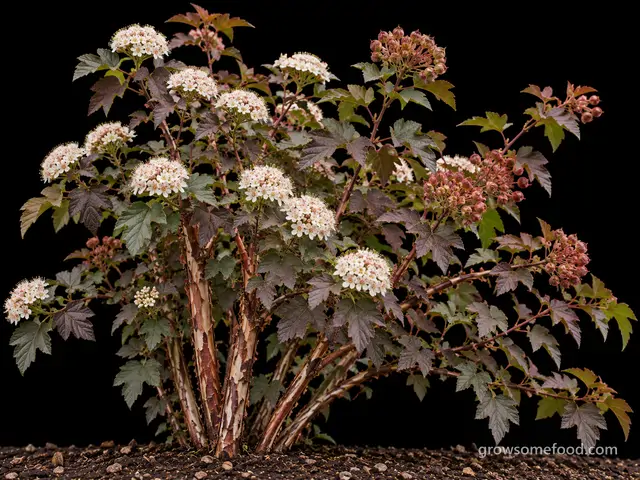
A bombproof native shrub reborn as a garden star - grown for season-long burgundy or gold foliage, late-spring flowers, and peeling winter bark, and tough enough for almost any site.
Safety notes Ninebark is grown as an ornamental shrub, and no part of it is edible - the small dry fruits are not food. It is safe to grow, handle, and prune, but do not brew or swallow it: bark and root preparations are emetic (they were used that way in folk medicine) and must not be ingested by people or animals. Grow it for its foliage, flowers, and peeling bark; there is nothing here to harvest or eat.
Overview
Ninebark (Physocarpus opulifolius) is a tough, adaptable native shrub that plant breeders have transformed into one of the most popular landscape shrubs in North America. The wild species is a rugged, arching, 5-10 foot shrub of streambanks and rocky slopes, but the modern cultivars are grown above all for their season-long foliage color - deep burgundy and near-black ('Diabolo,' 'Summer Wine'), bright gold ('Dart's Gold'), or multicolor ('Amber Jubilee') - a rare shrub that provides bold color all summer without relying on flowers.
Quick facts
- Sprouts in
- 35 daysRange: 20–60 days
- Soil temperature
- 68 °FRange: 60–72 °F
- Height
- 7 ftRange: 4–10 ft
- Spread
- 7 ftRange: 4–10 ft
- Cold
- Takes hard frostdamaged below -45°F
- Heat
- Struggles above 95°F
- Life cycle
- Perennial, lives about 30 years
- Save seeds
- About 100 days after plantingRange: 80–130 days
- Self-sows
- Yes, expect volunteers
- Soil
- Well-drained
- Water
- Medium
- Plant spacing
- 6 ftRange: 4–9 ft
When to plant
Nothing is open today. Spring transplanting opens 6 months, Apr 10 to May 22.
- Transplant Apr 10 – May 22 Opens in 173 daysAbout at to 6 weeks after your last frost (Apr 10 here)Plant in spring into full sun to part shade and average, well-drained soil; extremely adaptable and easy, tolerating clay, drought, and cold.
- Transplant Jun 1 – Aug 1 Opens in 225 daysContainer-grown plants can be set out in summer if you keep them watered; ninebark is tough enough to take it. (Taking softwood cuttings is a separate job - see Propagation.)
- Transplant Aug 16 – Sep 27 Opens in 301 daysAbout 10 weeks before to 4 weeks before your first frost (Oct 25 here)Fall planting works well; ninebark is tough and establishes readily. Water until dormancy.
Frost here: last around Apr 10 (Mar 27 to Apr 24 most years), first around Oct 25. Zone averages, your own yard may run a week or two either way.
Life stages
Establish, grow, repeat
Getting established and returning each season are different parts of the story.
Stage 1 of 4 · Getting established
Year 1 - rooting in
Day 0 to 75 after transplanting
Care at this stage
-
Water to establish
Water a new ninebark to root in over its first season. Once established it's remarkably tough and adaptable, taking drought, clay, wet spells, and cold with ease.
-
Mulch and site for foliage color
For the best foliage color on the burgundy and gold cultivars, give ninebark plenty of sun - color fades toward green in shade. A mulch ring conserves moisture and keeps mowers away.
Months are typical seasonal windows; climate, variety, and plant age can shift them.
Watch out for
3 to know. None are high-risk for Ninebark. 1 is active in October.
Powdery MildewSeverity Medium DiseaseSeason: Jun–SepWhite powdery film on leaves and shoot tips, distorted new growth, worst on dark-leaf cultivars in humid summers.
White powdery film on leaves and shoot tips, distorted new growth, worst on dark-leaf cultivars in humid summers.
Remove badly affected growth and improve airflow; hard-prune and let fresh growth come clean; fungicides help but choosing resistant cultivars is the real fix.
Choose newer mildew-resistant cultivars (Ginger Wine, Tiny Wine, Little Devil), give full sun and good airflow, avoid overhead watering, and don't crowd.
The main ninebark problem, especially on older dark-leaf cultivars in humid climates: a white powdery fungal coating that disfigures the foliage and new growth, worst in warm, humid, crowded conditions.
Leggy OvergrowthSeverity Low DisordernowSeason: Mar, Apr, Oct, NovAn oversized, leggy shrub bare at the bottom with all the growth and color up top.
An oversized, leggy shrub bare at the bottom with all the growth and color up top.
Cut the shrub back hard (by a third, or to the ground) in late winter - ninebark resprouts vigorously with fresh, well-colored growth.
Site it with room for its mature size, or choose a dwarf cultivar for small spaces; renewal-prune periodically.
Not a pest but a habit issue: with age, ninebark can become large, rangy, and sparse at the base, especially the bigger cultivars in confined spaces.
AphidsSeverity Low PestSeason: May–JulDense clusters of tiny insects packed onto shoot tips, flower buds, and the undersides of young leaves.
Dense clusters of tiny insects packed onto shoot tips, flower buds, and the undersides of young leaves. Curled, cupped, or distorted new growth that never opens properly. A sticky shine on the leaves - and on whatever sits under the plant - that later goes black with sooty mold. Tiny white cast skins left behind where a colony has been feeding. Ants running steadily up and down the stems, which is often the first thing you notice. Mottled, streaked, or misshapen leaves that do not grow out can mean a virus the aphids brought with them rather than the feeding itself.
Knock the colonies off with a hard jet of water and repeat every few days - on most plants that alone ends it. Pinch out or prune off the worst-infested tips rather than treating the whole plant. If colonies keep rebuilding, spray insecticidal soap or horticultural oil directly onto the insects, covering leaf undersides, and repeat weekly until they are gone; treat early or late in the day, and never spray a wilted or heat-stressed plant. Avoid broad-spectrum insecticides - they kill the ladybugs, lacewings, and parasitic wasps that were about to solve the problem for you, and aphid numbers usually come back worse afterward. Anything you spray must be labeled for the plant you are treating; follow that label and observe its pre-harvest interval. On anything you eat, wash leaves, heads, and buds well before use, since aphids hide down in crowns, folds, and tight growth.
Go easy on nitrogen: the soft, lush growth that heavy feeding produces is exactly what aphids breed on. Check new growth once a week through spring and early summer so you catch colonies while they are still small, and rub the first few out with your fingers. Leave flowering plants nearby and skip broad-spectrum sprays - ladybugs, lacewings, hoverflies, and parasitic wasps do most of this work for free, and they only stay if there is something for them to eat. Keep ants off the plant where you can, since they protect aphids from those predators. Water steadily so plants are not stressed, and check any new plant over before you bring it home or move it indoors, since aphids usually arrive on something else.
Aphids are small soft-bodied sap-suckers - green, black, gray, pink, or waxy white, and mostly wingless - that gather in dense colonies on the tenderest new growth: shoot tips, buds, and the undersides of young leaves. They breed extremely fast in mild weather, so a few can become hundreds inside a week. Their feeding curls and distorts soft growth, and the sticky honeydew they excrete coats everything below and turns black with sooty mold. Ants often farm and defend the colonies for that honeydew. A few aphids are normal on almost any plant and a healthy plant shrugs them off; only dense, persistent colonies do real damage, and some aphids also spread plant viruses as they feed.
Good & bad neighbors
Plant nearby
-
Blazing star's purple spikes echo a burgundy ninebark and contrast a gold one, both drawing pollinators on the same sunny, well-drained terms.
-
Coneflowers at the feet of a ninebark make a durable native combination - shared full sun and adaptability, with the shrub giving structure and season-long foliage color behind the perennials.
-
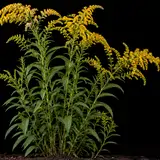
A tough native pairing - goldenrod's fall gold against ninebark's burgundy or gold foliage, both easy, sun-loving, and pollinator-friendly for a low-maintenance native border.
-
Native grassesLittle bluestem and other native grasses soften ninebark's structure and share its tough, sunny, well-drained conditions in a naturalistic planting.
Varieties · 5
You pick one when you add Ninebark to your garden. Its days to maturity set your harvest window.
Common Ninebark (Physocarpus opulifolius)
The wild species: a rugged, arching 5-10 foot green-leaved shrub with white flower clusters, peeling bark, and the most wildlife value.
Variety details for Common Ninebark (Physocarpus opulifolius)
Arching green-leaved shrub with white flower clusters and shredding, peeling bark.
speciesnativegreen-foliagearchingTough and adaptable for naturalizing, streambanks, and informal hedges.
Diabolo (Physocarpus 'Monlo')
The groundbreaking dark-leaf ninebark that launched the foliage-color craze: deep purple-black leaves all summer, pinkish-white flowers, and red seed pods on a large 8-10 foot shrub.
Variety details for Diabolo (Physocarpus 'Monlo')
Large shrub with near-black purple foliage, pink-white flowers, and red pods.
cultivardark-purple-foliagelargedramaticDramatic, but one of the more mildew-prone older cultivars.
Dart's Gold
A bright chartreuse-to-gold-leaved ninebark on a more compact 4-5 foot plant, glowing in the border (best gold color in full sun), with white flowers and good toughness.
Variety details for Dart's Gold
Compact shrub with bright golden-yellow foliage and white flower clusters.
cultivargold-foliagecompactbrightTiny Wine / Little Devil (dwarf, mildew-resistant)
Compact 3-4 foot ninebarks with fine burgundy foliage and better mildew resistance than the older dark-leaf types - the right choice for smaller gardens and humid climates.
Variety details for Tiny Wine / Little Devil (dwarf, mildew-resistant)
Small, dense shrub with fine wine-red foliage and pinkish-white flowers.
cultivardwarfburgundymildew-resistant'Tiny Wine,' 'Little Devil,' and 'Ginger Wine' are popular.
Amber Jubilee
A colorful multi-tone ninebark whose new growth emerges glowing orange, gold, and lime, maturing to reddish-purple, giving a warm multicolor effect all season on a hardy 5-6 foot shrub - especially popular in cold climates.
Variety details for Amber Jubilee
Shrub with new growth in orange-gold-lime tones aging to purple-red.
cultivarmulticolor-foliageorange-gold-redcold-hardy
Grower tips
Notes from growers, tagged with the zone they grow in. A person reads every post before it appears.
Nobody has posted about Ninebark yet. The first one usually saves someone a season.
Free account. Your post shows your grower name and zone, never your email.