Add it to your home screen and it opens full screen: no browser bars, one tap away, and everything stays signed in. Free, nothing to download from an app store.
- Tap the Share button in your browser
- Scroll down and choose “Add to Home Screen”
- Open GrowSomeFood from your home screen
- Open your browser’s menu
- Choose “Add to Home screen” or “Install app”
- Open GrowSomeFood from your home screen
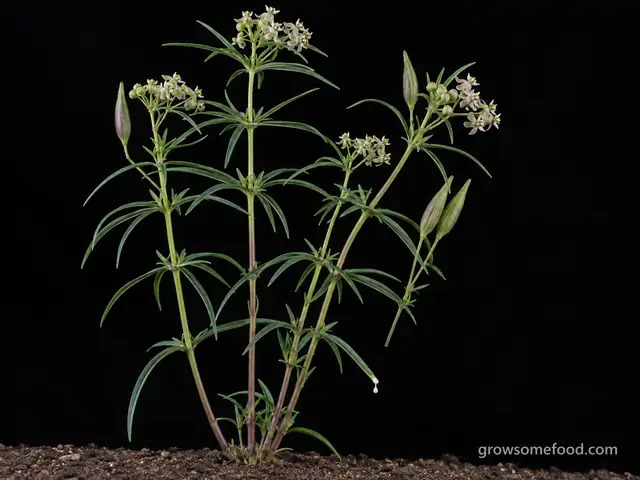
Narrowleaf Milkweed
California's monarch plant. Whorls of narrow leaves and modest greenish-white flowers on a tough summer-dry perennial - the most widespread native milkweed in the state and the main larval host of the western monarch. It dies back every winter, which is precisely why it beats the tropical milkweed nurseries sell.
Not a food plant, and not a mild one. The narrow-leaved milkweeds carry the highest toxin loads in the genus - cardiac glycosides plus a neurotoxic fraction - and they are the milkweeds most often behind livestock deaths in the West. Drying does not destroy it, so plants baled into hay stay dangerous; keep it out of pasture, paddocks and anything cut for feed, and away from pets. The milky sap irritates skin and is a serious eye irritant, so wear gloves and wash before touching your face.
Overview
Narrowleaf milkweed (Asclepias fascicularis) is the milkweed for California, and the plant most likely to put a monarch caterpillar in a West Coast garden. It is the most widespread native milkweed in the state - found from the coast ranges through the Central Valley and Sierra foothills and on into Oregon, Washington, the Great Basin and the Southwest - and it is a principal larval host of the western monarch, the population that breeds inland through summer and clusters in coastal groves from October to February.
It is not a showy plant and it does not pretend to be. Slender 2- to 3-foot stems carry very narrow leaves in whorls of three to six, and the flowers are small, greenish-white and flushed pink, in loose clusters. What matters is when they open: through midsummer into September, in the hottest, driest stretch of a California year, when almost nothing else is offering nectar. Monarchs, hairstreaks, bumble bees, tarantula hawks and a long list of native solitary bees all work them.
Two things make it the right choice rather than merely an available one. It is properly summer-dry adapted, so once established it wants no water at all - it belongs in an unirrigated garden and dies in a watered one. And it goes fully dormant every winter, vanishing to bare ground. That annual dieback is the whole ecological argument against the evergreen tropical milkweed sold in most nurseries, and it is a feature, not a flaw.
Quick facts
- Sprouts in
- 14 days7 to 25
- Soil to sprout
- 72 °F65 to 80
- Start indoors
- 8 weeks before transplant6 to 10
- Life cycle
- Perennial, lives about 10 years
- Seed to save
- About 120 days after planting100 to 150
- Height
- 30 in18 to 42
- Spread
- 18 in12 to 30
- Cold
- Takes hard frostdamaged below -15°F
- Heat
- Struggles above 110°F
- Self-sows
- Yes, expect volunteers
Full sun or part sun · low water · well-drained soil · 18 in apart (12 to 30) · direct sow or transplant or division
When to plant
Nothing is open today. Fall sowing opens in 13 days, Oct 4 to Nov 15.
- Direct sow Oct 4 – Nov 15 Opens in 13 daysAbout 3 weeks before to 3 weeks after your first frost (Oct 25 here)Sow outdoors in fall in the colder interior and let winter cold-stratify the seed naturally. Barely cover it; germination follows in spring once the soil warms.
- Start indoors Feb 13 – Feb 27 Opens in 145 daysAbout 8 weeks before to 6 weeks before your last frost (Apr 10 here)Chill seed damp in the fridge for 2-4 weeks, then sow indoors 6-8 weeks before last frost into deep pots or tree tubes that let the taproot run down.
- Transplant Apr 10 – May 22 Opens in 201 daysAbout at to 6 weeks after your last frost (Apr 10 here)Spring planting works in the cooler interior and the Northwest, but a spring-planted milkweed needs watching through its first summer. Plant small plugs, not large pots - the deep root resents being coiled.
Frost here: last around Apr 10 (Mar 27 to Apr 24 most years), first around Oct 25. Zone averages, your own yard may run a week or two either way.
Life stages
One stage to settle in, then three that repeat each year. Windows are typical; your zone and weather move them.
Year 1 - roots down
Day 0 to 60- WaterWater the first year, then wean it offevery 10 daysA new plant needs regular water through its first dry season to get its roots down - a deep soak every week or two in California summer heat. From the second year taper right off. This is a summer-dry plant, and the commonest way to lose an established one is to keep watering it.
- ProtectPlant it in fall, and plant it where it staysIn California and the low West, fall planting is the whole trick: put plugs in from October to December so the winter rains root them in before the first hot summer. Narrowleaf milkweed sends down a deep root and dislikes being moved once mature, so choose the permanent spot now.
Watch for- Slow, thin first-year top growth while the root system builds
- Sodden soil around the crown from irrigation or a low spot
- Late emergence in spring - it is not dead
Spring growth
Mar to Jun, every year- InspectCheck the whorled leaves for monarch eggs and caterpillarsFrom early spring in the Central Valley - later inland and north - look on the undersides of the narrow leaves for single pale monarch eggs, then for the striped caterpillars. Western monarchs arrive from the coastal groves in spring looking for exactly this plant. Leave every egg and caterpillar where it is, and never spray, including organic insecticides.
- WeedKeep weeds off it, and pull the shoots you do not wantYoung plants are easily crowded out by annual grasses, so clear around them. Established plants send up shoots from rhizomes a foot or two out; pull the outliers in spring while they are soft if you want the clump to stay put. In dry, unwatered ground it barely wanders at all.
Watch for- Monarch eggs and caterpillars (the whole point - do not treat)
- Oleander aphids in bright yellow clusters on new growth
- Annual grasses swamping a first-year plant
Summer bloom
Jun to Sep, every year- InspectWatch what comes to the flowersThe small pale flowers are unshowy at a distance and extraordinary up close - clusters of greenish-white stars flushed pink, blooming through the hottest, driest months when little else offers nectar. Expect monarchs, checkered whites, gray hairstreaks, bumble bees, tarantula hawks and dozens of native solitary bees on the same plant.
- ProtectNo sprays, and no neonicotinoid-treated stockA sprayed milkweed is worse than no milkweed, because monarchs lay eggs on it and the caterpillars die. That includes systemic neonicotinoids, which stay in the leaves for a season or more after treatment. Buy from a native-plant nursery that can tell you its stock is untreated, and never apply anything to the plant yourself.
Watch for- Caterpillars stripping the narrow leaves (welcome them)
- Oleander aphids on stems and flower buds
- Milky sap on hands and blades - keep it away from your eyes
Seed & winter dieback
Oct to Feb, every year- DoCollect seed as the first pods splitSlender pods dry and split along one seam in early fall, releasing silk-tufted seed on the wind. Pick a pod the day the seam opens - a day later the wind has it. Split it over a paper bag, strip the seed off the floss with your fingers, and store it dry and cool in a labelled envelope.
- PruneLet it die back completely - that is the pointNarrowleaf milkweed goes fully dormant and disappears to bare ground for winter, which is exactly what monarchs need: the annual dieback breaks the cycle of the OE parasite and lets the butterflies migrate. Cut the dead stems off at ground level any time from late fall to late winter. Do not try to keep it evergreen.
Watch for- Pods splitting and seeding downwind
- Bare ground where the plant was - normal winter dormancy, not death
Watch out for
3 to know. 2 are high-risk: Root Rot, Toxicity to Livestock and Pets. 3 are active in September.
Root RotSeverity High DiseasenowSeverity is High here for one reason: summer irrigation.
A summer-dry Mediterranean plant sitting in warm wet soil rots at the crown, and this is the commonest way a Californian loses an established narrowleaf milkweed. Turn the drip off after year one, keep it out of lawn spray, and plant on a slope or a raised bed on clay.
Wilting in the middle of the day on a plant whose soil is damp - the classic tell, and the reason people water a rotting plant and finish it off. Leaves yellowing from the bottom up, dull off-color foliage, and growth that stalls for no visible reason. Whole shoots, or one side of the plant, collapsing while the rest still looks fine. Soft, dark, or mushy tissue at the base of the stem or at the crown, sometimes with a sour smell. Lift a failing plant and look at the roots: healthy ones are firm and pale, rotted ones are brown or black and slimy, and the outer layer slips off between your fingers leaving a thread of core behind. Seedlings that topple over at soil level are the same problem, called damping-off.
There is no cure for tissue that has already rotted, so act on the conditions rather than looking for a spray. Stop watering at once and fix the drainage - open up compacted soil, or move the plant to a raised, sharply drained position or a container. Lift a badly affected plant, cut away every soft dark root and rotted section with a clean blade back to firm pale tissue, and replant only the healthy parts into fresh free-draining soil or mix. Often the better move is to give up on the plant and save its offspring instead: cuttings, offsets, or divisions taken from firm healthy growth root readily and give you a clean start. Bin the rotted material rather than composting it, and correct the drainage before you replant, because the rot comes straight back in the same wet spot.
Drainage is the whole defense. Match the plant to the site first - something that wants sharp drainage will not survive heavy clay or a low, water-collecting spot however well you tend it. Where the ground is heavy, plant on a raised bed, berm, or slope, or grow in a container. Set plants at the depth they were already growing, since burying the crown or the root flare is a common cause of rot, and keep mulch pulled back a few inches from the stem base instead of piled against it. Water the soil rather than the calendar: check that the top inch or two is dry before watering again, cut back hard in cool weather and winter dormancy, and never leave a pot standing in a full saucer. Do not plant or dig in soggy ground, and go easy on rich amendments for plants that want it lean. Rotate annual crops, and start with clean healthy plants and fresh mix.
Root rot is not one organism but a group of soil fungi and water molds - Pythium, Phytophthora, Fusarium, Rhizoctonia and others - that sit harmlessly in most soils and only turn destructive when the ground stays saturated. Waterlogged soil drives the air out, the roots suffocate, and the weakened tissue is invaded and goes soft, brown, and stringy. Because the damage is underground you usually see it first as something that looks like drought: wilting, yellowing, stunting, a plant that does not respond to being watered. Overwatering, heavy compacted ground, a low spot that collects runoff, a pot with no drainage or a saucer left standing full, and cold wet soil in winter are the usual causes. Once roots have actually rotted there is no cure - this is a problem you prevent rather than treat.
Toxicity to Livestock and PetsSeverity High DisordernowThis is the reason narrowleaf milkweed needs a deliberate siting decision rather than an automatic one.
In an ordinary garden with no grazing animals it is simply an excellent monarch plant; on or beside acreage with stock, plant it where they cannot reach it, or plant a different native.
Plants growing in or beside pasture, paddocks, corrals, hay ground or anywhere animals are turned out, especially on overgrazed or disturbed patches. In hay, look for the slender whorled leaves and dry pods mixed into a bale. In an affected animal, signs come on within hours: staggering, weakness, muscle tremors, dilated pupils, laboured breathing, rapid or irregular heartbeat, colic, and collapse or seizures in serious cases.
There is no home remedy and no antidote. If you suspect an animal has eaten it, call your veterinarian immediately and describe the plant - treatment is supportive and time matters. For a pet, call your veterinarian or an animal poison control line. Remove the animals from the source, and remove or fence off the plants before restocking.
Keep this species out of grazing land and out of anything cut for hay. Site garden plantings well away from paddocks and fence lines that animals can reach over. Never dispose of pulled plants or cut stems where stock can get to them, and never feed pulled milkweed to animals as green feed. Keep pastures in good condition, since poisoning happens when better forage runs short. Keep pets away from the plant and from cut material.
The narrow-leaved and whorled milkweeds are the most poisonous group in a poisonous genus, carrying a neurotoxic fraction on top of the usual cardiac glycosides, and they are the milkweeds most often responsible for livestock deaths across the western states. Horses, cattle, sheep and goats are all susceptible, and the amounts involved are small - on the order of a fraction of a percent of body weight for sheep. The plant colonizes disturbed and overgrazed ground, which is precisely where hungry animals meet it, and drying does not break the toxins down, so plants cut or baled into hay stay dangerous through the winter.
Oleander AphidSeverity Low PestnowReliably heavy on narrowleaf milkweed in California summers, and much worse on plants that are still being irrigated.
Turning the water off after the first year does more to reduce them than anything else.
Dense colonies of vivid yellow aphids packed along the stems and over the flower buds, sticky honeydew, sooty mold, and ants working the plant.
Blast them off with a jet of water, or wipe them off by hand - checking first for monarch eggs and small caterpillars on the same stems. Otherwise simply tolerate them, since predators usually catch up. Do NOT spray, including with insecticidal soap or neem, which kill caterpillars too.
Encourage lady beetles and lacewings and let them do the work; a strong plant carries a heavy colony without real harm. Never use insecticide on a monarch host plant. Soft, over-watered, over-fed growth carries far more of them, so growing the plant hard reduces the problem.
Bright yellow, black-legged aphids that cluster densely on milkweed stems, buds and new growth. They are conspicuous and very common but rarely fatal to an established plant - and they cannot be sprayed, because any insecticide that kills them also kills the monarch eggs and caterpillars the plant is there to support.
Good & bad neighbors
Plant nearby
-
The obvious California pairing: identical full sun, lean soil and no summer water, and it flowers in spring before the milkweed starts, so the two together cover most of the season without competing.
-
The other western monarch host. Where both are in range, growing them together widens the host window - showy milkweed leafs out and blooms earlier, narrowleaf carries on into September - and gives caterpillars somewhere to go when one is stripped.
-
Late-season nectar for monarchs on their way to the coastal overwintering groves, after the milkweed has set seed and shut down - the pairing that covers the far end of the monarch year.
-
A dry-garden native that blooms ahead of the milkweed and brings hummingbirds and specialist bees to the same lean, sunny, summer-dry bed.
-
Shares the unwatered, sharply drained conditions exactly, flowers over a long season, and draws in the lady beetles, syrphid flies and parasitic wasps that keep oleander aphids off the milkweed without any spraying.
Grower tips
Notes from growers, tagged with the zone they grow in. A person reads every post before it appears.
Nobody has posted about Narrowleaf Milkweed yet. The first one usually saves someone a season.
Free account. Your post shows your grower name and zone, never your email.