Add it to your home screen and it opens full screen: no browser bars, one tap away, and everything stays signed in. Free, nothing to download from an app store.
- Tap the Share button in your browser
- Scroll down and choose “Add to Home Screen”
- Open GrowSomeFood from your home screen
- Open your browser’s menu
- Choose “Add to Home screen” or “Install app”
- Open GrowSomeFood from your home screen
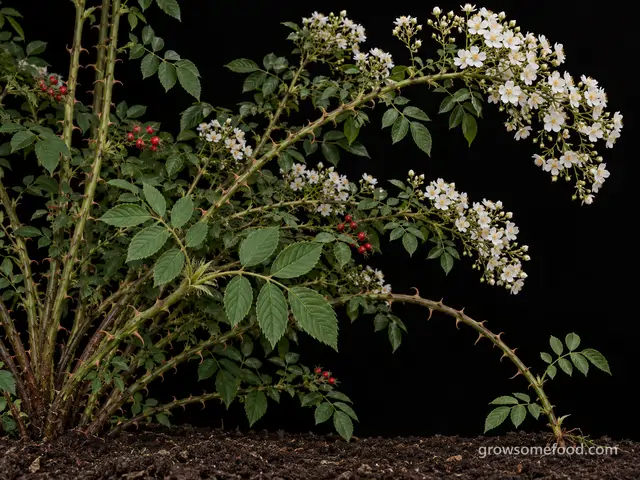
Multiflora Rose
Handed out by the government as a living fence and now a listed noxious weed across the Midwest and mid-Atlantic. It swallows pasture and woodland edge in impenetrable thorny thickets, and it is the wild reservoir of rose rosette disease, the untreatable virus that kills garden roses.
The hazard is mechanical. Multiflora rose is armed with stout curved prickles that catch and tear, and a thicket will shred bare arms and clothing - wear leather gloves, heavy sleeves, and eye protection, and cut your way in rather than push through. Its hips and petals are edible like any rose's, small and seedy, and only from plants that have never been sprayed; scrape the fine seed hairs out of hips, since they irritate skin, mouth, and throat. Eating it is no reason to keep it.
Overview
The one thing to knowIntroduced as rose rootstock, it was then promoted for decades by conservation agencies as a ‘living fence’ for livestock and as wildlife cover, and states distributed it to farmers by the millions.
Multiflora rose (Rosa multiflora) is the thorny thicket rose you meet on every neglected fenceline, pasture edge, and woodland margin in the eastern half of the country. For a fortnight in late spring it is genuinely lovely - a foam of small, fragrant, white flowers. For the rest of the year it is 10 to 15 feet of arching, prickle-armed cane that roots wherever it touches down and makes ground no animal and no person can walk through.
It got here on purpose. Introduced as rose rootstock, it was then promoted for decades by conservation agencies as a ‘living fence’ for livestock and as wildlife cover, and states distributed it to farmers by the millions. By the 1960s the same agencies were calling it a pest, and it is now a listed noxious weed across much of its range - Iowa, Missouri, West Virginia, Ohio, Pennsylvania, and Illinois among others - where planting or selling it is prohibited.
There is a second reason gardeners in particular need to know it. Multiflora rose is the wild reservoir of rose rosette disease, an untreatable mite-borne virus that kills roses. Wild multiflora upwind of a rose bed is a standing threat to it, and removing the multiflora is one of the few preventive measures that actually works. This entry is for identifying it (learn the fringed stipule and you will never confuse it with a native rose), removing it, and knowing what it is doing to the roses you do want.
Quick facts
For identification. Not a growing guide.
- Life cycle
- Perennial, lives about 25 years
- Where it grows
- Full sun · Part sun · Part shade, well-drained soil
- Height
- 10 ft4 to 15
- Spread
- 15 ft6 to 30
- Cold
- Takes hard frostdamaged below -30°F
- Heat
- Struggles above 100°F
- Self-sows
- Yes. Never let it set seed.
Through the year
How to recognize it in each season.
Early leaf-out and arching canes
Mar to May, every year- The one test that settles it: fringed stipulesWhere each leafstalk joins the cane there is a small flange called a stipule. On multiflora rose its edge is deeply cut into a comb of fine fringes, obvious with the naked eye. EVERY native North American rose has a smooth or merely gland-edged stipule. Combine that with 7 to 9 leaflets per leaf and long green arching canes to 10-15 feet armed with stout curved prickles, and the identification is finished. Learn the fringe and you will never mistake a native rose for this one again.
- Grub out young plants before the crown thickensA first- or second-year plant pulls or grubs out with a mattock in moist spring soil, crown and all, and that is by far the cheapest control there is. Older plants build a woody crown and a spreading root system that will resprout from anything left behind. Walk fencelines, hedgerows, pasture edges, and the drip line of perch trees in spring, when the rose leafs out ahead of most natives and is easy to spot.
Key signs- Fringed, comb-edged stipules at the base of each leaf
- Long arching canes rooting where their tips touch the ground
- Seedling flushes along fencelines and under perch trees
- New shoots from below the graft union on your own garden roses
The white bloom (the other giveaway)
May to Jun, every year- Sprays of many small white flowers, all at onceFor a fortnight in late spring the whole plant covers itself in branched clusters of small white (occasionally pale pink) fragrant flowers, each about an inch across with five petals. That is the difference from every native rose in one glance: natives carry solitary or few LARGE pink flowers, multiflora carries many SMALL white ones in a spray. It is also the easiest time of year to map an infestation - the white foam along a hedgerow in late May is all one plant.
- If you cannot remove it yet, cut it before it sets hipsCutting will not kill multiflora rose - it resprouts hard from the crown - but a plant cut in bloom sets no hips that year, and that alone stops birds moving it into the next woodlot. Treat it as a holding action while you plan real removal, and get the crown out or treated in the same season if you can.
Key signs- Branched sprays of small white five-petaled flowers in late spring
- Hedgerows and pasture edges turning white all at once - the best mapping window
- Heavy bloom on plants growing in full sun, which predicts a heavy hip crop
Small red hips through winter
Aug to Mar, every year- Dense clusters of pea-sized red hips that hang on all winterThe flowers become tight clusters of small, firm, bright-red hips, barely a quarter-inch across, which persist on the canes right through winter. A large plant can carry a staggering seed crop - counts of half a million seeds from a single mature shrub are routinely cited - and birds and small mammals move them everywhere. Seed stays viable in the soil for many years, which is why control has to be measured in seasons, not weekends.
- Take out the biggest fruiting plants firstWhen you cannot clear everything, clear the seed factories. Cut or treat the largest fruiting shrubs first, bag hip-bearing material rather than piling it at the wood's edge, and plan to come back to the same ground each spring for several years for the seedling flush - the existing seed bank will keep germinating long after the parent plants are gone.
Key signs- Tight clusters of pea-sized red hips persisting into midwinter
- Birds and mice working the hips in late winter, then seeding them elsewhere
- Seedling flushes each spring under fences, perches, and old thickets
Winter (cutting season, and the rootstock check)
Dec to Feb, every year- Cut and mow in winter, then follow up in the growing seasonWinter is the practical time for heavy cutting: the plant is bare, the red hips make it visible, and the ground is firm enough for machinery. But cutting is only step one - multiflora resprouts vigorously, so pair a winter cut with either immediate cut-stump treatment, a mowing regime through the following growing seasons, or grubbing out the crowns. A single winter brush-hogging with no follow-up produces a thicker thicket.
- Check your own grafted roses for multiflora suckersMultiflora rose is the traditional rootstock under many grafted garden roses, so this species turns up in tidy gardens as a sucker. Look below the knobby graft union for a shoot with different foliage: 7 to 9 leaflets, fringed stipules, and rampant thorny growth. Tear it off at its point of origin rather than cutting it flush, or it multiplies. If the grafted top has died and only the sucker is left, you now have a multiflora rose, not a garden rose - remove it.
Key signs- Bare arching canes with red hips - the easiest winter identification
- Vigorous resprouting from crowns cut in earlier seasons
- Rootstock suckers below the graft union on garden roses
- Witches'-broom growth on nearby roses, which means rose rosette disease is in the neighborhood
Watch out for
4 to know. 3 are high-risk: Massive Bird-Spread Seed Bank, Pasture & Woodland-Edge Thickets (ecological harm), Rose Rosette Disease. 3 are active in September.
Massive Bird-Spread Seed BankSeverity High DisordernowDense clusters of small red hips persisting on bare canes into midwinter.
Dense clusters of small red hips persisting on bare canes into midwinter. Birds working thickets in late winter. Uniform flushes of rose seedlings each spring along fences, under perch trees, and on ground cleared in previous seasons.
Accept a multi-year program: kill the crowns, then walk the same ground every spring for several years pulling the seedling flush while it is ankle-high, and replant cleared areas with competitive natives so bare ground is not simply re-colonized.
Remove the biggest fruiting plants first to shut off the seed supply, cut plants before hips form where you cannot remove them yet, and bag hip-bearing material rather than piling it at a wood's edge.
The reason multiflora control is measured in years. A large plant can set on the order of half a million seeds in a season, packed into pea-sized hips that hang on the canes right through winter and are eaten by birds and small mammals during the leanest months, then dropped anywhere they perch. The seed germinates readily and stays viable in the soil for a decade or more, so ground cleared of every visible plant keeps producing seedling flushes for years, and a single surviving thicket upwind re-seeds the whole neighborhood.
Pasture & Woodland-Edge Thickets (ecological harm)Severity High DisordernowArching thorny canes spreading outward along fencelines, pasture edges, and hedgerows, with cane tips rooted into the ground.
Arching thorny canes spreading outward along fencelines, pasture edges, and hedgerows, with cane tips rooted into the ground. Foam of small white flowers along an edge in late spring - the easiest way to map an infestation. Ground going out of use because nothing can walk through it.
Grub out small plants crown and all. On established plants, cut low and treat the stump immediately from late summer through the dormant season, or mow three to six times a season for two to four consecutive years, or grub crowns out mechanically; goats browse it hard and suppress it on steep ground. Any herbicide must carry a label listing the site - pasture, rangeland, fencerow, woodland, non-crop - and pasture products carry grazing and haying restrictions; follow the label, and use an aquatic-labelled product, with a permit or licensed applicator where required, anywhere near water.
Never plant it, and grub out first- and second-year plants while they still pull. Keep pasture competitive and hedgerows walked, since the plant establishes in thin, undergrazed, or neglected ground first. Remove fruiting plants near woodland edges before birds move the seed inward.
Multiflora rose converts open pasture, old field, fencerow, and woodland edge into impenetrable thorny thicket. Arching canes root wherever their tips touch soil, so a single plant walks outward and stands merge into continuous cover that excludes forage grasses, native shrubs, and tree seedlings, cuts usable grazing acreage, and blocks the movement of livestock, people, and wildlife. It tolerates sun to moderate shade, most soils, and drought once established, and it responds to being cut by producing more stems than it had.
Rose Rosette DiseaseSeverity High DiseasenowThis is the plant the reservoir warning is about.
The disease is killing multiflora stands across the central and eastern US and was once studied as a biological control for it - but a dying thicket is an active source of infected mites sitting upwind of every garden rose in range, so it is a reason to clear the stand faster, not to leave it to collapse on its own.
Bunched, distorted, hyper-thorny growth; shoots that stay unnaturally red instead of maturing green; thickened stems; flowers that ball or distort. Distinguish from harmless new growth, which is also red but matures normally.
None - dig out the entire plant including roots, bag it, and discard (don't compost). The soil is safe to replant after remaining roots are removed; it's the mites and living tissue that carry the virus.
Inspect new plants before buying, space roses so canes don't touch, remove any wild multiflora rose nearby, and avoid overhead high-pressure blowing that spreads the mites.
A fatal virus spread by a tiny wind-blown eriophyid mite, producing distorted 'witches'-broom' clusters of growth, excessive thorniness, and persistent bright-red shoots. There is no cure, and an infected plant is a reservoir that infects every rose downwind. Multiflora rose hedgerows are the wild reservoir, so it's worst in the central and eastern US.
Rootstock Suckers in Garden RosesSeverity Medium DisorderVigorous thorny shoots from below the graft union or from the soil beside the plant, with different foliage - paler, finer, 7 to 9 leaflets, and fringed comb-edged stipules.
Vigorous thorny shoots from below the graft union or from the soil beside the plant, with different foliage - paler, finer, 7 to 9 leaflets, and fringed comb-edged stipules. Sprays of small white flowers on a bush sold as something else.
Tear suckers off at their point of origin rather than cutting them flush - a clean cut leaves buds that produce several shoots in place of one. Where the grafted top has died and only the understock remains, dig the whole plant out; it is now a multiflora rose.
Plant own-root roses where you can, which removes the issue entirely. On grafted roses, set the bud union at the correct depth for your zone and check the base of the plant a few times each season.
The route by which this noxious weed turns up inside tidy gardens. Multiflora is the traditional understock for grafted garden roses, so a shoot arising from below the knobby graft union is multiflora, not the variety you bought. Left alone it outgrows and starves the grafted top, and if the top dies over a hard winter the gardener is left with a multiflora rose flowering small and white where a named variety used to be - and, in a listed state, with a noxious weed.
Grower tips
Notes from growers, tagged with the zone they grow in. A person reads every post before it appears.
Nobody has posted about Multiflora Rose yet.
Free account. Your post shows your grower name and zone, never your email.