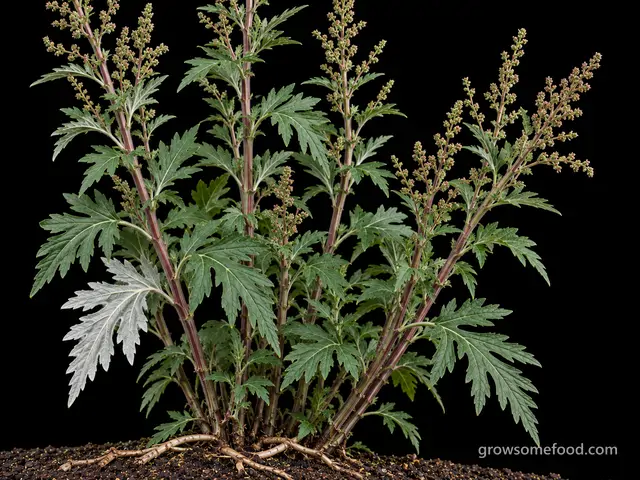
Mugwort

Artemisia vulgaris · Asteraceae
Other Perennial Herb Other
Introduced - native to Europe, temperate Asia and North Africa; naturalized across most of North America and genuinely invasive in the Northeast and Mid-Atlantic.
For identification only — don't plant. Do not plant mugwort, whatever a herb catalogue says. It runs from a shallow mat of rhizomes that regrow from every broken piece, takes over beds and roadsides across the Northeast and Mid-Atlantic, and its pollen is a major late-summer hay-fever allergen. Here to identify and remove it.

The hazard is pollen, not poison. Mugwort is wind-pollinated and one of the heaviest late-summer allergen producers in the Northeast; cutting a flowering stand releases a cloud of it, so wear a mask and long sleeves and do the work before it blooms. People allergic to mugwort pollen often react to celery, carrot, parsley, coriander, fennel, sunflower seed and chamomile too. It raises a rash in some people. It contains thujone - not an everyday tea herb, and traditionally avoided in pregnancy.

Overview

Turn a leaf over: mugwort's undersides are bright silver-white, and that is the whole identification. It runs from a shallow mat of rhizomes that regrows from every broken piece, so tilling multiplies it - and its wind-blown pollen is one of the worst late-summer allergens in the Northeast.

Mugwort is the tall, grey-green, aromatic plant along the fence line, in the neglected corner and up every roadside from New England to Virginia. It looks enough like a chrysanthemum that one of its common names is chrysanthemum weed, and it gets ignored for a season or two on exactly that basis. Then it is everywhere.

The identification is one gesture: turn a leaf over. The upper surface is dark green and deeply cut into pointed lobes; the underside is a bright silvery-white felt. Crush it and it smells sharp and sage-like. Nothing you are likely to confuse it with shares that combination — and the plant it is most often mistaken for, common ragweed, is plain green on both sides.

What makes it a problem is underground and shallow: a dense mat of creeping rhizomes in the top two to six inches of soil, from which shoots come up in a crowd rather than one at a time. Every broken piece with a node on it makes a new plant, so a rototiller turns one clump into a bed. It also releases chemicals that suppress its neighbours, and a mature stand ends up a near-monoculture with nothing else in it.

And then there is the pollen. Mugwort is wind-pollinated, flowers from midsummer into autumn, and is one of the heaviest late-season allergen producers where it is abundant. People who are allergic to it commonly react to celery, carrot, parsley, coriander, fennel, sunflower seed and chamomile as well — the mugwort-celery-spice cross-reaction. So a stand of it is a health nuisance for people who will never identify the plant responsible.

Honest note: mugwort has a real place in European and East Asian tradition, as a bitter flavouring, a ritual herb and the source of the moxa used in moxibustion. That history is worth knowing and is covered below. It is not a reason to keep a plant that will take your borders.

At a glance

Sun
Full sun · Part sun · Part shade
Water
Low
Spacing
Mature height
24–78 in (typ. 48)
Frost
Hardy
Spread
24–240 in (typ. 72)
Soil
Well-drained
Temperature
Damaged below -30°F · struggles above 100°F
Self-sows
Yes — expect volunteers

When to plant

No planting window on record for this zone.

Life stages

  1. Spring and summer shoots from the rhizome mat (act now) Apr, May, Jun, Jul (yearly)
    • Turn a leaf over - the silver underside is the whole identification
      Shoots come up in a crowd from a shallow mat of rhizomes, not singly from seed. Leaves are deeply cut into pointed lobes and look like chrysanthemum foliage, dark green above - and the underside is a striking bright silvery-white, densely woolly. Crushed, the leaf smells sharp and sage-like. Nothing else you will confuse it with has that white felt underneath: ragweed is green on both sides, wormwood is silver on both.
    • Dig young patches out whole - never rototill oneevery 21 d
      A small, new patch can be dug out. Work when the soil is moist, lift with a fork rather than a spade so you tease rhizomes out instead of slicing them, follow the runners sideways past the visible shoots, and sift the loosened soil for pale broken pieces. Every fragment with a node on it regrows. Do NOT rototill: chopping the mat is how one clump becomes a bed, and it is the commonest reason a mugwort problem doubles in a season.
    • Check new plants and delivered soil - this is how it arrives
      Most garden mugwort infestations were bought and paid for. It travels as rhizome pieces in nursery container stock, in bulk topsoil, in unscreened compost and in wood-chip mulch from roadside clearing. Before planting anything new, knock the pot off and look at the root ball for pale creeping rhizomes and shoots that do not belong to the plant you bought. Refuse or quarantine suspect deliveries; it is far cheaper than the removal.
    A crowd of shoots emerging together rather than single seedlingsBright silver-white woolly leaf undersidesRunners heading outward past the edge of the patch
  2. Inconspicuous flowers, conspicuous pollen Jul, Aug, Sep (yearly)
    • Cut it before it flowers, and wear a mask if you are late
      The flowers are tiny greenish-yellow heads in long leafy spikes at the top of the stem, easy to miss - and wind-pollinated, which is why this plant matters to people who have never seen it. Cutting a stand in bloom releases pollen in a cloud. Cut in early summer, before the spikes open; if you are cutting late, do it on a still, damp day, wear a mask and long sleeves, and shower afterwards.
    • Late summer is the moment a systemic treatment worksevery 30 d
      From bud through early flower and into the autumn regrowth, mugwort is moving reserves down into its rhizomes - so anything systemic travels down with them. A spring application mostly burns off leaves the mat can replace. If you are treating rather than digging, this is the window, and it will need repeating for two or three years.
    Long leafy spikes of tiny greenish-yellow flower headsHay-fever symptoms peaking as it bloomsNew patches appearing downwind and downslope
  3. Winter: dead canes over a living mat Jan, Feb, Mar, Oct, Nov, Dec (yearly)
    • The dead stems map the patch for you
      Top growth dies to reddish-brown woody canes that stand all winter, holding their seed spikes. That makes winter the best time of year to see the true extent of a stand - walk it, mark the edges, and note how far the outliers have travelled from where you thought the patch was. The rhizome mat almost always runs further than the shoots do.
    • Get the tarp down now for a full-season smother
      The mat sits shallow, mostly in the top two to six inches, which is why smothering works on mugwort when it fails on deeper-rooted weeds. Cut the canes off at ground level, lay heavy cardboard or an opaque tarp with a generous overlap past the edge of the patch, weight it down, and leave it in place for a full growing season. Starting in late winter buys you the whole year in one go.
    Standing reddish-brown canes marking the patch outlineOutlying shoots well beyond the main clumpCover blown loose or edges left uncovered

Watch out for

Regrowth from a Shallow Rhizome Mat High DisorderMar, Apr, May, Jun, Jul, Aug, Sep, Oct

The reason mugwort wins. It grows from a dense branching mat of rhizomes in the top two to six inches of soil, sends shoots up in crowds rather than singly, and regrows from any fragment carrying a node. Pulling snaps the stem off the mat and prunes it; rototilling slices the mat into hundreds of viable pieces and distributes them across the bed, which is how a single clump becomes a whole border in one season. The one advantage the gardener has is that the mat is shallow, which is what makes a full-season smother genuinely effective on this weed.

Watch for: Shoots appearing in a crowd rather than as scattered seedlings; a patch that doubled the year after the bed was rotovated; pale creeping runners found when digging well outside the visible clump.

Prevent: Keep tillers and rotovators out of mugwort ground entirely - mark the patches. Do not move soil from a cleared area to a clean one, and do not compost the plant; home heaps do not kill rhizome pieces. Replant cleared ground densely so there is no bare soil to recolonise.

Treat: Smother: cut to the ground, cover with overlapped cardboard or an opaque tarp extended two to three feet past the visible edge, weight it, and leave it a full growing season while patrolling the perimeter. Or dig small patches with a fork in moist soil, teasing runners out and sifting the soil for fragments, then remove every resprout for the rest of the season. Systemic herbicide works only when timed to bud, early flower or autumn regrowth; use a product whose label lists the site and follow that label.

Wind-Blown Pollen & Food Cross-Reaction High DisorderJul, Aug, Sep, Oct

Mugwort is wind-pollinated with inconspicuous flowers, and where it is abundant it is one of the heaviest late-summer and autumn allergen producers - a major named hay-fever allergen in European medicine and an increasing one in the northeastern US. Cutting a stand in bloom releases pollen in a cloud, which is why people often feel worse straight after clearing it. Beyond hay fever, mugwort pollen allergy is associated with reactions to celery, carrot, parsley, coriander, fennel, sunflower seed and chamomile - the mugwort-celery-spice cross-reaction. Handling the foliage also causes contact dermatitis in some people.

Watch for: Late-summer sneezing, itchy eyes and asthma symptoms that track with the flowering of nearby stands; symptoms that spike immediately after mowing or clearing; a rash on forearms after weeding.

Prevent: Cut stands in early summer, BEFORE the flower spikes open - a mown stand sheds no pollen. Wear gloves and long sleeves for any handling. If you must cut in bloom, pick a still, damp day, wear a mask, and shower and change clothes afterwards.

Treat: Standard hay-fever measures during the season, and a discussion with a clinician or allergist if symptoms are severe or if you also react to celery, carrot or related foods. Removing nearby stands helps, but pollen travels, so treat it as one part of the picture rather than a cure.

Arrives in Nursery Stock, Topsoil & Mulch Medium Disorderyear-round

Most garden mugwort was delivered, not blown in. Because the plant spreads mainly by rhizome rather than seed in North America, its realistic vectors are container-grown nursery plants with rhizome hidden in the root ball, bulk topsoil and fill, unscreened compost, and wood-chip mulch produced from roadside and rail-corridor clearing - all of which move it from an infested site straight into a clean bed. Gardeners routinely introduce a decade-long problem while planting a shrub.

Watch for: Shoots that do not belong to the plant you bought, coming up inside a new pot or right at the edge of a newly planted root ball; a flush of seedlings-that-are-not-seedlings on ground where soil or mulch was dumped.

Prevent: Knock new plants out of their pots and check the root ball for pale creeping rhizomes before planting. Ask where bulk topsoil and mulch came from, and stage deliveries on a tarp or hard standing rather than on soil. Quarantine anything suspect for a season.

Treat: Remove the affected plant from the ground, wash the root ball clean of soil and rhizome, and replant; or return it. Dig or smother the ground where a contaminated delivery sat, and watch that spot for two full seasons.

Allelopathy & Monoculture Medium DisorderApr, May, Jun, Jul, Aug, Sep

Mugwort releases compounds that suppress the germination and growth of neighbouring plants, and combined with its dense shading canopy and rhizome mat this turns a stand into something close to a monoculture. In a garden it means perennials thin out and disappear from a border it has entered; in a meadow or old field it means a loss of the diversity that supported insects and birds. The effect fades once the rhizomes are removed, which is why the last step of control is replanting rather than waiting.

Watch for: A patch where nothing else is coming up, including annual weeds; established perennials weakening and vanishing on the side of a bed the mugwort reached; seed sown into cleared ground failing to establish.

Prevent: Deal with mugwort while it is a clump rather than a stand, and keep beds densely planted so there is no open ground for it to claim. Do not leave cleared ground bare over a season.

Treat: Remove the rhizome mat by smothering or digging, then replant the ground promptly and densely - a cover crop, a thick mulch over new planting, or close-spaced perennials. Expect suppressed soil to recover over a season once the plant is gone.

Varieties · 3

Common Mugwort (Artemisia vulgaris)

Tall grey-green stand of deeply cut leaves that flash silver-white when the wind turns them, topped by inconspicuous greenish flower spikes.

speciesintroducedinvasiverhizome-spreaderallergendo-not-plant

The plant this entry is about: a 3 to 6 foot aromatic perennial with ridged purplish stems, deeply lobed leaves that are dark green above and bright silvery-white and woolly beneath, and long leafy spikes of tiny greenish flower heads from midsummer. Spreads by a dense shallow rhizome mat that regrows from every fragment, and arrives in gardens mostly in nursery stock, topsoil and mulch. Identify and remove; do not plant it.

Western Mugwort (Artemisia ludoviciana) - NOT this plant

Narrow, softly silver leaves on upright stems, silver on both surfaces, in dry open ground.

relatednativewesterndo-not-treat

A native North American Artemisia of the Plains and West, widely and legitimately grown as a silver-foliage garden plant and important in several Indigenous traditions. It is included here so you do not spray it by mistake. The difference is the leaf: western mugwort is silvery-grey on BOTH surfaces and its leaves are narrow and mostly unlobed or toothed only at the tip, while common mugwort is two-tone, dark green above and white beneath, with deeply cut pointed lobes. Western mugwort does run at the root and can be assertive in a border, but it is a native plant, not an invasive one.

Wormwood (Artemisia absinthium)

Low mound of finely cut leaves, silver-grey and softly felted on both sides, with small yellow button flowers.

relatedintroducedgarden-herbcontrast

The other Artemisia people confuse with mugwort, and the source of absinthe's reputation. Wormwood is silvery-grey and softly hairy on BOTH leaf surfaces, more finely divided, and grows into a low woody-based mound rather than a tall cane. It is a cultivated garden herb rather than an aggressive rhizome spreader, and it is far more bitter. If the leaf is silver top and bottom and the plant is knee-high and shrubby, you are not looking at common mugwort.

Grow

How to know it and how it moves: silver-white leaf undersides, sage-like smell, ridged often purplish stems 3 to 6 feet, tiny greenish flower spikes in late summer - spreading by a shallow rhizome mat and arriving in nursery pots, topsoil and mulch far more often than by seed.

You will not be planting this, so this is recognition and movement — and movement is the part most people get wrong.

The plant. An upright perennial, usually 3 to 5 feet and sometimes 6, with ridged, often reddish-purple stems that turn woody by late summer. Leaves are alternate, 2 to 4 inches, deeply cut into pointed lobes, dark green and nearly hairless above, and densely white-woolly underneath — the mark that settles it every time. Upper leaves on the flowering stem get narrower and less divided, so check a leaf from lower down. Crushed foliage is strongly aromatic, sage-like and slightly bitter.

The flowers disappoint anyone expecting a daisy. From July into September the stem tops carry long leafy spikes of tiny greenish-yellow to reddish flower heads, each a few millimetres across, with no petals worth the name. That is what wind pollination looks like, and it is why the plant is a serious allergen while remaining visually forgettable.

Underground is where it lives. A dense, branching mat of rhizomes sits shallow — mostly the top two to six inches — and pushes out in all directions, sending up shoots in crowds. Any fragment carrying a node regrows. Seed is produced but is a minor route in North America; the plant travels as pieces of rhizome. That is why the realistic arrival stories are nursery container stock with rhizome in the root ball, bulk topsoil, unscreened compost, and wood-chip mulch from roadside clearing. Check what you buy.

Lookalikes. Common ragweed is the important one, because both flower at the same time and both are blamed for autumn hay fever: ragweed's fern-like leaves are green on both sides and it is an annual with a single taproot. Wormwood (Artemisia absinthium) is silvery-grey on both surfaces and softly hairy all over. Western mugwort (A. ludoviciana) is a native western species with narrow, mostly unlobed silver leaves — if you are in the Plains or the West, look closely before you treat anything, because that one belongs there. Garden chrysanthemums have similar foliage but green undersides and, eventually, obvious flowers.

Care

Control, not care. The rhizome mat is shallow, which is the one piece of good news: a full-season smother under cardboard or tarp genuinely works. Digging works on small patches if you sift out every fragment. Tilling always makes it worse, and mowing alone never finishes it.

Mugwort is beaten by understanding one thing: the plant is a shallow rhizome mat, and every method either exhausts that mat or feeds it.

What fails. Rototilling is the worst thing you can do — it slices the mat into hundreds of viable pieces and spreads them evenly through the bed. Pulling snaps stems off the rhizome and prunes it. Mowing alone keeps a stand short and flowerless, which is genuinely useful for the pollen, but it does not kill it; mown mugwort simply grows sideways. Mulch alone, without a barrier under it, is walked through in a fortnight.

Smothering is the method that actually suits this weed, precisely because the rhizomes are shallow. Cut the stand to the ground, lay heavy overlapped cardboard or an opaque tarp, extend it a good two to three feet past the visible edge of the patch, weight it thoroughly, and leave it down for a full growing season — late winter to the following autumn is ideal. Walk the perimeter every few weeks and pull or cut the runners that escape at the edges, because they always do. A second season is common for an old stand, and it is still less work than any alternative.

Digging is right for a small or new patch. Moist soil, a fork rather than a spade so you lift and tease rather than chop, work outward from the shoots to find where the runners go, then sift the loosened soil by hand for pale broken fragments. Then keep the appointment: check every two to three weeks for the rest of the season and pull each resprout as it appears. Removing shoots before they build a surplus is what empties the rhizomes.

If you use a herbicide, timing decides everything. Treat actively growing plants from bud through early flower and again on autumn regrowth, when the plant is moving reserves down into the rhizomes; a spring application mostly removes leaves the mat can replace. Use a product whose label lists the site you are treating — ornamental bed, lawn, fence line, non-crop area — and follow that label, which is legally binding. Expect two or three years of follow-up either way; a single clean-looking season means nothing with this plant.

Then replant, and quickly. Bare ground is an invitation, and mugwort's own allelopathy fades once the mat is gone. A dense planting or a thick cover crop in the cleared ground is the difference between a fix and a truce. Finally, do not compost it and do not move soil from a cleared patch elsewhere in the garden — rhizome pieces survive a home heap comfortably.

Troubleshooting

Why it doubled after you tilled, whether it is really ragweed making you sneeze, why mowing helps but never finishes it, how it got into a bed you never planted it in, and what to do about the rash and the hay fever.

“I tilled it and now there is four times as much.” That is the defining mugwort mistake. Tilling cuts the shallow rhizome mat into hundreds of pieces, each with a node, and spreads them across the whole bed. Mark mugwort patches and keep machinery out of them; smother or dig instead.

“Is this what is making me sneeze, or is it ragweed?” Both flower in late summer and both are heavy wind pollinators, so the honest answer is that either could be. Tell them apart by turning a leaf over: mugwort is bright silver-white underneath, ragweed is green on both sides. Mugwort is a perennial that comes back from a spreading mat; ragweed is an annual with a taproot that pulls out easily. Ragweed is by far the bigger allergen nationally; mugwort matters most where it is locally abundant, which in the US means the Northeast and Mid-Atlantic.

“Cutting it made my allergies worse.” Because you cut it in bloom. Cut mugwort in early summer, before the spikes open. If you have to cut late, choose a still, damp day, wear a mask and long sleeves, and shower and change afterwards.

“I get a rash from weeding it.” Contact dermatitis from Asteraceae foliage is common and mugwort is one of the usual suspects. Gloves and sleeves; wash exposed skin afterwards. If reactions are severe or spreading, see a clinician rather than working through it.

“I never planted it - where did it come from?” Almost certainly delivered. Rhizome fragments ride in nursery container stock, bulk topsoil, unscreened compost and wood-chip mulch. Inspect root balls before planting, and keep an eye on the ground where a big soil or mulch delivery was dumped.

“Mowing keeps it down - is that enough?” It is worth doing, because a stand that never flowers never sheds pollen or seed. But mown mugwort spreads sideways instead of upward and the mat carries on. Treat mowing as damage limitation, not control.

“Nothing else grows in the patch.” Correct, and partly deliberate on the plant's part: mugwort is allelopathic and a mature stand becomes a near-monoculture. The effect fades once the rhizomes are gone, so plant the cleared ground densely rather than leaving it bare and waiting.

“It came back after a whole season under a tarp.” Usually from the edges, or from a fold that let light in, or from a runner that was already outside the covered area. Extend the cover two to three feet past the visible patch, weight it properly, and patrol the perimeter. A second season finishes most stands.

“Can I just use it as a herb since it is here?” People do, and there is a genuine tradition behind it — but it contains thujone, it is a notable allergen, and keeping a plant because it is useful is exactly how it stops being a small patch. This catalog treats it as a weed to remove.

“Is it illegal to have?” Mugwort is not a federal noxious weed, and most states do not regulate it; it appears on state invasive-plant advisory lists across the Northeast and Mid-Atlantic, which are advisory rather than enforcement lists. Check your own state's list before assuming either way.

Growing across climates

Hardy roughly zones 3 to 9 and present in most states, but genuinely invasive mainly in the Northeast and Mid-Atlantic, where the density of disturbed ground and mild moist summers suit it. Drought and shade slow it; nothing about winter stops it.

Mugwort is hardy over a very wide range — roughly zones 3 to 9 — and has been recorded in most states. But abundance and hardiness are different things, and the map that matters is the one of where it actually dominates.

Northeast and Mid-Atlantic: this is where it is a genuine invasive, blanketing roadsides, rail corridors, old fields, cemeteries and neglected garden ground, and where it appears on state invasive-plant advisory lists. Long mild autumns, plenty of disturbance and constant soil and mulch movement between sites suit it perfectly. If you garden here, assume it is nearby and inspect deliveries.

Midwest and Great Lakes: common and locally troublesome, especially on urban and industrial ground, but generally less blanketing than further east.

South: present but much less aggressive; hot, humid summers and heavy competition from warm-season growth hold it back.

West and Plains: scattered and mostly urban. The real caution here is not to confuse it with the native western mugworts (Artemisia ludoviciana and relatives), which are silvery, aromatic, rhizomatous and belong in the landscape. Check for the two-tone leaf — green above and white below — before treating anything.

What limits it anywhere: deep shade, permanent wet, and dense established vegetation. What favours it is disturbance, bare soil and full sun. Cold does not touch it: the rhizomes sit below the frost line's practical reach and shrug off zone-4 winters entirely, so nowhere in the temperate US gets a free pass from a hard year.

History

One of the oldest herbs in Europe - Roman travellers' herb, midsummer garlands, the bitter in beer before hops - and the source of the moxa burned in East Asian moxibustion, where the young leaves also flavour rice cakes. It reached America early and quietly became a roadside monoculture.

Few weeds have a longer written history. Mugwort appears in Roman, Anglo-Saxon and medieval European sources as a protective and medicinal herb: Roman soldiers were said to put it in their sandals against tired feet, it was worn in midsummer garlands and burned on St John's Eve (hence St John's plant), and it was one of the nine herbs of an Old English charm. Before hops took over, mugwort was among the bitter herbs used to flavour and preserve beer — the gruit tradition — which is one of the more plausible origins of the name. Sailor's tobacco and felon herb record two more old uses, one when the pipe ran empty and one for treating an infected finger.

In East Asia the same species and its close relatives are more prominent still. Dried, sieved mugwort fluff is the moxa burned in moxibustion, a practice paired with acupuncture for well over a thousand years. Young spring leaves are a food, not a garnish: kusa mochi in Japan and ssuk rice cakes and soups in Korea are seasonal staples, and the plant carries real cultural weight in both places.

All of that is true, and none of it changes what the plant does in an American garden. Mugwort arrived early with European settlement — in ballast, in seed and in deliberate plantings as a medicinal herb — and by the twentieth century it had become one of the signature weeds of disturbed ground in the Northeast, moving between sites in nursery stock and fill dirt rather than by seed. The plant that was carried across an ocean for its usefulness now spreads mainly because we keep moving soil around.

Two practical footnotes to the history. The herbal tradition is real but the plant contains thujone, the compound behind wormwood's reputation, so it was never an everyday tea and was traditionally avoided in pregnancy. And its allergenic pollen has its own literature: mugwort is a major named allergen in European hay-fever medicine, and the mugwort-celery-spice syndrome — cross-reaction with celery, carrot, parsley, coriander, fennel, sunflower seed and chamomile — is the reason an allergist may ask about this weed when you complain about salad.

No grower tips for Mugwort yet — yours could be the first.

Sign in to share what works in your garden.

Connection interrupted

Reconnecting to GrowSomeFood

Keep this page open. We are trying to restore your garden session.

Attempt of . Retrying automatically.

Still offline

Could not reconnect

Your phone may have switched networks or gone to sleep. Try again when the signal is steady.

Session expired

Reload to continue

This garden session is no longer available on the server. Reloading will start a fresh session.