Add it to your home screen and it opens full screen: no browser bars, one tap away, and everything stays signed in. Free, nothing to download from an app store.
- Tap the Share button in your browser
- Scroll down and choose “Add to Home Screen”
- Open GrowSomeFood from your home screen
- Open your browser’s menu
- Choose “Add to Home screen” or “Install app”
- Open GrowSomeFood from your home screen
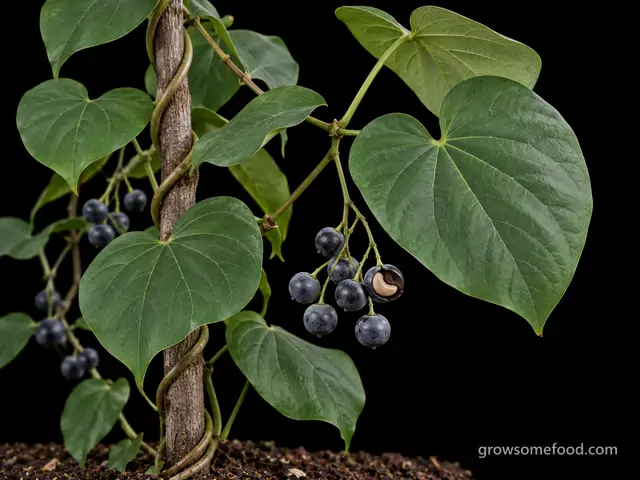
Moonseed
The vine that ripens fake grapes. It twines through the same hedgerows, fruits blue-black in the same weeks, and its berries have killed children - and one crushed berry tells you which vine you are holding.
POISONOUS - never eat the fruit. Moonseed berries look like small wild grapes, and children have died eating them. Any ONE of these settles it: crush a berry and look at the seed, because moonseed has a SINGLE flat crescent-moon seed while a grape has two to four plump pear-shaped seeds; grapes climb by forked TENDRILS and moonseed has none, twining its bare stem instead; grape leaves are toothed all round, moonseed leaves are smooth-edged. If any is eaten, call poison control immediately.
Overview
The one thing to knowIts fruit looks like a wild grape.
Moonseed (Menispermum canadense) is a slender native woodland vine of eastern and central North America, common along riverbanks, woodland edges, fencerows and roadside hedges. It is a perfectly respectable member of its habitat - birds eat the fruit without harm and scatter the seed - and it would be of no particular interest to a gardener except for one thing.
Its fruit looks like a wild grape. Loose clusters of round, blue-black berries with a dusty bloom, hanging from a woody vine in a hedge, ripening from late August through October: the same colour, the same size, the same place, the same weeks. Moonseed berries contain dauricine and related alkaloids, and eating them causes vomiting, convulsions and, in the recorded fatal cases, death. Children eating them as grapes is the classic scenario, and it is exactly why this plant needs a page.
The reassuring part is that the discrimination is easy, physical and instant, and it works on one berry, in your hand, without any botanical training. Crush a berry and look at the seed. A grape holds two to four plump, pear-shaped seeds. Moonseed holds one flattened seed curved into a crescent moon - which is where the plant gets its name. Back that up with the vine itself: grapes climb with forked tendrils, and moonseed has none at all. This entry exists so that anyone who picks wild grapes checks both, every time.
Quick facts
For identification. Not a growing guide.
- Life cycle
- Perennial, lives about 20 years
- Where it grows
- Full sun · Part sun · Part shade, consistently moist soil
- Height
- 15 ft6 to 20
- Spread
- 6 ft3 to 12
- Cold
- Takes hard frostdamaged below -30°F
- Heat
- Struggles above 100°F
- Self-sows
- Yes. Never let it set seed.
Through the year
How to recognize it in each season.
Spring leaves & twining stems (no tendrils)
Apr to Jun, every year- No tendrils - it climbs by wrapping its own stemA grapevine climbs by throwing forked tendrils that grab and coil round a wire or a branch. Moonseed has no tendrils at any age; the whole slender stem twines round its support like a bindweed. Check the vine before the fruit is even there: run your eye along a foot of stem and look for the tendrils. If there are none, it is not a grape, and you should not be planning to pick from it in autumn.
- Smooth leaf edges, and a stalk set in from the rimGrape leaves are toothed all the way round the margin, and the leaf stalk joins the blade at a notch on the edge. Moonseed leaves are broadly heart-shaped to shallowly 3- to 7-lobed with a SMOOTH, untoothed margin, and the stalk attaches to the underside of the blade a little way in from the rim, so the leaf sits on its stalk like a shield. Both are useful all summer, when the vines are just foliage.
Key signs- A grape-like vine with no tendrils anywhere on it
- Smooth-edged leaves held on a stalk set in from the leaf margin
- Moonseed threading up through an existing grapevine or hedge
Small greenish-white flowers (early summer)
Jun to Jul, every year- Loose sprays, not dense grape clustersMoonseed carries small greenish-white flowers in loose, open, few-flowered sprays on separate male and female vines. A grapevine in flower carries a dense conical panicle of tiny green flowers with a faint sweet scent, on the same architecture the fruit bunch will take. It is a softer clue than the seed test, but it is the first point in the season where the future fruit cluster shows its shape.
Key signs- Sparse open flower sprays rather than a tight conical grape panicle
Blue-black fruit (the dangerous stage)
Aug to Oct, every year- The one test that always works - crush a berry and look at the seedThis is the check to trust above all others, and it works on a single fruit. Cut or crush one berry and look at what is inside. MOONSEED: one seed only, flattened like a coin and curved into a crescent moon, with a ridged rim. GRAPE: two to four plump, hard, pear-shaped seeds. Nothing about colour, bloom, size or cluster shape is as reliable, and both fruits are blue-black with a dusty bloom in the same weeks.
- Do not taste-test, and clear fallen fruit where children playNever use taste to identify a wild berry - moonseed is bitter and unpleasant, but the poisoning cases are children who swallowed a handful anyway. Where a vine hangs over a path, a play area or a fence a child can reach, cut it at the base before the fruit ripens and rake up what has already fallen. Bag it for the trash.
Key signs- Loose clusters of blue-black berries on a tendril-less twining vine
- Fruit ripening in the same hedge and the same weeks as wild grapes
- Windfall berries within reach of children or dogs
Bare winter stems
Nov to Mar, every year- In winter, the bark tells youBare stems still separate the two. An old grapevine has thick shaggy bark that peels off in long vertical strips, and dried tendrils cling to whatever it climbed. Moonseed stays slender and greenish-brown to grey with tight, unshredding bark, and there is nothing clinging - only the spiral where the stem wrapped its support. Winter is the easiest time to cut a moonseed vine out of a hedge you pick fruit from.
Key signs- Slender unshredding stems with no clinging tendrils
- Spiral twining marks on a shrub or fence post
Watch out for
3 to know. 2 are high-risk: Moonseed Mixed into Picked Wild Grapes, Poisoning by Berries (grape confusion). 3 are active in September.
Moonseed Mixed into Picked Wild GrapesSeverity High DisordernowA tendril-less twining stem running up through grape wood; smooth-edged leaves among toothed ones; clusters that look sparser and looser than the grapes around them.
A tendril-less twining stem running up through grape wood; smooth-edged leaves among toothed ones; clusters that look sparser and looser than the grapes around them.
If a single crescent-shaped seed is found, discard the entire batch - it cannot be sorted afterwards. Cut the moonseed vine out at ground level, pull the top growth clear of the host, and expect to cut resprouts for a season or two.
Walk an arbor or a foraging hedge each summer looking specifically for a stem with no tendrils, and cut it at the base before the fruit colours. When picking wild fruit, cut open berries from every cluster taken, not just the first one.
The garden-scale hazard: moonseed twines up through fruiting grapevines and hedgerows, so the two fruit clusters hang together at picking height and end up in the same bucket. Once mixed and destemmed, the fruit cannot be sorted by eye, and cooking into juice or jelly removes any chance to check the seeds.
Poisoning by Berries (grape confusion)Severity High HazardnowBlue-black berry clusters on a vine with no tendrils; children picking berries from a fence line or hedge; vomiting, weakness, drowsiness or seizures after any hedgerow foraging.
Blue-black berry clusters on a vine with no tendrils; children picking berries from a fence line or hedge; vomiting, weakness, drowsiness or seizures after any hedgerow foraging.
Call poison control or emergency services immediately and do not wait for symptoms. Take a piece of the vine and a berry cut open to show the seed. Do not induce vomiting. There is no specific antidote; care is supportive.
Crush one berry and look at the seed before eating anything: a single flat crescent seed is moonseed, two to four plump pear-shaped seeds is a grape. Check the vine for forked tendrils, which grapes have and moonseed never does. Teach children not to eat wild berries at all, and cut moonseed out of hedges and fences they can reach.
Moonseed fruit contains dauricine and related alkaloids. Because the berries are blue-black, dusty-bloomed, hedge-borne and ripe in the same weeks as wild grapes, they are eaten as grapes - most often by children, who need far less than an adult to be seriously affected. Recorded effects include nausea and vomiting, weakness and convulsions, and there are documented fatalities.
Seed Spread by BirdsSeverity Low WildlifenowNew twining seedlings appearing along fences, under perching trees, and at the base of shrubs and grape arbors.
New twining seedlings appearing along fences, under perching trees, and at the base of shrubs and grape arbors.
Pull or cut seedlings at ground level and dig the crown where you can reach it; it resprouts from the rootstock, so repeat for a season or two.
Nothing stops the birds - the answer is an annual look. Check fence lines and arbors each summer and pull new twiners while they are small enough to trace to their roots.
Birds eat moonseed fruit without harm and drop the seed along perches - fence lines, hedges and woodland edges. That is precisely how the vine arrives in gardens and arbors it was never planted in, and why a hedge that was clean one year can carry it the next.
Grower tips
Notes from growers, tagged with the zone they grow in. A person reads every post before it appears.
Nobody has posted about Moonseed yet.
Free account. Your post shows your grower name and zone, never your email.