Add it to your home screen and it opens full screen: no browser bars, one tap away, and everything stays signed in. Free, nothing to download from an app store.
- Tap the Share button in your browser
- Scroll down and choose “Add to Home Screen”
- Open GrowSomeFood from your home screen
- Open your browser’s menu
- Choose “Add to Home screen” or “Install app”
- Open GrowSomeFood from your home screen
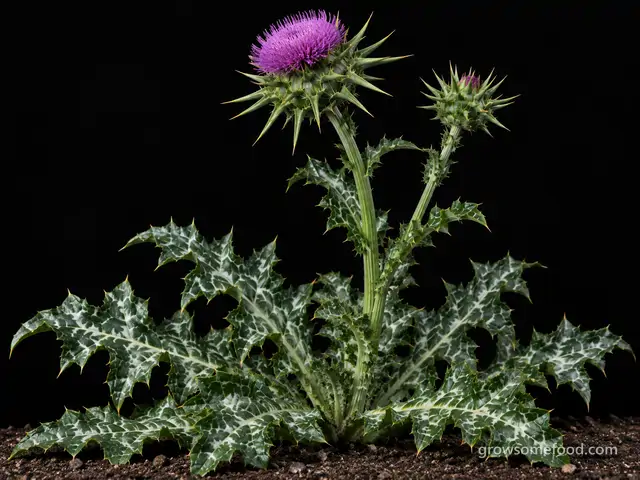
Milk Thistle
The big spiny thistle with white-marbled leaves that look like spilled milk, grown for the silymarin in its seed. Do not confuse it with sow thistle, which is a different, harmless plant. Handle it in leather gloves, and cut the heads before they open - one plant seeds a thicket.
The spines are the everyday hazard: mature leaves and flower bracts carry stiff needle points that go straight through cloth gloves, so wear leather gloves and long sleeves to handle it. Milk thistle also accumulates nitrate, and stands grazed by or cut for cattle, sheep and horses have caused fatal nitrate poisoning - keep it out of pasture and never feed it to stock. Seed preparations can interact with medication; ask your prescriber first, especially on diabetes or blood-thinning drugs.
Overview
Milk thistle is unmistakable once you have seen it: a broad flat rosette of glossy, deeply lobed leaves marbled with milky-white veins, as though someone had spilled milk down them, which then bolts into a stout 3 to 6 foot stalk carrying solitary purple flower heads ringed with long, rigid spines. It is a Mediterranean plant, naturalized across much of the country and abundant in California, and it is grown deliberately for one reason: the hard brown seed contains silymarin, the compound complex behind the best-known liver herb in the world.
One naming correction first, because it sends people to the wrong plant. Sow thistle (Sonchus oleraceus), the soft, mild, edible garden weed, is sometimes called 'milk thistle' for the white sap it bleeds when cut. It is not this plant, it contains no silymarin, and the two are not interchangeable. This page is the real Silybum marianum: genuinely, seriously spiny, with white-veined leaves and a purple thistle head.
It earns its Caution gate. A single plant produces thousands of seeds, each on a parachute of white pappus, and it self-sows into a spiny thicket that is miserable to remove once armed. It is a listed noxious weed in several western states, including California, Oregon and Washington, so planting it is restricted in places - check your state's list. And it is a genuine agricultural hazard: milk thistle accumulates nitrate, and stands grazed by or cut for cattle, sheep and horses have caused fatal poisoning.
Grown deliberately, in a small patch, on poor dry ground, with the heads cut and bagged before they open, it is an easy and striking plant - drought-proof, architectural, and worked hard by bees. The whole discipline of growing it is not letting it seed where you did not choose.
Quick facts
- Sprouts in
- 14 days7 to 21
- Soil to sprout
- 68 °F50 to 80
- Life cycle
- Biennial, grown as an annual
- Seed to save
- About 150 days after planting120 to 190
- Height
- 60 in24 to 100
- Spread
- 36 in18 to 48
- Cold
- Takes light frostdamaged below 10°F
- Heat
- Struggles above 100°F
- Self-sows
- Yes, expect volunteers
Full sun or part sun · low water · well-drained soil · 18 in apart (12 to 24) · direct sow
When to plant
Nothing is open today. Spring sowing opens 6 months, Mar 20 to May 1.
- Direct sow Mar 20 – May 1 Opens in 180 daysAbout 3 weeks before to 3 weeks after your last frost (Apr 10 here)Direct-sow into lean, well-drained ground in full sun as soon as the soil can be worked; it resents transplanting. Sow only a few plants - a handful makes more seed than a household uses. Check your state noxious weed list first: planting it is restricted in parts of the West.
Frost here: last around Apr 10 (Mar 27 to Apr 24 most years), first around Oct 25. Zone averages, your own yard may run a week or two either way.
Life stages
Four stages, about 4 months from sowing to the first pull. Windows are typical; your zone and weather move them.
Sowing to seedling
Day 0 to 14 from sowing- DoSow shallow into poor, dry, sunny ground - and sow fewDirect-sow about a quarter to half an inch deep into full sun and any well-drained soil, the poorer the better. It hates being moved, so sow where it is to stand rather than raising transplants. Sow far fewer plants than you think you want: a handful of plants produces more seed than a household will ever use, and every extra plant is more seed to contain later.
- InspectSeedlings show the white marbling almost at onceThe first true leaves already carry the milky white veining that gives the plant its name, so it is easy to tell milk thistle seedlings from other thistles and from ordinary weeds at a very early stage. That is worth knowing in both directions: it is also how you spot volunteers coming up where you did not sow them.
Watch for- White marbled veining on the very first true leaves
- Volunteers appearing well away from where you sowed
- Slow germination in cold soil
The marbled rosette
Day 21 to 130 from sowing- InspectA flat rosette that looks like spilled milkThe plant spends most of its life as a broad flat rosette of glossy, deeply lobed leaves, up to two feet across, marbled with striking milky-white veins and edged with spines that harden as the plant ages. It is genuinely handsome, which is why it turns up in ornamental borders and then in the whole garden. Leave it room: a crowded rosette produces a weak stalk.
- WaterWater it hardly at allevery 3 weeksMilk thistle is a Mediterranean dry-summer plant with a deep taproot and it wants lean, dry, well-drained ground. Water new sowings until they are up and growing, then leave them alone. Rich soil and regular water give you an enormous soft plant that flops, and nitrogen-rich ground is exactly what drives the nitrate accumulation that makes this plant dangerous to livestock.
- WeedHoe out the volunteers now, while they are still softevery 3 weeksRosettes are easy to remove when young and nearly impossible to handle once armed. Hoe or dig unwanted seedlings and rosettes through autumn and early spring, taking the top of the taproot with them - a rosette cut off at ground level often resprouts. This is the cheap moment; a mature plant costs leather gloves, long sleeves and a much worse temper.
Watch for- Rosettes spreading well beyond the row you sowed
- Spines hardening as the rosette matures
- Soft floppy growth on rich, watered ground
Purple heads on a spiny stalk
- InspectBig solitary purple heads inside a crown of spinesThe rosette bolts into a stout branched stalk, commonly 3 to 6 feet and sometimes taller, topped by solitary rounded flower heads two to three inches across: a dense brush of red-purple florets sitting inside a ring of broad bracts that end in long, rigid, genuinely dangerous spines. Bees work them hard. Nothing else in an American garden looks quite like it.
- ProtectDecide now how many heads you are letting ripenFlowering is the decision point. Every head you leave will make several hundred seeds with a parachute of pappus that carries them across the garden and beyond. Keep only the heads you actually intend to harvest, and cut the rest off at bloom while the seed is still soft. That single habit is the difference between a small medicinal patch and a spiny takeover.
Watch for- Solitary purple heads ringed by long rigid spines
- Bees and butterflies working the flowers
- More heads forming than you meant to keep
Seed heads - cut them before they open
- HarvestCut when the bracts brown and the first white pappus showsevery 3 daysA head is ready when the purple florets have dried off, the bracts have gone brown and papery, and a little white fluff begins to push out of the top. That is a narrow window - a day or two later the head opens fully and the seed blows away. Cut heads with secateurs into a paper bag held under them, wearing leather gloves, and take the stem with the head so nothing shatters on the way.
- HarvestDry the heads in bags, then rub the seed outPut the cut heads in open paper bags or a lidded box in a dry airy place for one to two weeks; they finish opening in the bag and the fluff stays contained. Then pull the heads apart with gloved hands, rub the pappus off the seed, and winnow the fluff away outdoors and downwind of the garden. The seed underneath is hard, shiny, brown and about the size of a large grain of rice.
- ProtectCut and bag every head you did not wantDeal with the leftovers in the same trip. Cut every remaining head before it opens, bag it, and put it in the trash rather than the compost heap - a cut head finishes ripening viable seed on its own stored moisture, and home compost does not reliably kill it. Then walk the perimeter and check for heads on plants you had forgotten about.
Watch for- Bracts turning brown and papery
- The first white pappus pushing out of the top of a head
- Heads that opened while you were not looking, with seed already gone
- Volunteer seedlings next season marking where a head shattered
Harvest
- Purple florets dried off and the bracts gone brown and papery
- The first white pappus just beginning to push out of the top of the head - cut now, not later
- Heads left a few days too long open fully and blow their seed away
- Cut when the bracts brown and the first white pappus shows · every 3 days
- Dry the heads in bags, then rub the seed out
- Cut and bag every head you did not want
Per plant 1 to 10 ozPicking pull once
Watch out for
4 to know. 2 are high-risk: Prolific Self-Seeding & Noxious Weed Listings, Nitrate Poisoning of Livestock. 2 are active in September.
Prolific Self-Seeding & Noxious Weed ListingsSeverity High DisordernowHeads opening on the plant like a dandelion clock, with white fluff drifting across the garden.
Heads opening on the plant like a dandelion clock, with white fluff drifting across the garden. Volunteer rosettes appearing well away from where you sowed, recognisable by their white marbled veining from the first true leaves. Spines hardening on rosettes you meant to hoe out weeks ago. Seedlings still coming up two or three seasons after a stand was cleared.
Work on the rosettes: hoe or dig every volunteer through autumn and early spring while they are soft and unarmed, lifting the top of the taproot, since a rosette cut at ground level often resprouts. Cut and bag any head that forms on a plant you missed, before it opens. Expect two or three seasons of follow-up because of the seed bank, and keep cleared ground planted or mulched rather than bare.
Grow only a few plants, and only in a contained bed away from pasture and boundaries. Decide at flowering how many heads you will ripen and cut the rest at bloom while the seed is still soft. Never let a head open on the plant - cut into a paper bag and dry the heads inside the bag. Bin cut heads rather than composting them, since a severed head ripens viable seed on its own moisture. Check your state's noxious weed list before sowing at all.
The reason this plant is gated Caution. A single milk thistle carries multiple heads and each ripe head releases several hundred seeds on a parachute of white pappus, so one unwatched plant seeds a wide area in a season. Seedlings come up as soft rosettes that are easy to remove, then arm themselves with rigid spines and become genuinely unpleasant to handle, and the seed persists in the soil for years, so a cleared patch keeps producing volunteers. On dry rangeland it forms dense stands that displace forage, which is why it is a listed noxious weed in several western states, including California, Oregon and Washington. Planting it is restricted in those places.
Nitrate Poisoning of LivestockSeverity High DisorderCattle or sheep that are suddenly breathing hard, staggering, weak, or collapsing shortly after being turned into a paddock carrying milk thistle.
Cattle or sheep that are suddenly breathing hard, staggering, weak, or collapsing shortly after being turned into a paddock carrying milk thistle. Brownish rather than red blood or dark discoloured membranes, which a vet will recognise. Dead animals near a heavy stand. Milk thistle standing in hay ground before cutting, or spiny heads found in baled hay.
This is a veterinary emergency, not a garden problem: get affected animals off the stand and call a vet immediately, as there is a specific treatment for nitrate poisoning that works only if given quickly. Remove the remaining stand before restocking the paddock, and have suspect forage or hay tested for nitrate rather than guessing.
Keep milk thistle out of pasture, paddocks and hay ground entirely, and control it along shared boundaries. Do not turn hungry stock into ground carrying it, since hungry animals eat what they otherwise avoid. Never cut it into hay and never throw pulled plants over the fence to livestock. Avoid growing it on heavily manured or fertilised ground, which is what drives the nitrate accumulation in the first place.
Milk thistle is a nitrate accumulator: growing on nitrogen-rich ground - manured paddocks, feedlot edges, fertilised fields - it concentrates nitrate in its tissue to levels that can kill grazing animals. Cattle and sheep are the usual victims, and deaths have been recorded from both grazing green stands and from cut or wilted plants offered as feed. Absorbed nitrate is converted to nitrite, which stops the blood carrying oxygen, so affected animals suffer rapid oxygen starvation. Onset can be quick and mortality high. The plant also carries a mechanical hazard for stock: the spiny heads foul hay, fleece and mouths.
Spine Injuries When HandlingSeverity Medium DisordernowSpines hardening on rosettes from midseason onward, so a plant that was soft in March is armed by June.
Spines hardening on rosettes from midseason onward, so a plant that was soft in March is armed by June. Needle points on the bracts of every flower head. Punctures through gloves and sleeves while cutting heads, and any wound that reddens or will not heal cleanly.
Clean punctures thoroughly and keep an eye on them; see a clinician for a wound that reddens, swells or will not heal, and for anything to the eye. Bag spiny material rather than leaving cut stalks lying where someone will kneel on them.
Leather gloves, long sleeves and eye protection for anything past the rosette stage, and secateurs rather than hands for cutting heads - hold a paper bag under the head and let it drop in. Do the bulk of your removal work on young unarmed rosettes in autumn and early spring, which is easier and safer than fighting mature plants. Keep a spiny stand away from paths, play areas and anywhere people brush past.
Not a threat to the plant but to you. Milk thistle arms itself as it matures: the leaf margins carry stiff yellow spines and the bracts around each flower head end in long, rigid needle points that go straight through cloth gloves and thin fabric. Harvesting, cutting or clearing a mature stand bare-handed or in ordinary garden gloves is how most people learn this. Punctures are painful, bleed, and can pick up infection, and the spines are stiff enough to be an eye hazard when you are working in among tall flowering stalks.
AphidsSeverity Low PestBlack aphid colonies build on the bolting stalk and in the developing flower heads, which is a nuisance when the heads are what you are harvesting rather than a real threat to a vigorous plant.
Do not spray a stand that bees are working; a jet of water and patience is enough, and ladybirds usually clear it.
Dense clusters of tiny insects packed onto shoot tips, flower buds, and the undersides of young leaves. Curled, cupped, or distorted new growth that never opens properly. A sticky shine on the leaves - and on whatever sits under the plant - that later goes black with sooty mold. Tiny white cast skins left behind where a colony has been feeding. Ants running steadily up and down the stems, which is often the first thing you notice. Mottled, streaked, or misshapen leaves that do not grow out can mean a virus the aphids brought with them rather than the feeding itself.
Knock the colonies off with a hard jet of water and repeat every few days - on most plants that alone ends it. Pinch out or prune off the worst-infested tips rather than treating the whole plant. If colonies keep rebuilding, spray insecticidal soap or horticultural oil directly onto the insects, covering leaf undersides, and repeat weekly until they are gone; treat early or late in the day, and never spray a wilted or heat-stressed plant. Avoid broad-spectrum insecticides - they kill the ladybugs, lacewings, and parasitic wasps that were about to solve the problem for you, and aphid numbers usually come back worse afterward. Anything you spray must be labeled for the plant you are treating; follow that label and observe its pre-harvest interval. On anything you eat, wash leaves, heads, and buds well before use, since aphids hide down in crowns, folds, and tight growth.
Go easy on nitrogen: the soft, lush growth that heavy feeding produces is exactly what aphids breed on. Check new growth once a week through spring and early summer so you catch colonies while they are still small, and rub the first few out with your fingers. Leave flowering plants nearby and skip broad-spectrum sprays - ladybugs, lacewings, hoverflies, and parasitic wasps do most of this work for free, and they only stay if there is something for them to eat. Keep ants off the plant where you can, since they protect aphids from those predators. Water steadily so plants are not stressed, and check any new plant over before you bring it home or move it indoors, since aphids usually arrive on something else.
Aphids are small soft-bodied sap-suckers - green, black, gray, pink, or waxy white, and mostly wingless - that gather in dense colonies on the tenderest new growth: shoot tips, buds, and the undersides of young leaves. They breed extremely fast in mild weather, so a few can become hundreds inside a week. Their feeding curls and distorts soft growth, and the sticky honeydew they excrete coats everything below and turns black with sooty mold. Ants often farm and defend the colonies for that honeydew. A few aphids are normal on almost any plant and a healthy plant shrugs them off; only dense, persistent colonies do real damage, and some aphids also spread plant viruses as they feed.
Good & bad neighbors
First rule: keep Pasture grass and hay ground apart. Never grow or tolerate milk thistle where livestock graze or where hay is cut.
Plant nearby
- Traditional pairings, thin evidence
-
Less a planting rule than a relative worth knowing, since the two get confused in herbal writing. Artichoke is the other big edible Asteraceae thistle, and both have long digestive reputations - but artichoke's compounds are cynarin and luteolin, while milk thistle's is silymarin. Different plants, different chemistry, not interchangeable.
Keep apart
-
Pasture grass and hay groundNever grow or tolerate milk thistle where livestock graze or where hay is cut. It accumulates nitrate and has caused fatal poisoning in cattle and sheep, and the spiny heads foul hay and fleece. Keep a deliberate patch well away from paddocks and shared boundaries, cut it before it seeds, and never throw pulled plants over the fence to animals.
Varieties · 3
You pick one when you add Milk Thistle to your garden. Its days to maturity set your harvest window.
Milk Thistle (Silybum marianum)
Flat rosette of white-marbled spiny leaves, then a tall branched stalk carrying purple thistle heads ringed with long spines.
speciesintroducedmedicinalsilymarinEssentially a single wild form rather than a set of cultivars: a broad rosette of glossy lobed leaves marbled with milky-white veins, bolting to a stout 3 to 6 foot branched stalk with solitary red-purple heads two to three inches across inside a ring of long rigid spines. The hard brown seed is the part grown for silymarin. Selections exist for commercial seed production in Europe, but home seed is sold simply as milk thistle. No recommended zone badge is shown because the plant is a listed noxious weed in several western states - check your own state's list before planting.
Sow Thistle (Sonchus oleraceus) - NOT this plant
Soft green lobed leaves with clasping bluish bases and small yellow dandelion-like flower heads - no white marbling and no rigid spines.
relateddifferent-plantedibledo-not-confuseIncluded so the confusion stops here. Sow thistle is sometimes nicknamed 'milk thistle' because it bleeds white sap when cut, but it is a different plant entirely: soft, only faintly soft-prickly, with plain green lobed leaves, clasping bluish leaf bases and small yellow dandelion-like flowers in branched clusters. It is a mild edible green with its own catalog entry, and it contains no silymarin. Milk thistle, by contrast, has milky-white marbled veining, rigid needle-tipped spines, and big solitary purple heads. If it is soft and yellow-flowered, it is sow thistle.
Blessed Thistle (Cnicus benedictus) - a different herb
Low sprawling hairy annual with pale-veined leaves and yellow flower heads inside spiny bracts.
relateddifferent-plantmedicinaldo-not-confuseAnother plant that gets tangled up with this one in herb commerce, partly because both carry saintly names. Blessed thistle is a smaller, softer, hairy Mediterranean annual, usually under two feet, with pale-veined leaves and yellow flower heads wrapped in spiny bracts, and its own quite separate bitter-tonic tradition. It contains cnicin, not silymarin, and it is not a substitute for milk thistle in any preparation. Check the botanical name on anything you buy.
Grower tips
Notes from growers, tagged with the zone they grow in. A person reads every post before it appears.
Nobody has posted about Milk Thistle yet. The first one usually saves someone a season.
Free account. Your post shows your grower name and zone, never your email.