Add it to your home screen and it opens full screen: no browser bars, one tap away, and everything stays signed in. Free, nothing to download from an app store.
- Tap the Share button in your browser
- Scroll down and choose “Add to Home Screen”
- Open GrowSomeFood from your home screen
- Open your browser’s menu
- Choose “Add to Home screen” or “Install app”
- Open GrowSomeFood from your home screen
Manzanita
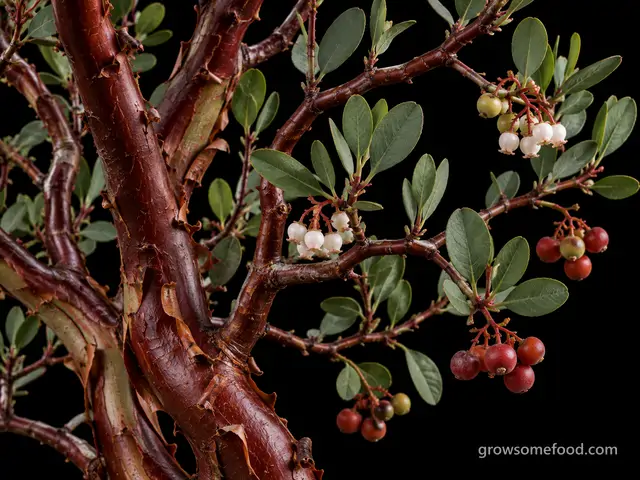
The sculptural backbone of the California native garden: smooth mahogany-red bark that peels itself every summer, urn-shaped flowers in the dead of winter that feed hummingbirds, small edible berries - and an absolute intolerance of summer water.
The ripe berries are edible - dry, mealy and mostly seed, traditionally soaked in cold water for a tart cider rather than eaten by the handful. Do not boil them: heat draws out tannins and turns the drink harsh. The leaves are another matter, rich in arbutin, which the body converts to hydroquinone, and the uva-ursi leaf tea of the herbal trade is a short-course medicine with real dosing limits - not a casual brew, not for children or in pregnancy, and not something to try from your own shrub.
Overview
The one thing to know) is grown first of all for its bark.
Manzanita (Arctostaphylos spp.) is grown first of all for its bark. Every summer the old skin curls off in papery strips to reveal wood the colour of polished mahogany, twisting through a framework of muscular branches that gets more sculptural with every decade. Set against small leathery evergreen leaves held edge-on to the sun, it is the most architectural shrub in the western native palette, and the reason old specimens are treated as garden furniture rather than planting.
Around sixty species grow from British Columbia to Baja California, most of them Californian, and they range from six-inch groundcovering mats to twenty-foot small trees. This is a genus-level guide - size, hardiness and garden tolerance vary so widely between species that the varieties below carry most of the practical decision.
What it gives back is out of season, which is exactly what makes it valuable. Manzanita flowers in midwinter, hanging small white and pink urns at a time when almost nothing else does, and those flowers are a mainstay for Anna's hummingbirds and the earliest bumble bee queens. By late summer they have become the little apples that give the plant its Spanish name - dry, mealy, tart, edible, and eaten by everything from bears to band-tailed pigeons. The genus name Arctostaphylos means bear grapes.
There is one rule, and it is not negotiable: no summer water. An established manzanita in an irrigated bed is a dead manzanita. Plant it where the hose does not reach.
Quick facts
- Sprouts in
- 120 days30 to 365
- Soil to sprout
- 60 °F50 to 70
- Life cycle
- Perennial, lives about 40 years
- Height
- 60 in6 to 240
- Spread
- 72 in24 to 180
- Cold
- Takes light frostdamaged below 15°F
- Heat
- Struggles above 110°F
- Self-sows
- Yes, expect volunteers
Full sun or part sun · low water · well-drained soil · 5 ft apart (3 to 10) · transplant or cuttings
When to plant
Nothing is open today. Fall transplanting opens 3 weeks, Oct 15 to Dec 15.
- Transplant Oct 15 – Dec 15 Opens in 24 daysThe right time in a dry-summer climate. Plant with or just before the first autumn rains so roots grow all winter and the shrub meets its first dry summer already established.
- Transplant Jan 1 – Feb 28 Opens in 102 daysMidwinter planting still works where winters are mild, with a little less root growth before summer. Water through the first dry season only, then stop.
- Transplant Apr 10 – May 22 Opens in 201 daysAbout at to 6 weeks after your last frost (Apr 10 here)For bearberry (kinnikinnick, A. uva-ursi) in cold-winter regions, plant in spring after frost into acidic, sandy, sharply drained ground. It is hardy to roughly zone 2 and far more forgiving than the Californian species.
Frost here: last around Apr 10 (Mar 27 to Apr 24 most years), first around Oct 25. Zone averages, your own yard may run a week or two either way.
Life stages
One stage to settle in, then four that repeat each year. Windows are typical; your zone and weather move them.
Years 1-3 - rooting in
The first year after planting- WaterWater sparingly for two summers, then stop for goodevery 18 daysGive a new manzanita a deep soaking every two or three weeks through its first dry summer, and rather less in its second, while the roots go down. After that, turn the water off permanently. Manzanita is even stricter about this than ceanothus - summer irrigation on an established plant is how most garden manzanitas die.
- ProtectPlant small, plant in fall, plant outside every sprinklerSet out a small container plant in autumn so winter rain settles it in. Keep the crown slightly proud of the surrounding soil, never bury the stem, and choose a spot that no lawn, drip line or overspray will ever reach. A slope or a raised mound is worth a great deal if your soil is heavy.
- MulchMulch with gravel or its own fallen leavesA few inches of gravel, decomposed granite, or the shrub's own leaf litter keeps roots cool without holding water at the crown. Pull it back a hand's width from the stem. Do not dig in compost or manure: manzanita relies on soil fungi rather than fertility, and rich amended ground makes soft growth and root rot.
Watch for- Any irrigation reaching the root zone
- Wilting on damp soil - root rot, not thirst
- Crown buried too deep at planting
Winter bloom - the hummingbird months
Dec to Mar, every year- InspectWatch the earliest nectar in the gardenManzanita opens small nodding urn-shaped flowers, white to shell pink, in the depth of winter - often the first substantial nectar of the year. Anna's hummingbirds hold territories on flowering shrubs, and the earliest queen bumble bees work them on mild days. Do nothing but watch; the flowers become the berries.
Watch for- Hummingbirds defending a shrub
- Bumble bees on warm winter afternoons
- Frost damage to open flowers in a hard cold snap
Spring growth - the one pruning window
Apr to Jun, every year- PrunePrune lightly now, in cool weather, and never in summerLate spring, after bloom and before the heat, is the only time to cut. Take out dead wood, and on a tree-form plant remove a few small interior branches to reveal the trunks. Make small clean cuts - most manzanitas do not resprout from bare old wood, so a heavy cut leaves a permanent hole, and summer pruning invites branch dieback fungi.
- InspectEnjoy the new growth and the first bark colourNew leaves flush pale green, bronze, or coppery red depending on the species, and the young stems begin to colour. This is also when leaf-gall aphids fold new leaves into red pouches - harmless, and best left alone.
Watch for- Puckered red leaf galls (harmless aphid work)
- Dead limbs showing up against the new growth
- The urge to shear it - resist
Berries and peeling bark (summer)
Jul to Sep, every year- HarvestPick berries when fully coloured, for cold-water ciderweeklyThe little apples ripen from green to red-brown or deep red and go dry and mealy. Pick a handful, crush them, and steep in COLD water for a few hours, then strain: that is the traditional manzanita cider, tart and faintly apple-like. Never boil them - heat pulls out tannins and ruins it. The flesh is thin and the seeds are stone-hard, so do not chew them.
- InspectLeave most of the crop, and watch the bark peelBears, coyotes, foxes and many birds eat manzanita berries - the genus name means bear grapes - so take a handful and leave the rest. Summer is also when the old bark curls and sheds in papery strips to reveal the smooth mahogany-red wood underneath. That is the point of the plant. Do not scrub or oil it; just let it happen.
Watch for- Bark peeling in strips (normal and welcome)
- Any summer watering - the worst thing you can do now
- A whole limb browning off while the rest looks fine (branch dieback)
Fall - planting season and first rains
Oct to Nov, every year- DoPlant now, and let the winter rains do the establishingIn a Mediterranean climate autumn is the real planting season: roots grow through the cool wet months, so an October planting meets its first dry summer with a root system already down. Flower buds are also forming now, so leave the shrub alone otherwise.
- InspectCheck that winter runoff drains away from the crownMake sure storm water will not pond around the base. A shallow berm that sends runoff past the plant, or setting it on a slight mound, does more good than anything you could spray. Standing winter water is the other half of the root-rot story.
Watch for- Water pooling at the base after storms
- Fat flower buds forming (winter bloom is close)
Harvest
- Berries fully coloured red-brown to deep red and dry to the touch, midsummer into fall
- Berries come away easily from the cluster
- For cider: crush ripe berries and steep in COLD water only - boiling makes it bitter
- Pick berries when fully coloured, for cold-water cider · weekly
- Leave most of the crop, and watch the bark peel
Per plant 8 to 96 ozPicking pick as they ripen
Watch out for
4 to know. 1 is high-risk: Root Rot. 3 are active in September.
Root RotSeverity High DiseasenowThe main way garden manzanitas die, and the trigger is summer irrigation rather than winter rain.
Warm damp soil wakes up Phytophthora, so a plant in a lawn, a drip-watered bed, or downhill of either is on borrowed time. Water every two or three weeks through the first dry summer, less the second, then never again. Keep the crown proud of the soil, mulch with gravel not compost, plant on a mound in clay, and choose Howard McMinn or Emerald Carpet where conditions are imperfect.
Wilting in the middle of the day on a plant whose soil is damp - the classic tell, and the reason people water a rotting plant and finish it off. Leaves yellowing from the bottom up, dull off-color foliage, and growth that stalls for no visible reason. Whole shoots, or one side of the plant, collapsing while the rest still looks fine. Soft, dark, or mushy tissue at the base of the stem or at the crown, sometimes with a sour smell. Lift a failing plant and look at the roots: healthy ones are firm and pale, rotted ones are brown or black and slimy, and the outer layer slips off between your fingers leaving a thread of core behind. Seedlings that topple over at soil level are the same problem, called damping-off.
There is no cure for tissue that has already rotted, so act on the conditions rather than looking for a spray. Stop watering at once and fix the drainage - open up compacted soil, or move the plant to a raised, sharply drained position or a container. Lift a badly affected plant, cut away every soft dark root and rotted section with a clean blade back to firm pale tissue, and replant only the healthy parts into fresh free-draining soil or mix. Often the better move is to give up on the plant and save its offspring instead: cuttings, offsets, or divisions taken from firm healthy growth root readily and give you a clean start. Bin the rotted material rather than composting it, and correct the drainage before you replant, because the rot comes straight back in the same wet spot.
Drainage is the whole defense. Match the plant to the site first - something that wants sharp drainage will not survive heavy clay or a low, water-collecting spot however well you tend it. Where the ground is heavy, plant on a raised bed, berm, or slope, or grow in a container. Set plants at the depth they were already growing, since burying the crown or the root flare is a common cause of rot, and keep mulch pulled back a few inches from the stem base instead of piled against it. Water the soil rather than the calendar: check that the top inch or two is dry before watering again, cut back hard in cool weather and winter dormancy, and never leave a pot standing in a full saucer. Do not plant or dig in soggy ground, and go easy on rich amendments for plants that want it lean. Rotate annual crops, and start with clean healthy plants and fresh mix.
Root rot is not one organism but a group of soil fungi and water molds - Pythium, Phytophthora, Fusarium, Rhizoctonia and others - that sit harmlessly in most soils and only turn destructive when the ground stays saturated. Waterlogged soil drives the air out, the roots suffocate, and the weakened tissue is invaded and goes soft, brown, and stringy. Because the damage is underground you usually see it first as something that looks like drought: wilting, yellowing, stunting, a plant that does not respond to being watered. Overwatering, heavy compacted ground, a low spot that collects runoff, a pot with no drainage or a saucer left standing full, and cold wet soil in winter are the usual causes. Once roots have actually rotted there is no cure - this is a problem you prevent rather than treat.
Manzanita Branch DiebackSeverity Medium DiseasenowLosing a limb is permanent on a tree-form manzanita: the sculptural branch structure is the whole point of the plant and it will not regrow.
That is the practical argument for the small, careful, once-a-year late-spring cut rather than an occasional heavy tidy-up.
One entire branch carrying brown, dry, still-attached leaves while its neighbours are green - the classic flag. Sunken, dark, cracked bark where the dying limb meets a larger branch, sometimes with weeping or resin. Wood that is stained brown or streaked when you cut into it. Damage concentrated where the plant was pruned in summer, where irrigation reaches, or on limbs newly exposed to hot sun after something beside them was removed.
Cut the affected limb out well back into clean, unstained wood, sterilizing the blade between every cut, and bin the prunings rather than composting them. Do it in dry, cool weather. There is no spray worth using. If limbs keep dying year after year, the real cause is the water or the soil, so go looking for the irrigation line before you go looking for a fungicide.
Keep the plant unstressed and dry in summer, which is most of the answer. Prune only in the cool weeks after bloom in late spring, never in summer heat, and make small clean cuts rather than large ones, sterilizing the blade between limbs. Do not open the canopy so far that interior bark is suddenly sunburnt. Keep irrigation out of the root zone, and mulch with gravel or the shrub's own leaf litter rather than moisture-holding compost piled against the trunk.
Canker fungi - Botryosphaeria and relatives - colonize stressed manzanita wood and kill it limb by limb. One branch browns off and dies while the rest of the shrub looks perfectly healthy, then another follows a year later. The fungi are nearly always present in the environment; what lets them in is stress, and on manzanita that means summer irrigation, a pruning wound made in hot weather, bark suddenly exposed to full sun, or roots struggling in heavy wet ground. After root rot, this is the second most common way a garden manzanita is lost.
Deer (browse resistance)Severity Low WildlifenowManzanita is one of the genuinely low-preference natives: the leathery, resinous leaves make poor browse and established plants are usually passed over even under heavy pressure.
Young plants still get sampled, and a rubbed trunk on a tree-form manzanita is a real loss, since the bark is the whole point and will not heal back. Cage a new plant for its first two or three years. Do not follow the general advice to feed and water a browsed plant here - that is the one thing manzanita cannot take.
Growth cleanly missing overnight, with the plant browsed back to a level line about as high as a deer can comfortably reach. Ragged, torn stem ends rather than the clean angled cut a rabbit leaves - the single most reliable identifier. Buds and flowers gone while the foliage below is untouched, since deer often take the best part first. Hoof prints and droppings in soft ground near the damage. Repeat visits, with fresh damage each morning once a planting has been found. On young trees, shredded and stripped bark and broken low branches in autumn - that is antler rubbing rather than feeding.
There is no chemical fix, only exclusion and recovery. Get physical protection up immediately after the first damage, because deer return to a known meal, and reinforce or rotate whatever you were relying on before. Most plants regrow from browsing if the crown and roots are intact - feed and water a grazed plant and protect the regrowth while it comes back. What does not recover in the same season is anything whose buds or flowers have been taken, and a young tree whose bark has been rubbed right around the trunk is usually lost. Where deer pressure is genuinely heavy, the honest answer is to fence properly or to grow the plants deer leave alone, rather than to keep replacing losses.
Fencing is the only thing that reliably works. Eight feet is the standard for excluding deer, or two parallel four-foot fences a few feet apart, which they will not jump because they cannot judge the landing. Short of that, cage individual plants: a sturdy wire cage or trunk guard around every young tree, left on until the trunk is thick and the canopy is above browse height, prevents both browsing and antler rubbing and is the single highest-value thing you can do for a young tree. Repellent sprays do help at moderate pressure, but they wash off and deer habituate, so reapply after rain and rotate between different types through the season. Motion-activated sprinklers, scent deterrents, and noise devices work for a while and then stop. Siting matters too: plants close to the house, in daily traffic, and screened behind other planting get browsed less than the same plant out at the boundary.
Deer are the largest garden problem across much of the country, and where pressure is high they set the limit on what you can grow at all. They browse at night and around dawn and dusk, taking tender shoots, leaves, buds, flowers, and fruit within about five feet of the ground, and they come back night after night to anything they have found and liked. Because they have no upper incisors they tear rather than cut, leaving ragged stem ends - that is how you tell deer damage from a rabbit's clean angled cut. In fall, bucks rub their antlers on young trunks and can strip the bark right around a stem, which kills a young tree outright. Palatability varies enormously between plants and between seasons: a herd short of food in late winter eats things it ignores in June, and no plant is truly deer-proof.
Manzanita Leaf Gall AphidSeverity Low PestOne of the most frequently asked questions about a garden manzanita, and the answer is always to leave it alone.
It does not damage the shrub, does not spread to unrelated plants, and is worst on plants pushing soft growth - which is a hint to stop feeding and watering.
New spring leaves folded lengthwise into thick, blistered, red or pink pouches, usually on the outermost new growth. Open one and you will find tiny pale aphids inside. Older galls dry brown and eventually drop.
Do nothing. If the appearance bothers you, pick the galled leaves off by hand and bin them. Sprays cannot reach aphids sealed inside a closed gall, and would only remove the predators that keep the population in check.
None needed, and none worth attempting. Growing the shrub lean and unirrigated means less soft new growth to colonize, which is the right approach for other reasons anyway.
A small native aphid (Tamalia coweni) that feeds on expanding manzanita leaves in spring and causes them to fold, thicken and swell into puckered red or rose-pink pouches. It looks dramatic and is very nearly harmless - the plant carries on growing, galled leaves are shed in their own time, and the aphid is a native part of the manzanita community rather than an invader.
Good & bad neighbors
First rule: keep Irrigated lawns and watered flower beds apart. A placement rule rather than a plant pairing, and the single most useful line on this page.
Plant nearby
-
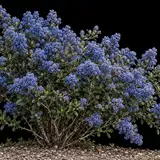
The other backbone evergreen of a chaparral garden and an almost perfect partner: identical no-summer-water needs and lean-soil siting, and manzanita's midwinter bloom hands the pollinator baton straight to ceanothus in early spring.
-
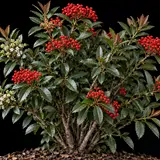
Completes the classic chaparral trio and adds the one thing manzanita cannot: a shrub that takes pruning and a little more water, flowering in early summer and carrying red berries through winter.
-
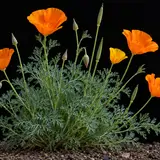
An easy underplanting that asks for exactly the same treatment - lean soil, full sun, no summer water - and simply goes dormant when the dry season shuts the garden down.
- Traditional pairings, thin evidence
-
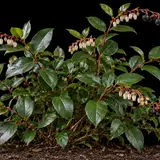
A fellow heath-family evergreen for Pacific Northwest gardens, sharing the acidic, sharply drained, low-fertility conditions manzanita needs, and layering a broader glossy leaf beneath its open branch structure.
Keep apart
-
Irrigated lawns and watered flower bedsA placement rule rather than a plant pairing, and the single most useful line on this page. An established manzanita inside a lawn, in a drip-irrigated bed, or downhill of either will very likely die of root rot within a few years. Keep it at the dry edge of the garden and outside every sprinkler pattern.
Varieties · 7
You pick one when you add Manzanita to your garden. Its days to maturity set your harvest window.
Upright shrub and tree-form manzanita 4 varieties
Howard McMinn (Arctostaphylos densiflora)
Dense rounded shrub to 7 feet with small glossy green leaves, red-brown bark and pale pink winter flowers.
cultivarreliableadaptablemost-plantedThe bulletproof garden manzanita and the right first choice almost everywhere in California. A dense rounded 5-7 foot shrub with small bright green leaves, abundant pink-white winter flowers and good red bark, notably more tolerant of clay, occasional water and light shearing than the rest of the genus. If you have killed manzanitas before, start here.
Dr. Hurd (Arctostaphylos manzanita)
Upright small tree to 15 feet with polished mahogany-red trunks, grey-green leaves and white winter flowers.
cultivartree-formbest-barklargeThe one grown for the trunks: a fast upright selection reaching 10-15 feet and readily limbed up into a small multi-trunked tree with superb smooth mahogany bark. A garden centrepiece, and correspondingly unforgiving - it needs sharp drainage, no summer water, and only careful late-spring pruning, since a lost limb never grows back.
Louis Edmunds (Arctostaphylos bakeri)
Upright shrub to 10 feet with dark red bark, grey-green foliage and clear pink winter flower clusters.
cultivarclay-tolerantpink-flowersmediumAn upright 6-10 foot selection with deep red bark and unusually rich pink flowers, and one of the few manzanitas that tolerates heavier clay and a little more garden water than the rest. A good compromise where the soil is imperfect but you still want the bark and the winter bloom.
Groundcover manzanita and bearberry 3 varieties
Emerald Carpet
Flat dense mat about a foot high with small bright green leaves and pale pink spring flowers.
cultivartoughshade-tolerantmost-planted-groundcoverThe standard groundcover manzanita: a dense, weed-smothering evergreen mat 12-14 inches high and 5-6 feet across, with small bright emerald leaves and pale pink flowers. Noticeably more tolerant of part shade and of occasional summer water than most of the genus, which makes it the practical choice for garden situations rather than pure chaparral.
Point Reyes (Arctostaphylos uva-ursi)
Flat spreading mat of small dark glossy leaves with white-pink flowers and red berries.
cultivarcoastalsalt-tolerantdark-foliageA coastal California selection of bearberry with darker, closely set leaves on a flat spreading mat about a foot high. Tolerant of coastal wind and salt spray and one of the best low covers for a bluff or a dry bank near the sea; less happy in hot dry interior gardens.
Bearberry / Kinnikinnick (Arctostaphylos uva-ursi)
Trailing evergreen mat of small spoon-shaped leaves, bronzing in winter, with pink-white flowers and red berries.
speciesnativevery-cold-hardycircumborealThe cold-climate member of the genus and the answer outside California: a trailing evergreen mat 6-12 inches high, native right across the northern United States and around the northern hemisphere, and hardy to roughly zone 2. Pink-white urn flowers in spring, bright red berries in fall, superb sandy-bank and dune cover - and the source of the uva-ursi leaf of the herbal trade, which is a medicine rather than a tea. Insists on acidic, sandy, sharply drained soil.
Grower tips
Notes from growers, tagged with the zone they grow in. A person reads every post before it appears.
Nobody has posted about Manzanita yet. The first one usually saves someone a season.
Free account. Your post shows your grower name and zone, never your email.