Add it to your home screen and it opens full screen: no browser bars, one tap away, and everything stays signed in. Free, nothing to download from an app store.
- Tap the Share button in your browser
- Scroll down and choose “Add to Home Screen”
- Open GrowSomeFood from your home screen
- Open your browser’s menu
- Choose “Add to Home screen” or “Install app”
- Open GrowSomeFood from your home screen
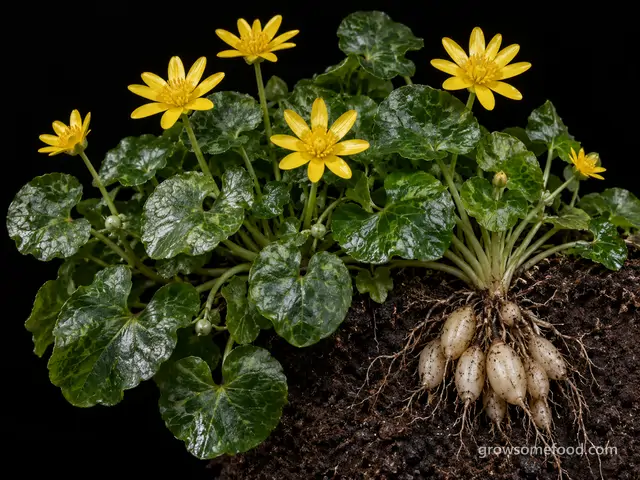
Lesser Celandine
Lesser celandine is NOT food. Like all buttercups it contains ranunculin, which turns to protoanemonin when the tissue is crushed or chewed - it burns and can blister the mouth and throat, causes vomiting and diarrhea, and raises a rash on skin. Wear gloves to pull it. The real risk is a foraging mistake: it comes up in the same moist shade as wild violet and BEFORE violets flower, so never take violet leaves from a patch you have not seen bloom. Toxic to pets and livestock.
Overview
The glossy yellow carpet that takes over floodplains, woodlands and lawns in early spring, erases the native spring wildflowers, then vanishes by June leaving nothing to fight. Never plant it - and never mistake it for a violet.
Lesser celandine (Ficaria verna, long known as Ranunculus ficaria) is the plant that turns a March floodplain into an unbroken sheet of glossy leaves and varnished yellow flowers. It is a spring ephemeral: it emerges in February, weeks ahead of almost everything native, holds the ground through the exact window when trout lily, spring beauty, Virginia bluebells, toothwort and trillium need light before the canopy closes, and then disappears completely by June, leaving bare soil that erodes and reseeds nothing. A woodland that has been carpeted for a few years has lost its spring flora, and with it the early pollen and nectar that specialist native bees emerge to find.
It is also toxic and, for a foraging catalog, it matters twice over. Like every buttercup it carries protoanemonin, which burns and can blister the mouth and throat. And it grows in exactly the same moist shade as wild violet and comes up before violets flower, so the flower check that makes violet leaves safe to pick is unavailable at the moment people pick them. This entry exists to help you identify and control it, to keep you from mistaking it for a violet or for the native marsh marigold, and to be honest that control here is a multi-year job squeezed into a six-week window each spring.
At a glance
- Sun
- Full sun · Part sun · Part shade · Shade
- Water
- Medium
- Spacing
- 3–240 in (typ. 8)
- Mature height
- 2–12 in (typ. 6)
- Start by
- —
- Frost
- Hardy
- Spread
- 4–480 in (typ. 12)
- Soil
- Consistently moist
- Temperature
- Damaged below -30°F · struggles above 95°F
- Self-sows
- Yes — expect volunteers
When to plant
No planting window on record for this zone.
Life stages
- Late-winter emergence (the control window opens) Feb, Mar, Apr (yearly)
-
Recognize it: glossy kidney leaves over fig-like root tubersLesser celandine comes up weeks before almost anything else, forming a low carpet of thick, GLOSSY, dark green, kidney- to heart-shaped leaves on succulent stalks. The decisive check is underground: lift a plant and you find a cluster of fat, cream-colored, fig-like tubers. Wild violet leaves are matte with evenly scalloped edges over plain fibrous roots and no tubers at all. Later in spring some plants also carry small pale bulbils in the leaf axils.
-
This short window is the only time control worksLesser celandine is a spring ephemeral: up from about February, gone by June, and once it is dormant there is nothing above ground to pull or treat. Everything you are going to do about it this year happens now, while it is fully leafed out and the native spring wildflowers around it have not yet emerged. Mark the date - the window is roughly six weeks long, and it does not reopen.
A glossy dark green carpet coming up weeks before anything elseFat fig-like tubers when you lift a plantNative spring ephemerals missing from ground the carpet has taken -
Recognize it: glossy kidney leaves over fig-like root tubers
- Glossy yellow bloom (March to April) Mar, Apr, May (yearly)
-
Varnished yellow flowers with 8 to 12 petalsThe flowers are bright, varnished yellow, about an inch across, usually with 8 to 12 narrow petals - more than a buttercup's five. A solid sheet of glossy yellow in a floodplain, a wet woodland or a lawn in early spring is the signature. Do not confuse it with marsh marigold, a NATIVE of genuinely wet ground: that has 5 to 9 broad yellow sepals, far larger and rounder leaves, no tubers and no bulbils, and grows in discrete clumps rather than a carpet.
-
Treat before or at bloom, never afterControl has to land while the plant is leafy and green and before it starts shutting down. Once the flowers fade, the leaves yellow and vanish within a few weeks, and by June there is nothing left to hit. If you are digging, dig now; if you are treating, treat now - and expect to be back at the same point next year, and the year after that.
Sheets of glossy yellow flowers in early springMarsh marigold, the native lookalike - leave that one aloneBloom fading, which closes the treatment window -
Varnished yellow flowers with 8 to 12 petals
- Gone by June - and that is the trap Jan, Jun, Jul, Aug, Sep, Oct, Nov, Dec (yearly)
-
It vanishes completely, and it has not gone awayBy late May or June the leaves yellow, collapse and disappear, leaving bare soil where the carpet was, and nothing is visible for eight months. The tubers and bulbils are all still there, and the patch returns larger next February. This is exactly why people believe they have solved it and are astonished the following spring - and why control is measured in years, not seasons.
-
Use the off-season to plan, not to digThere is nothing to treat from June onward, and digging blind only scatters tubers. Use the dormant months to map the infestation edges from spring photographs, stage the mulch and replacement plants, arrange help, and put next February in the calendar. Do not move soil, mulch, compost, leaf litter or divided plants off an infested area at any time of year - that is how it reaches new gardens.
Bare ground in summer where a solid carpet stood in AprilSoil, mulch or plant divisions leaving an infested areaNext spring's carpet, noticeably larger than this year's -
It vanishes completely, and it has not gone away
Watch out for
Displacement of Spring Wildflowers High
The core ecological hazard. Lesser celandine emerges weeks ahead of native plants and forms a continuous carpet through exactly the window when trout lily, spring beauty, Virginia bluebells, toothwort and trillium need light before the tree canopy closes. Those species are shaded and crowded out within a few seasons, and the early pollen and nectar that specialist native bees emerge to find goes with them. When the celandine dies back in June it leaves bare, erodible soil with no seed bank left to refill it.
Watch for: An unbroken glossy carpet under trees in March; spring ephemerals thinning or missing from ground that used to carry them; bare eroding soil in June where the carpet stood; the carpet's edge advancing a foot or more each year, especially downstream.
Prevent: Never plant it, in any cultivar. Attack the leading edge and outlying patches first, while they are still small enough to dig. Replant cleared ground with native spring plants promptly, because bare early-spring soil is precisely what it recolonizes.
Treat: Hand-dig small patches within the February-to-May window, sifting for every tuber and bagging the lot. On established carpets use a systemic herbicide in the early window while natives are still dormant, with a product whose label lists the site; follow the label. Near water an aquatic-labelled product and often a permit or licensed applicator are required. Repeat for at least three years.
Root Tubers & Bulbils (why digging backfires) High
Why it is so hard to remove. Every plant sits on a cluster of fat, fig-like root tubers, and a mature carpet banks hundreds per square foot; some subspecies also make small pale bulbils in the leaf axils. Any one of them restarts a colony. Turning the soil in an established stand breaks the clusters up and distributes them, so careless digging reliably makes the patch worse, and raking or mowing in late spring scatters bulbils. Floodwater, moved soil, mulch, compost, potted plants, boots and mower decks all carry them to new ground.
Watch for: Fat cream fig-like tubers when you lift a plant; small pale bulbils in the leaf axils late in the season; new patches appearing downstream of a stand, along a mown line, or wherever topsoil or mulch was delivered.
Prevent: Never move soil, mulch, compost, leaf litter or divided plants off infested ground at any time of year. Do not rake, mow or strim an infested patch in late spring. Clean boots, tools and mower decks after working in it. Dig only where you can be thorough.
Treat: Dig well outside the visible edge, lift soil rather than pulling tops, sift for every tuber, and bag everything for the trash - never the compost heap. On anything larger than a few square feet, switch to a labelled systemic in the early-spring window rather than digging. Re-inspect the same ground every spring for several years.
Protoanemonin (blistering irritant) & the Violet Mix-Up Medium
A direct hazard to people and pets, and a foraging trap. Like all buttercups, lesser celandine contains ranunculin, which converts on crushing or chewing to protoanemonin - an acrid irritant that burns and can blister the mouth, lips and throat and causes vomiting and diarrhea if swallowed, with sap that raises contact dermatitis. The route that actually catches people is misidentification: it grows in the same moist shade as wild violet, whose young leaves are a popular spring green, and it emerges before violets flower, so the flower check that makes violet safe is unavailable at picking time.
Watch for: Burning mouth, lip blistering, drooling or vomiting after anyone chews a leaf; rash on hands and forearms after pulling it bare-handed; anyone gathering violet leaves from a patch that has not yet been seen in flower; pets or livestock in an infested paddock or lawn.
Prevent: Wear gloves to pull or dig it. Never take violet leaves from a patch until you have watched a plant in it open a violet flower - and check the roots, because fig-like tubers mean celandine and fibrous roots mean violet.
Treat: For skin contact, wash promptly and treat as contact dermatitis. If any part has been chewed or swallowed by a person or a pet, rinse the mouth and call poison control or your veterinarian rather than waiting for symptoms.
The Six-Week Control Window Medium
The scheduling problem that defeats most attempts. Lesser celandine is a spring ephemeral: it is present from roughly February to late May and then dies back completely, leaving nothing above ground for eight months. Every control method depends on the plant being there, so from June onward nothing can be done, and the disappearance convinces people the problem is solved while the tuber bank quietly doubles. The same narrowness is an opportunity, though - it is up while native spring wildflowers are still dormant, which is the only moment treatment can spare them.
Watch for: Emergence in late winter, which opens the window - watch the ground, not the calendar, because the date shifts by weeks with latitude and season. Bloom fading and leaves yellowing, which closes it. Bare summer ground where a carpet stood.
Prevent: Diarize it. Photograph the infestation edges at peak so you can find them next year, stage tools, plants and help in advance, and be ready to act the week it emerges rather than the week you get around to it.
Treat: Do all digging and all treatment between emergence and the end of bloom. From June onward, plan and replant only - do not dig blind, which scatters tubers. Then repeat the same window for at least three years.
Varieties · 3
A continuous ankle-high sheet of glossy dark green kidney leaves studded with varnished yellow flowers in early spring; fat cream fig-like tubers below.
The species: a carpeting spring ephemeral with thick glossy kidney-shaped leaves, varnished yellow 8-to-12-petalled flowers in March and April, and clusters of fat fig-like root tubers under every plant. Up in February, gone by June. Spreads by tubers and leaf-axil bulbils carried in floodwater, soil and mulch, and displaces the native spring wildflowers wholesale. Toxic raw. Identify and control it; never plant it.
Varies by species - native woodland spring wildflowers and sedges that share the ground with each other instead of excluding everything.
Plant these instead for early spring ground in part shade: Virginia bluebells, wild ginger, foamflower, golden ragwort (Packera aurea), celandine poppy (Stylophorum diphyllum, for the yellow), woodland phlox, trout lily, and Pennsylvania sedge. For genuinely wet ground, marsh marigold (Caltha palustris) is the native that lesser celandine is mistaken for - keep it, do not spray it. Ask a local native-plant nursery what suits your region.
Same carpeting habit, with dark bronze-marbled foliage, doubled pompon flowers or cream-and-orange blooms depending on selection.
The bronze-leaved, double-flowered and cream selections still propagated and traded as choice early groundcovers. They are the same species with the same tubers and the same ability to carpet a floodplain, and where the species is prohibited the cultivars are covered too. A named cultivar is not a tamed one - the American invasion descends from garden plantings exactly like these.
Grow
How to recognize it and what it is not: glossy kidney leaves over fig-like tubers, 8-12-petalled varnished yellow flowers - not wild violet (matte, scalloped, fibrous roots) and not native marsh marigold (bigger, wetter, no tubers).
You should not plant lesser celandine, so what matters is recognizing it — and separating it from two plants you must not damage.
What it looks like. A low carpet, two to six inches tall, of thick, glossy, dark green, kidney- to heart-shaped leaves on succulent stalks, appearing from about February. In March and April it opens bright, varnished yellow flowers roughly an inch across with 8 to 12 narrow petals. Underground, every plant sits on a cluster of fat, cream-colored, fig-like tubers, and by late spring some subspecies also carry small pale bulbils tucked into the leaf axils. It favors moist ground — floodplains, stream banks, wet woods, damp lawns, ditch shoulders — but it will hold a dry lawn perfectly well once established.
Not wild violet. This is the confusion that puts people in hospital, because violet leaves are a popular spring green and celandine is up first. Four checks, best first. Roots — lift a plant: fat fig-like tubers mean celandine; plain fibrous roots on a rhizome mean violet. Sheen — celandine leaves are thick and glossy, violet leaves matte. Margin — violet edges are evenly scalloped and its new leaves unfurl rolled inward like a scroll. Flower — glossy yellow with 8 to 12 petals, versus violet's five blue-purple ones. The safe rule: do not take leaves from a patch until you have watched a plant in it open a violet flower.
Not marsh marigold. Caltha palustris is a native wetland plant of seeps, streamsides and standing water, and it gets killed by mistake every spring. It is much larger and coarser, with rounded leaves two to seven inches across; its yellow flowers have 5 to 9 broad sepals, not 8 to 12 narrow petals; it grows from fibrous roots with no tubers and no bulbils; and it forms discrete clumps in genuinely wet ground rather than a continuous carpet. If you are standing in water looking at a big clumped plant, stop and leave it alone. (Marsh marigold is a buttercup too and equally toxic raw — but it is native, and it belongs there.)
Not greater celandine or celandine poppy. Both share the name and neither is this. Chelidonium majus and the native Stylophorum diphyllum are poppies with deeply lobed leaves and orange-yellow sap, upright rather than carpeting.
Propagation & seed saving
How it spreads - and why digging usually backfires: fat root tubers and leaf-axil bulbils, moved by floodwater, soil, mulch, mowers, boots and gardeners. One tuber restarts a colony.
Lesser celandine barely bothers with seed in North America. It spreads almost entirely by two vegetative propagules, and both are small, abundant and easy to move without noticing.
Root tubers. Every plant sits on a cluster of fat, cream, fig-like tubers, and a mature carpet lays down an enormous number of them — a square foot of infested floodplain can hold hundreds. Each one is capable of restarting a colony on its own. This is the single most important fact about controlling the plant: digging that leaves tubers behind makes the patch worse, because turning the soil breaks the cluster up and distributes it. Hand-digging is only worth attempting on a small, new patch where you can sift the soil and lift every last one.
Bulbils. Some subspecies produce small pale bulbils in the leaf axils late in the season. They drop off, wash away and grow, which is why raking, mowing or strimming an infested patch in late spring scatters it.
Both propagules travel readily in floodwater — hence the plant's affinity for floodplains and stream corridors, where high water lays down a fresh carpet each year — and in moved soil, mulch, compost, potted plants, leaf litter, boots, tires and mower decks. A single potted division shared over a fence, or one load of contaminated topsoil, is how most new neighborhood infestations begin. Never move soil or plants off an infested area, at any time of year.
Care
Control, not care: everything happens in a six-week window each spring. Hand-dig only small new patches, sifting for every tuber; treat established carpets with a labelled systemic while natives are still dormant; repeat for at least three years.
For lesser celandine, care means control, and the defining constraint is the calendar. The plant is only present from about February to late May, so every option closes by June. Plan the year around that window.
Small, new patches: dig them. Hand-digging genuinely works if the patch is small and you are thorough. Dig well outside the visible edge, lift the soil rather than pulling the tops, and sift for every tuber — a tuber the size of a grain of rice will restart the colony. Bag everything and put it in the trash. Do not compost it and do not shake soil off into the bed. Wear gloves: the sap raises a rash. Expect to come back to the same square yard for two or three springs.
Established carpets: digging backfires. On anything larger than a few square feet, turning the soil breaks up the tuber clusters and spreads them. For these, the standard extension recommendation is a systemic herbicide applied in the narrow window when celandine is fully leafed out but the native spring ephemerals around it have not yet emerged — typically late winter into very early spring, before or at first bloom. That timing is the whole point: it is the only moment when you can treat the invader without killing the natives you are trying to rescue. Use a product whose label lists the site you are treating, and follow the label; it is legally binding, not advisory.
Near water, the rules change. Lesser celandine's heartland is floodplains and stream banks. Applying herbicide in or adjacent to water requires a product carrying an aquatic label, and in many states a permit and/or a licensed applicator. Check with your state environmental or agriculture agency, or your county extension office, before treating any streamside or wetland stand.
Smothering a small patch with heavy cardboard or black plastic for a full growing season also works and avoids chemicals, though it kills whatever else is under it.
Whatever you do, plan on three years minimum, and usually more, because the tuber bank outlasts a single treatment. Then replant the ground promptly — Virginia bluebells, wild ginger, foamflower, golden ragwort, celandine poppy, woodland phlox, native sedges — because bare spring soil is exactly what celandine recolonizes.
Traditional & historical uses
The old name pilewort records a doctrine-of-signatures use for hemorrhoids: the knobbly root tubers were thought to resemble them. That is essentially the whole medicinal record, and the plant is a blistering irritant raw. Historical only - never self-use. Educational, not medical advice.
This section records how people have traditionally used this plant, and what is known about the risks. It is history and general information — not medical advice, and not a recommendation to treat anything. Plants are not dosed like medicines, some interact with prescriptions, and some are harmful in ways that are not obvious. Talk to a clinician before using any plant medicinally.
Lesser celandine's herbal reputation rests almost entirely on one idea, and it is worth knowing precisely because it explains a name people still meet. The plant's country name is pilewort, and its use for hemorrhoids comes from the doctrine of signatures — the belief that a plant advertises its purpose by its appearance. The cluster of knobbly root tubers was thought to resemble piles, and so ointments and suppositories were made from the root and applied externally. That is a resemblance, not an observation, and it is close to the whole of the record. There is no meaningful modern clinical evidence behind it.
The safety side is not ambiguous. Lesser celandine contains ranunculin, which converts on crushing or chewing to protoanemonin, an acrid blistering irritant: it burns the mouth and throat, can raise blisters on the lips and skin, and causes vomiting and diarrhea if swallowed. Drying and cooking convert protoanemonin to comparatively harmless anemonin, which is why the traditional preparations used dried root and why some European traditions boiled the very young pre-flowering leaves as a scurvy green. That is an explanation of old practice, not a recommendation: the toxin rises sharply as the plant approaches bloom, the margin for error is thin, and there is nothing here worth the risk when violet, chickweed, dandelion and a dozen other spring greens are safe. It is also toxic to pets and livestock, which normally refuse it.
This is historical and educational information, not medical advice — and on top of the toxicity, this is an invasive plant to remove rather than harvest.
History
A beloved English spring flower - Wordsworth wrote three poems to it and had it carved on his memorial - deliberately introduced to American gardens as an early groundcover, from which every US infestation descends.
In its native Europe lesser celandine is a small, welcome, entirely well-behaved harbinger of spring, and it is genuinely beloved there. Wordsworth wrote three poems in its honor and it was carved on his memorial (by most accounts the carver used the wrong celandine, which is a fittingly confusing footnote for a plant with this many namesakes). It appears throughout English nature writing as the first varnished yellow of the year, and it stays put in the European woods that co-evolved with it.
It came to North America as a garden plant, planted deliberately for exactly the trait that now defines the problem: it covers ground very early, when nothing else does. Ornamental selections — bronze-leaved, double-flowered, cream forms — are still propagated and traded, and they are the same species with the same tubers. Every American infestation traces back to a planting, and from those plantings floodwater did the rest, which is why the worst stands follow rivers and creeks.
Recognition came late. Lesser celandine is now on the prohibited-plant lists of Massachusetts and Connecticut, is listed as a noxious weed in Washington, and is restricted or listed in a number of other states; the lists differ and have been changing, so check your own state's invasive-plant and noxious-weed list before you buy anything sold as fig buttercup or an early yellow groundcover. Its history is the ordinary shape of an ornamental invasion: a plant that is charming at home, sold on its charm, and unstoppable once the local rivers get hold of it.
Troubleshooting
Confirm it by the tubers, keep it separate from wild violet and native marsh marigold, do everything in the February-to-May window, dig only small patches, treat carpets while natives are dormant, and expect three years or more.
Is this lesser celandine or a wild violet? Lift a plant. A cluster of fat, fig-like tubers means celandine; plain fibrous roots on a rhizome mean violet. Then check the leaf: celandine is thick and glossy, violet is matte with evenly scalloped edges. Never pick violet leaves from a patch you have not seen open a violet flower — celandine is up first, so the flower check is not available when people are picking. Is this the native marsh marigold? Possibly, and if so leave it alone. Marsh marigold is much larger, has rounded leaves two to seven inches across, has 5 to 9 broad yellow sepals rather than 8 to 12 narrow petals, has no tubers and no bulbils, grows in genuinely wet ground, and forms clumps rather than a carpet. What about greater celandine or celandine poppy? Different plants entirely — both are poppies with deeply lobed leaves and colored sap, upright rather than carpeting. Can I eat it? No. Protoanemonin burns and blisters the mouth; drying and cooking destroy it, which is why old European recipes exist, but the margin is thin and there is no reason to take it. When do I treat it? Between roughly February and May, while it is fully leafed out and the native spring wildflowers have not yet emerged. After early June there is nothing above ground and nothing works. Can I just dig it up? Only a small new patch, and only if you sift the soil for every tuber and bag it all. On an established carpet, digging breaks up the tuber clusters and makes it worse. What about herbicide? A systemic applied in that early window is the standard recommendation for carpets; use a product whose label lists the site and follow the label. On a stream bank or wetland you need an aquatic-labelled product and often a permit or licensed applicator — ask your state agency or extension office first. It vanished in June, did I win? No. It is a spring ephemeral and goes dormant on its own; the tubers are all still there and the patch will be bigger next February. It came back for the third year. Expected. Three years is a minimum, not a worst case. How did it get into my yard? Usually floodwater, or contaminated topsoil, mulch or a shared potted plant — so never move soil or plants off infested ground.
Growing across climates
Naturalized roughly zones 4-9, worst on floodplains and stream corridors of the mid-Atlantic, Northeast and Pacific Northwest; moisture and flooding, not temperature, decide where it explodes.
Lesser celandine is hardy roughly zones 4-9 and naturalized across much of that range, but its distribution is written by water rather than temperature. Its worst infestations follow floodplains, stream corridors and river bottoms, where annual high water lifts tubers and bulbils out of one stand and lays them down in a fresh carpet a mile downstream. The mid-Atlantic and Northeast — Pennsylvania, Maryland, Virginia, New Jersey, New York, New England — and the wet, mild Pacific Northwest carry the heaviest stands.
Cold north (zones 4-5): present and spreading, though a late-arriving spring compresses an already short control window — watch for emergence rather than trusting a calendar date. Mid-Atlantic and Northeast (zones 6-7): the core of the problem, in floodplain forest, damp lawns and suburban stream buffers. Pacific Northwest (zones 7-8): mild wet winters suit it exactly, and it starts even earlier. Southeast (zones 8-9): present but less dominant, as its cool-season habit fits the region less well. Arid West: confined to irrigated ground and riparian strips.
Wherever you are, the practical guidance is the same and it is a calendar problem: watch for the glossy carpet to emerge, act while it is up and the natives are not, check upstream of anything you clear, and never move soil off infested ground.
No grower tips for Lesser Celandine yet — yours could be the first.
Sign in to share what works in your garden.