Kudzu

Pueraria montana var. lobata · Fabaceae
Other Perennial Vine Other
Introduced - native to East Asia (Japan, China, Korea); a catastrophic invasive across the southeastern US
Not recommended to plant. Do NOT plant this. Kudzu is one of the most destructive invasives in North America - it grows up to a foot a day, smothers trees, buildings, and whole hillsides, and is a listed noxious weed illegal to plant or spread in many states. This entry is for identification and control.

Kudzu is not toxic - its starchy roots ('Japanese arrowroot'), young leaves, and flowers are edible and used in Asian cooking. The real hazard is ecological and legal: it is a listed noxious/invasive weed in many US states where planting or transporting it is illegal, and it smothers native plants and buildings. Do not plant it; if foraging from existing stands take only unsprayed plants (many are herbicide-treated), and never spread any root or stem fragment, which can start a new infestation.

Overview

'The vine that ate the South' - one of the most destructive invasive plants in North America, smothering forests and buildings at up to a foot a day. Never plant it; this entry is for identifying and controlling it.

Kudzu (Pueraria montana) is the infamous invasive vine that has come to symbolize ecological invasion in America - 'the vine that ate the South.' A vigorous climbing legume from East Asia, it grows explosively in warm climates (up to a foot a day in summer), blanketing trees, fields, fences, buildings, and whole hillsides in solid green sheets, shading out and killing everything beneath it. It's a listed noxious weed in many states, where planting, selling, or transporting it is illegal.

This entry exists to help you recognize and control kudzu - never to plant it. It's worth knowing, honestly, that kudzu is not evil in itself: in its native Asia it's a valued plant, and even in North America its roots, young leaves, and grape-scented flowers are edible (the root yields a fine starch, 'Japanese arrowroot') and it has traditional medicinal uses. But in the American landscape it's a catastrophic invader with no natural checks, and the responsible response is to identify it, control it, and above all never introduce or spread it.

At a glance

Sun
Full sun · Part sun
Water
Medium
Spacing
24–1200 in (typ. 120)
Mature height
120–1200 in (typ. 600)
Start by
Direct sow
Frost
Hardy

When to plant

No planting window on record for this zone.

Life stages

  1. Explosive growth (identify & control) Apr, May, Jun, Jul, Aug, Sep (yearly)
    • Recognize it: leaves of three, foot-a-day growth
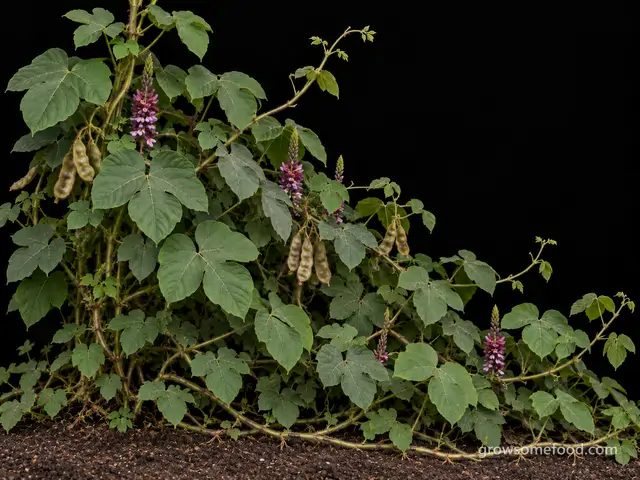
      Kudzu is a fast, hairy, climbing/sprawling vine with large compound leaves of THREE broad, often lobed leaflets. In summer it can grow up to a foot a day, blanketing trees, fences, and hillsides in a solid green sheet. If you see a vine smothering everything in its path, it's likely kudzu.
    • Control it - do not let it establish
      Kudzu is extremely hard to remove once established (it stores energy in huge tuberous roots). Control means persistent grazing, repeated close mowing/cutting, or targeted herbicide over multiple years - and digging out the root crowns. Never let it set seed or root at the nodes, and never plant it.
    Vines smothering trees, structures, and groundRooting at stem nodes (each node can start a new plant)Up-to-a-foot-a-day summer growth
  2. Late-summer flowers & pods Aug, Sep (yearly)
    • Fragrant purple grape-scented flowers
      In late summer, hidden among the leaves, kudzu bears spikes of reddish-purple, sweetly grape-scented pea flowers (it's a legume), followed by hairy seed pods. The flowers are edible (made into jelly and syrup) - but flowering means it's spreading, so control it.
    • Remove before it seeds and spreads
      Beyond seed, kudzu spreads mainly by rooting stems and its enormous root system, so cutting alone won't kill it. Remove or treat plants persistently; report new infestations to local authorities where required.
    Purple grape-scented flower spikesHairy seed podsContinued spread by rooting stems
  3. Winter die-back (roots survive) Jan, Feb, Mar, Nov, Dec (yearly)
    • Top dies back, huge roots persist - keep after it
      Frost kills the top growth, leaving a tangle of bare vines - but the massive tuberous roots (which can be huge and deep) survive and resprout with a vengeance in spring. Winter is a good time to dig out root crowns and plan the multi-year control campaign that eradication requires.
    Dead top growth over surviving rootsRoot crowns to dig outVigorous spring resprouting

Watch out for

Invasive Smothering (ecological harm) Disorder HighApr, May, Jun, Jul, Aug, Sep, Oct

The core hazard is ecological: kudzu grows so fast and dense that it smothers and kills native trees, shrubs, and whole plant communities, and overwhelms structures - one of the most destructive invasives in North America.

Watch for: Vines rapidly blanketing and killing trees, shrubs, fences, and buildings under a solid green sheet.

Prevent: NEVER plant it; remove small new infestations immediately before they establish; check local noxious-weed rules.

Treat: Multi-year control: repeated cutting/mowing, grazing, targeted herbicide, and root-crown removal; report new infestations to authorities where required.

Regrowth from Roots & Fragments Disorder HighMar, Apr, May, Jun, Jul, Aug, Sep

Why it's so hard to kill and why it spreads: kudzu resprouts vigorously from its huge tuberous roots, roots at every stem node, and can start anew from fragments - so cutting alone fails and careless disposal spreads it.

Watch for: Vigorous resprouting after cutting, rooting where stems touch soil, and new plants from dumped fragments.

Prevent: Never spread stem/root fragments; bag and dispose of material properly (don't compost or dump); clean equipment.

Treat: Sustained control over several years to exhaust the roots; dig out root crowns; combine methods and persist.

Varieties · 1

Kudzu (Pueraria montana var. lobata)
speciesinvasivedo-not-plantnoxious-weedclimbing-vineedible-root

The invasive kudzu vine: a fast-growing hairy legume with three-leaflet leaves that smothers landscapes at up to a foot a day, spreading by seed, rooting stems, and huge tuberous roots. A listed noxious weed in many states - identify and control, never plant. (Roots, leaves, and flowers are edible where foraged from unsprayed stands.)

Grow

How to recognize it (and why never to plant it): a fast, hairy vine with big three-leaflet leaves that smothers everything, spreading by rooting stems and massive roots - illegal to plant in many states.

You must never plant kudzu - and in many states it's illegal to do so. What matters is recognizing it: a fast-growing, hairy, climbing and trailing vine with large compound leaves of three broad, often lobed leaflets, forming dense blankets over anything in its path. In late summer it bears spikes of reddish-purple, grape-scented pea flowers (it's a legume, and fixes nitrogen). Its signature is speed and coverage - a vine visibly smothering trees and structures under a solid green sheet is almost certainly kudzu.

It spreads three ways, which is why it's so hard to stop: by seed, by rooting at every stem node that touches soil, and from a huge tuberous root system that can weigh hundreds of pounds and resprout endlessly. It thrives in warm climates (it's most aggressive in the Southeast) in sun and disturbed ground. Understanding this growth is the key to controlling it - and to appreciating why introducing it anywhere is a serious mistake with landscape-scale consequences.

Care

Control, not care: eradicating established kudzu takes years of persistent cutting/mowing, grazing, or targeted herbicide plus digging out root crowns - and never letting any fragment spread.

For kudzu, 'care' means control and eradication, and it's a multi-year campaign because the plant regrows from its enormous roots. Effective approaches, usually combined: repeated close cutting or mowing through the growing season to starve the roots; intensive grazing (goats and other livestock will knock it back over time); and targeted herbicide applied to the growing plant or cut stumps - all sustained over several years, plus digging out the root crowns where feasible. There's no quick fix; persistence is everything.

Crucially, never spread it: stem and root fragments can start new infestations, so bag and dispose of material properly (don't compost or dump it), clean equipment, and follow local rules - in many areas kudzu is a regulated noxious weed and new sightings should be reported to authorities. For large infestations, work with your local extension office or invasive-species program. And of course, the single most important 'control' is prevention: never plant kudzu, and remove small, new patches immediately before they establish that unstoppable root system.

Nutrition

Honestly, its roots, leaves, and flowers are edible and nutritious (a valued food and medicine in Asia) - but in North America it's a destructive invasive to control, not cultivate.

Here's the honest paradox of kudzu: it's genuinely edible and useful, yet must not be grown. In its native East Asia, kudzu is a valued crop - its root yields a prized starch ('kuzu' or Japanese arrowroot) used as a thickener and in traditional medicine (kudzu root, ge gen, is a long-used herb), its young leaves are eaten as a cooked green, and its fragrant flowers are made into jelly and syrup. It's nutritious, high in fiber and beneficial compounds, and it fixes nitrogen as a legume.

But in North America, none of that outweighs its ecological destruction. Kudzu has no natural controls here and smothers native forests and habitats on a massive scale, so it is emphatically a plant to control, not cultivate. If you want to make use of an existing infestation, you can forage its edible parts (from unsprayed stands only - many are herbicide-treated) as one small way to turn an invasion to account - but you must never plant it, never spread a fragment, and never let foraging become an excuse to keep it around. The right relationship with kudzu in North America is eradication, with a side of using what you remove.

Medicine

Kudzu root ('ge gen') is a major traditional Chinese medicine used for centuries for fevers, headache, and - famously - to reduce alcohol craving, a use now backed by some modern research on its isoflavones (puerarin). It is a genuine, non-toxic herbal plant in its native Asia; in North America, though, it is a destructive invasive to control, not cultivate. Educational, not medical advice.

Unlike most of the plants people fear, kudzu is a celebrated medicinal herb in its native range. Kudzu root, known in traditional Chinese medicine as ge gen (Radix puerariae), has been used for well over a thousand years — it appears in classical Chinese herbals for fevers, headache, stiff neck, thirst, and digestive upset, and the flowers were traditionally used for hangover and to ease the effects of alcohol. That last use has drawn real modern scientific interest: kudzu is rich in isoflavones such as puerarin, daidzein, and daidzin, and a number of studies have explored kudzu extract for reducing alcohol craving and intake and for cardiovascular and menopausal symptoms, with promising but not yet conclusive results.

So kudzu's medicinal tradition is genuine and, unusually, partly research-backed — and the plant is not toxic. The important honesty here is ecological and legal rather than about safety: in North America kudzu is a catastrophic invasive and a listed noxious weed that must never be planted or spread. Standardized kudzu supplements exist commercially, and any herbal use should rely on those or on qualified practitioners rather than on wild plants (many US stands are also herbicide-treated). This is educational information, not medical advice — and never an excuse to keep or propagate an invasive vine.

History

Introduced to the US as an ornamental and erosion-control plant in the early 1900s - even promoted by the government - kudzu escaped to become the icon of invasive-species disaster.

Kudzu's history is a cautionary tale about introducing plants. It arrived in the US at the 1876 Centennial Exposition as an ornamental, was widely promoted in the early 20th century as a fast-growing shade and forage plant, and - most fatefully - was planted en masse by the government in the 1930s-40s (the Soil Conservation Service even paid farmers to plant it) to control erosion on the denuded, gullied soils of the Depression-era South. It did control erosion; it also found the warm, humid Southeast perfectly suited and, with no natural enemies, exploded across the landscape.

By the 1950s kudzu was recognized as a weed rather than a savior, and in 1997 it was listed as a federal noxious weed. It has since become the enduring American symbol of invasive-species disaster - the green vines draping Southern forests and abandoned buildings are an iconic image. (Its actual acreage is often exaggerated, but its destructiveness where it does take hold is very real.) The lesson has shaped modern caution about introducing non-native plants: a species prized in one place can become a catastrophe in another, which is exactly why kudzu belongs in the 'never plant' category.

Troubleshooting

Confirm it (fast three-leaflet vine smothering everything), never plant or spread it, control it over years by cutting/grazing/herbicide plus root removal, and report new infestations where required.

Is this kudzu? Look for a fast, hairy, climbing/trailing vine with large compound leaves of three broad, often-lobed leaflets, smothering trees and structures under a green blanket, with reddish-purple grape-scented flower spikes in late summer. Its sheer coverage and speed are diagnostic. How do I get rid of it? There's no quick fix - it regrows from massive roots; combine repeated cutting/mowing, grazing, and targeted herbicide over several years, dig out root crowns, and be relentless. Can I just cut it down? Cutting alone won't kill established kudzu (the roots resprout) - it must be combined with sustained control and root removal. Is it legal to have/plant? In many states kudzu is a regulated noxious weed that's illegal to plant, sell, or transport, and new infestations should be reported to authorities - check your local rules. Can I eat it? Yes, its roots/leaves/flowers are edible from unsprayed existing stands, but never plant it or spread fragments, and don't let foraging become a reason to keep it. It came back after I removed it: expected - persistent multi-year control is required to exhaust the roots.

Growing across climates

Most catastrophic in the warm, humid Southeast (zones 6-10); it spreads with warming climate but is checked by hard winters, making it far less aggressive in cold-winter northern zones.

Kudzu's aggressiveness is strongly tied to climate. It's most devastating in the warm, humid Southeast (roughly zones 7-10), where long hot summers and mild winters let it grow explosively and its roots survive to resprout - this is its notorious 'ate the South' heartland. In zones 6-7 it's still a serious invader but somewhat more checked by winter. In colder northern zones (5 and below), hard winters kill more of the plant and limit its spread, so while it can persist, it's far less aggressive - which is one reason its worst impacts are regional.

A warming climate, however, has been allowing kudzu (and other warm-adapted invasives) to creep northward over recent decades, expanding its potential range. Wherever you are, the guidance is the same: never plant it, learn to recognize it, and control small infestations immediately - the difference between a manageable patch and an unstoppable blanket is often just a season or two of unchecked growth in a climate that suits it. It's a plant whose danger scales with warmth, and whose management is always easier the earlier you catch it.

No grower tips for Kudzu yet — yours could be the first.

Sign in to share what works in your garden.

Connection interrupted

Reconnecting to GrowSomeFood

Keep this page open. We are trying to restore your garden session.

Attempt of . Retrying automatically.

Still offline

Could not reconnect

Your phone may have switched networks or gone to sleep. Try again when the signal is steady.

Session expired

Reload to continue

This garden session is no longer available on the server. Reloading will start a fresh session.