Add it to your home screen and it opens full screen: no browser bars, one tap away, and everything stays signed in. Free, nothing to download from an app store.
- Tap the Share button in your browser
- Scroll down and choose “Add to Home Screen”
- Open GrowSomeFood from your home screen
- Open your browser’s menu
- Choose “Add to Home screen” or “Install app”
- Open GrowSomeFood from your home screen
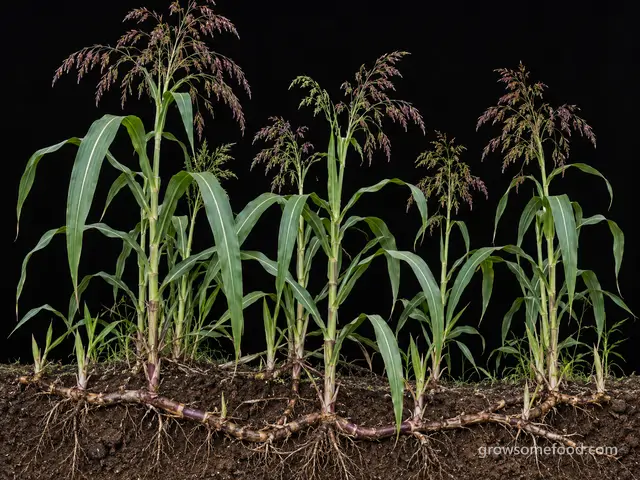
Johnsongrass
A coarse 3-8 foot grass with a white leaf midrib, thick creeping rhizomes, and an open purplish seedhead - a listed noxious weed in many states that also kills cattle and horses with prussic acid after frost or drought. It is the rhizomes that make it confusable with the sorghum crop, and the frost that makes it lethal.
This is a livestock killer, not a garden hazard. Johnsongrass foliage releases hydrogen cyanide (prussic acid), and the danger peaks in shoots under about 18-24 inches, in drought-stressed plants, and in foliage hit by frost - animals can die within an hour. It also accumulates nitrate, and unlike cyanide, nitrate does NOT break down when the plant is cut and cured for hay. Keep stock off it after frost or drought, and test suspect hay before feeding. It is not a human food.
Overview
Johnsongrass (Sorghum halepense) is a big, coarse perennial grass, 3 to 8 feet tall, with broad blades carrying a conspicuous white midrib, an open purplish seedhead, and a dense mat of thick, creeping rhizomes just under the soil. It is a listed noxious weed in many states, one of the worst weeds of row-crop agriculture worldwide, and it takes over pastures, fence lines, ditches, field edges, and any rural property that stops mowing for a season.
Two things make it more than an ordinary weed. The first is that it is genuinely dangerous to livestock. Like its crop relative sorghum, its foliage makes a compound that releases hydrogen cyanide (prussic acid), and the concentration spikes in three situations: young shoots and regrowth under about 18-24 inches, drought-stressed plants, and above all foliage hit by frost. Cattle, sheep, and horses can die within an hour. It also accumulates nitrate - a different poison with a crucial difference: cyanide largely dissipates when the plant is cut and cured, but nitrate does not, so it rides straight into the hay bale.
The second is that people confuse it with the sorghum crop. Grain sorghum, sudangrass, and the sorghum-sudan hybrids are annuals with no rhizomes and a compact seedhead; johnsongrass is a perennial with thick creeping rhizomes and a loose open panicle. Shattercane, another sorghum weed, is also an annual with no rhizomes. If you dig it up and find a thick scaly creeping underground stem, it is johnsongrass.
Nobody should plant it, and the app will never offer it. This entry is here so you can identify it, keep animals safe around it, and work out a control plan that actually depletes the rhizomes.
Quick facts
For identification. Not a growing guide.
- Life cycle
- Perennial, lives about 15 years
- Where it grows
- Full sun · Part sun, well-drained soil
- Height
- 6 ft3 to 8
- Spread
- 96 in24 to 360
- Cold
- Takes light frostdamaged below -10°F
- Heat
- Struggles above 110°F
- Self-sows
- Yes. Never let it set seed.
Through the year
How to recognize it in each season.
Spring emergence (from seed and from rhizomes)
Mar to May, every year- Recognize it: a big coarse grass with a white midribJohnsongrass comes up as a stout, coarse grass with broad blades half an inch to an inch wide, each carrying a conspicuous whitish midrib down the centre. Shoots from rhizomes appear first and grow fast; seedlings are slimmer and come later. Dig one up: if there is a thick, fleshy, creeping underground stem with purple-brown scaly nodes attached, it is johnsongrass and not a sorghum crop plant or shattercane.
- Keep animals off short spring regrowthThis is the highest-risk foliage of the year. Young shoots and regrowth under about 18-24 inches carry the highest concentration of the compound that releases hydrogen cyanide, and cattle, sheep, and horses can die within an hour of grazing it. Do not turn animals onto a paddock with short johnsongrass regrowth, and do not offer freshly pulled plants to livestock as green feed.
Key signs- Broad blades with a white midrib, coming up faster than surrounding grass
- Thick scaly rhizomes when you dig a shoot
- Short regrowth in any paddock or hay field - the peak prussic acid risk
Rapid growth to 3-8 feet
May to Jul, every year- Mow or cut repeatedly - and start before the seedheads formA single mowing does nothing but stimulate rhizome shoots. Cut the stand low and repeat every three to four weeks through the whole season, for two to three seasons, to run the rhizome reserves down. In a garden or fence line, dig entire rhizome systems out when the soil is moist and follow the runners as far as they go, then check the same ground monthly - anything you snapped off will resprout.
- Do not till or disc an infested areaRhizome pieces with a single node will start new plants, so a tiller or disc turns one patch into a field of evenly spaced plants. This is how johnsongrass moved through row-crop country. If ground must be worked, do it once and commit to relentless follow-up; otherwise leave it undisturbed and rely on cutting and competition.
- Check for prussic acid risk before any grazingCyanide risk stays high in fast-growing young foliage and rises again in any drought-stressed stand. The standard rule is not to graze johnsongrass under 18-24 inches, not to graze drought-stressed stands, and not to turn hungry animals onto it. If in doubt, cut a sample and have your extension office or vet arrange a prussic acid or nitrate test rather than guessing.
Key signs- Stems reaching 3-8 feet and shading out the crop or pasture
- Rhizomes running along tilled edges and fence lines
- Drought stress, which raises cyanide risk in foliage that looks fine
Open purplish seedhead (stop it here)
Jun to Sep, every year- The seedhead is the clearest ID against sorghumJohnsongrass carries a large, loose, OPEN purplish panicle up to a foot long, with branches spreading well away from the stalk. Grain sorghum, sudangrass, and shattercane all carry a tighter, more compact head. Combined with the rhizomes underground, the open panicle is what separates the weed from the crop - and shattercane, which also has a looser head, is an annual with no rhizomes at all.
- Cut seedheads before they ripenA single plant can set tens of thousands of seeds, and buried seed stays viable for several years - some studies find a decade or more. Cutting or mowing before the heads colour and harden is the highest-value hour you will spend, because it stops the patch reloading the soil seed bank while you work on the rhizomes.
- If you spray, spray at boot stage or in early fallSystemic herbicide only reaches the rhizomes when sugars are moving downward - at the boot-to-early-heading stage, and again on actively growing regrowth in early fall before frost. Choose a product whose label lists your site: grass-selective products exist for broadleaf crops, non-selective products for spot treatment, and pasture labels carry grazing and haying restrictions. Follow the label exactly - it is legally binding.
Key signs- Large open purplish panicles - the diagnostic seedhead
- Seed colouring and hardening - cut before this
- Boot stage and fall regrowth - the two windows when systemic treatment reaches the rhizomes
Frost and winter (the most dangerous weeks of the year)
Oct to Feb, every year- After a frost, keep every animal off itFrost ruptures the plant's cells and releases a burst of hydrogen cyanide into wilting foliage. This is when most johnsongrass poisonings happen, because the field looks finished for the year. Keep livestock off frosted johnsongrass until the plants are completely brown and dry - commonly given as at least 7 to 14 days after a killing frost - and remember that a light frost that only nips the tops can leave dangerous green regrowth lower down.
- The tops die, the rhizomes survive the winterTop growth is killed by hard frost, but the rhizome network - a dense mat of thick underground stems in the top foot of soil, loaded with the sugars pulled down in fall - overwinters intact through most of its range and resprouts vigorously. Winter is for planning next season's cutting schedule and marking the patch boundary, not for tilling.
Key signs- Frosted, wilting green foliage - the single most dangerous state for grazing animals
- Regrowth after a light frost, which is more dangerous than the frosted tops
- Rhizome mats in the top foot of soil, alive under dead stalks
Hazards
Prussic Acid (cyanide) Poisoning of LivestockSeverity High HazardnowCyanide is volatile and largely dissipates as cut forage dries and cures, so properly cured hay is far lower risk than the standing or wilting plant.
Nitrate behaves the opposite way - see the nitrate entry.
Any grazing animal with access to short johnsongrass regrowth, a drought-stressed stand, or frosted foliage. Poisoning signs are fast: staggering, laboured breathing, and bright cherry-red mucous membranes and blood.
This is a veterinary emergency where minutes decide the outcome - call a veterinarian immediately and move the rest of the herd off. For the stand itself, remove it: repeated cutting every three to four weeks over two to three seasons, plus a systemic herbicide at boot stage or on fall regrowth using a product whose label lists your site.
Do not graze johnsongrass under 18-24 inches, do not graze drought-stressed stands, and keep animals off for at least 7 to 14 days after a killing frost and until plants are fully brown and dry - a light frost that nips the tops can leave dangerous green regrowth below. Never turn hungry animals onto it, and never offer freshly cut or wilting plants as green feed. Herbicide-killed plants are dangerous while wilting for the same reason.
Johnsongrass foliage stores a compound that releases hydrogen cyanide when leaf cells rupture - by chewing, trampling, wilting, or frost. Concentrations peak in young shoots and regrowth under about 18-24 inches, in drought-stressed plants, and in frosted foliage. Cattle, sheep, and horses can die within an hour, and most poisonings happen in autumn because the field looks finished for the year.
Rhizome Spread (why tillage backfires)Severity High DisordernowA patch that gets denser and wider after cultivation; new stands appearing where soil was moved or where equipment worked after an infested field; regrowth three to four weeks after every cut.
A patch that gets denser and wider after cultivation; new stands appearing where soil was moved or where equipment worked after an infested field; regrowth three to four weeks after every cut.
Deplete the rhizomes: cut low every three to four weeks through the whole season for two to three years, and keep the ground under dense competing cover afterwards. Dig small patches out in moist soil following every rhizome to its end, bag the material, and re-check monthly. Systemic herbicide reaches rhizomes only at boot stage or on actively growing fall regrowth - use a product whose label lists your site and follow the label, including any grazing and haying intervals.
Do not till, disc, or rototill infested ground. Keep soil, tools, and harvest equipment from an infested area out of clean ground, and buy certified weed-free hay and crop seed where available.
Johnsongrass builds a dense mat of thick creeping rhizomes in the top foot of soil, and a rhizome piece carrying a single node will start a new plant. Discing, plowing, and rototilling therefore cut the mat into cuttings and plant them evenly across the ground - which is how the weed moved through row-crop country. A single mowing per year removes leaves and stimulates fresh rhizome shoots.
Nitrate Accumulation (persists in hay)Severity High DisordernowJohnsongrass making up a substantial share of hay cut off heavily fertilized ground, or off a stand that went through drought and then got rain.
Johnsongrass making up a substantial share of hay cut off heavily fertilized ground, or off a stand that went through drought and then got rain. Poisoned animals show weakness, rapid breathing, and dark chocolate-brown blood and mucous membranes.
Have suspect hay tested for nitrate before feeding - your extension office or veterinarian can arrange it, and it costs a fraction of one animal. If poisoning is suspected, call a veterinarian immediately; nitrate poisoning has a specific antidote that must be given fast.
Avoid cutting stressed or heavily fertilized stands for forage; cut higher to leave more of the nitrate-rich lower stem in the field; and dilute questionable hay with clean forage only on professional advice.
Johnsongrass accumulates nitrate, especially after heavy nitrogen fertilization and after a drought broken by rain. Unlike cyanide, nitrate is stable: it does NOT break down when the plant is cut, dried, and baled, so hay made from a loaded stand stays dangerous for as long as it is stored. Nitrate concentrates in the lower stem.
Noxious-Weed ListingSeverity Medium DisordernowJohnsongrass in hay, crop seed, or delivered soil, and along shared field boundaries where a neighbour complaint can start enforcement.
Johnsongrass in hay, crop seed, or delivered soil, and along shared field boundaries where a neighbour complaint can start enforcement.
Follow your state or county weed authority's control requirements and keep records. Your local extension office can advise on the control programs, tolerance thresholds, and herbicide options appropriate to your crop or pasture.
Buy certified weed-free hay and crop seed where available, clean equipment between fields, and do not sell or give away hay or soil from an infested area.
Johnsongrass is a listed noxious weed in many states, which can carry a legal duty to control it on land you own and restrictions on selling or moving contaminated crop seed, hay, soil, or equipment. It is also one of the most economically damaging agricultural weeds in the world. Check your own state and county list, since listing is what creates any obligation.
Confusion with the Sorghum CropSeverity Medium DisordernowDig the plant up.
Dig the plant up. Johnsongrass has thick fleshy creeping rhizomes with purple-brown scaly nodes; sorghum, sudangrass, and shattercane are annuals with fibrous roots and no rhizomes. Johnsongrass also carries a large loose open purplish panicle, while crop heads are more compact.
Treat confirmed johnsongrass as a perennial rhizome problem, not an annual one. Shattercane and volunteer sorghum can be beaten by preventing seed set alone; johnsongrass cannot.
Check underground before deciding what a sorghum-like grass is, and scout the margins of sorghum fields where hybridization with adjacent johnsongrass stands is most likely.
Johnsongrass, grain sorghum, sudangrass, and shattercane all look alike above ground and all share the white leaf midrib, so the weed is regularly mistaken for the crop and vice versa. The consequences run both ways: a perennial rhizomatous weed tolerated as a crop volunteer, or a crop stand treated as a weed. Johnsongrass can also hybridize with cultivated sorghum, passing crop traits into a rhizomatous perennial.
Grower tips
Notes from growers, tagged with the zone they grow in. A person reads every post before it appears.
Nobody has posted about Johnsongrass yet.
Free account. Your post shows your grower name and zone, never your email.