Add it to your home screen and it opens full screen: no browser bars, one tap away, and everything stays signed in. Free, nothing to download from an app store.
- Tap the Share button in your browser
- Scroll down and choose “Add to Home Screen”
- Open GrowSomeFood from your home screen
- Open your browser’s menu
- Choose “Add to Home screen” or “Install app”
- Open GrowSomeFood from your home screen
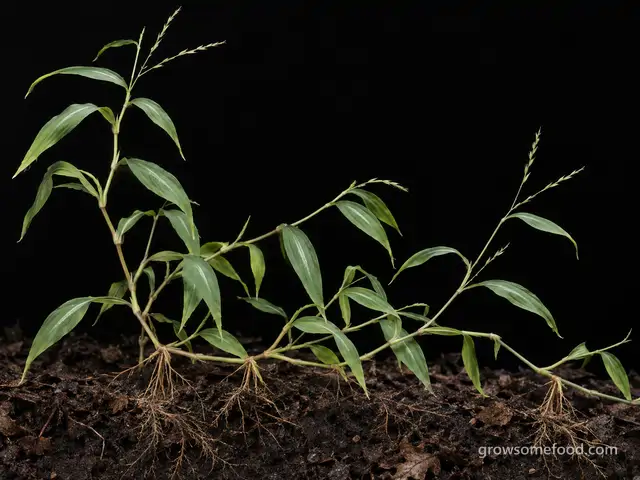
Japanese Stiltgrass
The pale, sprawling grass that has carpeted the eastern forest floor - and the one invasive on this list you can genuinely beat. It is an annual with a three-to-five-year seed bank, so several consecutive years without seed set actually ends it.
Japanese stiltgrass is not poisonous and it is not a food. Handling it is harmless - pulling it barehanded is the standard control. The risks are indirect: cured stiltgrass is dry and flammable, raising fine-fuel fire risk in southern woodlands; it is a favored cover for ticks and mice, so wear long pants and check for ticks after clearing; and any herbicide you use must be a product whose label lists your site - read and follow the label.
Overview
The one thing to knowWhat makes it unusual among invasive grasses is its shade tolerance.
Japanese stiltgrass (Microstegium vimineum) is the pale yellow-green grass that has spread across the floor of eastern woodlands, along trails, ditches, deer paths and shady yard edges from New England to Florida. It arrived in Tennessee around 1919, apparently as packing material for Chinese porcelain, and it now occupies more than half the states in the country.
What makes it unusual among invasive grasses is its shade tolerance. Almost no other aggressive grass can carpet a closed-canopy forest floor, and this one does, growing equally well in full sun. It germinates weeks before native woodland plants, sprawls into a knee-high mat by late summer, and suppresses tree seedlings, native forbs and sedges underneath it. It also changes the ground itself, altering soil pH and nitrogen cycling in ways that persist after it is gone, and it is deeply entangled with deer - deer will not eat it, so heavy browsing on everything else clears the way for it, and deer carry its seed on their hooves and coats.
Here is the part that matters most, and it is genuinely good news. Stiltgrass is an annual. Every plant you see grew from seed this year and will be dead at the first hard frost. Its seed bank lasts roughly three to five years. That means the goal is not to kill a root system that will outlast you - it is simply to prevent seed set for several consecutive years, at which point the seed bank empties and the patch is gone. It pulls out of the ground in armfuls. Of all the plants in this part of the catalog, this is the one where a determined homeowner with a few August afternoons can actually win.
Quick facts
For identification. Not a growing guide.
- Life cycle
- Annual
- Where it grows
- Full sun · Part sun · Part shade · Shade, consistently moist soil
- Height
- 24 in12 to 40
- Spread
- 18 in6 to 48
- Cold
- Killed by frostdamaged below 32°F
- Heat
- Struggles above 100°F
- Self-sows
- Yes. Never let it set seed.
Through the year
How to recognize it in each season.
Very early spring germination (before the natives)
Day 0 to 14 from sowing- It comes up before almost anything else - that is the first clueStiltgrass germinates as soil reaches roughly 50-55F, weeks earlier than most native woodland plants, which is a large part of why it wins. In March and April look for a fine haze of pale yellow-green seedlings on bare ground, along trail edges, deer paths, ditch lines and last year's thatch. If a patch of forest floor greens up conspicuously before the ephemerals, walk into it and look closely.
- Do NOT pull yet - and this is the pre-emergent windowResist pulling in spring. Germination continues for weeks, so clearing early just opens bare soil for the next flush and wastes the effort; late summer is the productive time to pull. Spring is instead the window for a pre-emergent product on large or restoration-grade infestations, applied before germination using a product whose label lists your site, at the label rate. Once seedlings are up, a pre-emergent does nothing.
Key signs- A pale yellow-green haze of seedlings on bare ground weeks before natives emerge
- Germination along trail edges, deer paths, ditch lines and skid trails
- Last year's orange thatch mat with new green coming up through it
Young plants (May-Jun)
Day 21 to 80 from sowing- Find the silver stripe - the single best identification featureHold a leaf to the light and look along the midrib. Japanese stiltgrass carries a distinct off-center line of silvery, reflective hairs down the middle of the upper leaf surface, and no native woodland grass in its range does. The leaves are pale yellow-green, one to three inches long and about half an inch wide, alternate, and set at an angle to thin wiry stems. The whole plant feels soft and slightly limp, not stiff.
- Map now, act in AugustThis is the season to walk the property and flag the boundaries of every patch, because in a month the plant will be everywhere and the edges will be impossible to judge. Note which patches sit upslope or upstream of clean ground, and which sit on the paths you and the deer use most - those are the ones to clear first, because they reseed everything downhill of them.
Key signs- A silvery reflective line down the middle of the upper leaf surface
- Pale yellow-green soft leaves set at an angle on thin wiry stems
- Patches expanding along the routes people, deer and water take through the site
Sprawling summer mat (Jul-Aug)
- Late summer is the pulling season - and it pulls beautifullyBy August the plant has sprawled into a loose knee-high mat on thin branching stems propped up by roots at the lower nodes, which is where the name comes from. Its root system is shallow and fibrous, so it comes up in armfuls with a light tug, even in dry soil. August is the sweet spot: germination is finished, so nothing replaces what you remove, and seed has not yet set. Pile pulled material off the ground, on a tarp or in bags.
- Replant or mulch what you clear, immediatelyBare ground under a cleared patch is a stiltgrass seedbed, and the seed bank is still sitting in it. Cover cleared ground the same day where you can: mulch, leaf litter raked back over, or a sowing of native woodland grasses and sedges if you are restoring. Where you cannot replant, at least avoid churning the soil - disturbance is what this plant is built to exploit.
Key signs- A loose sprawling knee-high mat with stems propped on stilt-like roots at the nodes
- Native forbs, sedges and tree seedlings vanishing from inside the mat
- Bare ground after clearing, which will refill from the seed bank if left open
Seed set (Sep-Oct) - including the hidden flowers
- There are two kinds of flower, and one of them is invisibleIn September thin flowering spikes rise from the stem tips. Those are the obvious ones. Stiltgrass also produces hidden self-pollinating flowers tucked inside the leaf sheaths along the stem, which set seed regardless of pollination, shading, or how small the plant is. That is why a mowed, trampled or heavily shaded plant six inches tall can still seed the ground it stands on, and why a patch that looks beaten is not.
- Mow or string-trim low, in the narrow window before seed ripensCutting works, but the timing is exact. Cut low, around two to three inches, in late August to mid-September as flowering begins. Cut earlier and the plant simply regrows and flowers below the blade; cut later and you scatter ripe seed across everything. If you are unsure, check for flowering spikes and cut within a week or two of first seeing them, and clean the mower deck before moving to clean ground.
Key signs- Thin flowering spikes rising from the stem tips in early fall
- Small, mowed or shaded plants that are still seeding from hidden sheath flowers
- Ripe seed shedding - the point after which any disturbance spreads the infestation
Winter: dead orange thatch over a loaded seed bank
- The orange mat is the best map you will getThe first hard frost kills every plant, and the dead stems collapse into a distinctive pale orange-tan thatch mat that persists all winter and is visible from a long way off. Walk the property now and record the true extent of the infestation - the mat shows you exactly where seed fell, which is exactly where next spring's crop will come up. Photograph the edges as a baseline you can measure against.
- Plan the year, and clean everything that movesWinter is planning time: decide which patches to pull in August, whether a spring pre-emergent is worth it, and where cleared ground will be replanted. It is also the season to fix the vectors, because that is what stops reinfestation. Clean boots, tires, ATVs and mower decks between sites; source fill dirt, hay and mulch from clean ground; and check that nursery stock is not arriving with stiltgrass in the pot.
Key signs- A pale orange-tan thatch mat covering the ground where the stand stood
- The mat mapping exactly where next spring's seedlings will emerge
- Seed and thatch travelling on tires, boots, mower decks and moved soil
Watch out for
5 to know. 3 are high-risk: Deer: They Refuse It, Eat Its Competitors, and Carry the Seed, Forest Floor Takeover & Soil Change, Seed Bank & Hidden Self-Pollinating Flowers. 4 are active in September.
Deer: They Refuse It, Eat Its Competitors, and Carry the SeedSeverity High WildlifenowStiltgrass following deer paths and bedding areas; a browse line and missing understory alongside a thriving stiltgrass carpet; new patches appearing at trail junctions and field edges deer use.
Stiltgrass following deer paths and bedding areas; a browse line and missing understory alongside a thriving stiltgrass carpet; new patches appearing at trail junctions and field edges deer use.
Combine direct control (August pulling, timed low mowing, grass-selective herbicide) with deer exclosure on any area being restored, and expect stiltgrass to return quickly to unfenced ground where browsing keeps the natives suppressed.
Where it is feasible, reduce deer pressure - fencing, exclosures around restoration plantings, or participation in local deer management does more for a stiltgrass site over time than most direct control; protect and replant native competitors so there is something to hold the ground.
A feedback loop that drives the invasion in much of the East. Deer will not eat stiltgrass, but they browse hard on the native forbs, shrubs, tree seedlings and palatable grasses that would otherwise compete with it - so its competitors are removed and it inherits the ground. The deer then carry seed on hooves and coats to the next opening, which is why stiltgrass so often maps onto deer trails, and their browsing keeps the site permanently disturbed and open. Deer exclosure studies repeatedly show stiltgrass thinning inside the fence and dominating outside it.
Forest Floor Takeover & Soil ChangeSeverity High DisordernowA continuous pale carpet on a shaded forest floor; tree seedlings, spring wildflowers and sedges absent inside it and present outside; patches spreading along trails, streams, skid roads, ditches and powerline cuts.
A continuous pale carpet on a shaded forest floor; tree seedlings, spring wildflowers and sedges absent inside it and present outside; patches spreading along trails, streams, skid roads, ditches and powerline cuts.
Pull in August, mow low in the narrow early-September window, or use a grass-selective herbicide where native broadleaf plants must be spared; then cover or replant cleared ground the same day with native sedges, woodland grasses, ferns or mulch, and repeat for several consecutive years.
Treat new arrivals at the edge of an infestation immediately - an afternoon where it has just reached is worth years where it has carpeted the ground; work upstream and uphill of what you want to protect; avoid unnecessary soil disturbance, which it is built to exploit.
The core ecological harm, and unusual because it reaches into closed forest. Almost no other aggressive grass tolerates deep shade; stiltgrass carpets shaded woodland floors as readily as sunny edges, germinating weeks before native plants and sprawling into a dense mat by late summer. It suppresses tree seedling regeneration, displaces native forbs and sedges along with the specialist insects that depend on them, and alters the soil itself - raising pH and changing nitrogen cycling and earthworm activity in ways that can persist after removal and hinder restoration.
Seed Bank & Hidden Self-Pollinating FlowersSeverity High DisordernowThin flowering spikes from late August; small mowed or shaded plants that look beaten but are seeding from the sheaths; a fresh crop of seedlings each spring in ground you cleared the year before.
Thin flowering spikes from late August; small mowed or shaded plants that look beaten but are seeding from the sheaths; a fresh crop of seedlings each spring in ground you cleared the year before.
Commit to three to five consecutive years with no seed set - one missed season restarts the clock, and a completed run finishes the patch. A very early spring pre-emergent prevents the crop on large areas; a grass-selective post-emergent spares broadleaf natives in restoration work. Use a product whose label lists your site and follow the label.
Pull in August before seed ripens; mow low only in the late-August to mid-September window as flowering begins, not earlier (it regrows and flowers under the blade) and not later (you scatter ripe seed); cover cleared ground the same day so bare soil over a live seed bank is not left open.
The reason control fails, and also the reason it can succeed. Each plant produces roughly one hundred to a thousand seeds, viable in the soil for about three to five years. Crucially, seed comes from two sources: open spikes at the stem tips, and closed self-pollinating flowers hidden inside the leaf sheaths that set seed regardless of pollination, shading or plant size - so a plant kept six inches tall by mowing or deep shade still seeds the ground it stands on. Because the plant is an annual with no rhizome, though, three to five consecutive years with zero seed set genuinely empties the bank.
Native Grass Confusion (whitegrass and nimblewill)Severity Medium DisordernowAny grass being pulled or sprayed on habitat alone without a leaf check; native woodland grasses and sedges disappearing from an area under stiltgrass control.
Any grass being pulled or sprayed on habitat alone without a leaf check; native woodland grasses and sedges disappearing from an area under stiltgrass control.
Where natives have been removed in error, replant with native woodland sedges, bottlebrush grass or deertongue and mark the area so it is not treated again; switch to targeted hand-pulling in mixed stands where you cannot spray selectively.
Check the leaf every time: a silvery off-center line of reflective hairs down the upper surface means stiltgrass. Whitegrass has no stripe, rough sandpapery leaf edges, a knotty perennial rhizome, and flowers in July and August; nimblewill has shorter, narrower unstriped leaves. Confirm before using any grass-selective product.
A misidentification hazard that damages the recovery you are trying to produce. Native whitegrass (Leersia virginica) shares stiltgrass's shady moist woodland habitat and has broadly similar leaves, and native nimblewill (Muhlenbergia schreberi) is also mistaken for it - both get pulled, mowed and sprayed in stiltgrass control. Since grass-selective herbicides kill native grasses and sedges just as readily as stiltgrass, an identification error in a restoration setting removes exactly the plants meant to reclaim the ground.
Cured Thatch as Fine FuelSeverity Medium DisorderThe tick and rodent association is a public-health consideration in Lyme-disease areas rather than a plant-health one, but it belongs on the page because it changes how you should dress to do the work.
Continuous cured thatch through the dormant season, particularly against structures, fences and woodpiles; heavy stiltgrass in areas managed with prescribed fire; ticks after working in a stand.
Remove or mow stands near structures before the thatch cures; treat fire-risk clearing as one more reason to complete the multi-year seed-set control rather than as a separate job.
Keep stiltgrass cleared from the immediate defensible space around structures; coordinate with whoever manages prescribed burning on the property, since a stiltgrass carpet changes what a planned burn will do; wear long pants and check for ticks after working in it.
An indirect but real hazard, most significant in the Southeast. Frost kills every plant at once and the stand collapses into a continuous dry orange-tan thatch mat that persists through winter. That mat is a fine fuel: heavy stiltgrass can carry fire through woodland that would not otherwise burn readily, changing fire behavior and intensity, which matters where prescribed burning is used and where houses sit within the woods. The same dense humid mat in the growing season is also well-documented habitat for mice and ticks.
Grower tips
Notes from growers, tagged with the zone they grow in. A person reads every post before it appears.
Nobody has posted about Japanese Stiltgrass yet.
Free account. Your post shows your grower name and zone, never your email.