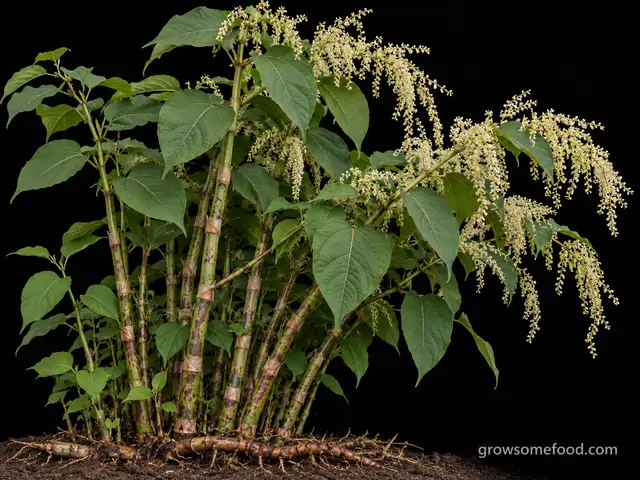
Japanese Knotweed

Reynoutria japonica · Polygonaceae
Other Perennial Herb Other
Introduced - native to East Asia (Japan, China, Korea); one of the most damaging invasive plants across North America and Europe
Not recommended to plant. Do NOT plant this - Japanese knotweed is among the world's most destructive invasives: its rhizomes wreck pavement and foundations, it regrows from a tiny fragment, it is nearly impossible to eradicate, and it is legally regulated in many places. For identification and control.

Japanese knotweed is not poisonous - its young shoots are edible, tart and rhubarb-like (like rhubarb they contain oxalic acid, so eat cooked and in moderation). The real hazards are structural and legal: its rhizomes damage foundations, walls, and drains; it regrows from tiny fragments; and it is a regulated invasive that in many places is illegal to spread. Do NOT plant it, and never move any root or stem fragment - each can start a new, near-unstoppable infestation.

Overview

One of the world's most destructive invasive plants - a bamboo-like thicket whose rhizomes break through foundations and pavement and which regrows from a fingernail-sized fragment. Never plant it; identify and get expert control.

Japanese knotweed (Reynoutria japonica) is widely regarded as one of the most destructive invasive plants in the world. This fast-growing, bamboo-like perennial forms dense 7-10 foot thickets that shade out all other vegetation, and - most notoriously - its powerful underground rhizomes push through pavement, foundations, retaining walls, and drainage pipes, causing serious structural damage. It regrows from a rhizome or stem fragment the size of a fingernail, spreads relentlessly, and is famously almost impossible to eradicate once established.

It's so serious that it's legally regulated in many places, with real consequences: in parts of the world it must be disposed of as controlled waste, spreading it can be an offense, and its presence can even affect property sales and mortgages. This entry is strictly for identification and control - you must never plant it, and you should be careful even removing it (careless cutting or digging spreads it). Honestly, its young shoots are edible like rhubarb, and it has some herbal use - but none of that is a reason to keep this plant; it's one to recognize early and control with expert help.

At a glance

Sun
Full sun · Part sun · Part shade
Water
Medium
Spacing
24–600 in (typ. 120)
Mature height
60–144 in (typ. 96)
Start by
Direct sow
Frost
Hardy

When to plant

No planting window on record for this zone.

Life stages

  1. Spring shoots & bamboo-like canes (identify & control) Apr, May, Jun, Jul, Aug (yearly)
    • Recognize it: red-speckled shoots, then bamboo-like canes
      In spring, reddish-purple asparagus-like shoots emerge fast from the ground, growing into hollow, bamboo-like, green canes (often red-speckled) with zig-zag stems and broad, shovel/heart-shaped leaves in an alternating pattern. By summer it forms dense 7-10 foot thickets. If you see a bamboo-like thicket with shovel-shaped leaves spreading relentlessly, suspect knotweed.
    • Do not cut, dig, or spread it casually
      This is the critical warning: knotweed regrows from tiny rhizome and stem fragments, so careless cutting, digging, mowing, or moving soil SPREADS it. Do not strim/mow it (flinging fragments), do not dig it out and dump the soil, and do not compost it. Effective control usually means professional-grade herbicide over several years, or specialist excavation - identify it and get expert advice before touching it.
    Red-purple asparagus-like spring shootsHollow bamboo-like canes with zig-zag stems and shovel-shaped leavesRhizomes spreading underground and through cracks in pavement/walls
  2. Late-summer flowers Aug, Sep (yearly)
    • Sprays of creamy-white flowers
      In late summer, knotweed produces showy sprays of tiny creamy-white flowers along the stems - attractive, and a late nectar source for bees, but a sign of a well-established, spreading stand. In North America it spreads mainly by rhizome and fragments rather than seed (many stands are a single clone), but the flowering thicket signals how entrenched it is.
    Creamy-white flower sprays in late summerA large, entrenched, spreading thicket
  3. Winter die-back (rhizomes survive) Jan, Feb, Mar, Oct, Nov, Dec (yearly)
    • Canes die, extensive rhizomes persist underground
      The canes die back to reddish-brown hollow stalks over winter (they look like dead bamboo), but the extensive underground rhizome system - which can extend many feet out and deep down - survives and resprouts vigorously in spring. The dead canes and any soil around the stand are still a contamination risk; don't move them. Winter is a planning time for professional control, not casual removal.
    Dead hollow bamboo-like canes over surviving rhizomesVigorous spring resprouting from the rhizome network

Watch out for

Structural & Ecological Damage Disorder HighApr, May, Jun, Jul, Aug, Sep, Oct

The core hazard: knotweed's powerful rhizomes exploit and widen cracks in foundations, walls, pavement, and drains, causing structural damage, while its dense thickets smother native vegetation and destabilize riverbanks - one of the world's most damaging invasives.

Watch for: Canes emerging through or beside pavement, walls, and foundations; dense thickets replacing other vegetation, especially along water.

Prevent: Never plant it; identify and treat small new stands early before the rhizome network entrenches.

Treat: Professional multi-year herbicide or specialist excavation of the rhizome mass; do not attempt casual removal, which spreads it.

Spread by Tiny Fragments Disorder Highyear-round

Why it's nearly unstoppable and why disturbance backfires: knotweed regrows from a rhizome or stem fragment as small as a fingernail, so mowing, cutting, digging, moving soil, or flooding all spread it to new sites.

Watch for: New stands appearing downstream, along mown edges, or where soil was moved from an infested area.

Prevent: Never cut, strim, dig, or move it or its soil casually; never compost or dump it; clean equipment; contain it until properly treated.

Treat: Expert control and legally compliant disposal as controlled waste; never spread fragments - a single piece can start a new infestation.

Legal & Property Consequences Disorder Mediumyear-round

A hazard beyond biology: in many jurisdictions knotweed is legally regulated - spreading it or improperly disposing of it can be an offense, its waste is controlled, and its presence can affect property sales, mortgages, and neighbor disputes.

Watch for: Knotweed on or near a property you own, buy, or sell - it can carry legal and financial obligations.

Prevent: Identify it early, don't cause it to spread (including onto neighboring land), dispose lawfully, and disclose where required.

Treat: Get professional treatment and, where relevant, legal/surveyor advice; keep records of treatment for property purposes.

Varieties · 2

Giant & Bohemian Knotweed (Reynoutria sachalinensis / x bohemica)
relatedinvasivedo-not-planteven-largerhybrid

Close relatives and hybrids - giant knotweed (even taller, huge leaves) and the vigorous Bohemian hybrid between the two - that are equally or more invasive and controlled the same way. Same lesson: identify and control, never plant.

Japanese Knotweed (Reynoutria japonica)
speciesinvasivedo-not-plantstructural-damagebamboo-likeedible-shootsregulated

The notorious invasive: a bamboo-like perennial forming 7-10 foot thickets from powerful rhizomes that damage foundations, pavement, and drains and regrow from tiny fragments. Legally regulated in many places. Identify and get expert control; never plant or disturb it casually. (Young shoots are edible, rhubarb-like.)

Grow

How to recognize it and why never to plant or disturb it casually: red-purple spring shoots, hollow bamboo-like zig-zag canes, shovel-shaped leaves, spreading by rhizomes and fragments through anything in their path.

You must never plant Japanese knotweed, and even disturbing it carelessly spreads it - so careful recognition is essential. In spring, reddish-purple, asparagus-like shoots shoot up fast; they grow into hollow, bamboo-like canes (often green with red speckles) with distinctive zig-zag stems and broad, shovel- or heart-shaped leaves arranged alternately, forming dense summer thickets 7-10 feet tall. In late summer it bears sprays of creamy-white flowers. In winter the canes die to hollow reddish-brown stalks that look like dead bamboo.

Its power is underground. An extensive rhizome system can spread many feet horizontally and deep down, exploiting and widening cracks in pavement, foundations, walls, and drains, and it regrows from the tiniest fragment - which is why mowing, strimming, digging, or moving contaminated soil all spread it rather than control it. In North America it reproduces mostly by rhizome and fragment (often as single clones) rather than seed. Understanding this is why the advice is unambiguous: never introduce it, don't disturb it casually, and get expert help to control an established stand.

Care

Expert control, not care: never mow, dig, or spread it casually; effective control means professional-grade herbicide over several years or specialist excavation, with regulated disposal - get expert advice.

Japanese knotweed is the one plant where casual DIY 'care' can make things much worse. Because it regrows from tiny fragments, mowing, strimming, cutting, and digging spread it, and moving contaminated soil starts new infestations - so the first rule is don't disturb it without a proper plan. Effective control almost always requires professional-grade herbicide treatment sustained over several years (repeated applications to knock back the rhizome), or costly specialist excavation and removal of the entire rhizome-laden soil mass. There's no quick or casual fix.

Disposal is also regulated in many jurisdictions: knotweed material and contaminated soil often must be handled as controlled waste (not composted, dumped, or moved), and improper disposal or allowing spread onto neighboring land can carry legal liability. So the right 'care' is: identify it early, don't disturb it, and get expert/professional advice and, where required, licensed contractors. Report it where local rules require. For a small, newly noticed patch, prompt professional treatment is far cheaper than dealing with an entrenched stand - and vastly cheaper than the structural damage it can cause if ignored.

Nutrition

Its young shoots are genuinely edible (tart and rhubarb-like, with vitamin C and resveratrol) - but this is a plant to control, not cultivate; foraging existing stands is fine, keeping the plant is not.

Japanese knotweed presents an honest paradox: it's a destructive invasive that also happens to be edible and even somewhat healthful. Its young spring shoots (harvested while tender, under about a foot tall) are a real foraged food - tart, tangy, and rhubarb-like, used in pies, crumbles, jams, sauces, and even wine. They contain vitamin C, fiber, and are a notable natural source of resveratrol (the compound also linked to red wine and used in supplements), and the root has a history in East Asian herbal medicine.

But - as with kudzu - none of that is a reason to keep or plant the plant, given its structural, ecological, and legal dangers. The sensible stance is: if you have an existing stand (or access to one) that isn't herbicide-treated, you can forage the young shoots and put an invasive to some use (cook them and eat in moderation, since, like rhubarb, they contain oxalic acid) - but you must never plant it, never move a fragment, and never let 'it's edible' become an excuse not to control it. The right relationship with Japanese knotweed is eradication; eating the shoots you cut is, at best, a small consolation prize.

History

Introduced to the West in the 1800s as a prized ornamental and even award-winning garden plant, Japanese knotweed escaped to become a byword for invasive destruction and a legally regulated menace.

Japanese knotweed's history is a striking cautionary tale. Native to East Asia (where natural enemies and volcanic soils keep it in check), it was introduced to Europe in the mid-1800s as an ornamental - admired for its fast growth, bamboo-like form, and late flowers, it was even given a gold medal by a European horticultural society and widely planted in gardens and estates, and it reached North America similarly as a garden and erosion plant. Only later did its capacity for destruction become clear.

Freed from its natural controls, it spread explosively along rivers, railways, roadsides, and gardens, and is now recognized as one of the world's worst invasive species, with strict legal regimes around it in many countries (in the UK, for instance, it's an offense to cause it to spread in the wild, its waste is legally controlled, and it can block property sales and mortgages). Its story - an award-winning garden treasure turned regulated menace - is one of the most-cited examples of why introducing vigorous non-native plants is so risky, and why 'beautiful and easy to grow' can be exactly the wrong reasons to plant something outside its native range.

Troubleshooting

Confirm it (bamboo-like zig-zag canes, shovel leaves, red-purple shoots), do NOT disturb or spread it casually, get expert/professional control, dispose of it lawfully, and act early - it only gets harder.

Is this Japanese knotweed? Look for fast red-purple asparagus-like spring shoots; hollow, bamboo-like, red-speckled canes with zig-zag stems; broad shovel/heart-shaped alternate leaves; 7-10 foot summer thickets; creamy-white late-summer flower sprays; and dead hollow 'bamboo' canes in winter. It's sometimes confused with true bamboo (which is a grass with round jointed canes and grassy leaves) - knotweed's zig-zag stems and shovel leaves distinguish it. What should I do if I have it? Do NOT mow, strim, dig, or move it casually - that spreads it. Get professional advice; effective control is multi-year herbicide or specialist excavation. Can I just dig it out? Rarely successfully by hand - the rhizomes are extensive and regrow from fragments, and moving the soil spreads it; professional removal handles the whole rhizome mass. How do I dispose of it? Often it's legally controlled waste - do not compost, dump, or move it; check and follow local rules. It affects my property/sale: in some places knotweed presence must be declared and can affect mortgages - get professional and, if needed, legal advice. Can I eat it? Young shoots from unsprayed stands, yes (rhubarb-like, in moderation) - but never plant or spread it. Act early: a small new patch is far easier and cheaper to control than an established stand.

Growing across climates

Extremely cold-hardy and widely adaptable across the temperate US (zones 4-9); it thrives in moist, disturbed ground - riverbanks, roadsides, gardens - across a huge range, limited little by climate.

Japanese knotweed is alarmingly adaptable and cold-hardy, invasive across much of the temperate United States and Canada, roughly zones 4-9 (and beyond). It's especially at home in moist, disturbed ground - riverbanks and streamsides (where fragments wash downstream to start new stands), roadsides, railway lines, waste ground, and gardens - in sun to part shade, and it tolerates a very wide range of soils and conditions. Hard winters barely check it, since it simply dies back to its protected rhizomes and resprouts.

Its worst impacts are often along waterways, where flooding breaks off and transports rhizome and stem fragments to colonize new banks, and in urban and suburban areas, where it damages infrastructure. Because it's so broadly climate-tolerant, there's essentially nowhere temperate that's safe to assume it 'won't do well' - which is exactly why vigilance is warranted everywhere. Wherever you are, the guidance holds: never plant it, learn to recognize it, don't disturb or spread it, and get expert control for any stand - the earlier the better, because with knotweed, time and disturbance are always on the plant's side.

No grower tips for Japanese Knotweed yet — yours could be the first.

Sign in to share what works in your garden.

Connection interrupted

Reconnecting to GrowSomeFood

Keep this page open. We are trying to restore your garden session.

Attempt of . Retrying automatically.

Still offline

Could not reconnect

Your phone may have switched networks or gone to sleep. Try again when the signal is steady.

Session expired

Reload to continue

This garden session is no longer available on the server. Reloading will start a fresh session.