
Add it to your home screen and it opens full screen: no browser bars, one tap away, and everything stays signed in. Free, nothing to download from an app store.
- Tap the Share button in your browser
- Scroll down and choose “Add to Home Screen”
- Open GrowSomeFood from your home screen
- Open your browser’s menu
- Choose “Add to Home screen” or “Install app”
- Open GrowSomeFood from your home screen
Hydrangea
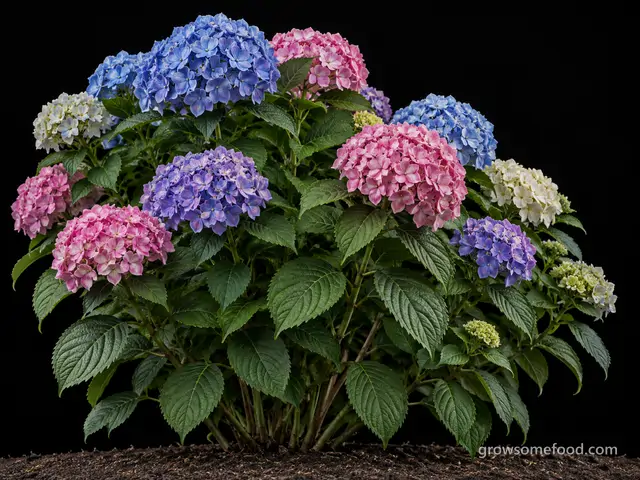
The billowing shade-garden shrub whose bigleaf types perform a party trick no other flower can: bloom color set by soil chemistry - blue in acid soil, pink in alkaline - plus native oakleaf and smooth species, and cone-flowered panicles for cold climates.
Safety notes Mildly toxic - hydrangea tissue contains small amounts of cyanogenic glycosides, so leaves, buds, and flowers should not be eaten by people or pets (vomiting and lethargy in dogs and cats that chew them, though serious poisoning is rare). Not a food or tea plant; keep flower arrangements away from nibbling pets. Handling is safe, though sensitive skin occasionally reacts to the sap.
Overview
Hydrangeas are the great billowing presence of the summer shade garden - softball-to-basketball-sized flower heads over lush foliage, blooming for months where many shrubs won't flower at all. The famous bigleaf hydrangea (H. macrophylla) performs botany's best party trick: on most varieties, soil chemistry sets the flower color - acid soil (available aluminum) turns them blue, alkaline soil pink, with murky purples in between. The same plant can be steered from pink to blue over a season or two with sulfur, or blue to pink with lime.
The one thing to knowThe famous bigleaf hydrangea (H.
Quick facts
- Height
- 4.5 ftRange: 3–8 ft
- Spread
- 5 ftRange: 3–8 ft
- Cold
- Takes hard frostdamaged below -20°F
- Heat
- Struggles above 95°F
- Life cycle
- Perennial, lives about 30 years
- Soil
- Consistently moist
- Water
- High
- Plant spacing
- 5 ftRange: 3–8 ft
When to plant
Nothing is open today. Spring transplanting opens 5 months, Mar 27 to May 22.
- Transplant Mar 27 – May 22 Opens in 158 daysAbout 2 weeks before to 6 weeks after your last frost (Apr 10 here)Plant container shrubs in spring into morning sun/afternoon shade and rich, moist, well-drained soil. Water heavily the first season - establishment is mostly about moisture.
- Transplant Aug 16 – Sep 27 Opens in 300 daysAbout 10 weeks before to 4 weeks before your first frost (Oct 25 here)Early fall planting into warm soil establishes roots before winter with less heat stress than midsummer - often the best window in the South. Mulch well and water until dormancy.
Frost here: last around Apr 10 (Mar 27 to Apr 24 most years), first around Oct 25. Zone averages, your own yard may run a week or two either way.
Life stages
Establish, grow, repeat
Getting established and returning each season are different parts of the story.
Stage 1 of 4 · Getting established
Year 1 - rooting in
Day 0 to 100 after transplanting
Care at this stage
-
Water generously - 'hydra' is in the name
Hydrangeas are thirsty, especially the first season: deep water 2-3 times a week in warm weather, more in sandy soil. Afternoon wilting that recovers by evening is normal in heat; wilting that persists into morning means water now.
-
Mulch 2-3 inches to hold moisture
A generous mulch ring is half the watering battle for this moisture-loving shrub. Site matters too: morning sun with afternoon shade is the classic hydrangea exposure in most of the country.
Months are typical seasonal windows; climate, variety, and plant age can shift them.
Watch out for
5 to know. None are high-risk for Hydrangea. 1 is active in October.
Deer (browse resistance)Severity Medium WildlifenowSeason: Jan, Apr, May, Jun, Jul, Oct, Nov, DecGrowth cleanly missing overnight, with the plant browsed back to a level line about as high as a deer can comfortably reach.
Hydrangeas are not a deer-resistant plant: deer browse the leaves, flower buds, and new shoots readily, and in winter nip the dormant stems and old-wood buds - which on bigleaf types removes next summer's bloom entirely. Netting or burlap over winter matters as much as summer repellents in high-pressure areas.
Growth cleanly missing overnight, with the plant browsed back to a level line about as high as a deer can comfortably reach. Ragged, torn stem ends rather than the clean angled cut a rabbit leaves - the single most reliable identifier. Buds and flowers gone while the foliage below is untouched, since deer often take the best part first. Hoof prints and droppings in soft ground near the damage. Repeat visits, with fresh damage each morning once a planting has been found. On young trees, shredded and stripped bark and broken low branches in autumn - that is antler rubbing rather than feeding.
There is no chemical fix, only exclusion and recovery. Get physical protection up immediately after the first damage, because deer return to a known meal, and reinforce or rotate whatever you were relying on before. Most plants regrow from browsing if the crown and roots are intact - feed and water a grazed plant and protect the regrowth while it comes back. What does not recover in the same season is anything whose buds or flowers have been taken, and a young tree whose bark has been rubbed right around the trunk is usually lost. Where deer pressure is genuinely heavy, the honest answer is to fence properly or to grow the plants deer leave alone, rather than to keep replacing losses.
Fencing is the only thing that reliably works. Eight feet is the standard for excluding deer, or two parallel four-foot fences a few feet apart, which they will not jump because they cannot judge the landing. Short of that, cage individual plants: a sturdy wire cage or trunk guard around every young tree, left on until the trunk is thick and the canopy is above browse height, prevents both browsing and antler rubbing and is the single highest-value thing you can do for a young tree. Repellent sprays do help at moderate pressure, but they wash off and deer habituate, so reapply after rain and rotate between different types through the season. Motion-activated sprinklers, scent deterrents, and noise devices work for a while and then stop. Siting matters too: plants close to the house, in daily traffic, and screened behind other planting get browsed less than the same plant out at the boundary.
Deer are the largest garden problem across much of the country, and where pressure is high they set the limit on what you can grow at all. They browse at night and around dawn and dusk, taking tender shoots, leaves, buds, flowers, and fruit within about five feet of the ground, and they come back night after night to anything they have found and liked. Because they have no upper incisors they tear rather than cut, leaving ragged stem ends - that is how you tell deer damage from a rabbit's clean angled cut. In fall, bucks rub their antlers on young trunks and can strip the bark right around a stem, which kills a young tree outright. Palatability varies enormously between plants and between seasons: a herd short of food in late winter eats things it ignores in June, and no plant is truly deer-proof.
Root RotSeverity Medium DiseaseSeason: Nov–MarWilting in the middle of the day on a plant whose soil is damp - the classic tell, and the reason people water a rotting plant and finish it off.
The trap here is that a moisture-loving shrub still needs oxygen at the roots. Sudden wilt that watering does not fix, in soggy ground, is the signature. Amend clay generously, plant slightly high, and never site a hydrangea where water stands.
Wilting in the middle of the day on a plant whose soil is damp - the classic tell, and the reason people water a rotting plant and finish it off. Leaves yellowing from the bottom up, dull off-color foliage, and growth that stalls for no visible reason. Whole shoots, or one side of the plant, collapsing while the rest still looks fine. Soft, dark, or mushy tissue at the base of the stem or at the crown, sometimes with a sour smell. Lift a failing plant and look at the roots: healthy ones are firm and pale, rotted ones are brown or black and slimy, and the outer layer slips off between your fingers leaving a thread of core behind. Seedlings that topple over at soil level are the same problem, called damping-off.
There is no cure for tissue that has already rotted, so act on the conditions rather than looking for a spray. Stop watering at once and fix the drainage - open up compacted soil, or move the plant to a raised, sharply drained position or a container. Lift a badly affected plant, cut away every soft dark root and rotted section with a clean blade back to firm pale tissue, and replant only the healthy parts into fresh free-draining soil or mix. Often the better move is to give up on the plant and save its offspring instead: cuttings, offsets, or divisions taken from firm healthy growth root readily and give you a clean start. Bin the rotted material rather than composting it, and correct the drainage before you replant, because the rot comes straight back in the same wet spot.
Drainage is the whole defense. Match the plant to the site first - something that wants sharp drainage will not survive heavy clay or a low, water-collecting spot however well you tend it. Where the ground is heavy, plant on a raised bed, berm, or slope, or grow in a container. Set plants at the depth they were already growing, since burying the crown or the root flare is a common cause of rot, and keep mulch pulled back a few inches from the stem base instead of piled against it. Water the soil rather than the calendar: check that the top inch or two is dry before watering again, cut back hard in cool weather and winter dormancy, and never leave a pot standing in a full saucer. Do not plant or dig in soggy ground, and go easy on rich amendments for plants that want it lean. Rotate annual crops, and start with clean healthy plants and fresh mix.
Root rot is not one organism but a group of soil fungi and water molds - Pythium, Phytophthora, Fusarium, Rhizoctonia and others - that sit harmlessly in most soils and only turn destructive when the ground stays saturated. Waterlogged soil drives the air out, the roots suffocate, and the weakened tissue is invaded and goes soft, brown, and stringy. Because the damage is underground you usually see it first as something that looks like drought: wilting, yellowing, stunting, a plant that does not respond to being watered. Overwatering, heavy compacted ground, a low spot that collects runoff, a pot with no drainage or a saucer left standing full, and cold wet soil in winter are the usual causes. Once roots have actually rotted there is no cure - this is a problem you prevent rather than treat.
Cercospora Leaf SpotSeverity Medium DiseaseSeason: Jul–SepNumerous small circular spots, tan-gray in the middle with a dark purple ring, on older leaves first; heavy spotting and leaf collapse when severe.
Numerous small circular spots, tan-gray in the middle with a dark purple ring, on older leaves first; heavy spotting and leaf collapse when severe.
Remove badly spotted leaves promptly (the plant keeps producing clean new ones), improve airflow, and apply copper early in a wet, warm season if pressure is high.
Rotate out of beet/chard ground on a 2-3 year cycle, space for airflow, water at the base and in the morning, and clear infected debris at season's end.
The most common hydrangea disease, especially on bigleaf types in the humid Southeast: a fungus producing small purple-brown spots, often with tan centers, freckling the lower leaves first and spreading up the plant in warm, wet late-summer weather. Unsightly and defoliating in bad years, but rarely a serious threat to the shrub's life.
AphidsSeverity Low PestSeason: May–JulDense clusters of tiny insects packed onto shoot tips, flower buds, and the undersides of young leaves.
Dense clusters of tiny insects packed onto shoot tips, flower buds, and the undersides of young leaves. Curled, cupped, or distorted new growth that never opens properly. A sticky shine on the leaves - and on whatever sits under the plant - that later goes black with sooty mold. Tiny white cast skins left behind where a colony has been feeding. Ants running steadily up and down the stems, which is often the first thing you notice. Mottled, streaked, or misshapen leaves that do not grow out can mean a virus the aphids brought with them rather than the feeding itself.
Knock the colonies off with a hard jet of water and repeat every few days - on most plants that alone ends it. Pinch out or prune off the worst-infested tips rather than treating the whole plant. If colonies keep rebuilding, spray insecticidal soap or horticultural oil directly onto the insects, covering leaf undersides, and repeat weekly until they are gone; treat early or late in the day, and never spray a wilted or heat-stressed plant. Avoid broad-spectrum insecticides - they kill the ladybugs, lacewings, and parasitic wasps that were about to solve the problem for you, and aphid numbers usually come back worse afterward. Anything you spray must be labeled for the plant you are treating; follow that label and observe its pre-harvest interval. On anything you eat, wash leaves, heads, and buds well before use, since aphids hide down in crowns, folds, and tight growth.
Go easy on nitrogen: the soft, lush growth that heavy feeding produces is exactly what aphids breed on. Check new growth once a week through spring and early summer so you catch colonies while they are still small, and rub the first few out with your fingers. Leave flowering plants nearby and skip broad-spectrum sprays - ladybugs, lacewings, hoverflies, and parasitic wasps do most of this work for free, and they only stay if there is something for them to eat. Keep ants off the plant where you can, since they protect aphids from those predators. Water steadily so plants are not stressed, and check any new plant over before you bring it home or move it indoors, since aphids usually arrive on something else.
Aphids are small soft-bodied sap-suckers - green, black, gray, pink, or waxy white, and mostly wingless - that gather in dense colonies on the tenderest new growth: shoot tips, buds, and the undersides of young leaves. They breed extremely fast in mild weather, so a few can become hundreds inside a week. Their feeding curls and distorts soft growth, and the sticky honeydew they excrete coats everything below and turns black with sooty mold. Ants often farm and defend the colonies for that honeydew. A few aphids are normal on almost any plant and a healthy plant shrugs them off; only dense, persistent colonies do real damage, and some aphids also spread plant viruses as they feed.
Powdery MildewSeverity Low DiseaseSeason: Jul–SepRound white powdery spots on the upper leaf surfaces that spread and merge until whole leaves look dusted.
Most common on crowded bigleaf hydrangeas in shade, showing as a gray-white film with purplish blotching beneath. Cosmetic on an established shrub - morning sun, spacing and base watering prevent most of it, and some cultivars are notably more resistant.
Round white powdery spots on the upper leaf surfaces that spread and merge until whole leaves look dusted. It usually starts on the oldest, lowest, most shaded leaves and works upward, so check there first. Look at the undersides too, and at stems, buds, and flower stalks, which get coated as it advances. Leaves that yellow, brown, curl, or go crisp and drop early under the coating. New growth that opens small, crumpled, or twisted where the fungus has reached the shoot tips. On plants where it gets onto the fruit, a dull gray film, russeted or scarred skin, and cracking. Late in the season, tiny dark specks scattered through the white felt - that is the fungus setting up to overwinter on the debris.
Start early: sprays protect healthy tissue, they do not clean up leaves that are already coated. Pick off and bin the worst leaves as soon as you see them, and open the plant up by thinning or pruning so air moves through. On anything that regrows quickly, shearing the whole plant back forces a clean flush and beats spraying. If it keeps spreading, potassium bicarbonate, horticultural oil, or neem applied weekly will hold it - cover both leaf surfaces. Sulfur also works, but it burns the foliage of some plants, should never go on in heat, and must not be mixed with or applied close behind an oil spray. Whatever you use must be labeled for the plant you are treating: follow that label and observe its pre-harvest interval on anything you eat. Do not compost badly infected material. Late-season mildew on a plant that is finishing anyway is usually cosmetic; on a crop still filling out it is worth acting on.
Give plants room. Crowding and still air are the biggest single driver, so space at the full recommended distance, thin seedlings properly, and divide or prune out congested growth until air moves through the plant. Full sun and an open position help; deep shade and a still corner against a wall are where it always starts. Water at the base rather than overhead, and water early in the day so nothing stays damp overnight. Keep plants evenly watered - drought stress at the roots leaves them far more susceptible, even though the fungus itself likes dry air. Go easy on nitrogen, since soft lush growth is the most vulnerable. Where resistant varieties exist for what you are growing, choosing one is the single most effective thing you can do on a plant that mildews every year. Clear infected leaves and stems away at the end of the season rather than composting them.
Powdery mildew is a fungal disease that coats leaves - and often stems, buds, and fruit - in a white-to-gray powder that looks like spilled talcum. It is not one fungus but a large family of them, each fairly specialised to its own group of plants, which is why mildew on one crop rarely jumps to an unrelated one beside it. Unlike most leaf diseases it does not need wet leaves: it thrives on warm dry days followed by humid nights, and it takes hold fastest where plants stand crowded in still air or in shade. The coating blocks light, so heavily covered leaves yellow, brown, and drop early. On many plants that is mostly disfiguring and arrives late enough not to matter; where it strips away the leaves a crop still needed to finish, it costs you size, sweetness, and quality.
Good & bad neighbors
Plant nearby
-
AstilbeFeathery flower plumes in the same moist part-shade conditions, blooming alongside the hydrangeas and thriving on the same generous watering.
-
Spring bulbs bloom around the hydrangea's bare feet before it leafs out, and the shrub's summer canopy then hides their dying foliage - each covers for the other.
-
FernsClassic texture partners for the same moist shade - fern filigree against the hydrangea's bold leaves and heavy flower heads.
-
The definitive shade-garden pairing: hostas carpet the ground below hydrangeas, both wanting the same rich, moist soil and dappled light, with bold leaf contrast doing the design work.
- Traditional pairings, thin evidence
-
Airy part-shade native that flowers in the gap before hydrangea bloom, enjoying the same moist, humusy woodland-edge conditions.

Varieties · 7
You pick one when you add Hydrangea to your garden. Its days to maturity set your harvest window.
Bigleaf 3 varieties
Endless Summer
The 2004 game-changer: the first mass-market bigleaf that blooms on BOTH old and new wood, so northern gardeners get mophead flowers even after bud-killing winters.
Variety details for Endless Summer
Classic 4-8 inch mophead blooms, blue to pink by soil pH, on a rounded 3-4 foot shrub.
remontantrebloomingpH-color-changingcold-insuranceBlue in acid soil, pink in alkaline. The series (BloomStruck, Summer Crush) extends the idea with stronger stems and deeper colors.
Nikko Blue
The classic blue mophead of southern porches and coastal gardens: big sky-blue heads (in acid soil) on a vigorous 4-6 foot shrub.
Variety details for Nikko Blue
Large rounded sky-blue flower heads over lush green foliage.
mopheadclassicblueold-woodBlooms on old wood only, so it needs mild winters and no ill-timed pruning - in the right climate, still one of the most beautiful of all.
Twist-n-Shout (lacecap)
A reblooming lacecap from the Endless Summer program: flat heads with a delicate ring of showy florets around tiny fertile centers - the lacecap form the pollinators can actually use, unlike sterile mopheads.
Variety details for Twist-n-Shout (lacecap)
Flat lacecap blooms - a lacy ring of large florets around beaded fertile centers - on red stems.
lacecapremontantpollinatorpH-color-changingBlue or pink by pH, on red-stemmed 3-5 foot plants.
Panicle 2 varieties
Limelight (panicle)
The modern landscape standard: big cone-shaped lime-green heads aging to cream, then pink-blushed antique tones in fall, on a strong 6-8 foot shrub that takes full sun and zone 3 cold and blooms on new wood every single year.
Variety details for Limelight (panicle)
Dense chartreuse-to-cream flower cones on strong upright stems.
new-woodsun-tolerantlime-whitevery-hardyNearly foolproof; 'Little Lime' is the half-size version.
PeeGee (H. paniculata 'Grandiflora')
The Victorian classic (1860s) still anchoring old farmsteads: massive white flower cones aging to dusty pink on a shrub commonly trained into a small tree.
Variety details for PeeGee (H. paniculata 'Grandiflora')
Huge drooping white-to-pink flower cones, often on a standard (tree) form.
heirloomtree-formnew-woodvery-hardyBlooms on new wood, hardy to zone 3, and nearly immortal - century-old specimens are common.
Smooth (Annabelle type) 2 varieties
Annabelle (smooth hydrangea)
The beloved NATIVE smooth hydrangea (H.
Variety details for Annabelle (smooth hydrangea)
Enormous globular white flower heads on a 3-5 foot suckering native shrub.
nativesmooth-hydrangeanew-woodwhitearborescens), found wild near Anna, Illinois: huge round white heads up to a foot across on a tough shrub that blooms on new wood - cut it nearly to the ground each winter and it never misses. Famously floppy after rain; the modern Incrediball is the stiff-stemmed upgrade.
Incrediball (smooth hydrangea)
The 'Annabelle fixed': basketball-sized white heads on stems stiff enough to hold them up through summer storms.
Variety details for Incrediball (smooth hydrangea)
Giant round white heads held upright on notably thick, strong stems.
native-speciessmooth-hydrangeanew-woodstrong-stemsSame native toughness and cut-to-the-ground new-wood habit, without the face-plant.
Grower tips
Notes from growers, tagged with the zone they grow in. A person reads every post before it appears.
Nobody has posted about Hydrangea yet. The first one usually saves someone a season.
Free account. Your post shows your grower name and zone, never your email.