
Add it to your home screen and it opens full screen: no browser bars, one tap away, and everything stays signed in. Free, nothing to download from an app store.
- Tap the Share button in your browser
- Scroll down and choose “Add to Home Screen”
- Open GrowSomeFood from your home screen
- Open your browser’s menu
- Choose “Add to Home screen” or “Install app”
- Open GrowSomeFood from your home screen

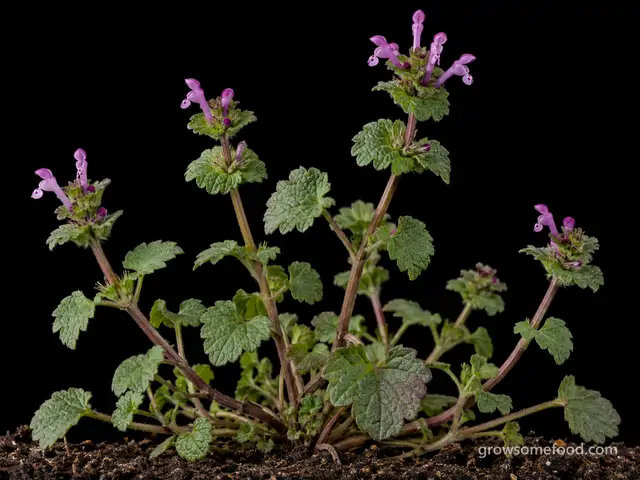
Henbit
The purple-flowered mint-family 'weed' that carpets lawns and bare beds in early spring - a mild, tender, free edible green and one of the very first nectar sources for early bees.
Safety notes Henbit is a mild, non-toxic edible weed - young leaves, tender stems, and purple flowers are all edible raw or cooked. Purple dead-nettle, the plant it is most often confused with, is also edible, so that mix-up is harmless; ground ivy (creeping Charlie) is the one to know apart - strongly minty when crushed, and not a green to eat in quantity. Tell henbit by its upper leaves, stalkless and clasping the stem in scalloped whorls. Only forage from ground free of herbicides and lawn chemicals.
Overview
Henbit (Lamium amplexicaule) is that low carpet of scalloped green leaves and slender pinkish-purple flowers that turns lawns, gardens, and fallow fields faintly purple in late winter and early spring, often alongside its cousin purple dead-nettle. Most people pull it as a weed, but it is a perfectly good, mild edible green in the mint family - the young leaves, tender stems, and little flowers are all edible raw or cooked, with a gentle, faintly sweet, slightly grassy taste and none of the bitterness of many wild greens.
Quick facts
- Sprouts in
- 12 daysRange: 7–21 days
- Soil temperature
- 60 °FRange: 50–70 °F
- Height
- 8 inRange: 3–16 in
- Spread
- 8 inRange: 4–14 in
- Cold
- Takes hard frostdamaged below -20°F
- Heat
- Struggles above 85°F
- Life cycle
- Annual
- Save seeds
- About 60 days after plantingRange: 45–80 days
- Self-sows
- Yes, expect volunteers
- Soil
- Well-drained
- Water
- Medium
- Plant spacing
- 8 inRange: 4–12 in
When to plant
Fall sowing is open for 19 more days. Next: spring, Feb 27 to Apr 10.
- Direct sow Sep 13 – Nov 8 Open now · 19 days leftAbout 6 weeks before to 2 weeks after your first frost (Oct 25 here)If growing on purpose, surface-sow in fall in cool, moist soil for a winter-and-early-spring green; far more often it simply volunteers and needs no sowing.
- Direct sow Feb 27 – Apr 10 Opens in 130 daysAbout 6 weeks before to at your last frost (Apr 10 here)Sow in earliest spring while soil is cool; henbit bolts and fades quickly once warm weather arrives.
Frost here: last around Apr 10 (Mar 27 to Apr 24 most years), first around Oct 25. Zone averages, your own yard may run a week or two either way.
Life stages
From the first start to harvest
Follow the growing sequence. Choose a stage to see its care and signs to watch for.
Stage 1 of 3 · The growing sequence
Cool-season sprouting
Day 0 to 14 from sowing
Care at this stage
-
Comes up in cool, moist weather
Henbit germinates in the cool, moist conditions of fall and early spring - it is a winter annual that sprouts in autumn, overwinters small, and races to bloom in early spring. Keep a sowing damp; it needs almost no help.
Stages can overlap; weather, variety, and growing conditions change the pace.
Harvest
- Lush, tender top growth in the cool season (fall, and late winter through spring)
- Harvest before warm weather makes it stringy and before heavy seeding
- Snip the tender tops for greens · every 10 days
- A cool-season carpet
Picking cut and it regrows
Cook with Henbit
Watch out for
3 to know. None are high-risk for Henbit. 1 is active in October.
Herbicide / Pollution ContaminationSeverity Medium DisordernowSeason: Feb, Mar, Apr, Oct, NovPlants growing in treated lawns, sprayed beds, pastures or croplands, along busy or polluted roadsides, or anywhere the ground around them looks suspiciously weed-free.
Henbit is a lawn and cropland weed, and both settings are commonly sprayed. Early spring, when henbit is at its best, is also when lawn pre-emergents and broadleaf herbicides go down.
Plants growing in treated lawns, sprayed beds, pastures or croplands, along busy or polluted roadsides, or anywhere the ground around them looks suspiciously weed-free. Yellowed, twisted or distorted growth on neighboring plants is a sign something has been sprayed recently.
Do not harvest a contaminated plant - there is no washing this off, and no way to tell by looking. The plant itself is fine, so the answer is simply to choose a different site.
Only forage from ground you know has not been treated with herbicides or pesticides, and stay well back from busy roadsides. Ask before harvesting on land you do not manage. If you are not sure, grow your own patch, or gather only from a clean site you have watched across a full season.
A risk to the forager rather than to the plant. This species grows in lawns, gardens, pastures, croplands, field margins, paths and roadsides - exactly the places that get sprayed with herbicides and lawn chemicals, or that collect road pollution and runoff. The plant itself is harmless; what can make it unsafe to eat is where it has been growing.
Look-Alike ConfusionSeverity Medium DisorderSeason: Feb–MayPurple dead-nettle has STALKED, triangular, purple-flushed upper leaves; henbit's upper leaves are STALKLESS and clasp the stem.
Purple dead-nettle has STALKED, triangular, purple-flushed upper leaves; henbit's upper leaves are STALKLESS and clasp the stem. Ground ivy is a low creeping mint that runs on above-ground stems, with round scalloped leaves and a strong minty smell when crushed - that smell is the tell, and it is the one of the three you should not be eating.
No harm between henbit and dead-nettle (both edible). Ground ivy (creeping Charlie) is a different plant - strongly minty-aromatic when crushed, with round scalloped leaves on creeping runners. It contains pulegone (the compound that makes pennyroyal toxic), so do not eat it in quantity, and avoid it in pregnancy. If in doubt about any plant, do not eat it.
Check the square stem (mint family), the clasping stalkless upper leaves, and the mild taste; henbit and dead-nettle are both edible, so a mix-up between them is harmless. If it smells strongly minty when crushed, it is not henbit - set it aside.
A common ID mix-up: henbit is routinely confused with purple dead-nettle - both are edible, so that swap is harmless - and, more loosely, with ground ivy (creeping Charlie), which is a different matter and not a green to eat in quantity. Knowing the difference is part of foraging henbit with confidence.
Aggressive Self-Seeding & SpreadSeverity Low DisorderSeason: Mar–MayRipe seed heads or stalks shedding onto the ground, and a flush of volunteer seedlings coming up well beyond where the parent plant stood - most obvious in the first weeks of the plant's growing season.
Henbit completes its cycle fast and reseeds prolifically as a cool-season weed. It is shallow-rooted and easy to pull, and harvesting it is the pleasant version of weeding it.
Ripe seed heads or stalks shedding onto the ground, and a flush of volunteer seedlings coming up well beyond where the parent plant stood - most obvious in the first weeks of the plant's growing season.
Hoe or hand-pull volunteers while they are small and before they set seed - the existing seed bank will keep germinating for several seasons either way, so this is an ongoing job rather than a single fix. Where the volunteers are themselves edible, harvesting them is the easiest control, but only ever eat or grow on a seedling you can positively identify.
Cut, deadhead or harvest the seed heads before they ripen and shatter, which is far easier than dealing with what they drop. Where the plant is grown deliberately, keep it in defined rows or a contained bed so that volunteers are obvious, and site it only where naturalizing is welcome.
Not a pest but a management issue. This plant sets and sheds seed prolifically, so anything left to ripen builds a persistent seed bank in the soil and returns as a heavy flush of volunteers the following season. Much of that seed stays viable for years, which is why one season of letting it go can take several seasons to undo.
Good & bad neighbors
All of these are traditional pairings. The evidence is thin, so treat them as a nudge, not a rule.
Plant nearby
-
Another mild cool-season edible weed that carpets the same moist beds at the same time of year; harvested together they make a gentle mixed wild-greens salad in the lean early-spring window.
-
The classic edible lawn weed offering a bold bitter contrast to henbit's mildness; foraged together they cover the flavor range of early-spring wild greens.
-
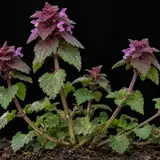
Henbit's near-constant companion and look-alike, often growing intermingled in the same beds - learning the pair together (clasping vs stalked upper leaves) is the easiest way to know your mild edible early-spring mint-family greens.
Grower tips
Notes from growers, tagged with the zone they grow in. A person reads every post before it appears.
Nobody has posted about Henbit yet. The first one usually saves someone a season.
Free account. Your post shows your grower name and zone, never your email.