Add it to your home screen and it opens full screen: no browser bars, one tap away, and everything stays signed in. Free, nothing to download from an app store.
- Tap the Share button in your browser
- Scroll down and choose “Add to Home Screen”
- Open GrowSomeFood from your home screen
- Open your browser’s menu
- Choose “Add to Home screen” or “Install app”
- Open GrowSomeFood from your home screen
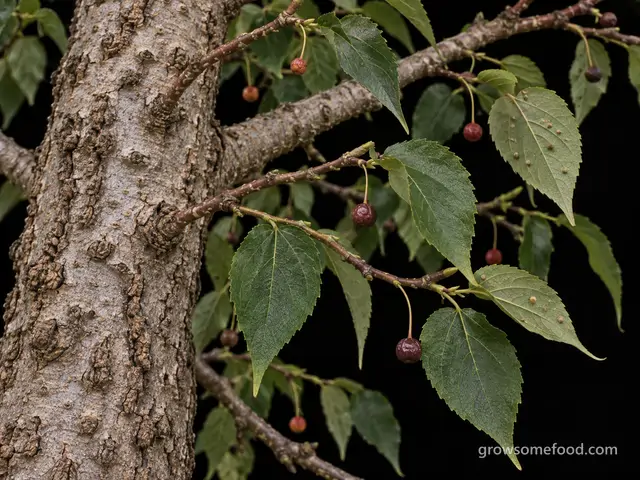
Hackberry
The only host plant for three American butterflies, a winter bird feeder that holds its sweet edible berries until February, and the toughest native shade tree there is - hackberry survives drought, wind, salt, clay, and city soil where nothing else will.
Hackberry is a safe, non-toxic tree, and its small brick-red berries are genuinely edible raw - sweet, date-like, and eaten by people for thousands of years. The catch is the pit: each berry is mostly hard stone, so bite gently rather than crunching down on a dental crown, and don't hand whole berries to a toddler, who can choke on them. The warty leaf galls and twiggy witches' brooms hackberries carry are harmless to people and do not affect the fruit.
Overview
The one thing to knowThree American butterflies - the hackberry emperor, the tawny emperor, and the American snout - lay their eggs on nothing else, and the question mark and mourning cloak use it among a short list of hosts.
Plant a hackberry (Celtis occidentalis) for what it feeds. Three American butterflies - the hackberry emperor, the tawny emperor, and the American snout - lay their eggs on nothing else, and the question mark and mourning cloak use it among a short list of hosts. If there is no hackberry in your neighborhood, those butterflies are not there either. Its berries then do a second job that almost no other tree does: they hang on the branches through fall and deep into winter, so when every other fruit has been eaten, flocks of cedar waxwings, robins, mockingbirds, and flickers come to a hackberry in January.
It is also, quite simply, the toughest native shade tree in the eastern half of the country. Hackberry handles drought, wind, heat, road salt, alkaline soil, heavy clay, and compacted city ground without complaint, grows one to two feet a year, and lives well over a century, which is why it became the go-to replacement for the ash trees killed by emerald ash borer across the Midwest. Its pale bark is covered in strange corky warts, its arching crown casts good high shade, and its small brick-red berries are sweet and genuinely edible - if mostly stone.
The reason more people do not plant it is cosmetic. Hackberries carry warty leaf galls and twiggy witches' brooms almost universally, and neither one hurts the tree at all. If you can look past that, you get an enormous amount of wildlife for a tree that asks nothing.
Quick facts
- Sprouts in
- 60 days30 to 120
- Soil to sprout
- 50 °F40 to 65
- Life cycle
- Perennial, lives about 150 years
- Seed to save
- About 155 days after planting130 to 185
- Height
- 60 ft40 to 80
- Spread
- 50 ft35 to 65
- Cold
- Takes hard frostdamaged below -40°F
- Heat
- Struggles above 105°F
- Self-sows
- Yes, expect volunteers
Full sun or part sun · low water · well-drained soil · 40 ft apart (25 to 60) · direct sow or transplant
When to plant
Fall transplanting is open for 13 more days. Next: fall, Sep 27 to Nov 15.
- Transplant Aug 16 – Oct 4 Open now · 13 days leftAbout 10 weeks before to 3 weeks before your first frost (Oct 25 here)Fall planting works well in milder zones if the roots get six weeks before the ground freezes. Water it in thoroughly and mulch the root zone.
- Direct sow Sep 27 – Nov 15 Opens in 6 daysAbout 4 weeks before to 3 weeks after your first frost (Oct 25 here)Clean the pulp off ripe berries and sow the stones an inch deep in fall where the tree will stand; winter cold breaks their dormancy and they come up in spring. Cover the spot with hardware cloth against rodents.
- Transplant Mar 20 – May 22 Opens in 180 daysAbout 3 weeks before to 6 weeks after your last frost (Apr 10 here)Set a container or balled-and-burlapped hackberry out in early spring. It transplants easily and tolerates almost any soil, including heavy clay, sand, alkaline ground, and compacted city dirt.
Frost here: last around Apr 10 (Mar 27 to Apr 24 most years), first around Oct 25. Zone averages, your own yard may run a week or two either way.
Life stages
One stage to settle in, then three that repeat each year. Windows are typical; your zone and weather move them.
Years 1-3 - young tree
The first year after planting- WaterWater through the first two or three yearsweeklyWater a young hackberry deeply once a week through its first two or three summers. After that it is one of the most drought-proof shade trees you can grow and will almost never need watering again.
- MulchMulch wide, keep it off the barkSpread a broad ring of wood-chip mulch out to the branch tips to hold moisture and keep mowers and string trimmers away from the trunk. Leave a few inches of bare ground right at the bark so the trunk does not stay damp.
- PruneTrain one strong leader earlyYoung hackberries branch low and can grow two or three competing leaders. Pick one central stem in the first few winters and shorten its rivals - a single strong trunk is what keeps an older hackberry from splitting in a storm.
- ProtectGive it room, and cage it against deerHackberry becomes a 40-70 foot tree with a wide, arching crown, so site it well away from the house and from power lines. A wire cage or trunk guard on a young tree stops both deer browsing and autumn antler rubbing.
Watch for- Deer browsing and antler rubbing on young trunks
- Competing leaders that need thinning to one
- Fast growth - young hackberries put on 1-2 feet a year
Spring & summer canopy
Apr to Aug, every year- InspectA butterfly nursery - look for the caterpillarsHackberry is the only host plant for the hackberry emperor, the tawny emperor, and the American snout butterfly, and one of a small handful for the question mark and mourning cloak. Check leaf undersides in early summer for the spiky green caterpillars with forked tails. This is the reason to plant the tree; never spray it.
- InspectExpect galls and brooms - and ignore themHard warty bumps on the leaf undersides are hackberry nipple galls, made by tiny psyllids. Dense twiggy tangles at the branch tips are witches' brooms, caused by a mite and a mildew working together. Both are near-universal on hackberry, both are cosmetic, and neither harms the tree, the fruit, or the wildlife.
- WaterWater only in a severe droughtAn established hackberry shrugs off drought, heat, wind, poor soil, road salt, and alkaline ground better than almost any other native shade tree. Water it only in an extended severe drought, and only for the first few years otherwise.
Watch for- Emperor and snout butterfly caterpillars (welcome them)
- Nipple galls on leaf undersides (harmless)
- Witches' brooms at branch tips (harmless)
- Sticky honeydew from woolly hackberry aphids, mainly in the South
Berry drop (fall into winter)
Sep to Jan, every year- HarvestPick berries once they turn dark brick-redevery 2 weeksFrom September the pea-sized fruits ripen from orange to dark brick-red or purple-brown and stay on the tree for months. Pick a handful straight off a low branch and chew gently - the thin flesh tastes like a date, and the stony seed inside is edible but hard. Traditional preparation grinds fruit and pit together into a paste. Leave the great majority for the birds.
- InspectWatch the winter bird trafficHackberries hang on the tree long after other fruit is gone, which makes them one of the most valuable late-winter bird foods in the country. Cedar waxwings, robins, mockingbirds, cardinals, and flickers strip them in flocks in January and February.
Watch for- Berries staining pavement and parked cars beneath the tree
- Flocks of waxwings and robins arriving to strip the crop
- Seedlings sprouting wherever birds perch
Fall color & winter dormancy
Oct to Mar, every year- PrunePrune in late winter, for structure onlyPrune while the tree is bare, in late winter before the buds swell. Take out crossing limbs, damaged wood, and any second leader; leave the rest alone. Removing witches' brooms is purely cosmetic and there are usually far too many to bother with.
- InspectEnjoy the corky barkWith the leaves gone, hackberry shows its best feature: pale gray bark covered in warty corky ridges and knobs, unlike any other tree in the woods. It is the easiest way to identify one in winter.
Watch for- Warty corky bark ridges - the winter ID feature
- Storm damage on old, overextended limbs
- Volunteer seedlings from bird-dropped seed
Harvest
- Berries fully colored from orange to dark brick-red or purple-brown, usually from September
- Flesh sweet and date-like when you chew it, not astringent
- Fruit still hanging in late fall and winter - hackberries hold on the tree for months
- Pick berries once they turn dark brick-red · every 2 weeks
- Watch the winter bird traffic
Picking pick as they ripen
Watch out for
4 to know. None are high-risk for hackberries. 4 are active in September.
Deer (browse resistance)Severity Medium WildlifenowHackberry is readily browsed as a sapling and deer strip the fallen fruit as well.
Cage a young tree and leave the guard on until the trunk is thick and the lowest branches are above reach - autumn antler rubbing kills more young hackberries here than browsing does. A mature tree is untouchable and needs nothing.
Growth cleanly missing overnight, with the plant browsed back to a level line about as high as a deer can comfortably reach. Ragged, torn stem ends rather than the clean angled cut a rabbit leaves - the single most reliable identifier. Buds and flowers gone while the foliage below is untouched, since deer often take the best part first. Hoof prints and droppings in soft ground near the damage. Repeat visits, with fresh damage each morning once a planting has been found. On young trees, shredded and stripped bark and broken low branches in autumn - that is antler rubbing rather than feeding.
There is no chemical fix, only exclusion and recovery. Get physical protection up immediately after the first damage, because deer return to a known meal, and reinforce or rotate whatever you were relying on before. Most plants regrow from browsing if the crown and roots are intact - feed and water a grazed plant and protect the regrowth while it comes back. What does not recover in the same season is anything whose buds or flowers have been taken, and a young tree whose bark has been rubbed right around the trunk is usually lost. Where deer pressure is genuinely heavy, the honest answer is to fence properly or to grow the plants deer leave alone, rather than to keep replacing losses.
Fencing is the only thing that reliably works. Eight feet is the standard for excluding deer, or two parallel four-foot fences a few feet apart, which they will not jump because they cannot judge the landing. Short of that, cage individual plants: a sturdy wire cage or trunk guard around every young tree, left on until the trunk is thick and the canopy is above browse height, prevents both browsing and antler rubbing and is the single highest-value thing you can do for a young tree. Repellent sprays do help at moderate pressure, but they wash off and deer habituate, so reapply after rain and rotate between different types through the season. Motion-activated sprinklers, scent deterrents, and noise devices work for a while and then stop. Siting matters too: plants close to the house, in daily traffic, and screened behind other planting get browsed less than the same plant out at the boundary.
Deer are the largest garden problem across much of the country, and where pressure is high they set the limit on what you can grow at all. They browse at night and around dawn and dusk, taking tender shoots, leaves, buds, flowers, and fruit within about five feet of the ground, and they come back night after night to anything they have found and liked. Because they have no upper incisors they tear rather than cut, leaving ragged stem ends - that is how you tell deer damage from a rabbit's clean angled cut. In fall, bucks rub their antlers on young trunks and can strip the bark right around a stem, which kills a young tree outright. Palatability varies enormously between plants and between seasons: a herd short of food in late winter eats things it ignores in June, and no plant is truly deer-proof.
AphidsSeverity Medium PestnowThe one to know here is the Asian woolly hackberry aphid (Shivaphis celti), waxy-white and now widespread across the South and Southwest.
It does not harm the tree, but it rains honeydew for weeks and everything below goes sticky and then sooty black. Nothing sprayed on a 60-foot tree will fix it, so treat it as a siting rule instead: never plant a hackberry over a patio, deck, walkway, or parking spot.
Dense clusters of tiny insects packed onto shoot tips, flower buds, and the undersides of young leaves. Curled, cupped, or distorted new growth that never opens properly. A sticky shine on the leaves - and on whatever sits under the plant - that later goes black with sooty mold. Tiny white cast skins left behind where a colony has been feeding. Ants running steadily up and down the stems, which is often the first thing you notice. Mottled, streaked, or misshapen leaves that do not grow out can mean a virus the aphids brought with them rather than the feeding itself.
Knock the colonies off with a hard jet of water and repeat every few days - on most plants that alone ends it. Pinch out or prune off the worst-infested tips rather than treating the whole plant. If colonies keep rebuilding, spray insecticidal soap or horticultural oil directly onto the insects, covering leaf undersides, and repeat weekly until they are gone; treat early or late in the day, and never spray a wilted or heat-stressed plant. Avoid broad-spectrum insecticides - they kill the ladybugs, lacewings, and parasitic wasps that were about to solve the problem for you, and aphid numbers usually come back worse afterward. Anything you spray must be labeled for the plant you are treating; follow that label and observe its pre-harvest interval. On anything you eat, wash leaves, heads, and buds well before use, since aphids hide down in crowns, folds, and tight growth.
Go easy on nitrogen: the soft, lush growth that heavy feeding produces is exactly what aphids breed on. Check new growth once a week through spring and early summer so you catch colonies while they are still small, and rub the first few out with your fingers. Leave flowering plants nearby and skip broad-spectrum sprays - ladybugs, lacewings, hoverflies, and parasitic wasps do most of this work for free, and they only stay if there is something for them to eat. Keep ants off the plant where you can, since they protect aphids from those predators. Water steadily so plants are not stressed, and check any new plant over before you bring it home or move it indoors, since aphids usually arrive on something else.
Aphids are small soft-bodied sap-suckers - green, black, gray, pink, or waxy white, and mostly wingless - that gather in dense colonies on the tenderest new growth: shoot tips, buds, and the undersides of young leaves. They breed extremely fast in mild weather, so a few can become hundreds inside a week. Their feeding curls and distorts soft growth, and the sticky honeydew they excrete coats everything below and turns black with sooty mold. Ants often farm and defend the colonies for that honeydew. A few aphids are normal on almost any plant and a healthy plant shrugs them off; only dense, persistent colonies do real damage, and some aphids also spread plant viruses as they feed.
Hackberry Witches' BroomSeverity Low DiseasenowReaches its worst on common hackberry in the Midwest.
Genuinely harmless, and the single most common reason gardeners are talked out of an excellent wildlife tree.
Congested clusters of short, twiggy shoots at the ends of branches, looking like birds' nests or clenched fists, and most visible on a leafless tree in winter. Brooms accumulating over the years so that an older tree may carry dozens. Slightly distorted, undersized leaves on the broomed shoots themselves, while the rest of the canopy looks normal.
None warranted. Individual brooms can be pruned out in late winter if a few bother you, but a mature tree usually carries far too many for that to be practical, and removing them changes nothing about the tree's health. Leave them - they make good winter perches and nest sites.
Choose the species. Common hackberry (Celtis occidentalis) is the one that brooms heavily; sugarberry (Celtis laevigata) rarely does, and selections such as 'Prairie Pride' were chosen partly for their resistance. If you are planting where appearance matters, that decision at the nursery is the whole of the prevention. Miticides and fungicides are not effective or recommended on a landscape tree.
A dense, twiggy tangle of short shoots at the branch tips, caused by an eriophyid mite and a powdery mildew fungus attacking the buds together. The affected bud produces a cluster of stunted shoots instead of one normal twig, and the resulting brooms persist and accumulate year after year, becoming most obvious in winter when the tree is bare. Like nipple galls, this is a disfigurement rather than a disease of consequence: heavily broomed trees grow, fruit, and live normally, and no extension program recommends treating it.
Hackberry Nipple GallSeverity Low PestnowNear-universal on common hackberry (Celtis occidentalis) and much less frequent on sugarberry.
Purely cosmetic - do not let a nursery or a lawn service sell you a treatment for it.
Hard, pea-sized warty bumps studding the undersides of the leaves from early summer, each with a corresponding pit on the upper surface, so the leaf looks pebbled or blistered. Tiny insects that look like miniature cicadas jumping off the foliage when disturbed. Clouds of pinhead-sized insects around windows and screens on warm fall afternoons, which is how most people first notice them.
None. The galls cannot be removed and the tree does not need help. Raking and removing fallen leaves in autumn reduces the local population slightly but will not stop reinfestation, since psyllids fly in from surrounding trees. Accept the galls as the cost of a tree that feeds five butterfly species.
There is no practical prevention on a mature tree and none is warranted. The only window in which a spray could work is the brief period when the leaves are expanding and the eggs are being laid, which is impossible to hit reliably on a 60-foot tree and would kill the butterfly caterpillars the tree exists to feed. If the appearance genuinely matters to you, plant sugarberry (Celtis laevigata) or a selection like 'Prairie Pride' instead, both of which gall far less. For the fall indoor nuisance, repair torn window screens before the adults emerge.
Hackberry psyllids - tiny jumping insects, sometimes called jumping plant lice - lay their eggs on the expanding spring leaves, and each larva causes the leaf to grow a hard, wart-like pouch around it. By late summer a tree can carry hundreds of them, with a matching dimple on the upper leaf surface. This is the most common complaint about hackberry and it is essentially cosmetic: extension research finds no measurable effect on the tree's growth, fruiting, or lifespan. The one genuine nuisance comes in fall, when the pinhead-sized adults emerge and drift indoors through window screens in numbers.
Good & bad neighbors
First rule: keep Patios, decks and parking spots apart. Do not site a hackberry over anything you sit on, eat at, or park under.
Plant nearby
-
A native understory tree that blooms in the light shade at a hackberry's edge, adding early-spring nectar under a canopy whose value comes later in the season.
-
Native sedges and woodland groundcoversA soft, unraked layer of sedges, leaf litter, and low natives beneath the tree lets the caterpillars that drop from the canopy complete their life cycle in the ground - the step most gardens skip.
-
Fruits in early summer, months before hackberries ripen - planting both spreads bird food across the whole year, with serviceberry covering June and hackberry covering January.
-
The two heavyweight host trees of the eastern woodland - oak feeds hundreds of caterpillar species and hackberry feeds the butterflies that use nothing else. Together they cover far more of the food web than either alone; give each plenty of room.
- Traditional pairings, thin evidence
-
Host plants work best in pairs of larva and adult food. Milkweed and other native perennials in the sunny ground near a hackberry give the adult butterflies nectar and the caterpillars somewhere to pupate.
Keep apart
-
Patios, decks and parking spotsDo not site a hackberry over anything you sit on, eat at, or park under. The fruit drops and stains for weeks, and in the South the woolly hackberry aphid rains sticky honeydew onto everything below all summer.
Varieties · 4
You pick one when you add Hackberry to your garden. Its days to maturity set your harvest window.
Common Hackberry (Celtis occidentalis)
Arching gray tree with strikingly warty, corky bark and pea-sized dark brick-red berries.
speciesnativebutterfly-hosturban-toughThe wild northern species: a fast, wind-firm 40-70 foot shade tree with warty corky bark, an arching vase-shaped crown, and sweet brick-red berries that hang into winter. The most cold-hardy hackberry and the classic Midwest shelterbelt and street tree - and the one most prone to nipple galls and witches' brooms.
Sugarberry (Celtis laevigata)
Smoother gray bark with scattered corky warts; narrow glossy leaves; orange-red to purple berries.
speciesnativesouthernbutterfly-hostThe southern hackberry, native from Virginia through Texas and up the Mississippi valley. Narrower, smoother-barked leaves and much cleaner foliage - it gets far fewer galls and witches' brooms than common hackberry, which makes it the better ornamental choice anywhere it is hardy. Same butterfly-host value, and it takes wet bottomland soils well.
Netleaf Hackberry (Celtis reticulata)
Small rugged tree with warty bark, thick sandpapery net-veined leaves, and orange-red berries.
speciesnativesouthwestdesert-toughThe hackberry of the arid West and Southwest - a smaller, gnarled 20-30 foot tree with thick, rough, net-veined leaves, extraordinary drought and heat tolerance, and orange-red fruit. The right hackberry for New Mexico, Arizona, Nevada, and the dry Great Basin, where it grows along washes and rocky slopes.
Prairie Pride
Uniform oval crown with thick, dark, glossy foliage on a straight single trunk.
cultivaruniformfewer-gallscompact-crownA widely planted common-hackberry selection chosen for a compact, uniform, oval crown, thicker glossier leaves, and noticeably less witches' broom than seedling trees. The usual nursery choice where a tidier street or lawn tree is wanted; it still hosts the same butterflies.
Grower tips
Notes from growers, tagged with the zone they grow in. A person reads every post before it appears.
Nobody has posted about Hackberry yet. The first one usually saves someone a season.
Free account. Your post shows your grower name and zone, never your email.