Add it to your home screen and it opens full screen: no browser bars, one tap away, and everything stays signed in. Free, nothing to download from an app store.
- Tap the Share button in your browser
- Scroll down and choose “Add to Home Screen”
- Open GrowSomeFood from your home screen
- Open your browser’s menu
- Choose “Add to Home screen” or “Install app”
- Open GrowSomeFood from your home screen
Ground Ivy
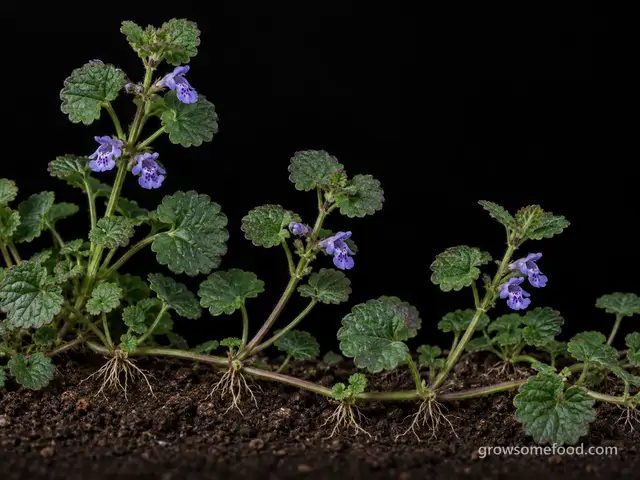
The creeping mint already in your lawn - and the one plant a forager has to tell from henbit and purple dead-nettle. It runs on stems that root as they go, its round leaves are long-stalked at every node, and it smells strongly minty crushed.
Not a salad green. Ground ivy carries pulegone, the liver-toxic compound behind pennyroyal's danger, so do not eat it in quantity, brew it as a regular tea, or use it in pregnancy or with liver or kidney trouble. It is the look-alike that matters when foraging henbit and purple dead-nettle: ground ivy CREEPS on stems that root at every node, its round leaves are long-stalked all the way up, and it smells strongly minty when crushed. Toxic to horses in quantity.
Overview
The one thing to knowGround ivy (Glechoma hederacea) is the low, square-stemmed mint that most Americans know as creeping Charlie.
Ground ivy (Glechoma hederacea) is the low, square-stemmed mint that most Americans know as creeping Charlie. It came from Europe as a medicinal and brewing herb, escaped, and now runs through lawns, shady beds and woodland edges across most of the continent, rooting at every node into a mat that mowing never touches.
It earns a page here for two reasons. The first is that it is the look-alike that matters when you gather the early-spring mint-family greens. Henbit and purple dead-nettle are both mild edibles, both carpet the same lawns in the same weeks, and ground ivy grows straight through them. The second is that ground ivy is not one of them: its leaves carry pulegone, the liver-toxic compound behind pennyroyal's danger. A stray leaf in a salad is not an emergency, but this is not a green to eat by the handful, brew as a daily tea, or take at all in pregnancy.
Told apart, it is easy. Ground ivy creeps and roots as it goes, its round scalloped leaves sit on long stalks at every node right up to the flowers, and a crushed leaf smells unmistakably of mint. Henbit and dead-nettle stand upright, never root along the stem, and have almost no scent. Learn those three checks once and you have both the foraging answer and the lawn answer.
Quick facts
For identification. Not a growing guide.
- Life cycle
- Perennial, lives about 15 years
- Where it grows
- Full sun · Part sun · Part shade · Shade, consistently moist soil
- Height
- 6 in2 to 12
- Spread
- 96 in24 to 360
- Cold
- Takes hard frostdamaged below -30°F
- Heat
- Struggles above 95°F
- Self-sows
- Yes. Never let it set seed.
Through the year
How to recognize it in each season.
Creeping mat (the year-round giveaway)
Mar to Nov, every year- Square stems that creep and root at every nodeTake hold of one strand and pull gently: ground ivy comes up as a rope of rooted plants, because its square stems run along the ground and put down roots at each leaf joint. That habit is the single clearest separator from henbit and purple dead-nettle, which stand upright from one base and never root along the stem. The leaves are round to kidney-shaped with scalloped edges and sit on long stalks at EVERY node, right up to the flowers.
- Crush a leaf - it should smell strongly mintyGround ivy has a strong, slightly musty mint smell when crushed. Henbit and purple dead-nettle, the two mild edible greens it grows through, have almost no scent at all. If you are gathering early-spring greens and a leaf smells like mint, you have picked ground ivy - set it aside rather than sorting it at the sink.
- Pull in damp soil, and get every nodeHand-pulling works on small patches and only if the soil is damp and you lift the whole runner: any rooted node left behind grows a new plant, and so does a chopped piece dragged around by a tiller or a mower. Work outward from the edge of the patch, roll the runners up like a carpet, and bag them - do not compost the strands and do not leave them lying on the lawn.
Key signs- Runners rooting at every leaf joint (pull one strand and a rope of plants lifts)
- Round, scalloped, long-stalked leaves creeping through thin turf and shady beds
- Re-growth from every fragment left after pulling or tilling
Blue-violet spring bloom
Apr to Jun, every year- Funnel flowers in twos and threes at the leaf jointsIn spring ground ivy raises short flowering shoots carrying blue-violet, two-lipped funnel flowers about half an inch long, spotted purple inside, held in small clusters of two or three where the leaves join the stem. Henbit and purple dead-nettle bunch their much smaller pink-purple flowers in tight whorls at the top of the plant. Bloom is the easiest week of the year to map the true size of a patch.
- Do not gather greens from a patch it runs throughGround ivy blooms in the same weeks that people forage henbit, purple dead-nettle and chickweed from the same lawns. The safe rule is separation, not sorting: if ground ivy is running through the patch, pick your greens somewhere else. Its pulegone content makes it a poor thing to eat by the handful, and mixed greens cannot be sorted reliably once they are in the basket.
Key signs- Blue-violet funnel flowers in the leaf axils (not in a spike at the tip)
- Bees working the flowers - it is an early nectar plant, which is the one point in its favour
- The true extent of the patch, which is always larger than it looked
Winter (still there - and the best time to act)
Dec to Feb, every year- Green in winter is itself a clueGround ivy is a perennial and stays green or semi-evergreen through mild winters, so a low mat of round scalloped leaves in January is almost certainly this plant. Henbit and purple dead-nettle are winter annuals: in that season they are small seedlings, and by midsummer they are gone entirely while ground ivy is still running.
- Autumn, not spring, is when treatment worksIf you use a broadleaf herbicide, apply it in autumn - after the first light frosts and while the plant is still green - because the plant is then moving sugars down into its roots and carries the product with them. Products containing triclopyr are the ones that work on ground ivy; standard lawn weedkillers often burn the top and leave the runners alive. Spring treatment usually gives regrowth. Follow the label, and keep it off garden beds.
Key signs- Green mats visible in the lawn in midwinter (the perennial giveaway)
- Bare, shaded, compacted turf that will let it back in next season
Hazards
Lawn & Bed InvasionSeverity High DisordernowRound scalloped leaves creeping through thin or shaded turf; runners rooting at each node so that pulling one strand lifts a rope of plants; a green mat still visible in midwinter; rapid regrowth after mowing or tilling.
Round scalloped leaves creeping through thin or shaded turf; runners rooting at each node so that pulling one strand lifts a rope of plants; a green mat still visible in midwinter; rapid regrowth after mowing or tilling.
Pull whole runners from damp soil so every rooted node comes up, and bag them - never compost or leave strands lying. Smother larger patches with cardboard or black plastic for a full season. If treating chemically, use a broadleaf product containing triclopyr in AUTUMN after the first light frosts while the plant is still green; spring treatment usually regrows. The circulated borax recipe is unreliable, injures turf and builds up in soil - the extension service that first published it has withdrawn the recommendation.
Do not plant it, including the variegated basket form, and do not tip spent baskets or pulled runners onto compost or the back of a border. Reduce what invites it: thin heavy shade, relieve compaction, fix drainage, mow higher and feed the lawn so the turf stays thick enough to hold the ground.
The defining problem with this plant: ground ivy spreads by square stems that root at every leaf joint, forming a dense mat that grows under mowing height, tolerates deep shade, and regrows from any fragment left in the soil. It colonizes lawns, shady borders and woodland edges and crowds out turf and low plantings, and a patch is almost always larger than it looks.
Pulegone Toxicity (people and horses)Severity Medium DisordernowHabitual use of ground ivy tea or any concentrated extract; use in pregnancy or by anyone with liver or kidney disease; clippings or pulled runners inside a paddock; horses showing salivation, sweating, laboured breathing or dilated pupils after access to a quantity of it.
Habitual use of ground ivy tea or any concentrated extract; use in pregnancy or by anyone with liver or kidney disease; clippings or pulled runners inside a paddock; horses showing salivation, sweating, laboured breathing or dilated pupils after access to a quantity of it.
For a person who has eaten a quantity, or taken any concentrated oil, call poison control immediately and do not wait for symptoms. For an affected horse, call a veterinarian promptly; keeping the material out of the paddock is far more reliable than treatment.
Keep it out of the kitchen entirely - it is not a salad green, a smoothie green or a regular tea - and never use pennyroyal-style concentrated oils. Bag pulled and mown material as household yard waste and keep it away from grazing animals and their bedding.
Ground ivy's essential oil contains pulegone, the liver-toxic compound that makes pennyroyal dangerous, at far lower concentrations than pennyroyal but enough to rule it out as a food green or a daily tea. It is also a documented hazard to horses, which can be poisoned by eating it in quantity - usually from mown or pulled material rather than by grazing the living mat.
Look-Alike Confusion (foraged spring greens)Severity Medium DisorderStems CREEPING along the ground and rooting at every node (henbit and dead-nettle stand upright and never root along the stem); a leaf stalk at EVERY node including the top ones (henbit's upper leaves are stalkless and clasp the stem; dead-nettle's are stalked but triangular and purple-flushed); a strong minty smell when crushed (the two Lamium species barely smell at all); and a plant that is still there in midsummer and midwinter, when both winter annuals are gone.
Stems CREEPING along the ground and rooting at every node (henbit and dead-nettle stand upright and never root along the stem); a leaf stalk at EVERY node including the top ones (henbit's upper leaves are stalkless and clasp the stem; dead-nettle's are stalked but triangular and purple-flushed); a strong minty smell when crushed (the two Lamium species barely smell at all); and a plant that is still there in midsummer and midwinter, when both winter annuals are gone.
A stray leaf is not an emergency. Discard the whole picking rather than trying to pick ground ivy out of it. If a child has eaten a real quantity, or anyone has taken concentrated ground ivy or pennyroyal oil, call poison control immediately and do not wait for symptoms.
Separate the site rather than sorting the basket: if ground ivy is running through a patch, gather greens elsewhere. Run the three checks - creeping and rooting, stalks on every leaf, minty crush - before anything goes in the bag, and teach them to anyone foraging with you.
Ground ivy grows through the same lawns, in the same weeks, as henbit and purple dead-nettle - two mild mint-family greens that people gather and eat. All three have square stems, scalloped leaves and small purple flowers, so they end up in the same basket. Ground ivy is the one that should not be there: it contains pulegone, the compound behind pennyroyal's liver toxicity, and it is a strong aromatic rather than a salad green.
Good & bad neighbors
First rule: keep Henbit apart. Not a growing conflict - a foraging one.
Keep apart
-
Not a growing conflict - a foraging one. Henbit is a mild edible green gathered from exactly the lawns and beds ground ivy runs through, in exactly the same weeks. Learn the pair together: henbit stands upright with stalkless clasping upper leaves and no smell; ground ivy creeps, roots at every node, has a stalk on every leaf, and smells strongly minty. If ground ivy is in the patch, gather greens somewhere else.
-
The same hazard as henbit. Purple dead-nettle is edible, upright, and topped with stalked triangular purple-flushed leaves; ground ivy is a creeping perennial that roots as it goes and smells of mint when crushed. Both are picked in early spring from the same ground, so keep the picking site clear of ground ivy rather than trying to sort the basket afterwards.
-
The two low creeping mint-family mats people most often mix up with each other, and the reason the pulegone warning on this page is worded the way it is. Pennyroyal is far the more dangerous of the two - it carries much more pulegone and has killed people - so if a creeping minty mat is in question, identify it properly rather than assuming it is the harmless one.
Grower tips
Notes from growers, tagged with the zone they grow in. A person reads every post before it appears.
Nobody has posted about Ground Ivy yet.
Free account. Your post shows your grower name and zone, never your email.