Add it to your home screen and it opens full screen: no browser bars, one tap away, and everything stays signed in. Free, nothing to download from an app store.
- Tap the Share button in your browser
- Scroll down and choose “Add to Home Screen”
- Open GrowSomeFood from your home screen
- Open your browser’s menu
- Choose “Add to Home screen” or “Install app”
- Open GrowSomeFood from your home screen
Giant Hogweed
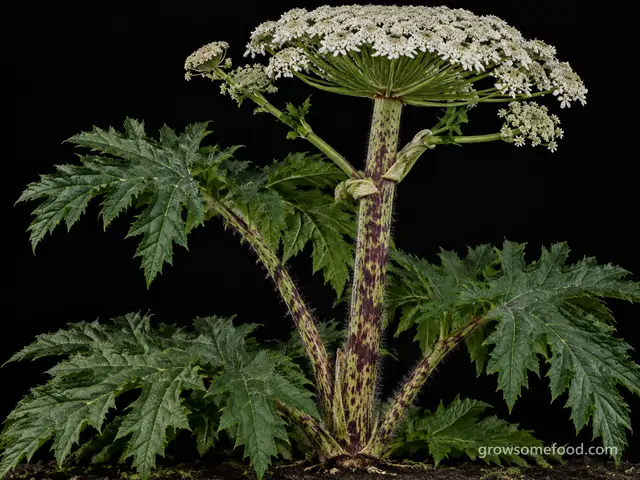
A 14-foot Caucasian umbel with a purple-blotched, white-bristled stem and a flower head the width of a car tyre. Its sap plus sunlight causes burns that blister, scar and leave skin sun-sensitive for years, and it can blind. It is a federal noxious weed: identify it, stay off it, and report it.
DO NOT TOUCH, CUT OR STRIM IT. Giant hogweed sap plus sunlight causes severe burns: painless at first, then redness at about 15 hours, deep blistering by 48, and scars and brown marks that can last years. Sap in the eye can cause temporary or permanent blindness. If sap touches you, get out of the sun, wash with soap and cold water, cover the skin from sunlight for 48 hours and see a doctor. A federal noxious weed - report it to your state agriculture department; do not clear it yourself.
Overview
Giant hogweed (Heracleum mantegazzianum) is the largest and most dangerous member of the carrot family in North America. A flowering plant stands 8 to 14 feet tall, occasionally higher, on a hollow stem two to four inches thick that is blotched dark purple and covered in coarse white bristles, carrying leaves up to five feet across and a flat white flower head that can span two and a half feet - the reason for its old name, the cartwheel flower.
Its sap carries furanocoumarins at concentrations far beyond anything else most people will meet. Sap on skin that then sees sunlight produces phytophotodermatitis: nothing at all for several hours, then redness, then deep blisters that behave like burns, then dark scarring, and skin that stays hypersensitive to sunlight for years. Sap in the eye has caused temporary and, in some cases, permanent blindness. Wild parsnip and cow parsnip work by the same chemistry; this plant is that mechanism at several times the dose.
It is also a federally listed noxious weed, which makes it illegal to import, sell, or move across state lines, and a long list of states run active reporting and eradication programs for it. That combination - extreme injury plus legal status - produces the single instruction this page exists to give: do not touch it, do not cut it, and report it. Control is a job for a trained crew in protective equipment, and in many states it is free.
Quick facts
For identification. Not a growing guide.
- Life cycle
- Perennial, lives about 4 years
- Where it grows
- Full sun · Part sun · Part shade, consistently moist soil
- Height
- 12 ft7 to 18
- Spread
- 5 ft3 to 7
- Cold
- Takes hard frostdamaged below -30°F
- Heat
- Struggles above 90°F
- Self-sows
- Yes. Never let it set seed.
Through the year
How to recognize it in each season.
Rosette years (identify and report)
Mar to Oct, every year- Huge jagged leaves and a bristled, purple-blotched stalkFor three to five years the plant is a rosette, and it is already dangerous. Leaves reach up to 5 feet across, deeply incised into sharply pointed jagged lobes, with stiff bristles on the underside of the midrib. Leaf stalks are thick, hollow, spotted purple, and coarsely white-bristled at the base. This is the stage most often mistaken for cow parsnip. Photograph it; do not handle it.
- Keep children and pets off it, and report itChildren are hurt by this plant more than anyone, usually because a hollow stem makes a good telescope or pea-shooter and puts sap around the mouth and eyes. Keep the area off-limits, tell neighbours, and contact your state department of agriculture or invasive species program with photographs and a location. In many states a trained crew will treat it, often at no cost.
Key signs- Deeply jagged leaves over 3 ft across on a stalk thicker than a broom handle
- Coarse white bristles and sharp-edged purple blotches on the stalks
- Children treating hollow stems as toys
The flowering year (June to July, then it dies)
Jun to Aug, every year- 8-14 ft tall with a white umbel up to 2.5 ft acrossIn its final year the plant bolts to 8-14 feet, occasionally taller, on a hollow stem 2 to 4 inches thick, and opens a flat white umbel up to two and a half feet across with 50 or more spokes - the reason for its old name, cartwheel flower. Nothing else in North America looks like this. It flowers once, sets tens of thousands of seeds, and dies.
- Never mow, strim, chip or burn itA string trimmer aerosolises the sap straight onto your face and forearms and is the most reliable way to get a serious burn from this plant. Chipping sprays it; burning puts the same compounds into smoke. If a stand must come down, that is a job for a trained crew in full waterproof coveralls, goggles and a face shield, on a still, overcast day.
Key signs- A white umbel wider than a car tyre standing above everything around it
- Seed forming - flat, dry, oval discs by late summer
- Anyone approaching it with a trimmer or mower
Seed, dead stalks and the seed bank
Sep to Feb, every year- Dead stalks still burn, and seeds float downstreamThe flowering plant dies, but the dry standing stalks still carry phototoxic sap residues, so spring cleanup of last year's canes is as hazardous as summer work. Seeds are shed in huge numbers, float, and colonise downstream banks, which is why river corridors are the main spread route. Never clear old stalks bare-handed.
- Expect a decade of follow-up, done by the programBuried seed can stay viable for around a decade, so a treated site needs monitoring for years. This is the reason to hand a site to a state or county program rather than treat it once yourself: the follow-up visits are the part that actually works, and they are usually included.
Key signs- Standing dead canes that still burn on contact
- New rosettes appearing downstream or downslope of a treated stand
- Seedlings on riverbanks and flood-deposited soil
Hazards
Federal Noxious Weed Status & ReportingSeverity High DisordernowPlants offered for sale or seed traded as an ornamental curiosity - it still circulates occasionally under names like cartwheel flower; and any find on your own or adjacent land, which is what triggers the reporting duty.
Plants offered for sale or seed traded as an ornamental curiosity - it still circulates occasionally under names like cartwheel flower; and any find on your own or adjacent land, which is what triggers the reporting duty.
Photograph the plant from a safe distance - whole plant, stem, leaf and flower head - note the location, and contact your state department of agriculture or invasive species program. In much of its range a trained crew will treat the site and return for follow-up years, often at no cost.
Never buy, accept, plant or move this species or its seed, and never move soil from an infested site. Check your state noxious weed and quarantine lists, since state obligations often go beyond the federal ones.
Not a horticultural problem but a legal one. Giant hogweed is on the US Federal Noxious Weed List, which makes it illegal to import, sell, or move across state lines, and many states carry their own prohibited or quarantine listing on top of that. Several states also run reporting hotlines and funded eradication programs, and in some a landowner is expected to report or control a find.
Sap Burn & Eye InjurySeverity High HazardnowAny contact at all - there is nothing to see or feel during the window when action still helps.
Any contact at all - there is nothing to see or feel during the window when action still helps. Then redness and burning appearing about half a day later in streaks where stems brushed skin, followed by fluid-filled blisters, most often on forearms, shins, neck and face.
Get out of the sun at once, wash with soap and cold water, and keep the skin covered from sunlight for at least 48 hours - that shielding is what limits the burn. Do not break blisters. See a doctor for blistering, facial involvement or large areas; severe cases are treated as burns. Sap in the eye needs immediate medical care with the eye shielded from light. Protect healed skin from sun for months to years.
Do not touch, cut, mow, strim, chip or burn it. Keep children and pets away, since hollow stems get used as toys and put sap around the mouth and eyes. If work is unavoidable, full waterproof coveralls, goggles, face shield and gloves taped to the sleeves, on a still overcast day - or hand the site to a state or county crew, which in much of its range is free.
The defining hazard, and the most severe phytophotodermatitis of any plant in North America. Sap from any part on skin later exposed to sunlight causes a delayed chemical burn: no sensation at contact, redness at roughly 15 hours, deep blistering by 48, then slow-healing wounds, dark scarring, and skin that can stay hypersensitive to sunlight for years. Sap in the eye has caused temporary and in some cases permanent blindness. Dry, dead stalks remain phototoxic, so spring cleanup carries the same risk as summer work.
Riverbank Invasion & Bank ErosionSeverity High DisordernowNew rosettes appearing downstream or on flood-deposited soil below a known stand; expanding colonies along ditches, rail margins and woodland edges; bare, eroding bank under last year's dead canes.
New rosettes appearing downstream or on flood-deposited soil below a known stand; expanding colonies along ditches, rail margins and woodland edges; bare, eroding bank under last year's dead canes.
Root cutting or program-applied herbicide before seed set, with the seed heads bagged and removed, followed by monitoring for around a decade while the seed bank runs down. Replant treated banks with competitive vegetation so bare soil does not persist.
Report and treat upstream stands first - treating downstream while a seed source remains upstream achieves nothing. Never move soil or fill from an infested site, and do not let cut seed heads reach water.
One flowering plant sets tens of thousands of seeds, and they float - so a single stand seeds an entire river corridor downstream. Dense stands shade out everything beneath them, and because the plants die back completely in winter they leave bare riverbank soil through the erosive season, worsening bank collapse and sediment loss.
Confusion with Cow Parsnip & Other UmbelsSeverity Medium DisordernowHeight under 8 ft, a stem under 2 inches thick, fine soft fuzz instead of coarse white bristles, a general purple flush instead of sharply defined blotches, broad maple-like leaves instead of jagged ones, and umbels 6-12 inches rather than up to 2.
Height under 8 ft, a stem under 2 inches thick, fine soft fuzz instead of coarse white bristles, a general purple flush instead of sharply defined blotches, broad maple-like leaves instead of jagged ones, and umbels 6-12 inches rather than up to 2.5 ft - that combination is cow parsnip.
Report anything you are unsure about, with photographs. State programs would rather examine a picture of a cow parsnip than miss a real giant hogweed, and identification by an inspector is free in most of the range.
Check all four giant hogweed features together - size, bristled and blotched stem, jagged leaves, umbel width - rather than any one alone, and photograph the stem close up. Treat cow parsnip with gloves and sleeves regardless, since its sap causes a milder version of the same burn.
Most giant hogweed reports are something else - usually the native cow parsnip, sometimes angelica, elderberry, poison hemlock or wild parsnip. The mistake matters in both directions: native cow parsnip gets destroyed unnecessarily, and, more dangerously, a real giant hogweed gets dismissed as cow parsnip and then cut by hand.
Grower tips
Notes from growers, tagged with the zone they grow in. A person reads every post before it appears.
Nobody has posted about Giant Hogweed yet.
Free account. Your post shows your grower name and zone, never your email.