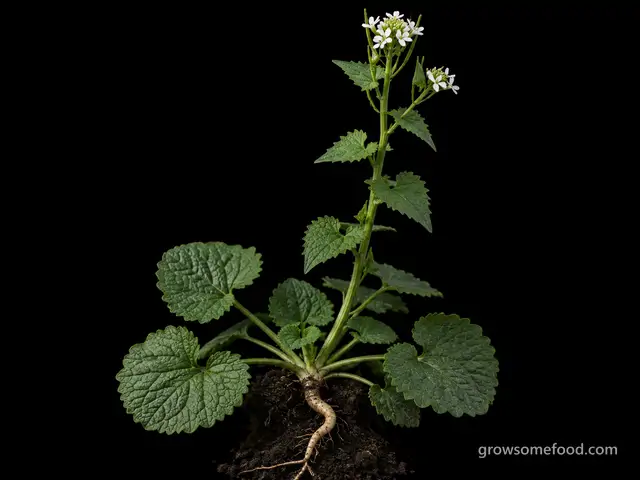
Garlic Mustard

Alliaria petiolata · Brassicaceae
Other Biennial Herb Other
Introduced - native to Europe, western Asia and northwest Africa; invasive through the woodlands of the Northeast, Midwest, mid-Atlantic and Pacific Northwest
Not recommended to plant. Do NOT plant or move this. Garlic mustard is a woodland invasive whose roots disrupt the soil fungi native seedlings depend on, and one plant banks thousands of seeds that stay viable for years. It is good to eat - pull it, eat it, and never let it set seed. A noxious weed in several states.

Garlic mustard is genuinely edible - leaves, flowers, seeds and first-year roots - and crushing a leaf to smell garlic is the confirming test. Do that test every time; the first-year rosette turns up beside violets and lesser celandine. Like other mustards it carries glucosinolates and traces of cyanide-releasing compounds, so eat it in normal food amounts rather than by the bowlful, and skip sprayed roadside and right-of-way stands.

Overview

The most-foraged wild green in North America and one of its most damaging woodland invasives, at the same time. It poisons the soil fungi that native seedlings need and banks a decade of seed. The honest answer is simple: pull it, eat it, and never let it seed.

Garlic mustard (Alliaria petiolata) is two things at once, and pretending otherwise helps nobody. It is a serious woodland invasive — a European biennial that carpets the floor of eastern and midwestern forests, where its roots release compounds that disrupt the mycorrhizal fungi that native tree seedlings and spring wildflowers depend on. It does not merely crowd its neighbors out; it changes the soil so their seedlings cannot establish. Deer decline to eat it and eat the natives around it instead, which speeds the takeover.

And it is genuinely good food: garlicky, mustardy, abundant, free, and available in March when nothing else is up. It is probably the most-foraged wild green on the continent. Those two facts do not cancel out — they combine into one instruction. Pull it, eat it, and never let it set seed. Do not plant a patch, do not move seed to a new site, do not leave a pulled flowering plant on the ground where it will ripen its pods anyway, and do not let a good harvest become a reason to keep the patch. This entry covers identifying it (crush a leaf: garlic), removing it on a realistic multi-year schedule, and cooking what you take out.

At a glance

Sun
Full sun · Part sun · Part shade · Shade
Water
Medium
Spacing
2–18 in (typ. 8)
Mature height
12–48 in (typ. 30)
Start by
Direct sow
Frost
Hardy
Spread
6–18 in (typ. 12)
Soil
Consistently moist
Temperature
Damaged below -30°F · struggles above 95°F
Self-sows
Yes — expect volunteers

When to plant

No planting window on record for this zone.

Life stages

  1. Year one: the spring germination flush Mar, Apr, May (yearly)
    • Seedlings come up in a carpet, all at once
      Garlic mustard seed needs a winter of cold before it will germinate, so it arrives as a dense flush of seedlings in early spring - often hundreds per square foot under a parent plant. Seedlings show two smooth kidney-shaped seed leaves, then round, scalloped true leaves that already smell of garlic when crushed. A carpet of small round-leaved seedlings under last year's dead stalks is the classic sight.
    • Seedlings are the cheapest ones to remove
      A seedling flush can be scuffed out with a hoe or a boot sole, or smothered under cardboard and mulch in a garden bed, at a fraction of the effort a second-year plant costs. This is the moment where an hour of work is worth ten later - but do not till, which buries seed at depths where it survives longer and simply spreads the problem across the bed.
    Dense carpets of round-leaved seedlings in early springSeedlings clustered under last season's dead flower stalksA garlic smell from crushed seedling leaves
  2. Year one: the green winter rosette Jan, Feb, Jun, Jul, Aug, Sep, Oct, Nov, Dec (yearly)
    • Recognize the rosette: kidney-shaped, scalloped, green all winter
      The first-year plant is a low rosette of dark green, kidney-shaped to round leaves with scalloped edges and a wrinkled surface, on long stalks. It stays green through winter, so a patch of green rosettes in a bare December woodland is nearly always garlic mustard. Crush a leaf: garlic. Nothing else with that leaf shape smells like that.
    • Late fall and early spring are the selective windows
      Because the rosette is green while native woodland plants are dormant, late fall and very early spring are when you can work on it without collateral damage - hand-pulling, or a foliar herbicide treatment where the infestation is too big to pull. Use a product whose label lists the site you are treating and follow that label; it is legally binding. In floodplains and along streams the product must be labelled for aquatic sites, and many states require a permit or a licensed applicator.
    • The rosette is also the best eating
      First-year rosette leaves, picked in late fall or very early spring while it is cold, are the mildest and best-tasting stage of this plant - garlicky and only lightly bitter. The first-year root, dug at the same time, grates like a mild horseradish. Take what you want from a patch you are about to remove, from unsprayed ground, and pull the whole plant rather than picking leaves off one you intend to leave.
    Green rosettes in a bare winter woodlandKidney-shaped scalloped leaves that smell of garlic when crushedRosettes spreading outward from an established patch
  3. Year two: bolting and white flowers (the pull window) Apr, May, Jun (yearly)
    • A stalk with triangular leaves and small white four-petalled flowers
      In its second spring the rosette bolts into a stalk one to four feet tall. The leaves change shape as it climbs - triangular to heart-shaped with coarse teeth - and it opens clusters of small white flowers with four petals in a cross, the mustard-family signature. It still smells of garlic. The root has a distinctive S-shaped crook just below the crown, which is a useful confirmation when you pull one.
    • Pull it now, whole, and bag it
      This is the deadline. Pull second-year plants from moist soil, grasping low and lifting steadily so the crooked root comes out with the crown - a snapped stem resprouts and flowers again. Bag every pulled plant into the trash. Do not compost it and do not leave it in a pile: a pulled flowering plant will finish ripening viable seed on its own stored moisture. Work outward from the satellite patches toward the dense core.
    • Where you cannot pull, cut at ground level at peak bloom
      On steep or rooty ground where pulling causes more damage than it prevents, cutting works - but only cut at GROUND level, and only at peak bloom. Topped plants simply branch and flower again lower down. Because it is a biennial that dies after flowering, a clean cut at the base at full bloom kills the plant outright. Bag the cut tops.
    • Young stalk leaves, buds and flowers are still worth eating
      Before the pods form, the young upper leaves, flower buds and open flowers are good food - more bitter than the winter rosette, and better blanched thirty seconds and drained before use. Eat what you pull; do not make a second trip to a patch you have not cleared.
    One- to four-foot stalks with triangular toothed leavesClusters of small white four-petalled flowersS-shaped crook in the root when you pull a plantSnapped stems resprouting and flowering lower down
  4. Year two: seed pods (the point of no return) Jun, Jul, Aug (yearly)
    • Slender upright pods, then a shower of black seed
      After flowering the plant sets siliques - slender pods two to three inches long held stiffly upright against the stem. They ripen from green to straw brown and split, flinging small black seeds several feet. The dead stalks stand through the following winter, which is how you find last year's patches. Once pods are browning, the seed is largely made and the year is lost.
    • Bag pods where they stand - do not shake them loose
      If you find pods, cut and bag stems carefully rather than yanking them, which shatters ripe pods across the ground. Slide a bag over the top of the stalk before you cut it where you can. Everything goes in the trash, never the compost. Then mark the spot: you now know where next spring's seedling flush will be, and that is where to spend April.
    • Clean your boots, tires and dog before you leave
      Seed travels on mud - on boot treads, bike and ATV tires, mower decks, hooves, and dog coats - which is how it jumps from a trailhead into an untouched woodlot. Brush off before you leave an infested site, and again before you enter a clean one. This costs nothing and prevents the kind of long-distance jump that hand-pulling can never undo.
    Slender upright pods along the upper stemPods browning and splitting (seed shed has begun)Standing dead stalks marking last year's patchesSeed carried on boots, tires, mowers and pets

Watch out for

Allelopathy & Mycorrhizal Disruption High DisorderMar, Apr, May, Jun, Jul, Aug, Sep, Oct

The signature harm, and the reason this plant matters more than its size suggests: its roots release glucosinolate-derived compounds that suppress the mycorrhizal fungi native tree seedlings and woodland wildflowers depend on for water and nutrients. It therefore degrades the ground for the plants that would follow it, rather than simply out-competing the ones already there. Later research suggests the chemical effect weakens in long-established populations as local fungi adapt, which is a reason for patience in decades-old stands and no reason at all to tolerate a new one.

Watch for: Tree seedlings and spring ephemerals failing to establish under an otherwise healthy canopy where garlic mustard carpets the floor; native regeneration thinning year on year inside an infested patch.

Prevent: Keep it out. A single self-pollinating plant can found a colony, so removing scattered outlying plants before they seed protects far more ground than clearing the dense core does.

Treat: Stop seed production every year - pull whole plants before the pods form, or cut at ground level at peak bloom - and keep at it for five to ten years while the seed bank drains. Do not till, which prolongs the bank.

Seed Bank & Pulled-Plant Seed Ripening High DisorderMay, Jun, Jul, Aug

Why one good clearing season is not enough, and how well-meant work backfires: a vigorous plant sets hundreds to a few thousand seeds that are flung several feet when the pods split, most of the bank stays viable about five years with some seed recovered considerably later, and a pulled or cut flowering plant will finish ripening viable seed on its own stored moisture if it is left in a pile or a compost heap. Seed also travels long distances in mud on boots, tires, mower decks, hooves and dog coats.

Watch for: Standing dead stalks marking last year's patch; dense seedling carpets the following spring; new infestations starting at trailheads, parking areas and stream crossings; pulled plants heaped at the edge of the woods.

Prevent: Bag everything in flower or pod into the household trash rather than composting it, work outlying satellite patches before the dense core, and brush mud off boots, tires and pets before leaving an infested site.

Treat: Bag pods where they stand rather than shaking them loose, mark the spot for next spring's seedling flush, and plan on five to ten years of annual spring walk-throughs, measuring success by falling seedling density.

Egg-Laying Trap for Native Butterflies Medium DisorderApr, May, Jun

An indirect harm that hand-pulling directly prevents: garlic mustard is chemically similar enough to the native toothworts that female West Virginia white butterflies mistake it for a host plant and lay eggs on it, but the caterpillars do not survive on it. Where it replaces toothwort in a woodland, it acts as an evolutionary trap, consuming the season's egg production of an already uncommon butterfly.

Watch for: Garlic mustard replacing toothwort colonies in rich moist woodland; small white butterflies working over a garlic mustard patch in spring.

Prevent: Protect toothwort populations by clearing garlic mustard from around them before it flowers, and prioritize rich woodland sites where the native host still persists.

Treat: Remove flowering plants in the spring egg-laying window rather than after it, and keep the surrounding native spring flora intact so the butterfly has somewhere correct to lay.

Deer Browse Facilitation Medium WildlifeApr, May, Jun, Jul, Aug, Sep, Oct

Why heavily browsed woods fill up fastest: deer avoid garlic mustard and eat the native wildflowers, shrubs and tree seedlings around it, so every browsing season tilts the competition further in the invader's favor. Deer also disturb the soil and carry seed in mud on their hooves and coats, opening ground and delivering seed to it in the same trip.

Watch for: Heavily browsed woodland with a thinning native understory and a thickening carpet of untouched garlic mustard; deer trails running through infested patches.

Prevent: Where deer pressure is high, expect faster reinvasion and schedule more frequent spring walk-throughs; protecting native regeneration with fencing or tubes also helps the natives compete.

Treat: Address the garlic mustard on its own schedule - stopping seed production is still the lever - and recognize that in heavily browsed woodland, control needs to run longer than the five-year seed-bank estimate suggests.

Varieties · 2

Garlic Mustard (Alliaria petiolata)

Year one: dark green kidney-shaped scalloped rosette leaves on long stalks, green through winter. Year two: upright stalk with triangular toothed leaves, clusters of small white four-petalled flowers, then stiff upright pods that brown and split.

speciesinvasivedo-not-plantbiennialallelopathicediblenoxious-weed

The single species, in two very different years. Year one is a low rosette of kidney-shaped, scalloped, wrinkled leaves that stays green all winter and is the best eating. Year two bolts to a one- to four-foot stalk with triangular toothed leaves, small white four-petalled flowers, and slender upright seed pods, after which the plant dies. Crushed leaves smell of garlic; the root has an S-shaped crook below the crown. Genuinely edible and genuinely invasive - pull it, eat it, and never let it set seed.

Look-alikes to rule out before eating

Violet: heart-shaped leaves, no scent. Ground ivy: opposite scalloped leaves, square creeping stem, mint scent. Lesser celandine: glossy fleshy kidney-shaped leaves, yellow flowers, fig-like tubers, no scent.

lookalikeidentificationsafety

Do the garlic test every time. Violets have heart-shaped leaves, purple or white flowers and no smell. Ground ivy (creeping charlie) has scalloped leaves too, but they sit OPPOSITE each other on a square, creeping stem and smell of mint. Lesser celandine has glossy, fleshy, kidney-shaped basal leaves, fig-like root tubers, and bright yellow flowers, emerges before violets bloom, has no garlic smell, and contains protoanemonin, which burns the mouth. Young rosettes of several other woodland plants are round-leaved as well. If it does not smell of garlic, do not eat it.

Grow

How to recognize it in both of its years - the kidney-shaped scalloped rosette that stays green all winter, and the second-year stalk with triangular leaves and small white four-petalled flowers - plus the garlic test and the look-alikes it grows beside.

Garlic mustard is a biennial, so it looks like two different plants and you need both. In its first year it is a low rosette of dark green, kidney-shaped to round leaves with scalloped edges and a wrinkled, slightly puckered surface, on long stalks. It stays green all winter, which is the easiest way to find it: a patch of green rosettes in a bare December or February woodland is almost always this plant. In its second spring it bolts to a stalk one to four feet tall, the leaves changing to triangular or heart-shaped with coarse teeth, topped by clusters of small white flowers with four petals in a cross. Then come the siliques — slender pods held stiffly upright — and the plant dies, leaving pale dead stalks that stand all the following winter and mark the patch for you.

Two confirmations. Crush a leaf and smell it: garlic. Distinctly, unmistakably garlic, strongest in cool weather and fading in old summer growth. And when you pull a plant, look at the root: a slender white taproot with a characteristic S-shaped crook just below the crown. Do the smell test every time, because the rosette shares ground with several round-leaved plants. Violets have heart-shaped leaves and no smell. Ground ivy (creeping charlie) has scalloped leaves too, but they are opposite on a square, creeping stem and smell of mint. Lesser celandine has glossy, fleshy, kidney-shaped leaves, fig-like root tubers, and no garlic smell — and it burns the mouth, so that is the one to be sure about. None of these smells like garlic. If yours does not, do not eat it.

Propagation & seed saving

How it spreads: entirely by seed, self-pollinated so one plant can found a colony, thousands of seeds per plant, a seed bank that stays viable five years or more, and mud on boots and tires doing the long-distance work.

Garlic mustard spreads only by seed — no runners, no rhizomes, no root suckers. That sounds like good news and is not, because the seed side of its biology is formidable. It is self-compatible, so a single plant arriving in a clean woodlot can found an entire colony without a partner. A vigorous second-year plant produces hundreds to a few thousand seeds, flung several feet when the pods split. And the seed is long-lived: most of the bank is exhausted after about five years, but viable seed has been recovered considerably later, which is why the honest timescale for clearing a site is five to ten years rather than a season.

Long-distance movement is almost entirely human and animal assisted. Seed rides in mud on boot treads, bike and ATV tires, mower decks, hooves and dog coats, which is why infestations start at trailheads, parking areas, and stream crossings and work inward. Water moves it along floodplains. Because germination requires a winter's chilling, seed that arrives in July appears as a carpet the following March — the lag is why a site can look clean the season after a visit and be full the season after that. All of this points control in one direction: stop seed production, then wait out the bank, and clean your gear so you are not re-seeding what you cleared.

Care

Control, not care: pull whole plants before the pods form and bag them, cut at ground level at peak bloom where pulling is destructive, work the outlying satellites before the dense core, use the green-in-winter window for anything chemical, and plan on five to ten years.

The whole campaign rests on one rule: no seed this year. Everything else is scheduling. Hand-pulling is the core method — second-year plants come out of moist spring soil easily if you grasp low and lift steadily so the crooked root comes with the crown, because a snapped stem resprouts and flowers again. Bag everything you pull into the household trash. A pulled flowering plant left in a pile will finish ripening viable seed on its own stored moisture, so composting it or heaping it at the edge of the woods undoes the work. Where the ground is too steep or too rooty for pulling to be worth the soil disturbance, cut at ground level at peak bloom: because this is a biennial that dies after flowering, a clean basal cut at full bloom kills it, while merely topping it just makes it branch and flower lower down.

Two strategic points do more than any technique. First, work the outlying satellite patches first and the dense core last. It feels backwards, but the scattered outliers are what convert a contained problem into a landscape one, and the dense core is not going anywhere. Second, use the phenology. The rosette is green while native woodland plants are dormant, so late fall and very early spring are when treatment is selective. Where an infestation is beyond hand-pulling, that is the window for a foliar herbicide application to the rosettes. Use a product whose label lists the site you are treating — woodland, natural area, lawn, riparian edge — and follow that label exactly, because it is the legally binding instruction. In a floodplain or along a stream, the product must be labelled for aquatic sites, and many states require a permit or a licensed applicator for that work.

Then be realistic about time. Do not till, which buries seed deeper and prolongs the bank. Do not clear a large area you cannot revisit; a cleared patch with an intact seed bank and no natives left simply grows garlic mustard again, and monitoring beats heroics. Plan on five to ten years of a spring walk-through, and count success in shrinking seedling density rather than in a season without plants. Clean your boots on the way out.

Harvest

Pull, do not pick. Take the whole plant from a patch you intend to clear, on unsprayed ground - first-year rosettes in late fall and early spring are the best eating, and the last worthwhile window closes when the seed pods form.

The right way to gather garlic mustard is not the right way to gather most greens: you pull the whole plant rather than picking leaves and leaving it. Picking leaves keeps the plant alive to flower; pulling it feeds you and removes a seed source in the same motion. So take it from a patch you actually intend to clear, and take as much as you will use.

The windows, best to worst. First-year rosettes in late fall and very early spring are the prize — garlicky, only lightly bitter, and available when nothing else is. Dig the root at the same time if you want a horseradish substitute. Young second-year stalk leaves, buds and open flowers, in April and May before the pods form, are still very good, a little sharper, and better for a thirty-second blanch. Green seed pods, while still soft and snapping cleanly, are sharply mustardy and worth pickling — and taking them is control work. Once pods brown, stop eating and start bagging.

The rules that go with it. Confirm the garlic smell on every gather, not just the first. Skip roadsides, right-of-way corridors and utility cuts, which are sprayed on a schedule, and skip anywhere you would not eat soil from. Bag anything in flower or pod into the trash rather than the compost. Eat it in normal food quantities: like other mustards it carries glucosinolates and traces of cyanide-releasing compounds, which is a reason for a bowl of pesto and not a diet. And never, ever move a live plant or seed to start a patch closer to home — that is how new infestations begin, and in several states it is illegal.

In the kitchen

Garlicky, mustardy and assertive - best as pesto, wilted into eggs and soups, or blanched and squeezed into anything that wants a green punch. Bitterness rises with age, flowering and heat; a thirty-second blanch is the fix.

Garlic mustard tastes like what it is: garlic and mustard greens together, pungent up front with a horseradish-ish bite and a bitter finish that grows as the season does. Pesto is the classic and the best use — swap it straight in for basil, use walnuts or pecans, plenty of hard cheese and lemon, and go easy on the added garlic, since the leaves bring their own. Beyond pesto, it wilts into eggs, soups, beans, and potatoes, blends into a green sauce or salad dressing, and works chopped small and raw as a sharp accent in a salad rather than as the salad itself.

Managing the bitterness is most of the skill. It rises with the plant's age, jumps once it flowers, and increases with cooking time — a long braise concentrates it rather than mellowing it. The reliable fix is a thirty- to sixty-second blanch in plenty of boiling water, then drain and squeeze, discarding the water; that removes much of the bitterness while keeping the garlic character. Fat and acid help too, which is part of why pesto works so well. Pick the coldest-weather leaves you can — late fall and very early spring rosettes are noticeably milder than anything gathered in May.

The other parts earn their keep. Flower buds behave like a tiny sharp broccoli raab. Green pods pickle well in a hot vinegar brine. Ripe seeds, threshed indoors from bagged pods, grind into a peppery mustard-seed substitute. And the first-year root, scrubbed and grated, is a passable fresh horseradish for a small batch of sauce — fiddly, but a genuine surprise the first time. Two cautions worth repeating: eat it in ordinary food amounts rather than in bulk every day, and gather only where nothing has been sprayed.

Storage

Leaves wilt within a day, so blanch and freeze in portions or turn the haul straight into pesto. Dry the pods in a bag indoors if you want seed as a spice, and keep first-year roots wrapped and cold like horseradish.

Leaves do not keep. They wilt within a day or two even wrapped damp in the fridge, and they lose their garlic aroma as they go, so a big haul should be dealt with the same evening. Blanch thirty to sixty seconds, cool, squeeze dry, and freeze in portioned pucks — that keeps well for months and conveniently removes some bitterness on the way in. Pesto freezes beautifully in an ice-cube tray, then goes into a bag; in the fridge under a film of oil it holds about a week. Drying is not worth it: the garlic character is volatile and mostly disappears, leaving a dull bitter powder.

Seed is the one part that stores indefinitely, and it must be handled carefully. Cut and bag whole pods before they brown, finish drying them in a closed paper bag indoors so nothing escapes, then thresh, winnow into a bowl, and store the seed dry in a jar. Put the chaff in the trash, not the compost, and sweep the floor — a seed-harvesting session should never turn into a seed-spreading one. First-year roots keep about a week wrapped in the fridge and are best grated fresh; grated root held in vinegar behaves like prepared horseradish for a couple of weeks before it fades. Green pods keep only as pickles. And whatever else you store, do not store live plants: nothing in flower or pod belongs anywhere but a sealed bag in the household trash.

Troubleshooting

Is it garlic mustard or a look-alike? Why did it come back thicker? Can I compost it? Is eating it really enough? The practical answers, including why you work the outlying patches first and why five years is the honest number.

Is this garlic mustard? Crush a leaf. If it smells of garlic and the leaves are kidney-shaped and scalloped (first year) or triangular and toothed on a stalk with small white four-petalled flowers (second year), yes. Pull one and check the root for the S-shaped crook. What are the look-alikes? Violets (heart-shaped, no smell), ground ivy or creeping charlie (opposite leaves on a square creeping stem, mint smell), and lesser celandine (glossy fleshy kidney-shaped leaves, fig-like root tubers, no garlic smell, and it burns the mouth). No smell, no eating. I pulled it all and it came back thicker. Expected — you removed the standing plants, not the seed bank, and clearing the canopy of rosettes releases the seedling flush. The measure of progress is falling seedling density over years. Can I compost it? No. A pulled flowering plant ripens viable seed on its own stored moisture. Bag it into the household trash. Can I just mow it? Only a clean cut at ground level at peak bloom kills it; topping it makes it branch and flower lower. Should I clear the big patch first? No — take the scattered outlying patches first. Those are what turn a contained problem into a landscape one. Does eating it control it? Only if you pull whole plants rather than picking leaves, and only if you are honest about not preserving the patch as a food source. How long does this take? Five to ten years of a spring walk-through on a given site. Is it legal to move or plant? Several states list it as a noxious or prohibited weed, which typically bars sale and transport — check your state's list. Nowhere is it a good idea. Why do the deer not eat it? They avoid it and browse the natives around it instead, which is one of the reasons it wins.

History

Brought from Europe by settlers in the 1860s as a pot herb and medicinal green, it escaped into eastern woodlands and became the flagship example of invasive allelopathy - a plant that changes the soil rather than simply outgrowing its neighbors.

Garlic mustard has been a kitchen plant in Europe for a very long time — archaeological residues on Baltic pottery suggest its seeds were used as a seasoning thousands of years ago, and the English name sauce-alone records its use as a standalone relish. It was cultivated in gardens as a pot herb and used medicinally, and settlers brought it to North America deliberately. The first American record is from Long Island in 1868, which is a strikingly recent date for a plant now present in more than thirty states and several Canadian provinces.

Its spread was quiet for decades and then explosive, and its scientific reputation changed with it. Garlic mustard became the textbook case of invasive allelopathy: research through the 1990s and 2000s showed that its roots release glucosinolate-derived compounds that suppress the mycorrhizal fungi native tree seedlings and woodland wildflowers rely on, so it does not merely compete, it degrades the ground for the plants that follow. Later work added nuance — the chemical effect appears to weaken in long-established populations as local fungi and plants adapt, and some old infestations thin over decades — but that is a reason for patience in the oldest stands, not a reason to tolerate a new one. Meanwhile the foraging revival rediscovered what Europe always knew: it is excellent food. The modern American answer, and the honest one, is to treat those as the same fact.

Growing across climates

Invasive across roughly zones 3-8 in shaded, moist, disturbed ground - the Northeast, Midwest, mid-Atlantic and Pacific Northwest worst - and largely absent from the hot South. Its timing shifts with latitude, so calibrate the pull window to bloom rather than to the calendar.

Garlic mustard is invasive across roughly zones 3-8, worst through the Northeast, Great Lakes, Midwest and mid-Atlantic, and increasingly serious in the Pacific Northwest, where Oregon and Washington both list it as a noxious weed. It is scarce in the hot Southeast and the arid Southwest, which lack the cool, moist, shaded conditions it wants. Its habitat is consistent everywhere it does well: moist deciduous woodland, floodplains, shaded trail edges, hedgerows and disturbed shade, on rich soils, in anything from deep shade to part sun.

The practical climate adjustment is timing, not method. The germination flush, the bolt, and the pod set all shift by several weeks between the southern and northern ends of its range and by altitude, so calibrate the pull window to the plant rather than to the calendar: the deadline is when pods start forming, wherever you are. The green-rosette selective window likewise opens earlier in the fall and later in the spring going north. A warming climate is expected to let it push further north and to higher elevations rather than into the South, so the northern woodlands where it is already worst are the ones to watch. Everywhere it grows, the instruction does not change: pull it, eat it, bag the seed, clean your boots, and come back next spring.

No grower tips for Garlic Mustard yet — yours could be the first.

Sign in to share what works in your garden.

Connection interrupted

Reconnecting to GrowSomeFood

Keep this page open. We are trying to restore your garden session.

Attempt of . Retrying automatically.

Still offline

Could not reconnect

Your phone may have switched networks or gone to sleep. Try again when the signal is steady.

Session expired

Reload to continue

This garden session is no longer available on the server. Reloading will start a fresh session.