
Add it to your home screen and it opens full screen: no browser bars, one tap away, and everything stays signed in. Free, nothing to download from an app store.
- Tap the Share button in your browser
- Scroll down and choose “Add to Home Screen”
- Open GrowSomeFood from your home screen
- Open your browser’s menu
- Choose “Add to Home screen” or “Install app”
- Open GrowSomeFood from your home screen
Fothergilla
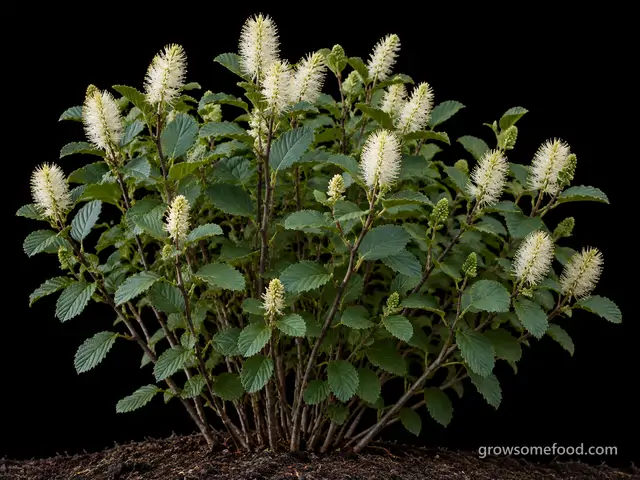
An easy, well-behaved native shrub with two outstanding shows - honey-scented white bottlebrush flowers in spring and spectacular multicolored (yellow, orange, scarlet) fall foliage - plus clean summer leaves, few pests, and deer resistance.
Safety notes Fothergilla is grown as an ornamental flowering shrub - it is not a food plant and has no notable toxicity. It is valued for its honey-scented white bottlebrush flowers in spring and its spectacular multicolored fall foliage, and for being easy, well-behaved, and deer-resistant. Simply enjoy it for its flowers and fall color; there are no edible or hazardous parts to be concerned with.
Overview
Fothergilla is one of the most rewarding and well-behaved native shrubs for four-season interest, a relative of witch hazel with a pair of standout displays. In spring, before or with the leaves, it opens fluffy, bottlebrush-like spikes of tiny white flowers - made of showy stamens rather than petals - that carry a sweet honey fragrance and feed early pollinators. Then in fall, it delivers what many consider the finest fall color of any shrub: a spectacular blend of yellow, orange, scarlet, and red-purple, often all glowing on the same plant at once.
The one thing to knowIn spring, before or with the leaves, it opens fluffy, bottlebrush-like spikes of tiny white flowers - made of showy stamens rather than petals - that carry a sweet honey fragrance and feed early pollinators.
Quick facts
- Sprouts in
- 180 daysRange: 60–540 days
- Soil temperature
- 70 °FRange: 60–75 °F
- Height
- 48 inRange: 24–120 in
- Spread
- 48 inRange: 24–96 in
- Cold
- Takes hard frostdamaged below -25°F
- Heat
- Struggles above 90°F
- Life cycle
- Perennial, lives about 30 years
- Save seeds
- About 150 days after plantingRange: 120–180 days
- Soil
- Consistently moist
- Water
- Medium
- Plant spacing
- 4 ftRange: 3–7 ft
When to plant
Fall sowing is open for 19 more days. Next: spring, Mar 27 to May 22.
- Direct sow Oct 11 – Nov 8 Open now · 19 days leftAbout 2 weeks before to 2 weeks after your first frost (Oct 25 here)Fothergilla seed has a complex double dormancy and can take up to two years to germinate, so cuttings or nursery transplants are far more practical than seed.
- Transplant Mar 27 – May 22 Opens in 158 daysAbout 2 weeks before to 6 weeks after your last frost (Apr 10 here)Plant container fothergilla in spring into moist, acidic, humusy, well-drained soil in full sun to part shade; more sun gives the most flowers and the brightest fall color. Keep it evenly moist while establishing. It is a cool-to-temperate woodland shrub and performance falls off past 8b.
- Transplant Aug 16 – Sep 27 Opens in 300 daysAbout 10 weeks before to 4 weeks before your first frost (Oct 25 here)Fall planting works well in milder zones, letting roots establish in cool moist soil; mulch and keep watered until dormancy.
Frost here: last around Apr 10 (Mar 27 to Apr 24 most years), first around Oct 25. Zone averages, your own yard may run a week or two either way.
Life stages
Establish, grow, repeat
Getting established and returning each season are different parts of the story.
Stage 1 of 4 · Getting established
Years 1-2 - rooting in
The first year after planting
Care at this stage
-
Keep evenly moist while establishing
Fothergilla is a woodland shrub that wants moist, acidic, humusy, well-drained soil - keep a new plant evenly watered through its first two years and do not let it dry out. It establishes at a measured pace, so be patient and keep it moist.
-
Mulch with acidic organic matter
Mulch with pine straw, leaf litter, or bark to keep the roots cool and moist and maintain the acidic soil it needs. It is well-behaved and slow-spreading (dwarf types sucker modestly into a clump); little management is needed.
Months are typical seasonal windows; climate, variety, and plant age can shift them.
Watch out for
3 to know. None are high-risk for Fothergilla. 1 is active in October.
Chlorosis (Alkaline or Dry Soil)Severity Medium DisorderSeason: May–JulFronds paling to yellow-green while veins stay greener, weak stunted growth, especially in limy or high-pH soils.
Fronds paling to yellow-green while veins stay greener, weak stunted growth, especially in limy or high-pH soils.
Acidify the root zone with organic matter and appropriate soil amendments over time; in strongly alkaline ground, relocate the fern to a more acidic, wet spot.
Plant in naturally acidic soil, amend generously with organic matter, and mulch with acidifying materials like pine straw and leaf mold.
Yellowing between the leaf veins can appear in very alkaline soils, where the plant struggles to take up iron; wax myrtle prefers acidic to neutral ground and rarely needs feeding since it fixes nitrogen.
Reduced Flowers & Fall Color in ShadeSeverity Low DisordernowSeason: Apr, May, OctSparse flowering and dull, less vivid fall color on plants in heavy shade.
Sparse flowering and dull, less vivid fall color on plants in heavy shade.
Give more light by limbing up surrounding plants or relocating; flowering and fall color improve markedly with more sun.
Site in full sun to part shade for the best flowers and brightest fall color; avoid deep shade.
Fothergilla flowers and, especially, colors best with good light; in too much shade its blooms are sparser and its famous fall color is muted.
Drought StressSeverity Low DisorderSeason: Jun–AugWilting on hot afternoons, browning and crisping along leaf edges and tips, premature leaf drop, collapsed flower stems, and thin, stunted growth - showing up first on young plants and on the driest, most exposed side of the planting.
Fothergilla is a moisture-loving woodland shrub. A dry or hot exposed site costs you the fall color and the following spring's flowers as well as scorching the leaves.
Wilting on hot afternoons, browning and crisping along leaf edges and tips, premature leaf drop, collapsed flower stems, and thin, stunted growth - showing up first on young plants and on the driest, most exposed side of the planting.
Water deeply and consistently, then mulch. Mild wilting reverses within a day or two, but a prolonged drought sets a plant back hard and can kill a young one outright. If a plant scorches every summer, the site is wrong - move it to damper ground rather than trying to water it through.
Match the site to the plant: put a moisture-loving species where the ground actually stays damp - a rain garden, pond edge, ditch, seep or low spot - rather than in an ordinary border you intend to keep watered. Mulch to hold moisture and keep the roots cool, water deeply through every dry spell while the plant is establishing, and avoid hot, windy, exposed positions.
Not a pest but a siting problem, and on a moisture-loving plant it is usually the thing that actually kills it. When the soil dries out, leaf edges brown and crisp, foliage wilts and drops early, flowering and fall color are cut short, and growth thins. Hot sun, wind and exposed positions make it worse by pulling water out faster than the roots can replace it. A plant that wants reliably moist or wet ground has no drought tolerance to fall back on, and young or recently planted ones have the least of all.
Good & bad neighbors
Plant nearby
-
Evergreen christmas fern and other woodland ferns underplant fothergilla beautifully, sharing its moist, acidic, shaded conditions and softening its base year-round.
-
Both native acid-loving woodland shrubs - fothergilla's fragrant white spring flowers and flame azalea's fiery blooms share the season and the cool, moist, acidic conditions of the Appalachian understory.
-
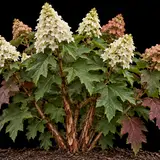
Two native part-shade shrubs with superb fall color - fothergilla's fiery blend and oakleaf hydrangea's burgundy - plus fragrant fothergilla flowers and hydrangea cones, layer a rich shaded native border.
-
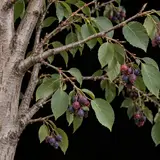
Serviceberry's early flowers and June fruit above fothergilla's fragrant blooms and brilliant fall color layer a four-season native woodland-edge planting for pollinators and birds.
Varieties · 5
You pick one when you add Fothergilla to your garden. Its days to maturity set your harvest window.
Dwarf fothergilla (F. gardenii) 2 varieties
Dwarf Fothergilla (Fothergilla gardenii)
The compact coastal-plain species, a tidy 2-3 foot mound (3-4 feet wide, spaced about 3-4 feet) with fragrant white bottlebrush flowers in spring and brilliant multicolored fall foliage.
Variety details for Dwarf Fothergilla (Fothergilla gardenii)
Low, dense, mounded shrub with white bottlebrush spring flowers and fiery yellow-orange-red fall color.
speciesnativefragrant-flowersfall-colorIdeal for smaller gardens, foundations, and massing; suckers modestly into a small clump and is easy in moist, acidic soil.
Blue Mist
A dwarf Fothergilla gardenii selection with the bluest summer foliage in the genus - a compact 2-3 foot mound (3-4 feet wide, space 3-4 feet), not a hybrid, so give it dwarf-fothergilla room and expect dwarf-fothergilla size.
Variety details for Blue Mist
Low, compact mound with powder-blue summer leaves, white spring flowers, and muted yellow fall color.
cultivarblue-foliagefragrant-flowerscoastal-plainFragrant white bottlebrush flowers in spring; its fall color is softer and less fiery than most fothergillas, which is the trade for the foliage.
Mountain witch alder (F. major) 1 variety
Mountain Witch Alder (Fothergilla major)
The larger Appalachian species, an upright shrub 6-10 feet tall and 5-8 feet wide (space 5-7 feet) with big fragrant white bottlebrush flowers and superb fall color, for the back of a border or a woodland-edge specimen.
Variety details for Mountain Witch Alder (Fothergilla major)
Tall upright shrub with large white bottlebrush flowers and brilliant orange-red-purple fall foliage.
speciesnativelargeappalachianMuch more substantial than dwarf fothergilla, with the same easy, refined, deer-resistant character - buy it knowing the size.
Hybrid fothergilla (F. x intermedia) 2 varieties
Mount Airy
The benchmark cultivar, a robust F.
Variety details for Mount Airy
Upright robust shrub with big white bottlebrush flowers and reliably spectacular multicolored fall foliage.
cultivarreliablelarge-flowersoutstanding-fall-colorx intermedia hybrid around 5-6 feet tall and wide (space 4-6 feet) with abundant large fragrant white flowers, excellent blue-green summer foliage, and consistently outstanding yellow-orange-red fall color. Vigorous, dependable, and widely available - the standard recommendation for garden performance.
Blue Shadow
A vigorous blue-leaved sport of 'Mount Airy', so a full-size F.
Variety details for Blue Shadow
Upright shrub with distinctive powder-blue summer leaves, white spring flowers, and colorful fall foliage.
cultivarblue-foliagefragrant-flowersfall-colorx intermedia hybrid at 4-5 feet tall and wide (space 4-6 feet), prized for striking powdery blue-green summer foliage alongside the usual fragrant white bottlebrush flowers and good multicolored fall color. Plant it where a mid-size shrub belongs, not as a low mound.
Grower tips
Notes from growers, tagged with the zone they grow in. A person reads every post before it appears.
Nobody has posted about Fothergilla yet. The first one usually saves someone a season.
Free account. Your post shows your grower name and zone, never your email.