Add it to your home screen and it opens full screen: no browser bars, one tap away, and everything stays signed in. Free, nothing to download from an app store.
- Tap the Share button in your browser
- Scroll down and choose “Add to Home Screen”
- Open GrowSomeFood from your home screen
- Open your browser’s menu
- Choose “Add to Home screen” or “Install app”
- Open GrowSomeFood from your home screen
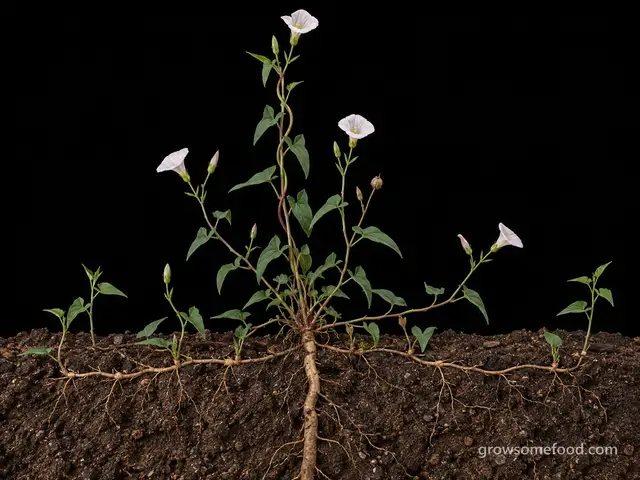
Field Bindweed
The twining, arrowhead-leaved weed with small white-pink morning-glory flowers - and a root system 10 to 20 feet deep that laughs at digging. It is a listed noxious weed in most western and plains states, and beating it takes three to five seasons of patience, not one weekend.
Field bindweed is not a food plant - do not eat it. Its foliage and seed carry tropane alkaloids; horses that graze it in quantity can develop colic and lasting gut damage, and it is not safe fodder for other livestock. The risks to you are indirect: never compost it or move soil from an infested bed, because root fragments resprout. If you use a herbicide, choose a product whose label lists your site - lawn, vegetable garden, pasture - and follow that label, which is legally binding.
Overview
Field bindweed (Convolvulus arvensis) is the weed most gardeners meet as a thin, wiry vine with arrowhead-shaped leaves and pretty little white or pale-pink funnel flowers that look exactly like miniature morning glories - because they are close relatives. It twines up tomato cages, corn, roses, and fences, sprawls flat across lawns and paths, and reappears every spring no matter what you did to it last year.
What makes it different from almost every other garden weed is what you cannot see. A mature bindweed plant has a vertical root reaching 10 to 20 feet down, with lateral roots running sideways for several yards, and buds all along them that can each send up a new shoot. Pull the top and you have removed a leaf; the plant is untouched. Rototill the bed and you have cut the roots into hundreds of cuttings and planted them all - a fragment two inches long can start a new plant. Its seed, meanwhile, stays alive in the soil for decades.
So this entry is not about growing bindweed. It is a listed noxious weed across most of the western and plains states, nobody plants it deliberately, and the app will never offer it to you. It is here so you can identify it, understand why the obvious approaches backfire, and use the one method that actually works: starving the roots by removing every leaf, on a schedule, for several years running.
Quick facts
For identification. Not a growing guide.
- Life cycle
- Perennial, lives about 25 years
- Where it grows
- Full sun · Part sun, well-drained soil
- Height
- 18 in4 to 72
- Spread
- 120 in24 to 240
- Cold
- Takes hard frostdamaged below -30°F
- Heat
- Struggles above 110°F
- Self-sows
- Yes. Never let it set seed.
Through the year
How to recognize it in each season.
Spring emergence (from seed and from root buds)
Mar to May, every year- Recognize it early: arrowhead leaves on a thin twining stemField bindweed comes up as slender, wiry stems with alternate, arrowhead-shaped leaves 1-2 inches long, the two lobes at the base pointing backward and slightly outward. The stems twine counter-clockwise around anything upright and sprawl flat over anything that is not. Most of what you see in spring is not a seedling at all - it is a shoot from a root bud on an established root system that has been there for years.
- Do not rototill an infested bedThis is the single most common mistake. Bindweed regenerates from root pieces as short as two inches, so a rotary tiller turns one plant into dozens spread evenly across the bed. If you must cultivate, do it shallowly with a sharp hoe that severs shoots at the surface, and expect to repeat it every two to three weeks all season - the point is starvation, not removal.
Key signs- Arrowhead-shaped leaves on thin twining stems
- Shoots coming up in a line, which traces a lateral root beneath
- New patches appearing where soil or a tiller was moved
Twining growth (the starvation window)
May to Sep, every year- Cut every shoot to the ground, every two to three weeksYou cannot pull bindweed out - the roots go down 10 feet and more, with laterals running sideways for yards. What you can do is deny the roots the leaves that refill them. Hoe or clip every shoot flush with the soil the moment it has a few leaves, on a strict two-to-three-week cycle, for three to five growing seasons. Extension trials show this genuinely works; skipping a month undoes months of progress.
- Smother it - but plan on three full seasonsHeavy cardboard plus 6-8 inches of mulch, or opaque landscape fabric, will exhaust a patch, but bindweed has enough root reserve to send shoots up through and around a cover for two years or more. Leave the cover down for at least three growing seasons, overlap the edges by a foot, and check monthly for shoots creeping out from under the perimeter.
- Crowd it out with something that shades the groundBindweed is a sun plant with weak seedlings. A dense stand of perennial grass, a thick cover crop, or a closely spaced vegetable canopy shades the soil, blocks new seedlings, and slows regrowth from roots. Competition will not kill an established patch on its own, but it is what keeps a cleared area clear.
Key signs- Stems twining up crops, fences, and shrubs and pulling them over
- Regrowth two to three weeks after each cutting - keep the cycle
- Runners escaping from under a mulch or fabric cover
Flowers and seed (and the treatment window)
Jun to Oct, every year- Confirm the ID at flowering: small funnels with bracts low on the stalkThe flowers are white to pale pink funnels about 1 inch across, opening in the morning and closing in the afternoon or in cloudy weather. The giveaway is two tiny leaf-like bracts set about an inch BELOW the flower on the stalk. Hedge bindweed, the bigger lookalike, has 2-3 inch flowers with two large bracts wrapped right around the base of the flower itself.
- Clip flowers before they set seedEach plant sets a few hundred seeds, and those seeds stay viable in the soil for decades - buried samples have germinated after 20 years and more. You will not win the seed-bank fight, but you can stop adding to it: cut or pull flowering stems before the little round capsules dry and split.
- If you spray, spray at full bloom or in early fallSystemic herbicides only work on bindweed when the plant is actively moving sugars down to the roots, which is at full bloom and again in early fall before frost. Spraying a young shoot in spring burns the top and the root shrugs it off. Use a product whose label lists your site, follow the label rate and any pre-harvest interval, and never spray a food bed with a product not labelled for it.
Key signs- White-to-pink 1-inch funnel flowers with bracts low on the stalk
- Round seed capsules drying on the vine
- Full bloom and early fall - the two windows when systemic treatment works
Winter (the top dies, the root does not)
Nov to Feb, every year- Bare ground is not a clean bedFrost kills the vines and the patch vanishes, which is why so many people think they beat it. The root system - a vertical taproot reaching 10-20 feet with laterals radiating out - is untouched, loaded with the food it stored in late summer, and studded with buds ready to shoot in spring. Mark the patch now so you start the cutting cycle the day it emerges.
- Do not move soil out of the patch over winterWinter is when people dig beds, move topsoil, and share plant divisions. Any of those will carry root fragments to a clean part of the yard, or to a friend's. Keep tools, boots, and soil from an infested area out of clean ground, and do not pass on divisions of perennials lifted from a bindweed patch.
Key signs- Dead vines over a completely intact root system
- Soil, tools, or divisions leaving the infested area
Hazards
Regrowth from Root FragmentsSeverity High DisordernowNew patches appearing exactly where soil was moved, where a bed was tilled, or where a division was planted; bindweed shoots coming up inside a newly delivered load of topsoil or compost.
New patches appearing exactly where soil was moved, where a bed was tilled, or where a division was planted; bindweed shoots coming up inside a newly delivered load of topsoil or compost.
Bag removed material for disposal, or dry it to a crisp on pavement first. Clean tillage and digging tools before moving to clean ground, and watch any newly disturbed area for a full season.
Never rototill an infested bed. Never compost bindweed. Keep soil, tools, and boots from an infested area out of clean ground, and do not pass on divisions lifted from a bindweed patch.
A root piece as short as two inches will produce a new plant. Tilling, digging, moving topsoil, sharing perennial divisions, and unwashed equipment therefore spread field bindweed efficiently, and are the main way a patch reaches a clean garden or a new property.
Deep Root Reserves (why digging fails)Severity High DisordernowRototilling is the worst thing you can do to a bindweed patch - it turns the root system into hundreds of cuttings and plants them across the bed.
Shoots reappearing within two to three weeks of every removal; shoots emerging in a line, which traces a lateral root beneath the surface; a patch that looks gone in spring and is back by June.
Starve the roots: sever every shoot flush with the soil every two to three weeks through the whole season for three to five consecutive years, with no gaps. Combine with heavy mulch or opaque fabric left down at least three seasons, and dense competing cover. Where herbicide is appropriate, apply a systemic product at full bloom or in early fall when sugars move downward, using a product whose label lists your site and following that label exactly.
Kill seedlings in their first three to four weeks, before they can regenerate from root. Keep ground covered and shaded so new plants never establish, and never move soil from an infested area.
Field bindweed's control problem is entirely below ground. A mature plant has a vertical root reaching 10-20 feet with laterals running several yards sideways, studded with buds that each produce a shoot. Removing top growth removes almost none of the plant, and late-season sugars stored in that system fund a fast, repeated emergence the following spring.
Noxious-Weed ListingSeverity Medium DisordernowBindweed in hay, crop seed, nursery containers, or delivered topsoil - the routes that state rules are written to interrupt.
Bindweed in hay, crop seed, nursery containers, or delivered topsoil - the routes that state rules are written to interrupt.
Follow your state or county weed authority's control requirements, and contact your local extension or weed district for the control programs and any biological-control agents available in your area.
Buy certified weed-free seed, hay, and topsoil where that is available; do not sell or give away plants, soil, or hay from an infested area.
Field bindweed is listed as a noxious weed by most western and plains states, and by many others - it is one of the most widely listed weeds in the country. Listing can carry duties to control it on land you own, and restrictions on selling or moving contaminated seed, hay, soil, or nursery stock. Check your own state and county list, since listing is what creates any obligation.
Tropane Alkaloids (livestock risk)Severity Medium DisordernowBindweed established in pasture, or twining through a hay field where it will be baled in with the crop.
Bindweed established in pasture, or twining through a hay field where it will be baled in with the crop.
Remove animals from a heavily infested pasture and consult a veterinarian if a horse shows recurring colic or unexplained weight loss where bindweed is abundant.
Keep bindweed out of hay ground and paddocks, and inspect purchased hay. Do not offer pulled bindweed to animals as green feed.
Field bindweed foliage and seed contain tropane alkaloids. Horses are the most sensitive: sustained grazing or contaminated hay has been associated with colic, intestinal thickening, weight loss, and lasting digestive damage. It is not a hazard to handle, and it is not a human food.
Decades-Long Seed BankSeverity Medium DisordernowSmall arrowhead-leaved seedlings appearing in a bed you thought was clear, especially after cultivation brings buried seed to the surface.
Small arrowhead-leaved seedlings appearing in a bed you thought was clear, especially after cultivation brings buried seed to the surface.
Hoe seedlings out within their first three to four weeks, while they can still be killed outright; after about a month they can regenerate from root and become a long-term problem.
Cut or pull flowering stems before the round capsules dry and split, so you stop adding to the bank. Keep soil covered - buried seed needs light and warmth near the surface to germinate.
Each plant produces a few hundred hard-coated seeds, and buried-seed trials have recovered viable field bindweed seed after 20 years and longer. This is why an apparently cleared area produces a trickle of new seedlings for many years, and why control has to include a permanent low-level watch rather than ending at eradication.
Grower tips
Notes from growers, tagged with the zone they grow in. A person reads every post before it appears.
Nobody has posted about Field Bindweed yet.
Free account. Your post shows your grower name and zone, never your email.