Add it to your home screen and it opens full screen: no browser bars, one tap away, and everything stays signed in. Free, nothing to download from an app store.
- Tap the Share button in your browser
- Scroll down and choose “Add to Home Screen”
- Open GrowSomeFood from your home screen
- Open your browser’s menu
- Choose “Add to Home screen” or “Install app”
- Open GrowSomeFood from your home screen
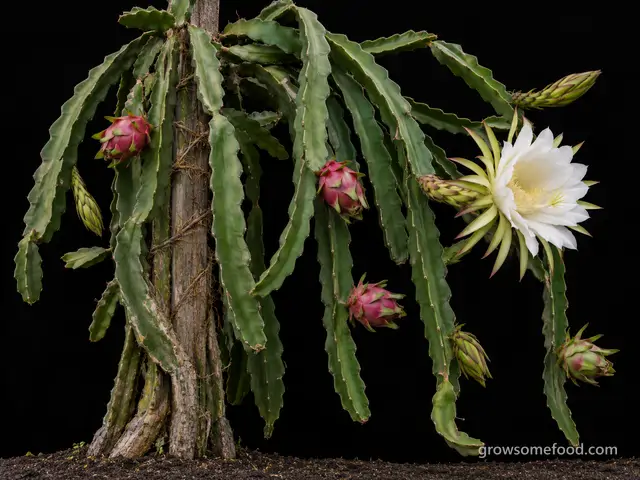
Dragon Fruit
A climbing jungle cactus that fruits within a year or two of a cutting, flowers for one night only, and often needs you to hand-pollinate after dark. Frost-tender - zones 10-11 in the ground, a big pot anywhere colder - and it must have a serious post to climb.
The fruit and the flowers are food, and there are no toxic parts. Wear gloves anyway: the stems carry short spines at every areole, and young fruit stays armed until the spines dry off as it colors. Red- and magenta-fleshed varieties contain betacyanin pigment that can turn urine and stool pink or red for a day after a good serving - it is harmless, but it alarms people who do not expect it and is regularly mistaken for blood.
Overview
The one thing to knowDragon fruit is a climbing cactus, not a tree and not a desert plant.
Dragon fruit is a climbing cactus, not a tree and not a desert plant. In its native Mexican and Central American forests it scrambles up trunks and rocks with aerial roots, and that is exactly how it behaves in a garden: three-sided green stems that climb whatever you give them, then cascade back down and flower on the hanging branches. Give it a serious post and it will fruit within a year or two of a rooted cutting - one of the fastest returns of any perennial fruit.
The flowering is the part nobody warns you about. Buds swell for two or three weeks, then open for a single night - a dinner-plate-sized white flower that unfolds after dark and is finished by mid-morning. In the tropics moths and bats handle it; in a US backyard there is often no night pollinator at all, so many growers hand-pollinate with a brush after dark. Several red-fleshed selections go further and are self-incompatible, setting little or nothing without pollen from a different variety. This one fact explains most of the “my plant flowers beautifully and never fruits” disappointment.
It is frost-tender: stems are damaged around freezing and killed in the upper 20s, so in-ground culture means zones 10-11, with zone 9 growers covering the crown on cold nights. Anywhere colder, grow it on a post in a large pot and move it under cover for winter - it takes to that better than almost any other tropical fruit. What it will not tolerate is wet feet: cold, soggy soil rots the base faster than any pest will ever kill it.
Quick facts
- Life cycle
- Perennial, lives about 20 years
- Height
- 7 ft5 to 10
- Spread
- 6 ft4 to 10
- Support
- Grows better on a trellis or stake
- Cold
- Killed by frostdamaged below 32°F
- Heat
- Struggles above 100°F
Full sun or part sun · medium water · well-drained soil · 8 ft apart (4 to 15) · transplant or cuttings
When to plant
No planting window on record for this zone. Nearest zone with one: 8a.
Frost here: last around Apr 10 (Mar 27 to Apr 24 most years), first around Oct 25. Zone averages, your own yard may run a week or two either way.
Life stages
One stage to settle in, then five that repeat each year. Windows are typical; your zone and weather move them.
Establishment on the post
The first year after planting- SupportSet the post before you set the plantA dragon fruit is a climbing cactus that ends up carrying a heavy, top-loaded crown, so the support goes in first: a 4x4 or a concrete post sunk deep, standing 4-5 ft above ground, with a frame, tire, or crosspiece on top for the branches to cascade over. Retrofitting support to an established plant means fighting a spiny 60-pound tangle.
- WaterWater lightly until roots take, then settle into a rhythmweeklyA fresh cutting rots far more easily than it dries. Let a new cutting callus for a week to ten days before planting, keep the mix barely moist until it roots, then water when the top inch or two has dried. This is a cactus with a jungle habit - it wants more water than a desert cactus and far less than a banana.
- ProtectShade a young plant through its first desert summerIn low-desert heat (inland California, Arizona, south Texas) unhardened stems scorch and turn papery white in full afternoon sun. Give a young plant 30-50 percent shade cloth or an east-facing position for its first summer; established plants take much more sun.
- SupportTrain ONE stem straight up the postTie a single leader to the post and rub off side shoots below the top. You want all the plant's energy going into reaching the crossbar, because dragon fruit flowers on mature, hanging branches - not on the climbing stem. Loose ties, checked as the stem thickens.
Watch for- Cuttings rotting at the base from being planted too wet or too deep
- White or tan sunburn patches on young stems
- Side shoots stealing energy from the leader
- Ants and mealybugs sheltering under the ties
Building the crown
Mar to Sep, every year- PruneTip the leader at the top and let it branchOnce the leader clears the crossbar, cut its tip. That releases the buds below it and the plant throws the cascading branches that actually flower. Aim for a mop-head crown of 30-40 hanging branches on a mature post; thin out anything crowded, damaged, or trailing on the ground.
- FertilizeFeed little and often through the warm seasonevery 56 daysDragon fruit is a shallow, fine-rooted plant that responds to light, frequent feeding rather than heavy doses: a balanced fertilizer or compost every 6-8 weeks in the growing season, easing off nitrogen and favoring potassium once flowering starts. Heavy nitrogen gives you a magnificent green plant and very little fruit.
- WaterWater when the top inch dries, and never leave it standingweeklySteady moisture in warm weather makes fat, productive stems; standing water kills. Water deeply, let the surface dry, and cut back sharply in cool weather. Containers need more frequent water than the ground and absolutely need free-draining mix and open holes.
- MulchMulch the root zone, but keep it off the stemsThe roots are shallow and near the surface, so a few inches of coarse mulch around (not against) the base holds moisture and keeps the soil cooler. Bare stems at ground level stay dry and rot-free.
Watch for- Branches sprawling on the ground where they root, rot, and collect slugs
- Yellow, orange, or sunken spots on stems (stem canker or anthracnose)
- Soft, mushy sections after a cool wet spell
- Ants farming scale and mealybugs in the crown
Night flowering
May to Sep, every year- PollinateHand-pollinate at night - the flower opens once and closes by morningevery 2 daysBuds swell for two to three weeks, then open for a single night, roughly from dusk to just after dawn. Brush pollen from the anthers onto the star-shaped stigma any time after the flower opens; if you will be asleep, collect anthers into a small closed container in the evening, refrigerate, and pollinate at first light before the flower shuts.
- PollinateUse pollen from a DIFFERENT variety where set is poorMany white-fleshed selections set well on their own, but several red- and magenta-fleshed types and most Selenicereus costaricensis hybrids set little or nothing without pollen from an unrelated variety. Two different varieties flowering the same night is the reliable fix, and cross-pollination usually increases fruit size on self-fertile plants too. Refrigerated pollen keeps several days if the two do not bloom together.
- InspectWatch for buds aborting in heat or droughtDragon fruit drops buds when the plant is water-stressed, badly sunburned, or shocked by a heat spike. Keep water steady and shade the crown in extreme heat while buds are developing.
Watch for- Buds swelling for 2-3 weeks before opening
- Flowers opening after dark and closing by mid-morning
- Buds yellowing and dropping (heat or water stress)
- Ants and beetles inside open flowers - they are not effective pollinators
Fruit fill
Jun to Oct, every year- WaterKeep water steady while fruit sizesevery 5 daysThe whole fruit forms in roughly 30-50 days after pollination, so there is no time to recover from a drought. Even moisture through fill gives full-sized fruit and prevents splitting; a soaking after a dry spell splits ripening fruit open.
- ProtectBag or net prize fruit if birds and rats find themRipe dragon fruit is soft and conspicuous. Mesh or organza bags over individual fruit protect them without netting a spiny crown, and picking promptly is half the battle.
Watch for- Skin turning from green to pink, red, or yellow
- The leafy bracts (wings) starting to wither and dry back
- Splitting after heavy rain or a late soaking
- Birds, rats, and ants working ripening fruit
Harvest flushes
Jul to Nov, every year- HarvestCut when the color is full and the wings dry backevery 3 daysPick 3-5 days after the skin finishes coloring, when the leafy bracts have begun to wither and the fruit gives very slightly under a thumb. Cut the stalk with pruners rather than twisting it off, which tears the branch. Unlike a banana, dragon fruit gains no sugar after picking - what you cut is what you get.
- PruneClean up after each flushRemove branches that fruited themselves ragged, anything damaged or diseased, and growth trailing on the soil. A mature plant crops in 3-6 waves through the season, and an open, tidy crown flowers better in the next one.
Watch for- Fruit left too long going soft, splitting, and drawing ants
- 3-6 separate flushes across one season
- Cut stubs left on branches - trim them flush to avoid rot entry
Cool season
Nov to Feb, every year- WaterCut water right back in cool weatherCold soil plus water is what kills dragon fruit. Once nights drop into the 50s the plant barely grows - water sparingly, and stop entirely during a cold, wet stretch.
- ProtectCover below freezing, or roll the pot indoorsStems are damaged around 32°F and killed in the upper 20s. In zone 9-10a, drape frost cloth over the crown on cold nights (old-style incandescent holiday lights under the cloth add real warmth) and wrap the post. Anywhere colder, grow in a large pot and move it into a bright garage, greenhouse, or sunroom for winter.
Watch for- Translucent, water-soaked, then brown stem tips after a frost
- Soft rot spreading down from frozen sections
- Rot at the base from cold wet soil
Harvest
- Skin has colored fully - bright pink, red, or yellow depending on variety - and has held that color for several days
- The leafy bracts or wings along the fruit start to wither and dry at their tips
- The fruit yields very slightly to thumb pressure but is not soft
- Roughly 30-50 days have passed since the flower was pollinated (much longer for yellow pitaya)
- Cut when the color is full and the wings dry back · every 3 days
- Clean up after each flush
Per plant 5 to 100 fruits, 2.5 to 56.3 lbPicking pick as they ripen
Cook with Dragon Fruit
Watch out for
6 to know. 3 are high-risk: Poor Fruit Set (Pollination Failure), Dragon Fruit Stem Canker, Root Rot. 5 are active in September.
Poor Fruit Set (Pollination Failure)Severity High DisordernowThis is the single most useful thing to know before buying a dragon fruit plant, and it is the reason so many well-grown plants never fruit.
Ask about self-fertility at the nursery, and plan on two varieties.
Large flowers opening after dark and closing by late morning with no fruit forming behind them. Small green ovaries that yellow, shrivel, and drop three to seven days after flowering. A plant that flowers heavily year after year and produces only a handful of fruit, or none. Fruit that does form being small and lopsided, which points to partial pollination rather than none.
Nothing can be done for a flower that has closed unpollinated - it will not reopen. The fix is entirely for the next flush: get a brush into the crown at night, and get a second variety planted. Where fruit sets but is small and misshapen, more thorough pollination across the whole stigma usually corrects it. Bud drop before flowering is a different problem - that one is heat or water stress.
Hand-pollinate as routine rather than as a rescue. Brush pollen from the anthers onto the star-shaped stigma once the flower is fully open in the evening, or at first light before it shuts. If you cannot be there at night, snip a few anthers into a closed container in the evening, refrigerate them, and pollinate at dawn. Plant at least two different varieties that flower in the same season so cross-pollen is available, and ask the nursery whether a variety is self-fertile before buying a single plant. Refrigerated pollen keeps for several days and can be frozen for longer if two varieties bloom out of step.
The commonest disappointment in home dragon fruit growing: a healthy plant flowers spectacularly and sets almost nothing. There are two causes and they compound. First, the flower opens for a single night and closes by mid-morning, and in most US gardens the moths and bats that pollinate it in its native range are simply absent, so nothing visits it. Second, many red- and magenta-fleshed selections and most Selenicereus costaricensis hybrids are self-incompatible - their own pollen will not set fruit at all, no matter how many insects visit. Unpollinated flowers wither and drop within a day or two.
Dragon Fruit Stem CankerSeverity High DiseasenowThe single most likely thing to go wrong with dragon fruit in a humid climate, and the reason growers in Florida and the Gulf keep crowns open and off the soil.
Dry-climate growers in California and Arizona see far less of it.
Small round yellow-to-orange spots on green stems that turn into sunken, bleached, tan or rust-colored lesions, often with tiny black specks in the center. Soft, rotting sections of branch, particularly where growth crowds together, rests on the ground, or was damaged by wind or handling. Orange or brown blotches on ripening fruit. The pattern is worst after long warm rainy spells and on the shaded, poorly ventilated inside of a dense crown.
Cut affected sections well back into clean, firm green tissue, sterilizing the blade between every cut, and bin the removed material. Let the cut surfaces dry rather than sealing them. Copper-based fungicides labeled for the crop give some protection on new growth in a wet season, but they do not cure existing lesions - sanitation, pruning, and airflow are the real controls. Badly infected, repeatedly cut-back plants are usually best replaced with clean cuttings taken from a healthy plant.
Keep the crown open and off the ground: prune to a manageable number of hanging branches, remove anything trailing on soil, and space posts so air moves through. Water at the base rather than over the plant, and avoid working in the crown while it is wet. Handle stems carefully - most infections start in a wound, including the ties and cuts you make yourself. Start with clean cutting material; the fungus travels in infected stems, which is the most common way it arrives in a new garden. Remove and bin infected material rather than composting it.
The main disease of dragon fruit worldwide, caused chiefly by the fungus Neoscytalidium dimidiatum, with Colletotrichum anthracnose behaving much the same way. It infects stems and fruit through wounds and spreads in warm, wet, humid weather, so it is far worse in a Florida or Gulf Coast summer than in a dry California one. Small orange-yellow spots become sunken, bleached, or rotted lesions dotted with black fruiting bodies, and on a badly infected plant whole branch sections turn soft and collapse. Infected fruit is marked and unsaleable but the plant itself is what is at stake: repeated infection weakens a crown over several seasons.
Root RotSeverity High DiseaseThe most common way a dragon fruit dies, and it usually happens in winter rather than summer: cold soil plus water rots the base and the buried end of a cutting.
Cut water right back in cool weather, plant shallow rather than deep, and never plant a cutting whose cut end has not calloused for a week to ten days. A rotted plant can often be saved as a cutting taken from firm green tissue well above the damage.
Wilting in the middle of the day on a plant whose soil is damp - the classic tell, and the reason people water a rotting plant and finish it off. Leaves yellowing from the bottom up, dull off-color foliage, and growth that stalls for no visible reason. Whole shoots, or one side of the plant, collapsing while the rest still looks fine. Soft, dark, or mushy tissue at the base of the stem or at the crown, sometimes with a sour smell. Lift a failing plant and look at the roots: healthy ones are firm and pale, rotted ones are brown or black and slimy, and the outer layer slips off between your fingers leaving a thread of core behind. Seedlings that topple over at soil level are the same problem, called damping-off.
There is no cure for tissue that has already rotted, so act on the conditions rather than looking for a spray. Stop watering at once and fix the drainage - open up compacted soil, or move the plant to a raised, sharply drained position or a container. Lift a badly affected plant, cut away every soft dark root and rotted section with a clean blade back to firm pale tissue, and replant only the healthy parts into fresh free-draining soil or mix. Often the better move is to give up on the plant and save its offspring instead: cuttings, offsets, or divisions taken from firm healthy growth root readily and give you a clean start. Bin the rotted material rather than composting it, and correct the drainage before you replant, because the rot comes straight back in the same wet spot.
Drainage is the whole defense. Match the plant to the site first - something that wants sharp drainage will not survive heavy clay or a low, water-collecting spot however well you tend it. Where the ground is heavy, plant on a raised bed, berm, or slope, or grow in a container. Set plants at the depth they were already growing, since burying the crown or the root flare is a common cause of rot, and keep mulch pulled back a few inches from the stem base instead of piled against it. Water the soil rather than the calendar: check that the top inch or two is dry before watering again, cut back hard in cool weather and winter dormancy, and never leave a pot standing in a full saucer. Do not plant or dig in soggy ground, and go easy on rich amendments for plants that want it lean. Rotate annual crops, and start with clean healthy plants and fresh mix.
Root rot is not one organism but a group of soil fungi and water molds - Pythium, Phytophthora, Fusarium, Rhizoctonia and others - that sit harmlessly in most soils and only turn destructive when the ground stays saturated. Waterlogged soil drives the air out, the roots suffocate, and the weakened tissue is invaded and goes soft, brown, and stringy. Because the damage is underground you usually see it first as something that looks like drought: wilting, yellowing, stunting, a plant that does not respond to being watered. Overwatering, heavy compacted ground, a low spot that collects runoff, a pot with no drainage or a saucer left standing full, and cold wet soil in winter are the usual causes. Once roots have actually rotted there is no cure - this is a problem you prevent rather than treat.
Stem SunburnSeverity Medium DisordernowAlmost universal on first-summer plants in the desert Southwest and almost unknown in humid Florida shade.
Cosmetic on its own, but it opens the door to stem canker, which is not.
Papery white, cream, or tan patches on the side of the stem that faces the afternoon sun, usually with a sharp boundary. Yellowing or reddening of stems as a first warning before tissue actually dies. Damage concentrated on newly planted cuttings, on the outer face of the crown, and on growth that was shaded until a recent pruning.
There is no repair for burned tissue - the patches are permanent scars. Leave them unless they are large or start to rot, in which case cut back into clean green tissue. Shade the plant, correct any drought stress, and let new growth cover the damage. Watch scarred areas for the sunken lesions of stem canker, which often colonises them.
Harden new plants gradually rather than moving them straight into full sun, and give young plants and fresh cuttings 30-50 percent shade cloth or a morning-sun position through their first summer in a hot-summer climate. Keep water steady in heat, since a water-stressed plant burns far more readily. Prune in stages in the desert, so you do not suddenly expose interior stems that have never seen direct sun. Established, well-watered plants in coastal and humid climates need no shading at all.
A physical injury rather than a disease: intense sun on unhardened or newly exposed stem tissue kills the surface, leaving papery white, tan, or bleached patches on the sun-facing side. It is common on young plants, on cuttings moved straight from a shaded nursery into full sun, and on stems suddenly exposed by pruning, and it is worst in the low desert of Arizona, inland southern California, and south Texas where summer temperatures run well above 100 degrees F. Damaged tissue never recovers, and badly scarred sections are an entry point for stem canker.
Birds & WildlifeSeverity Medium WildlifenowNetting a spiny crown is unpleasant, so individual mesh or organza bags over ripening fruit are the practical answer on dragon fruit.
Rats and ants take fruit on the same schedule, and a fruit that has already split is what draws all three.
Fruit disappearing from the outermost, most exposed parts of the plant first, and from the top of a tree where you cannot reach anyway. Single neat pecks and gouges in ripening fruit, with several fruits sampled rather than one eaten through - the classic sign that it was birds rather than an animal. Heads of grain or seed going visibly lighter and emptier as they ripen, with hulls and chaff scattered underneath. Freshly sown seed vanishing off the surface of a bed before it germinates. Bird traffic in and out of the plant picking up as the crop colors, and birds waiting on nearby wires and branches. Wasps arriving at the pecked and split fruit shortly afterward.
There is no treatment once a crop is being taken - only protection and timing, so the answer is to get netting on and to pick what is ready. Reflective tape, flash ribbon, spinners, and decoy predators do work, but only for a few days at a time: birds habituate fast, so move and rotate them and never rely on them as the main defense for a crop you care about. Cut and gather grain or seed heads a little early, at firm dough, and finish drying them under cover instead of leaving them standing for the flocks. Plant a little extra, or a decoy crop the birds prefer, and accept sharing anything that crops heavily. On a wild or foraged patch, fruit going to birds and small mammals is the point of the plant rather than a problem to solve.
Net, and net early. Bird netting draped over a frame or hoops so it stands off the fruit, with the edges closed at ground level, is the only thing that reliably works at harvest scale - and it has to go on before the crop starts to color, because once birds have found the food they are far harder to displace. Keep fruit trees small enough that netting them is actually feasible; that decision gets made years earlier, at planting. Bags of mesh, organza, or paper slipped over individual heads, clusters, or prize fruit protect a small crop without netting the whole plant. Then shorten the exposure: pick promptly and completely rather than leaving ripe fruit hanging as a lure, clear split and dropped fruit that draws birds and wasps alike, and where a crop can finish off the plant, harvest a little early and ripen or dry it under cover. Rake in or cover broadcast seed so it is not lying in plain view.
Birds find ripening fruit and seed before you do. Robins, waxwings, starlings, catbirds, jays, sparrows, finches, blackbirds, and doves all work a garden, and the pressure arrives in a narrow window - the last days before harvest, when sugar rises, color changes, and the crop softens or the grain hardens. A flock can strip a small planting in a day or two, and birds that only peck rather than take whole fruit still leave wounds that rot or draw wasps. Squirrels, chipmunks, and other wildlife usually turn up on the same crop at the same time. This is competition rather than disease: the birds are not harming the plant, and a big tree or a heavy-cropping bush often has enough for everyone - but on a small planting it can be the difference between a harvest and none.
Scale & Sooty MoldSeverity Low PestnowOn dragon fruit, scale and mealybugs shelter in the crowded shade of the crown, under ties, and in the grooves along the stem ribs, usually with ants farming them.
Opening the crown up and controlling ants does most of the work; oil sprays reach into the grooves better than soaps do.
Rows of small brown, tan, black, white, or waxy bumps along stems, twigs, leaf midribs, and leaf undersides that do not brush off but can be scraped loose with a fingernail. A sticky shine on the leaves - and on the floor, table, or path beneath the plant - that later turns black with sooty mold. Ants running steadily up and down the stems, since they farm and defend scale for that honeydew; often the first sign anything is wrong. Yellowing leaves, weak thin growth, and dieback of individual branches or canes that are heavily encrusted. On fruit crops, scale covers and sooty mold directly on the fruit. Check the leaf undersides and the shaded inner wood, which is where colonies build up unseen.
Horticultural oil is the main control: it works by smothering, so it has to coat the insects thoroughly - stems, twigs, and leaf undersides - and it usually needs repeating, because the waxy covering shields them and no single pass reaches everything. On deciduous woody plants a dormant-season oil smothers the overwintering stage while the leaves are out of the way, and timing a growing-season spray to the crawler stage, when the young are mobile and uncovered, is far more effective than spraying settled adults. On a small plant or a light infestation, scrub or wipe the scales off by hand, or dab them with a cotton swab of rubbing alcohol. Prune out and destroy badly encrusted wood rather than trying to save it. Wash off the sooty mold once the scale is gone - it lives on the honeydew, not on the plant, and stops once the supply does. Anything you spray must be labeled for the plant, and oils can burn delicate foliage, so test first.
Inspect. Look over leaf undersides and stems regularly - on a crop you pick, every harvest is a scouting chance - and check every new plant thoroughly before you buy it, plant it, or set it beside anything else, because scale almost always arrives on a plant rather than flying in. Quarantine new houseplants for a few weeks. Keep plants unstressed and not over-fertilized, since soft, forced growth is what populations build on. Prune for airflow and light to open up the shaded inner growth where scale hides, and prune out heavily infested wood as routine maintenance - on anything that gets a hard annual pruning, that alone removes most of any buildup. Leave the lady beetles, lacewings, and parasitic wasps alone, since they normally keep scale down to nothing, and keep ants off the plant where you can, because ants protect the colonies from those predators. Indoors, avoid hot, dry, still winter air.
Scale insects are sap-suckers that spend most of their lives immobile, fixed to a stem, twig, or leaf underside beneath a waxy or shell-like cover. They look far more like bumps, blisters, or crusty encrustations than like insects, which is why an infestation is usually well established before anyone notices it. Soft scales excrete large amounts of sticky honeydew that drips onto everything below and grows a black sooty mold - and those blackened leaves are often the first thing a gardener actually sees. Armored scales produce no honeydew but sit under a hard shield that protects them from most sprays. They spread as tiny mobile crawlers in the weeks after hatching, which is the only stage that moves and the only stage that is easy to kill. Populations build on stressed plants, on crowded shaded growth, and above all on plants kept indoors in dry, still air over winter.
Good & bad neighbors
All of these are traditional pairings. The evidence is thin, so treat them as a nudge, not a rule.
Plant nearby
-
A clumping, drought-tolerant edging plant that suits the same warm, well-drained ground and keeps foot traffic away from shallow dragon fruit roots without competing for the root zone under the post.
-
Draws hoverflies and other beneficials to a planting that otherwise offers nothing for daytime insects, and suppresses root-knot nematodes in sandy southern soils. Harmless at the base of a post.
-
A living mulch under a dragon fruit post: shades and cools the shallow root zone and suppresses weeds in a spot that is awkward to hoe around a spiny plant. Keep it from climbing the post.
-
Not a companion in any biological sense - simply a cactus with the same drainage and sun needs, useful when grouping plants by what they want rather than by folklore.

Keep apart
-
Turf grass and lawnDragon fruit roots run shallow and wide, and turf competes hard for exactly that layer while irrigation aimed at a lawn keeps the base too wet. Keep grass a few feet back from the post and mulch the root zone instead.
Varieties · 8
You pick one when you add Dragon Fruit to your garden. Its days to maturity set your harvest window.
White-fleshed dragon fruit 2 varieties
Vietnamese White (Vietnamese Jaina)
Large bright pink fruit with long green scales, crisp white flesh.
white-fleshself-fertilevigorousheavy-cropperThe commercial standard and the plant most people meet first: a vigorous, tough, heavy-cropping white-fleshed variety sold as self-fertile, producing large pink fruit in reliable flushes. Flavor is mild rather than exciting, but nothing is easier or more forgiving, and it makes a good pollen donor for fussier varieties.
David Bowie
Large pink-red fruit with white flesh and a slightly floral flavor.
white-fleshself-fertilelarge-fruitsweet-for-a-whiteA popular white-fleshed hobbyist selection: large fruit, sweeter and more interesting than the commercial Vietnamese types, on a vigorous plant sold as self-fertile. A good choice if you want one plant that fruits on its own but tastes like more than a supermarket dragon fruit.
Red- and magenta-fleshed dragon fruit 5 varieties
Physical Graffiti
Very large pink-red fruit with striking magenta-purple flesh.
red-fleshself-fertilelarge-fruitpopularProbably the most widely grown red-fleshed variety in American backyards: very large fruit with deep magenta flesh, sweet with a berry note, on a vigorous plant usually sold as self-fertile. Cross-pollination still increases fruit size noticeably. An excellent first red variety.
American Beauty
Medium-large red-pink fruit with dense, deeply colored magenta flesh.
red-fleshself-fertilerich-flavorreliableA favourite for flavor: deep magenta flesh with a strawberry-kiwi character that is markedly better than the white commercial types, on a manageable, dependable plant usually sold as self-fertile. A standard recommendation for a home grower who has room for only one or two varieties.
Delight
Pink-skinned fruit with soft pink flesh.
red-fleshpink-fleshself-fertileproductiveA productive pink-fleshed variety with a mild, clean sweetness between the white and the deep-red types, sold as self-fertile. Sets well and crops generously, which makes it a common recommendation for a second plant beside a fussier red variety.
Yellow pitaya (Selenicereus megalanthus) 1 variety
Yellow Dragon (Selenicereus megalanthus)
Small yellow fruit with knobbly spine clusters that rub off when ripe; translucent white flesh.
very-sweetslowlong-maturationthinner-stemsA different species entirely, and the sweetest fruit in the group: small yellow, spiny-skinned fruit with translucent white flesh and a honeyed, floral flavor. Slower to reach fruiting size, with thinner stems and fruit that takes several months rather than weeks to mature after flowering - so plan for a much later harvest. Widely considered worth the patience.
Grower tips
Notes from growers, tagged with the zone they grow in. A person reads every post before it appears.
Nobody has posted about Dragon Fruit yet. The first one usually saves someone a season.
Free account. Your post shows your grower name and zone, never your email.