Add it to your home screen and it opens full screen: no browser bars, one tap away, and everything stays signed in. Free, nothing to download from an app store.
- Tap the Share button in your browser
- Scroll down and choose “Add to Home Screen”
- Open GrowSomeFood from your home screen
- Open your browser’s menu
- Choose “Add to Home screen” or “Install app”
- Open GrowSomeFood from your home screen
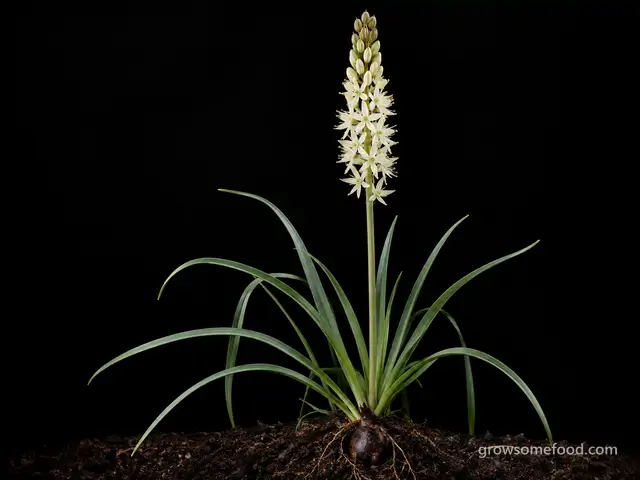
Death Camas
The lethal look-alike behind two of foraging's absolute rules: it grows with edible camas and wild onions, its bulb is indistinguishable from theirs, and it has no onion smell.
DEADLY POISON - never eat, plant, or dig any part. All parts contain steroidal alkaloids; the BULB is the most poisonous and has killed both people and livestock. Two absolute foraging rules exist because of this plant: (1) never eat a wild bulb that does NOT smell of onion or garlic when crushed - death camas has NO onion smell; (2) never dig camas outside bloom, because only the FLOWER separates edible blue camas from this. Suspected ingestion is an emergency - call poison control immediately.
Overview
The one thing to knowDeath camas (Toxicoscordion venenosum, long known as Zigadenus) is a native western bulb that is lethally poisonous in every part, with the bulb most dangerous of all.
Death camas (Toxicoscordion venenosum, long known as Zigadenus) is a native western bulb that is lethally poisonous in every part, with the bulb most dangerous of all. Its toxins are steroidal alkaloids - zygacine chief among them - which slow the heart and drop blood pressure, and can kill both people and livestock.
What makes it matter to a gardener or forager is not that it is poisonous, but where it grows and what it resembles. Death camas shares meadows and grassy slopes with edible blue camas (Camassia), one of the most important traditional food plants of the Pacific Northwest, and with wild onions and wild garlic. Out of bloom, its grass-like leaves and dark-coated bulb are effectively indistinguishable from both. Nearly every serious camas or wild-onion poisoning traces to this one confusion.
This entry exists so you can recognize and avoid it. It is never planted, never dug, and never eaten. Several related species occur across the continent - foothill death camas, Nuttall's death camas and others - and all should be treated the same way.
Quick facts
For identification. Not a growing guide.
- Life cycle
- Perennial, lives about 10 years
- Where it grows
- Full sun · Part sun, well-drained soil
- Height
- 18 in8 to 28
- Spread
- 6 in3 to 10
- Cold
- Takes hard frostdamaged below -30°F
- Heat
- Struggles above 100°F
- Self-sows
- Yes. Never let it set seed.
Through the year
How to recognize it in each season.
Grass-like spring foliage (the dangerous stage)
Mar to May, every year- Grass-like leaves with NO onion smellDeath camas emerges early as a clump of narrow, folded, V-channelled grass-like leaves from an underground bulb - almost identical to young camas, wild onion, and wild garlic. The decisive test at this stage is smell: crush a leaf, and if there is NO onion or garlic smell, it is NOT a wild onion. Death camas has no smell. Leaf shape is not a safe test - death camas leaves are flat and solid, exactly like meadow garlic's.
- This is when livestock are poisonedDeath camas greens up earlier than most range plants, so it is often the first green thing available - which is why sheep and cattle losses concentrate in early spring on overgrazed or snow-patchy range. Keep animals off ground with a known stand until other forage is up.
Key signs- Grass-like clumps in spring meadows with no onion smell when crushed
- Early green growth on range before other forage breaks dormancy
Cream-white flower spike (the only certain separator)
May to Jul, every year- CREAM-WHITE star flowers in a dense racemeIn late spring death camas sends up a spike of small, six-parted, cream to greenish-white star flowers, each with a green or yellow gland at the petal base. This is the single reliable way to tell it from edible blue camas, whose flowers are unmistakably BLUE to violet. Both grow in the same meadows, often intermingled - so mark and avoid every death camas plant while it is in bloom, because after bloom you cannot tell the bulbs apart.
- Do not gather the flowers, and keep pollen out of the kitchenThe flowers and pollen are poisonous too. Do not cut death camas for arrangements, do not add it to foraged flower salads, and be aware that honey from heavy death-camas bloom has been implicated in poisoning.
Key signs- Cream-white star flowers among blue camas - the stand is mixed
- Any pale-flowered bulb plant in a meadow you forage
Dormant bulb (indistinguishable underground)
Aug to Feb, every year- The bulb stays lethal, and looks like an onionAfter the tops die back, the poisonous bulb persists underground - dark-coated, onion-like, and effectively impossible to tell from an edible camas or wild onion bulb by eye. This is why the rule is to identify camas IN BLOOM, mark the good plants, and never dig a wild bulb from a stand you did not watch flower.
Key signs- Any wild bulb dug outside bloom - there is no safe way to identify it then
Hazards
Livestock PoisoningSeverity High HazardSheep or cattle grazing early green growth on known stands; staggering, salivation, weakness and collapse in animals turned onto spring range.
Sheep or cattle grazing early green growth on known stands; staggering, salivation, weakness and collapse in animals turned onto spring range.
A veterinary emergency - call a veterinarian immediately. Prevention through grazing management is far more reliable than treatment.
Keep livestock off infested range until other forage is well up, avoid turning hungry animals onto spring range, and manage grazing pressure so stock are not forced onto it.
One of the most damaging poisonous plants on western rangeland, killing sheep especially. Death camas greens up before most forage, so hungry animals eat it when little else is available - losses concentrate in early spring and on overgrazed or snow-patchy ground.
Poisoning by Ingestion (deadly)Severity High HazardAny ingestion of a wild bulb whose identity was not confirmed in bloom, or of an onion-like bulb with no onion smell; symptoms usually begin within about an hour, starting with heavy salivation and persistent vomiting.
Any ingestion of a wild bulb whose identity was not confirmed in bloom, or of an onion-like bulb with no onion smell; symptoms usually begin within about an hour, starting with heavy salivation and persistent vomiting.
Suspected ingestion is an EMERGENCY - call poison control or emergency services immediately and do not wait for symptoms. There is no antidote; treatment is urgent supportive hospital care.
Never eat a wild bulb that does not smell of onion or garlic. Never dig camas outside bloom - identify and mark blue-flowered plants first. Discard an entire foraged batch if one bulb is doubtful.
All parts contain zygacine and related steroidal alkaloids, concentrated in the bulb. Poisoning follows eating the bulb mistaken for camas or a wild onion, and causes vomiting, weakness, a slowed heart and a dangerous fall in blood pressure. There is no specific antidote.
Grower tips
Notes from growers, tagged with the zone they grow in. A person reads every post before it appears.
Nobody has posted about Death Camas yet.
Free account. Your post shows your grower name and zone, never your email.