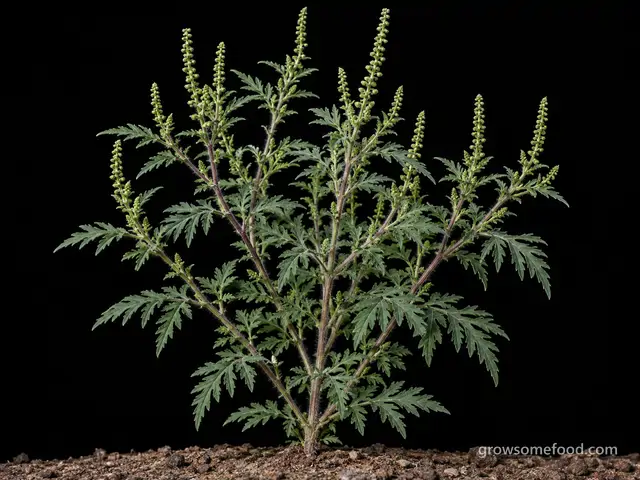
Common Ragweed

Ambrosia artemisiifolia · Asteraceae
Other Annual Herb Other
Native to North America - an indigenous annual of bare and disturbed ground, not an introduced invasive (it is the US that exported it, and it is now a serious invasive weed in Europe)
For identification only — don't plant. Nobody plants this. Common ragweed is the plant actually behind late-summer hay fever - a single plant sheds around a billion pollen grains - and it is a native annual weed of bare, disturbed ground. This entry is here so you can identify it, cut it before it flowers, and stop blaming goldenrod.

Ragweed's hazard is its pollen, not its sap. One plant releases roughly a billion wind-borne pollen grains between August and the first hard frost, and ragweed is the leading cause of late-summer hay fever in North America. Pollen travels for hundreds of miles, so clearing your own yard helps your neighbourhood more than your own sinuses. Handling it can also cause an itchy contact rash, so wear gloves and long sleeves, and cut it BEFORE it flowers rather than while it is shedding.

Overview

The plant actually responsible for late-summer hay fever, and the reason goldenrod gets blamed unfairly. A native annual of bare ground with drab green flower spikes and about a billion wind-borne pollen grains per plant - but an annual with a shallow taproot, so pulling it in spring genuinely works.

Common ragweed (Ambrosia artemisiifolia) is the plant behind your late-summer misery. It is an unremarkable-looking annual, 1 to 4 feet tall, with hairy stems and deeply cut, fern-like leaves, growing on bare and disturbed ground — roadsides, field edges, driveways, thin lawns, construction scrapes, and neglected vegetable beds. Its flowers are tiny, green, and petal-less, carried in slender spikes at the stem tips, and almost nobody notices them.

That anonymity is the whole problem. Ragweed is wind-pollinated, so it spends nothing on petals and everything on pollen: a single plant releases on the order of a billion pollen grains in a season, grains light enough to travel hundreds of miles and to be found miles up in the atmosphere. Ragweed pollen is the leading cause of late-summer allergic rhinitis in North America, affecting something like one American in six, from about mid-August until the first hard frost.

Meanwhile goldenrod blooms in the same ditches at the same moment with big showy yellow plumes, and takes the blame every year. Goldenrod is insect-pollinated: its pollen is heavy and sticky and stays on the flower, and it almost never reaches anyone's nose. If you are sneezing in September while looking at goldenrod, the culprit is the drab green plant standing next to it.

One piece of genuinely good news: unlike almost every other weed on this list, ragweed is an annual with a modest taproot — no rhizomes, no creeping roots, no regenerating fragments. Pull it in spring and that plant is gone forever. The catch is the seed bank, which lasts decades, so the job is a yearly one. Nobody plants it, and the app will never offer it; this page is here so you can recognize it and remove it in time.

At a glance

Sun
Full sun · Part sun
Water
Low
Spacing
4–30 in (typ. 12)
Mature height
12–72 in (typ. 36)
Frost
Tender
Germination
5–25 days (typ. 12) @ 45–85 °F (typ. 60)
Spread
8–36 in (typ. 18)
Soil
Well-drained
Temperature
Damaged below 30°F · struggles above 105°F
Seed ready
100–170 days (typ. 130) (for saving)
Self-sows
Yes — expect volunteers

When to plant

No planting window on record for this zone.

Life stages

  1. Spring seedlings (the cheapest time to remove it) Mar, Apr, May (yearly)
    • Recognize the seedling: fern-like, deeply cut leaves
      Ragweed comes up early in spring on bare ground, with the first true leaves already showing the plant's signature: deeply cut, fern-like or carrot-top-like foliage, hairy, dull green, and roughly the same colour on both sides. Look for it in the places bare soil sits in full sun - garden edges, driveway strips, thin lawn, construction scrapes, and last year's vegetable beds.
    • Pull it now - it is an annual with a shallow taproot
      This is the great advantage of ragweed over most weeds on this list: it is an ANNUAL with a modest taproot and no rhizomes, no creeping roots, and no fragments to worry about. A seedling pulls out cleanly and never comes back. Ten minutes in April is worth a whole miserable September, and unlike bindweed or thistle you are not fighting an underground network.
    • Cover the bare ground it needs
      Ragweed seed needs light and bare soil to germinate. Mulch, cover crops, dense planting, and a thick lawn all shut it out - it cannot establish in closed vegetation. Covering the ground is the only measure that reduces next year's crop as well as this year's.
    Fern-like, deeply cut hairy seedlings on bare groundBare, sunny, disturbed soil - the only place it establishesConfusion with mugwort seedlings, which have silvery-white leaf undersides
  2. Bushy growth (the last easy window) May, Jun, Jul (yearly)
    • Get it out before the last week of July
      Common ragweed grows into a bushy, hairy plant 1-4 feet tall through early summer. Pull, hoe, or mow it out before flower spikes appear - in most of the country that means finishing by late July or the first days of August. Everything you remove now is pollen that never enters the air, and the plant is still easy to pull.
    • Confirm the ID against mugwort and giant ragweed
      Mugwort (Artemisia vulgaris) has similar dissected leaves but distinctly SILVERY-WHITE undersides and a strong sage-like smell when crushed; ragweed leaves are dull green on both sides and only faintly aromatic. Giant ragweed (Ambrosia trifida) is the other ragweed - much taller, to 12 feet or more, with big leaves in three or five broad lobes rather than fern-like dissection. Both giant and common ragweed are serious pollen producers.
    Bushy hairy plants 1-4 feet tall by midsummerLate July - the deadline for removal before floweringGiant ragweed towering nearby, with three- to five-lobed leaves
  3. Pollen season (August to first frost) Aug, Sep, Oct (yearly)
    • Drab green spikes - and why goldenrod gets the blame
      Ragweed flowers are tiny, green, and petal-less, carried in slender upright spikes at the stem tips. They are wind-pollinated, so they invest nothing in looking attractive, and most people never notice them. Goldenrod blooms at exactly the same time in exactly the same ditches with big showy yellow plumes, and gets blamed - but goldenrod pollen is heavy and sticky and carried by insects, and it almost never reaches your nose.
    • Cutting now still helps, but do it defended
      Removing flowering ragweed still cuts off the rest of the season's pollen, and it stops seed set. But you will be working in a cloud of the exact thing you are allergic to: wear gloves, long sleeves, and a well-fitted mask, choose a still or damp morning rather than a dry breezy afternoon, and shower and change clothes afterwards. Mowing works too, though a mown plant will branch and re-flower lower down, so repeat every three weeks.
    • Stop the seed - it lasts decades in the soil
      A single common ragweed plant can produce a few thousand seeds, and buried ragweed seed has stayed viable for 30 to 40 years in long-running germination trials. You cannot clear that bank, but you can stop feeding it. Cut or pull flowering plants before the seed hardens and browns, and never let a patch stand through to fall unmanaged.
    Slender green flower spikes at the stem tips - pollen is already movingPeak symptoms mid-August through September in most of the countrySeed hardening and browning - remove plants before this
  4. First hard frost (pollen season ends) Jan, Feb, Oct, Nov, Dec (yearly)
    • The frost that ends the season - and what it does not end
      The first hard frost kills common ragweed outright and ends pollen season, which is why hay fever sufferers watch the forecast in October. But the plant has already shed its seed into the soil, where it will stay viable for decades. Nothing about the plant survives winter; everything about the problem does.
    • Cover bare ground before spring
      The whole battle is decided by whether next spring's soil is bare and sunny. Sow a cover crop, mulch beds, overseed thin lawn, and leave as little exposed soil as you can over winter. This is far more effective than anything you can do next August.
    First hard frost - the end of pollen seasonBare ground going into winter, which is next year's ragweed crop

Watch out for

Ragweed Pollen (late-summer hay fever) High DisorderAug, Sep, Oct, Nov

Common ragweed is the leading cause of late-summer allergic rhinitis in North America, affecting roughly one American in six. A single plant releases on the order of a billion wind-borne pollen grains between early August and the first hard frost, and the grains are light enough to travel hundreds of miles - so local removal helps the neighbourhood more than the individual sufferer. Goldenrod, which blooms alongside it with showy yellow plumes, is insect-pollinated and almost never responsible.

Watch for: Slender green petal-less flower spikes at the stem tips from early August; symptoms peaking on dry, breezy mid-mornings and easing after rain and after the first hard frost.

Prevent: Remove ragweed before flower spikes appear - the working deadline is late July across most of the country - and keep bare ground covered so fewer plants germinate each spring.

Treat: Cutting during pollen season still stops the rest of the season's pollen and prevents seed set; wear gloves, long sleeves and a well-fitted mask, work on a still or damp morning, and shower and change clothes afterwards. For symptoms, track local pollen counts, keep windows shut in peak weeks, and speak to a clinician about antihistamines, nasal steroids or immunotherapy - this is general information, not medical advice.

Ragweed allergy commonly cross-reacts with melon, banana, cucumber, zucchini, sunflower seed and chamomile tea (oral allergy syndrome), and with mugwort pollen.

Decades-Long Seed Bank High DisorderAug, Sep, Oct

A single common ragweed plant sets a few thousand seeds, and buried-seed trials have recovered viable ragweed after 30 to 40 years in the soil. That bank is why ragweed reappears on the same bare ground every summer regardless of how completely it was cleared the year before, and why control is an annual habit rather than a one-time job.

Watch for: Seedlings appearing every spring on the same bare, sunny patches; seed hardening and browning on plants left standing into fall.

Prevent: Never let a plant set seed - remove or cut flowering plants before the seed hardens. Keep the ground covered with mulch, cover crops, dense planting, or thick turf, because the seed needs light at the surface to germinate.

Treat: Pull seedlings in spring while they are small; as an annual with a modest taproot and no rhizomes, every plant removed before flowering is permanently gone. Expect several years of declining numbers rather than an immediate clearance.

Contact Rash from Handling Medium DisorderJun, Jul, Aug, Sep, Oct

Separate from hay fever, ragweed foliage contains sesquiterpene lactones that cause an itchy contact dermatitis in sensitive people - a delayed, eczema-like rash on the hands, forearms, and any exposed skin that brushed the plant. It is not an urgent hazard, but it surprises people who assume ragweed is only an airborne problem.

Watch for: An itchy, spreading rash appearing a day or two after weeding, on the areas that contacted the foliage.

Prevent: Wear gloves and long sleeves when pulling or cutting ragweed, and wash exposed skin and clothing afterwards.

Treat: Wash the area promptly and treat as you would any contact dermatitis; see a clinician if it is widespread or persistent. Sensitized people should have someone else do the removal.

Herbicide-Resistant Populations Medium DisorderMay, Jun, Jul, Aug

Common ragweed populations across US cropland have developed documented resistance to several herbicide groups, so repeated reliance on a single product is a poor strategy and a common reason chemical control appears to fail. This matters far less for a homeowner, since ragweed is an annual that can simply be pulled.

Watch for: A treated stand that shrugs off an application which worked in previous years, or that thins only where plants were also cut.

Prevent: Use physical removal as the primary method - it is fully effective on an annual with no rhizomes - and reserve any herbicide for situations where hand removal is genuinely impractical.

Treat: If you use a herbicide, choose a product whose label lists the site you are treating (turf, ornamental bed and food garden all have different labels), follow that label exactly since it is legally binding, and do not repeat the same product season after season.

Varieties · 4

Common Ragweed (Ambrosia artemisiifolia)

Bushy hairy annual with fern-like dissected leaves and slender green flower spikes at the stem tips.

speciesnativeannualallergendo-not-plantpioneer

The main late-summer allergen in North America: a native annual 1-4 feet tall with hairy stems, deeply cut fern-like leaves that are dull green on BOTH sides, and slender spikes of tiny petal-less green flowers from early August to first frost. One plant sheds roughly a billion wind-borne pollen grains and sets a few thousand seeds that stay viable in soil for 30-40 years. It has no rhizomes and no creeping roots, so pulling before it flowers removes it permanently. Identify and remove - never plant.

Giant Ragweed (Ambrosia trifida) - the other big allergen

Very tall coarse annual with big three- or five-lobed leaves and green flower spikes well overhead.

relatednativeannualallergentaller

The other major ragweed: an annual reaching 12 feet or more with large rough leaves divided into three or five broad lobes rather than fern-like dissection. It is a major pollen producer and a serious crop weed, and like common ragweed it is an annual, so removing it before flowering is permanent - you just need loppers rather than a hoe. Also native to North America.

Mugwort (Artemisia vulgaris) - the lookalike

Upright perennial colony with dissected leaves that flash silvery-white underneath in the wind.

lookalikeintroducedperennialallergen

The plant most often mistaken for ragweed. Similar dissected foliage, but the leaf undersides are distinctly SILVERY-WHITE and the crushed foliage smells strongly of sage; ragweed is dull green on both sides and only faintly aromatic. Mugwort is an introduced rhizomatous perennial that spreads into a dense colony, so it needs repeated cutting rather than pulling. Its pollen is also allergenic and cross-reacts with ragweed, so an allergy sufferer has reason to remove either.

Western Ragweed (Ambrosia psilostachya) - the perennial one

Ragweed-like dissected foliage in spreading colonies rather than isolated annual plants.

relatednativeperennialallergenrhizomes

Looks much like common ragweed but is a RHIZOMATOUS PERENNIAL, common through the plains and West and often the more important local allergen there. Because it spreads and returns from roots, one pull will not do it - it needs repeated cutting through the season like the other creeping-rooted weeds. Check for creeping underground stems before assuming a one-and-done removal.

Grow

How it takes ground: a pioneer annual that needs bare, sunny, disturbed soil to germinate, grows fast through summer, and flowers on shortening days in August - which is why closing the ground is the only real prevention.

Common ragweed is a pioneer. Its entire strategy is to be first onto ground that has just been cleared, and it is very good at it. Seed needs light and bare soil to germinate, which is why ragweed follows the plow, the excavator, the drought-thinned lawn, and the freshly weeded bed — and why it is scarce in dense meadow, thick turf, and closed woodland.

Germination begins early, often as soon as soils reach the mid-40s°F, so ragweed seedlings are up before most summer weeds. Through late spring and early summer the plant builds a bushy, branching frame 1 to 4 feet tall on a modest taproot. It is drought-tough and thrives in poor, compacted, and gravelly ground where little else bothers.

Flowering is triggered by shortening days, which is why ragweed season starts so reliably in the first half of August across most of the country regardless of how the summer went. Male flower spikes at the stem tips release pollen; inconspicuous female flowers sit in the leaf axils below. A plant sets a few thousand seeds, and the first hard frost kills it outright.

Two consequences follow, and they define everything on this page. First, because it needs bare ground, covering the soil is the only measure that reduces the problem year on year — mulch, cover crops, dense planting, thick turf. Second, because it is an annual with no underground persistence, anything you remove before it flowers is permanently gone. You are not fighting a root system; you are racing a calendar.

Care

Control is a deadline, not a campaign: pull or mow it out before flower spikes appear in late July, keep bare ground covered so next year's seed cannot germinate, and if you must cut it in pollen season, mask up and pick a still, damp morning.

Ragweed control is refreshingly simple compared with the perennial weeds, because you are dealing with an annual. There are three things that matter.

Beat the flowering date. In most of the country ragweed starts shedding pollen in the first half of August, so the working deadline for removal is late July. Pull, hoe, or mow before flower spikes form and that plant contributes nothing to the season. Pulling is genuinely permanent — there is no root system left behind to resprout.

Keep the ground covered. Ragweed seed will not germinate under closed cover. Mulch beds, sow cover crops, plant densely, overseed and mow a lawn high, and do not leave soil bare over winter. This is the only thing that reduces the number of plants you face next year, and it works against the decades-long seed bank by simply denying it the light it needs.

If you are already in pollen season. Cutting still helps — it stops the remaining weeks of pollen and prevents seed set. But protect yourself properly: gloves, long sleeves, and a well-fitted mask, on a still or damp morning rather than a dry, breezy afternoon, and shower and change clothes afterwards. Mown ragweed branches and re-flowers lower down, so repeat every three weeks until frost.

On herbicide. It is rarely necessary for an annual you can pull, but if you use one, be aware that common ragweed populations have developed resistance to several herbicide groups across US cropland, so repeated use of one product is a poor plan. Choose a product whose label lists the site you are treating — turf, ornamental bed, and food garden are different labels — and follow that label exactly; it is legally binding. In a lawn, a thick, high-mown, well-fed turf does the job without any of that.

An honest caveat. Clearing your own yard will not fix your hay fever, because ragweed pollen travels for hundreds of miles and the air you breathe comes from the whole region. Do it anyway — it helps the neighbourhood, it stops the seed bank growing, and it removes the plant that is touching you when you garden — but manage your symptoms with a clinician rather than a hoe.

Propagation & seed saving

One plant, a few thousand seeds, and a seed bank that stays viable for 30 to 40 years - which is why ragweed returns to the same bare ground every summer no matter how thoroughly you cleared it last year.

Common ragweed reproduces by seed only. There are no rhizomes, no creeping roots, and no regenerating fragments — the good news that makes hand-pulling actually work.

The bad news is the seed itself. A single plant produces a few thousand seeds, each in a small woody burr, and buried ragweed seed is famously long-lived: in long-running buried-seed experiments, ragweed has germinated after 30 to 40 years in the soil. Practically, that means every bare, sunny patch of ground in a yard that has ever had ragweed carries a reservoir you cannot empty.

Seeds move mostly by gravity, water, soil movement, and machinery rather than wind — it is the pollen that flies, not the seed. Ragweed is also a well-known contaminant of birdseed and of uncertified crop and forage seed, which is how it turns up in gardens that had none.

So the propagation facts point at exactly two habits. Never let a plant set seed, which keeps the bank from growing. And keep the ground covered, which keeps the existing bank in the dark, because the seed needs light at the surface to germinate. Do both for a few years and a yard goes from dozens of plants a season to a handful.

Worth knowing before you resent it entirely: ragweed seed is a genuinely important winter food for wildlife, ranking among the top seed foods for bobwhite quail and mourning doves and eaten by many songbirds. It is a native plant doing a native job on disturbed ground. That does not make it a garden plant — but it explains why it is here and why it is not going anywhere.

Troubleshooting

Is it ragweed or goldenrod, mugwort, or giant ragweed; why your yard work does not fix your symptoms; what actually helps; and the contact rash people do not expect.

Is it ragweed or goldenrod? Look at the flowers. Ragweed's are tiny, green, and petal-less in slender upright spikes; goldenrod's are showy yellow plumes. They bloom at the same time in the same places, which is the entire source of the confusion. Goldenrod is insect-pollinated with heavy sticky pollen that stays on the flower; it is essentially never the cause of hay fever. If you can see the flowers clearly from across the road, it is not what is making you sneeze.

Is it mugwort? Mugwort (Artemisia vulgaris) has similarly dissected leaves and is the most common ragweed lookalike. The tell is the leaf underside: mugwort is distinctly silvery-white beneath and strongly sage-scented when crushed, while ragweed is dull green on both sides and only faintly aromatic. Mugwort is a spreading perennial with rhizomes; ragweed is an annual you can pull. (Mugwort pollen is also allergenic and cross-reacts with ragweed.)

Is it giant ragweed? Giant ragweed (Ambrosia trifida) grows to 12 feet or more with large leaves divided into three or five broad lobes rather than fern-like dissection. It is also a major pollen producer and also an annual, so the same removal rules apply — you just need loppers.

Is it western ragweed? Western ragweed (A. psilostachya) looks much like common ragweed but is a rhizomatous perennial common through the plains and West, so it comes back from roots and needs repeated cutting rather than one pull.

I cleared my whole yard and I still have hay fever. Expected, unfortunately. Ragweed pollen travels hundreds of miles, so your local air is regional air. Clearing your yard is still worth doing — it shrinks the seed bank, helps neighbours, and removes the plant you brush against while gardening — but symptom control belongs with a clinician.

What actually helps my symptoms? Track local pollen counts and do outdoor work on damp, still mornings; pollen peaks on dry breezy mid-mornings. Shower and change clothes after being outside, keep windows shut during peak weeks, and talk to a clinician about antihistamines, nasal steroids, or immunotherapy — ragweed is one of the best-characterized allergens there is. This is general information, not medical advice.

Why does melon make my mouth itch in September? Ragweed allergy commonly cross-reacts with melons, banana, cucumber, zucchini, sunflower seed, and chamomile tea — a form of oral allergy syndrome that flares during pollen season. Mention it to your clinician rather than diagnosing yourself.

Handling it gave me a rash. That is real and separate from hay fever: ragweed foliage contains sesquiterpene lactones and causes contact dermatitis in sensitive people. Gloves and long sleeves, and wash up afterwards.

History

A native pioneer of bare ground that exploded with plowed agriculture - pollen cores show ragweed spiking as North America was cleared - and that the US then exported to Europe, where it is now a regulated invasive weed.

Common ragweed is native to North America, and unlike most plants in this section of the catalog it did not come from anywhere. It has always grown here, on riverbanks, blowouts, and other naturally disturbed ground, as a specialist pioneer waiting for bare soil.

What changed was the amount of bare soil. Pollen preserved in lake sediments gives an unusually clear record: ragweed pollen is scarce through the pre-colonial layers and then rises sharply at the horizon where land was cleared and plowed, so distinctly that palaeoecologists use the ragweed rise as a dating marker for European settlement across eastern North America. Agriculture did not introduce ragweed; it handed a native pioneer a continent of exactly what it needed.

The traffic then reversed. Common ragweed was carried to Europe in the nineteenth and twentieth centuries, largely in contaminated crop and forage seed, and it has since become a serious invasive weed and public-health problem there — several countries now run active control and reporting programs against it, and its spread is tracked as a growing allergy burden.

The modern trend is not encouraging either. Longer growing seasons and higher atmospheric carbon dioxide have been linked to longer ragweed pollen seasons and more pollen per plant, with the season lengthening most at northern latitudes. Its story is a reminder that a plant does not have to be foreign to be a problem — it just has to be well suited to the way we treat the ground.

Growing across climates

Present essentially everywhere in the lower 48 (zones 3-10); day length triggers flowering in early August almost everywhere, so the removal deadline barely moves, but the frost that ends the season varies by months.

Common ragweed grows across effectively the whole of the lower 48, roughly zones 3 through 10, and is most abundant through the East, Midwest, and mid-South where summer rainfall and cultivated ground are plentiful.

Because flowering is triggered by day length rather than heat, the start of pollen season is remarkably consistent — the first half of August almost everywhere — which is why the late-July removal deadline holds nationwide. What varies enormously is when the season ends.

Northern and mountain zones (3-5): an early first frost can shut pollen season down by late September, giving a relatively short six-week run. These are also the areas where seasons have lengthened most in recent decades, so the historical end date is drifting later.

The Midwest, mid-Atlantic, and Ohio Valley: the heartland of ragweed pollen, with abundant cropland and a season commonly running mid-August into October. This is where regional pollen loads are highest and where clearing your own yard makes the least difference to your own symptoms.

The South and Gulf states: frost comes late or barely at all, so pollen season can run well into November, and plants that are mown branch and re-flower repeatedly. Plan on cutting every three weeks from August to frost rather than once.

The arid West: common ragweed is present but far less dominant, concentrated on irrigated and disturbed ground; western ragweed, the rhizomatous perennial cousin, is often the more important allergen there.

Everywhere the plan is identical: remove it by late July, keep bare ground covered, and never let it set seed.

No grower tips for Common Ragweed yet — yours could be the first.

Sign in to share what works in your garden.

Connection interrupted

Reconnecting to GrowSomeFood

Keep this page open. We are trying to restore your garden session.

Attempt of . Retrying automatically.

Still offline

Could not reconnect

Your phone may have switched networks or gone to sleep. Try again when the signal is steady.

Session expired

Reload to continue

This garden session is no longer available on the server. Reloading will start a fresh session.