Add it to your home screen and it opens full screen: no browser bars, one tap away, and everything stays signed in. Free, nothing to download from an app store.
- Tap the Share button in your browser
- Scroll down and choose “Add to Home Screen”
- Open GrowSomeFood from your home screen
- Open your browser’s menu
- Choose “Add to Home screen” or “Install app”
- Open GrowSomeFood from your home screen
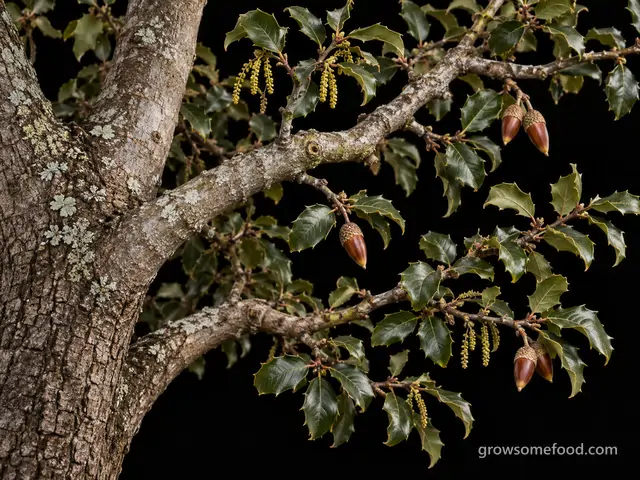
Coast Live Oak
California's defining evergreen oak and its single most valuable wildlife tree - a dense, spreading, two-century tree that hosts more caterpillars, and therefore more nesting birds, than anything else you can plant in the state, and lives on winter rain alone.
Coast live oak is safe to grow, but its leaves are stiff and spine-toothed - wear gloves and eye protection when pruning. Its acorns were a staple Indigenous food but sit in the high-tannin red oak group: never eat them raw, and leach them thoroughly first. Acorns and oak leaves also poison dogs and livestock eaten in bulk. Before pruning or removing an established tree, check local rules - most California cities and counties protect oaks by ordinance, and permits and fines apply.
Overview
The one thing to knowIt is a dense, broad, evergreen oak of dark cupped leaves edged with holly-like spines, usually wider than it is tall, often on a short massive trunk with heavy low limbs, and it can stand for two hundred years and more.
The coast live oak (Quercus agrifolia) is the tree that makes a California hillside look like California. It is a dense, broad, evergreen oak of dark cupped leaves edged with holly-like spines, usually wider than it is tall, often on a short massive trunk with heavy low limbs, and it can stand for two hundred years and more. From Mendocino County down through the Coast Ranges to Baja, it is the shade in the valley, the canopy over the creek, and the silhouette on the ridge.
It is also, by a wide margin, the most valuable wildlife plant a California gardener can grow. Oaks host more species of caterpillars and moths than any other tree in the state - hundreds of them - and those caterpillars are the protein that nesting songbirds raise their young on, so an oak is a bird nursery before it is anything else. Its acorns run the winter economy of acorn woodpeckers, scrub-jays, deer, and woodrats, and were a staple human food across coastal California for thousands of years.
And it asks for nothing. A coast live oak wants no summer water at all once established. The single most important thing to know about this tree is that watering it in summer, or putting a lawn under it, is how most of them are killed in gardens - a tree that survives a decade of drought can be finished by a sprinkler.
Quick facts
- Sprouts in
- 40 days21 to 70
- Soil to sprout
- 58 °F45 to 70
- Life cycle
- Perennial, lives about 250 years
- Seed to save
- About 180 days after planting150 to 210
- Height
- 40 ft20 to 70
- Spread
- 60 ft30 to 90
- Cold
- Takes hard frostdamaged below 12°F
- Heat
- Struggles above 110°F
- Self-sows
- Yes, expect volunteers
Full sun or part sun · low water · well-drained soil · 60 ft apart (35 to 90) · direct sow or transplant
When to plant
No planting window on record for this zone. Nearest zone with one: 8b.
Frost here: last around Apr 10 (Mar 27 to Apr 24 most years), first around Oct 25. Zone averages, your own yard may run a week or two either way.
Life stages
One stage to settle in, then three that repeat each year. Windows are typical; your zone and weather move them.
Years 1-3 - young tree
The first year after planting- WaterDeep, infrequent soaks for the first three dry seasonsevery 24 daysThrough its first two or three summers a young oak does need water - but deeply and rarely, roughly every three to four weeks, and applied out at the edge of the root zone rather than against the trunk. Never keep the soil around the crown damp. From about year four taper to nothing: an established coast live oak is meant to go from the last spring rain to the first fall rain on its own.
- ProtectCage it, and keep a weed-free circleGround squirrels, gophers, rabbits, and deer all eat young oaks. Put a wire cage around the seedling and a gopher basket under it, and keep a bare or coarsely mulched circle several feet across free of grass - non-native annual grasses are one of the main reasons California oaks fail to regenerate, because they take the shallow moisture a seedling needs.
- DoPlant small, plant in fall, and do not amendOaks form a deep taproot and resent transplanting, so a one-gallon tree or a sown acorn beats a boxed specimen and will pass it within a few years. Plant in fall so the winter rains establish it. Backfill with the native soil, add no compost or fertilizer, and set the root flare slightly high - a buried flare is a slow death sentence.
Watch for- Squirrels, gophers, and deer taking young trees
- Grass growing right up to the trunk
- Transplant shock in anything bigger than a five-gallon tree
- Soil staying damp near the trunk in summer
Spring flush & leaf swap
Mar to Jun, every year- InspectAn evergreen that sheds all at once in springCoast live oak is evergreen but not leaf-forever: in spring the old leaves drop in a rush just as the new flush comes out, so a heavy carpet of small curled leaves in March and April is normal and not a sign of illness. Leave the litter where it falls under the canopy - it is the mulch the tree evolved with, and it shelters the ground-dwelling stages of the insects the tree feeds.
- InspectExpect chewed leaves, and never spray this treeCalifornia oaks host more caterpillar and moth species than any other tree in the state, and those caterpillars are what nesting birds feed their young. Some chewed foliage every spring is the tree working, not failing. Periodic California oakworm outbreaks can strip a tree and it still refoliates. Do not spray a keystone oak.
Watch for- Heavy spring leaf drop as the new flush emerges (normal)
- California oakworm caterpillars and their frass on paths in spring
- Galls of every shape on leaves and twigs (harmless)
- Powdery white new growth in a cool damp spring (cosmetic)
Acorn drop (fall)
Sep to Nov, every year- HarvestGather acorns - for wildlife, for planting, or leached for foodevery 4 daysMature trees drop slender pointed acorns each fall, heavily in mast years every few seasons. Most are best left: they are the winter economy of acorn woodpeckers, jays, deer, and woodrats. If you gather for food, float-test to discard the weevilled ones, shell them, and leach the tannins out until no bitterness remains - coast live oak sits in the red oak group and is more tannic than a white oak, so expect more changes of water.
- InspectWatch the acorn woodpeckers workAcorn woodpeckers drill granary trees riddled with thousands of acorn holes and defend them as a family through winter; scrub-jays cache acorns in the ground and forget enough of them to plant the next generation of oaks. A bearing oak is the center of a small economy - one of the best things to sit and watch that a garden can offer.
Watch for- Mast years - heavy crops every few seasons with light ones between
- Weevil holes in fallen acorns (float-test discards them)
- Acorns sprouting where they lie in the first rains
Cool season, rain, and the pruning window
Dec to Feb, every year- PrunePrune rarely, in the DRY season, and check the permit firstThe pruning rule in California is the opposite of the eastern one: prune oaks in the dry months, roughly midsummer through early fall, and never in wet weather, because the Phytophthora diseases that kill California oaks spread in the rain. Take structural deadwood only, never top a tree, and remove no more than a small fraction of a mature canopy. Most California cities require a permit and a certified arborist - check before a saw comes out.
- InspectWalk the trunk after the first rainsWinter is when to look at the lower trunk for the dark, sticky, red-black seeping that signals a Phytophthora canker, and for the small D-shaped exit holes and staining of goldspotted oak borer in Southern California. Both are far more treatable noticed early. Also check that nothing has changed the grade, paved, or trenched inside the root zone since last year.
Watch for- Dark bleeding or oozing patches on the lower trunk
- D-shaped exit holes and woodpecker damage on the bark (Southern California)
- Standing water or new irrigation inside the dripline
- Mistletoe clumps high in the canopy
Harvest
- Mature tree (roughly 15-25 years) - young oaks bear no acorns
- Slender pointed acorns fully brown and dropping in fall, heaviest in mast years
- For food: acorns float-tested, shelled, and leached until no bitterness is left
- Gather acorns - for wildlife, for planting, or leached for food · every 4 days
- Watch the acorn woodpeckers work
Picking pick as they ripen
Watch out for
5 to know. 3 are high-risk: Goldspotted Oak Borer, Armillaria Root Rot (Oak Root Fungus), Sudden Oak Death. 2 are active in September.
Goldspotted Oak BorerSeverity High PestnowA Southern California problem rather than a statewide one, concentrated in San Diego, Riverside, Orange, Los Angeles, and San Bernardino counties.
If you are in that range, the practical takeaway is short: never move oak firewood, and look at your trunk for D-shaped holes once a year.
Crown thinning and dieback starting in the upper and outer branches and progressing over several years. Small D-shaped exit holes about an eighth of an inch across, scattered over the bark of the trunk and larger limbs - the shape is the giveaway, since round holes are other borers. Dark wet staining, weeping, or red-black patches on the bark where larvae are feeding beneath. Heavy woodpecker chipping and flaking of the bark, often the most visible sign from a distance. Adults on the foliage in summer, dark with gold spots. In Southern California, any oak declining from the top down is worth checking for exit holes.
There is no rescue for a heavily infested tree; management is preventive and is arborist work. On high-value oaks in an infested area, systemic and bark-applied insecticide programs are used prophylactically to protect uninfested trees, applied on a schedule around the summer flight period. Have a suspected infestation confirmed and reported to your county agricultural commissioner or UC Cooperative Extension, since detection outside the known range matters. Remove and properly handle dead and dying trees rather than leaving them as a beetle source, keep the wood on site, and never sell or give it away as firewood.
Do not move oak firewood - buy it where you burn it and leave what is left behind. This is the single most important rule, and it is how the beetle reaches new areas. If you have wood from a felled oak in an infested county, keep it on site, and if it must be stored, tightly tarp or solarize it or have it chipped small. Keep trees unstressed: no summer irrigation inside the root zone, no root-zone disturbance, and no unnecessary pruning. Inspect valued oaks yearly for exit holes and bark staining, especially in San Diego, Riverside, Orange, Los Angeles, and San Bernardino counties.
The goldspotted oak borer (Agrilus auroguttatus) is an invasive flatheaded beetle from southeastern Arizona, first found in San Diego County in 2004 and since established across parts of Southern California. It has killed many thousands of oaks. Adults are small, dark, bullet-shaped beetles with several gold spots along each wing cover; the larvae tunnel in the living tissue between bark and wood, and repeated attacks over several years girdle and kill the tree. Coast live oak, California black oak, and canyon live oak are the species it kills. Its long-distance spread is almost entirely human: it travels in infested firewood, which is why every California campground and county now carries a do-not-move-firewood rule. Trees stressed by drought or root damage die faster.
Armillaria Root Rot (Oak Root Fungus)Severity High DiseasenowThis is the most common way a healthy mature coast live oak is killed in a garden, and the cause is almost always a lawn or an irrigated bed installed under the canopy by a previous owner.
A tree that shrugs off a decade of drought can be finished by a sprinkler. If you inherit an oak with lawn beneath it, turning the water off is the most valuable thing you will do for it.
Slow, unexplained decline over several years - thinning crown, smaller and paler leaves, dieback starting at the top and outer branches, and a tree that simply is not as full as it used to be. Honey-colored mushrooms clustered at the base of the trunk or over the roots in fall and winter, which is the fungus fruiting. Peel back the bark at ground level and look for flat white fan-shaped sheets of fungal tissue with a strong mushroom smell, and for black shoestring-like strands running through the soil and over the roots. Loose or sloughing bark at the root crown. A tree that fails suddenly in a storm despite a full canopy, because the anchoring roots were already gone.
There is no chemical cure, and by the time symptoms show the roots are already lost, so treatment means removing the cause and buying time. Turn off all irrigation in the root zone immediately and remove the lawn or planting that was being watered. Some arborists excavate soil away from the root crown to expose and dry the collar, which can slow the disease on a valuable tree; this is arborist work, not a weekend job. Relieve every other stress - no pruning beyond deadwood, no disturbance, no fertilizer. Have a declining mature tree assessed for hazard, since Armillaria destroys the anchoring roots and the tree can fail while the crown still looks reasonable. Replant the site only with species known to resist the fungus.
Keep the root zone dry in summer - this is the whole of it. Put no lawn and no irrigated planting under a native oak; the root zone reaches well past the dripline and lies mostly in the top three feet of soil. Plant only dry-shade species beneath and leave them unwatered once established, water young trees deeply and rarely out at the edge of the root zone rather than at the trunk, and stop entirely by about the fourth year. Check that sprinklers, drip lines, downspouts, and pool backwash are not wetting the area. Do not raise or lower the grade, pave, compact, or trench inside the root zone, and never pile soil or mulch against the trunk. Leave the natural leaf litter in place.
Armillaria mellea, the oak root fungus, lives in the soil of much of California and sits harmlessly on native trees that get the dry summer they evolved for. It becomes lethal when the root zone is kept moist through the warm months - which is exactly what a lawn, a summer-irrigated bed, a leaking line, or a misdirected sprinkler does. The fungus invades the roots and root crown, spreads through the soil along root contacts, and girdles the tree from below, so the visible decline appears years after the cause. It is the leading cause of death of established oaks in California gardens, and the reason the standard advice for anything planted under a native oak is to leave it unwatered. Landscape disturbance compounds it: grading, paving, trenching, and compaction inside the root zone all weaken a tree that then cannot resist.
Sudden Oak DeathSeverity High DiseaseCoast live oak is one of the most susceptible species, and this is the leading disease killer of the tree in the coastal counties from Monterey to Humboldt.
It matters far less in Southern California and in the interior. If you have both a coast live oak and a California bay laurel close together in that range, the bay is the risk factor to act on.
Dark red-brown to black seeping or bleeding patches on the lower trunk, often sticky and running down the bark, with no obvious wound behind them - this is the first and most important sign, and it appears while the canopy still looks normal. Later, fine boring dust in bark crevices from ambrosia beetles, and small black crusty fungal fruiting bodies on the bark. Finally the whole crown turns dull green then brown over a few weeks, usually holding the dead leaves rather than dropping them. On the plants that actually spread it, look for brown leaf-tip blotches on California bay laurel, and shoot dieback on tanoak, rhododendron, camellia, viburnum, and huckleberry.
There is no cure for an infected tree, so everything useful is done beforehand. On high-value, uninfected oaks in or near an infested area, a phosphonate treatment - potassium phosphite applied to the trunk with a bark-penetrating surfactant, or injected - boosts the tree's own defenses and is applied preventively, usually in fall before the rains and sometimes again in spring; it protects, it does not rescue. Have any suspected tree diagnosed properly, since several other things cause bleeding cankers. A confirmed infected tree near a target should be assessed for hazard, because it decays and fails fast once dead. Report suspected cases to your county agricultural commissioner or extension office, and keep the wood on site.
Distance from the spreaders is the main defense. Do not plant California bay laurel near a valued oak, and on an infested property consider removing bay within roughly fifteen feet of an oak trunk - this is the single most effective step. Buy nursery stock of known host shrubs from clean sources, since infected nursery plants have moved the pathogen long distances. Do not move oak or tanoak firewood, wood chips, or soil out of a quarantined county. Clean soil and leaf debris off boots, tools, tires, and dogs before leaving infested woodland, and stay out of wet woods in the rainy season when spores are active. Prune oaks only in the dry season, never in wet weather, and keep trees otherwise unstressed - no summer irrigation, no root-zone disturbance.
Sudden Oak Death is caused by Phytophthora ramorum, a water mold introduced to coastal California and Oregon that has killed millions of oaks and tanoaks. It behaves unusually: the plants it kills are mostly not the plants that spread it. California bay laurel, tanoak, and a long list of shrubs carry harmless-looking leaf spots and produce enormous quantities of spores in wet weather; rain then splashes those spores onto the trunks of nearby oaks, where the pathogen forms a canker under the bark that eventually girdles the tree. Trees can be infected for years while looking healthy, then brown out over a few weeks - which is where the name comes from. Bark beetles and a black fungus usually move into a dying tree afterward. Affected California counties are under state and federal quarantine restricting the movement of host plants, wood, and soil.
California OakwormSeverity Low PestThis is the answer to the most common question a coast live oak owner asks - what is eating my oak and covering my patio.
The answer is a native moth, the tree recovers, and the right action is almost always none.
Olive-to-dark caterpillars with lengthwise yellow and black stripes and conspicuously large heads, feeding on the leaves in spring and again in fall. Leaves first skeletonized on the underside, then chewed through. Small gray-brown moths fluttering around the tree in numbers. Frass falling steadily onto surfaces below the canopy - usually the first thing people notice. In an outbreak year, a coast live oak stripped to bare twigs by early summer, then pushing new leaves within weeks.
In almost every case, do nothing and let the tree refoliate. Where a specific tree is genuinely at risk - repeated defoliation on an already declining oak - Btk applied to small early-instar caterpillars is the selective option and spares most other insects, and is best handled by an arborist on a large tree. Do not use a broad-spectrum insecticide on an oak: it kills the parasitic wasps and predators that end the outbreak, along with hundreds of other species the tree exists to feed.
Nothing needs to be done in a normal year, and prevention mostly means keeping the tree otherwise unstressed so it can shrug off defoliation - no summer irrigation in the root zone, no root disturbance, no unnecessary pruning. Leave the natural predators and parasitic wasps alone; broad-spectrum sprays remove them and make outbreaks longer, not shorter. Hosing the trunk and lower canopy dislodges caterpillars where they are a nuisance around a patio.
The California oakworm (Phryganidia californica) is a native moth whose caterpillars feed on live oak foliage, and which builds to a visible outbreak every several years before natural enemies and disease crash the population again. Outbreak years can strip a coast live oak nearly bare and cover paths, cars, and patios with caterpillars and frass, which is alarming and messy. It is not, on a healthy tree, a serious threat: oaks refoliate, and defoliation by a native insect is part of the system the tree evolved in. It only becomes a real risk when a tree is already weakened by drought stress, root damage, or disease, and is defoliated repeatedly.
Oak GallsSeverity Low PestCalifornia oaks carry an extraordinary variety of them - buttons, spangles, urns, spiky balls, and the pink-and-white apples of the California gall wasp, which was once collected to make ink.
They are one of the most interesting things about owning an oak, and none of them needs treating.
Round balls, woolly patches, or bumps on leaves and twigs, each housing a developing insect; sometimes abundant but rarely harmful.
None warranted; leave them. Heavily galled twigs can be pruned out in the cool season if you object to the look.
None needed - galls rarely harm the tree and support wildlife.
Tiny gall wasps and mites induce the tree to form bumps, balls, and woolly or spiky growths on leaves and twigs. Diverse and curious but essentially harmless, and part of the oak's rich insect community.
Good & bad neighbors
First rule: keep Lawn and summer-irrigated plantings apart. The single worst thing you can put under a California oak.
Plant nearby
-
The right kind of planting for the sunny outer edge of an oak canopy: it needs exactly the same dry summer the oak's roots require, so you get flowers and pollinators under the tree without ever turning on a sprinkler inside the root zone.
-
Self-sowing spring annual that fills the light-shade edge of an oak canopy on winter rain alone and dies back before the dry season - the classic unirrigated understory for a young oak planting.
-
A coastal sage scrub shrub for the sunny edge beyond the dripline, on the same no-summer-water terms. Keep it out of the deeper shade under the crown, where it stretches and thins.
Keep apart
-
Lawn and summer-irrigated plantingsThe single worst thing you can put under a California oak. Summer water in warm soil inside the root zone is what triggers Armillaria oak root fungus and Phytophthora, and a lawn under an oak is the classic way a healthy two-hundred-year-old tree is killed in a decade. Leave the root zone dry and unwatered.
-
California Bay LaurelIn the coastal counties where Sudden Oak Death is established, California bay laurel is the main plant that produces and spreads the pathogen, and oaks with bay growing close to them are far likelier to be infected. Do not plant bay near a valued oak, and consider removing bay within about fifteen feet of the trunk.
Varieties · 5
You pick one when you add Coast Live Oak to your garden. Its days to maturity set your harvest window.
Coast Live Oak (Quercus agrifolia)
Rounded dense crown of dark cupped spine-edged leaves on heavy low limbs and a short massive trunk.
speciesnativeevergreenkeystoneThe wild species: a dense, broad, evergreen oak 30-60 feet tall and often wider, with small cupped holly-toothed leaves, slender pointed acorns maturing in one season, and a lifespan of two centuries or more. The defining tree of coastal California and its single most valuable wildlife plant.
Interior Live Oak (Quercus wislizeni)
Dense evergreen crown of flatter glossy leaves, often shrubbier and smaller than coast live oak.
speciesnativeevergreeninlandThe inland counterpart, of the Sierra foothills and interior coast ranges: evergreen like coast live oak but with flatter, glossier leaves and better tolerance of hot, dry interior summers and colder winters. The right live oak away from the coastal fog belt, and less affected by Sudden Oak Death.
Canyon Live Oak (Quercus chrysolepis)
Spreading evergreen oak with leathery leaves gold-felted beneath when young, and thick-capped acorns.
speciesnativeevergreencanyonA tough evergreen oak of canyons, slopes, and higher elevations across much of California, with gold-fuzzed young leaf undersides and famously hard wood. More cold-hardy and more widely distributed than coast live oak - the choice on a steep, rocky, or higher site.
Valley Oak (Quercus lobata)
Massive deciduous oak with deeply lobed leaves and long pendulous winter branches.
speciesnativedeciduousvalley-floorCalifornia's giant deciduous white oak, of deep valley soils with groundwater within reach - the biggest oak in North America, with deeply lobed leaves, dramatic winter branch structure, and sweeter lower-tannin acorns. Needs a deep soil and a great deal of room, and gives spectacular scale in return.
Engelmann Oak (Quercus engelmannii)
Open-crowned oak with distinctive blue-green oblong leaves and pale bark.
speciesnativerareblue-greenA rare, blue-green, semi-evergreen oak native to a narrow band of Southern California from the Pasadena foothills to San Diego County - much of its range now built over. Smaller and slower than coast live oak, and worth planting deliberately within its range as a genuine conservation choice.
Grower tips
Notes from growers, tagged with the zone they grow in. A person reads every post before it appears.
Nobody has posted about Coast Live Oak yet. The first one usually saves someone a season.
Free account. Your post shows your grower name and zone, never your email.