Add it to your home screen and it opens full screen: no browser bars, one tap away, and everything stays signed in. Free, nothing to download from an app store.
- Tap the Share button in your browser
- Scroll down and choose “Add to Home Screen”
- Open GrowSomeFood from your home screen
- Open your browser’s menu
- Choose “Add to Home screen” or “Install app”
- Open GrowSomeFood from your home screen
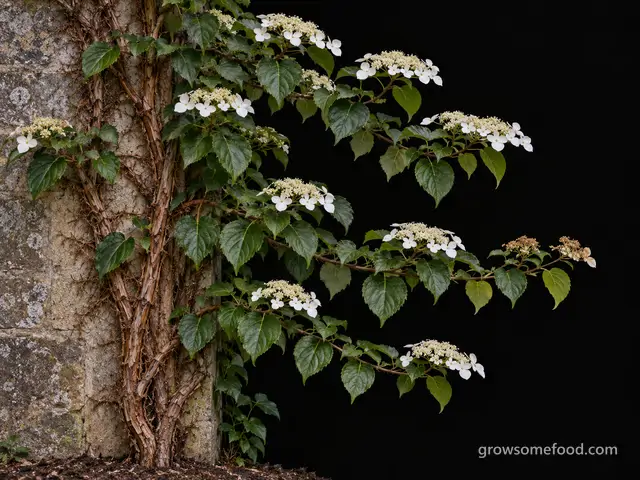
Climbing Hydrangea
The best flowering vine for shade there is, and the slowest. Self-clinging to brick, stone and tree trunks, it carries huge flat white lacecaps in June on a north wall where nothing else will bloom - after three to five years of appearing to do nothing at all.
Mildly toxic, like the shrub hydrangeas: the tissue holds small amounts of cyanogenic glycosides, so leaves, buds and flowers are not for people or pets - dogs and cats that chew them get vomiting and lethargy, though serious poisoning is rare. Not a food or tea plant, and handling is safe. The real hazard here is structural rather than chemical: a mature vine is extremely heavy, and its clinging rootlets damage paint and wood siding.
Overview
The one thing to knowClimbing hydrangea is the answer to a question most gardeners eventually ask: what flowers on a north wall?
Climbing hydrangea is the answer to a question most gardeners eventually ask: what flowers on a north wall? Very little does. This one covers cold brick and stone in deep shade with clean dark foliage and then, in June, hangs it with flat white lacecap heads six to ten inches across - a ring of showy sterile florets around a haze of tiny fertile ones that bees work all day. It climbs by aerial rootlets that grip a surface directly, so it needs no trellis and no tying once it takes hold, and it will run thirty to fifty feet up a wall or a mature tree trunk without twining around anything or strangling it.
It is also, without question, the slowest good vine in the catalog, and that single fact explains almost every disappointment with it. A young plant spends its first years building roots and making almost no visible top growth; three seasons is normal before it starts to climb, four or five before the first real flowers. The old nursery line - the first year it sleeps, the second it creeps, the third it leaps - understates it here. Gardeners routinely dig one up in year two believing it has failed. It has not; it is doing exactly what it does. What you get for the wait is a fifty-year vine, largely pest-free, deer-shrugging, and beautiful in winter, when the old stems peel away in cinnamon-brown papery strips over a rugged framework and the dried flower heads hold on into the snow.
Two decisions matter before planting, and both are made once. What it climbs - masonry, stone, block or a big mature tree, never painted wood siding or a light trellis. And whether you can reach the top of it in ten years, because pruning happens in a single window right after flowering and a vine that has reached the roof line is a serious job.
Quick facts
- Life cycle
- Perennial, lives about 50 years
- Height
- 40 ft20 to 60
- Spread
- 10 ft5 to 20
- Cold
- Takes hard frostdamaged below -30°F
- Heat
- Struggles above 95°F
Part sun or part shade or shade · medium water · consistently moist soil · 8 ft apart (5 to 12) · transplant or cuttings
When to plant
Fall transplanting is open for 6 more days. Next: spring, Mar 27 to May 22.
- Transplant Aug 16 – Sep 27 Closes in 6 daysAbout 10 weeks before to 4 weeks before your first frost (Oct 25 here)Early fall planting into warm soil gets roots down before winter with less heat stress, which on a plant this slow to establish is worth having. Mulch well and keep watering until the ground is cold.
- Transplant Mar 27 – May 22 Opens in 187 daysAbout 2 weeks before to 6 weeks after your last frost (Apr 10 here)Plant in spring into rich, moist, well-drained soil improved with compost, about a foot out from the wall or trunk so the roots are not in the dry strip against the footing. Lean the first shoots onto the surface and tie them in. Water deeply and weekly through the first three summers.
Frost here: last around Apr 10 (Mar 27 to Apr 24 most years), first around Oct 25. Zone averages, your own yard may run a week or two either way.
Life stages
One stage to settle in, then three that repeat each year. Windows are typical; your zone and weather move them.
Years 1-4 - sleep, creep, then leap
The first year after planting- SupportGuide the first shoots onto the wall and tie them inA shoot lying on the ground will keep lying on the ground - it has to touch the surface before it makes holdfasts. Lean the young stems against the wall or trunk and tie them loosely with soft ties until the rootlets grip, which can take a season. Once attached, the vine needs no further support and the ties can come off. Never start it on lightweight lattice or a thin trellis, which the mature weight will eventually pull apart.
- WaterWater deeply through the first three summersweeklyEverything about this plant is about getting roots down first. Soak it slowly and deeply once a week through warm weather for the first three seasons - more in sandy ground, less in clay - and keep going into fall until the ground is cold. Consistent water is the difference between a vine that starts climbing in year three and one that is still sulking in year five.
- MulchMulch 2-3 inches, kept clear of the stemsA 2 to 3 inch mulch of shredded bark or leaf mold over the root zone holds the moisture this plant wants and keeps the shallow roots cool. Spread it out well beyond the crown rather than piling it against the stems. Refresh it annually. Skip the heavy feeding - nitrogen buys leaves, not the root system and flower wood you are actually waiting for.
- ProtectDo not dig it up in year two - this is what it doesThe commonest way to fail with climbing hydrangea is to conclude in the second season that it is dead or defective. It is not. Three years of near-invisible growth before it climbs, and four to five before the first real bloom, is normal for a healthy plant in good soil. If you need cover in the meantime, run an annual vine up the same wall for the first few years and let the hydrangea come through behind it.
Watch for- Almost no top growth for two seasons - normal, not failure
- Shoots creeping along the ground instead of climbing (they must touch the surface to grip)
- Dry soil in the first three summers, which stretches the wait out even further
Spring growth and tie-in
Apr to May, every year- InspectDo NOT prune now - it flowers on last year's woodClimbing hydrangea sets its flower buds on wood made the previous season, so a spring tidy-up removes this year's bloom. The pruning window is the few weeks right after flowering, in July. In spring, limit yourself to cutting out anything obviously dead and to redirecting stems that are heading somewhere you do not want them - under siding, into a gutter, up toward the roof line.
- SupportRedirect new shoots before they commitNew growth extends fast once the plant is established, and it is far easier to steer a soft green shoot than to detach an attached one later. Walk the wall in spring, pull loose any stem heading under siding, into a soffit, behind a downspout or up past the height you can safely reach with a ladder, and tuck it back where you want it. Ten minutes now saves an afternoon on a ladder.
Watch for- Stems reaching under siding, shingles or soffits
- Growth loading a gutter or downspout
- Leaves scorching where afternoon sun reaches the vine
Early summer lacecaps
Jun to Jul, every year- PruneThe ONE pruning window: right after bloomThis is the only time to cut. As soon as flowering finishes, shorten the outward-projecting laterals to keep the vine close to the wall, take out crowded or dead wood, and cut the whole plant back from gutters, soffits and roof edges. Climbing hydrangea takes hard renovation well - an overgrown vine can be cut back severely - but it flowers on old wood, so a hard cut costs you a season or two of bloom.
- WaterKeep the root zone moist through bloomweeklyThe big flat lacecaps and broad leaves transpire heavily in early summer, and a vine on a hot wall dries out faster than the surrounding border. Deep-soak through dry spells while it is flowering. Brown, papery leaf edges mean the roots cannot keep up with the exposure, not that the plant is diseased.
Watch for- Flat white lacecap heads 6-10 inches across, faintly fragrant, in June
- Bees and hoverflies working the tiny fertile florets inside the ring
- No flowers on a climbing vine - usually spring pruning, or too little light
Fall and winter - the structure shows
Oct to Mar, every year- InspectCheck what the vine is holding on to, and what it is pulling onWith the leaves down you can see the framework. Look for stems that have worked under siding or shingles, growth resting on or inside a gutter, weight hanging off a downspout, shutter or light trellis, and paint lifting behind the vine on any wood surface. Note what needs cutting so you can do it in the post-bloom window in July rather than now.
- DoLeave the bark alone and enjoy itThe winter picture is the point of this plant as much as the flowers are. The old stems shed in cinnamon-brown papery strips over a rugged framework, the dried lacecap heads hold on well into winter, and the tracery of holdfasts against masonry reads well against snow. Nothing here needs cutting off - the dried heads can be left until the July pruning.
Watch for- Paint lifting or damp wood behind the vine
- Growth in or over a gutter carrying the vine's weight
- Deer browsing low stems in hard winters - uncommon, but it happens
Watch out for
5 to know. None are high-risk for Climbing Hydrangea. 2 are active in September.
Holdfast Damage to Walls and SidingSeverity Medium DisordernowThis is the one genuinely consequential decision about growing this plant, and it is made once, at planting.
Masonry, stone and big trees: yes. Painted wood siding, shingles and light trellis: no.
Paint lifting or blistering behind the vine, and bare wood where a stem has been pulled away. Rootlet residue - a permanent pattern of small dark stubs - left on any surface the vine has been removed from. Damp, dark wood behind the growth, and rot at lap joints and around trim. Mortar crumbling out of the joints of an old wall where stems have worked in. Gutters, downspouts, shutters or a light trellis pulling away from the wall under the load. Stems reaching up under siding, roof shingles or soffits, or wandering into window frames. Side branches standing further out from the wall each year - normal growth, but it is where the weight comes from.
Cut the stems through at the base first and let the top growth die and dry for several weeks - dead holdfasts release far more easily than living ones, and you will do much less damage to the surface. Then work the vine off gently from the top down rather than hauling from the bottom. Expect rootlet residue to remain: a stiff brush and repainting is the usual finish on wood, while on masonry the stubs weather off over a year or two. Where a vine has reached the roof line or is loading a gutter, cut it back hard - climbing hydrangea takes hard renovation well - but do it in the weeks right after flowering, and accept that it costs a season or two of bloom because the plant flowers on old wood. If the structure itself is soft or failing, remove the vine rather than trying to manage it in place.
Choose the surface before you plant. Solid masonry, brick, stone, block, a concrete retaining wall, a stone chimney or the trunk of a large mature tree are all fine, and are what this vine is for. Painted or stained wood siding, shingles and anything with lap joints are not - if that is the wall you have, build a sturdy freestanding frame a foot clear of it and grow the vine on that instead, so air moves behind. Keep the vine well below gutters, soffits and the roof line from the start, and prune it back to stay there every year after flowering; letting it reach the roof and then reversing that is a far bigger job. Never start it on lightweight lattice or a thin trellis, which the mature weight will pull apart. And site it where you can still reach the top of it with a ladder in ten years.
Climbing hydrangea climbs by aerial rootlets - short adhesive holdfasts that grip a surface directly rather than twining around a support. On brick, stone, block, concrete and mature tree bark that is harmless and remarkably strong. On painted or stained wood siding, shingles and trim it is not: the holdfasts grip the paint film rather than the wood, they hold a permanent damp layer against the boards, and they work into any gap or lap joint. Old, soft or already-failing mortar can be loosened where rootlets penetrate the joints, though the vine does not attack sound mortar. The other half of the problem is weight. A mature vine is genuinely heavy, with side branches standing two to three feet out from the wall, and over time it will pull down gutters, downspouts, shutters, lattice and light trellis. It does not strangle a tree it climbs, because it never twines around the trunk.
Root RotSeverity Medium DiseaseThe trap is that a moisture-loving vine still needs air at the roots.
Downspout discharge and the splash line under a roof edge are the two spots that catch people out - both keep the soil against a wall saturated all winter. Direct the runoff elsewhere, amend heavy clay generously, and plant a foot out from the footing.
Wilting in the middle of the day on a plant whose soil is damp - the classic tell, and the reason people water a rotting plant and finish it off. Leaves yellowing from the bottom up, dull off-color foliage, and growth that stalls for no visible reason. Whole shoots, or one side of the plant, collapsing while the rest still looks fine. Soft, dark, or mushy tissue at the base of the stem or at the crown, sometimes with a sour smell. Lift a failing plant and look at the roots: healthy ones are firm and pale, rotted ones are brown or black and slimy, and the outer layer slips off between your fingers leaving a thread of core behind. Seedlings that topple over at soil level are the same problem, called damping-off.
There is no cure for tissue that has already rotted, so act on the conditions rather than looking for a spray. Stop watering at once and fix the drainage - open up compacted soil, or move the plant to a raised, sharply drained position or a container. Lift a badly affected plant, cut away every soft dark root and rotted section with a clean blade back to firm pale tissue, and replant only the healthy parts into fresh free-draining soil or mix. Often the better move is to give up on the plant and save its offspring instead: cuttings, offsets, or divisions taken from firm healthy growth root readily and give you a clean start. Bin the rotted material rather than composting it, and correct the drainage before you replant, because the rot comes straight back in the same wet spot.
Drainage is the whole defense. Match the plant to the site first - something that wants sharp drainage will not survive heavy clay or a low, water-collecting spot however well you tend it. Where the ground is heavy, plant on a raised bed, berm, or slope, or grow in a container. Set plants at the depth they were already growing, since burying the crown or the root flare is a common cause of rot, and keep mulch pulled back a few inches from the stem base instead of piled against it. Water the soil rather than the calendar: check that the top inch or two is dry before watering again, cut back hard in cool weather and winter dormancy, and never leave a pot standing in a full saucer. Do not plant or dig in soggy ground, and go easy on rich amendments for plants that want it lean. Rotate annual crops, and start with clean healthy plants and fresh mix.
Root rot is not one organism but a group of soil fungi and water molds - Pythium, Phytophthora, Fusarium, Rhizoctonia and others - that sit harmlessly in most soils and only turn destructive when the ground stays saturated. Waterlogged soil drives the air out, the roots suffocate, and the weakened tissue is invaded and goes soft, brown, and stringy. Because the damage is underground you usually see it first as something that looks like drought: wilting, yellowing, stunting, a plant that does not respond to being watered. Overwatering, heavy compacted ground, a low spot that collects runoff, a pot with no drainage or a saucer left standing full, and cold wet soil in winter are the usual causes. Once roots have actually rotted there is no cure - this is a problem you prevent rather than treat.
Leaf Scorch (sun & drought)Severity Medium DisorderA wall makes this worse than an open border does: masonry radiates stored heat into the evening and the strip of soil along a footing is the driest ground on the property.
A hot west or south wall in the South scorches this vine every summer regardless of watering - the fix is a north or east aspect, not more water.
Browning that starts at the leaf edges and tips and spreads inward, with a fairly sharp line between the crisp brown tissue and the green that is still healthy. Leaves and fronds going dry, papery, and crisp rather than soft, yellow, or spotted - that is what separates this from a fungal problem. Damage worst on the side of the plant facing the sun or the prevailing wind and on the most exposed upper leaves, while the shaded interior stays fine. Symptoms appearing sharply after a heat wave, a dry spell, or a bright windy week in winter. Whole leaves or fronds shed early as the plant cuts its losses.
Water deeply, mulch, and improve the shade - that is the whole treatment, because there is nothing here to kill. Leaves that are already scorched will not recover, so trim off badly browned foliage or fronds for appearance if you want to; the crown and roots are usually unharmed and push out fresh growth once conditions improve. On a plant that scorches badly every year the answer is to move it rather than to keep watering harder, because the siting is what is wrong. Some plants respond well to being cut back hard, which brings a clean flush of new foliage. And on plants that naturally die back or brown off late in the season, scorching at the end of a dry summer is normal and needs nothing at all.
Site the plant where it actually wants to be. This is a placement problem far more often than a watering problem, and a shade plant in hot afternoon sun will scorch every summer however much you water it. Give shade and woodland plants part-to-full shade and shelter from hot afternoon sun and drying wind. Keep the root zone consistently moist and mulch it well with leaf litter or another organic mulch, which holds water and keeps the roots cool - the single most useful routine step. Water deeply and thoroughly during dry spells rather than little and often, so moisture reaches the whole root zone. Pay particular attention through the first year after planting, when the root system is small and cannot keep up with the leaves. On evergreens in cold regions, make sure the plant goes into winter well watered, and keep it out of bright, windy, exposed positions.
Leaf scorch is not a disease and there is nothing to spray for it. It is what happens when a leaf loses water faster than the roots can replace it: the tissue farthest from the veins - the margins and the tips - dries out first and turns brown and papery, and the browning works inward while the rest of the leaf stays green. Hot sun, dry soil, drying wind, heat reflected off paving or a wall, a small or damaged root system, and a plant sited somewhere sunnier or drier than it wants are the usual causes, singly or together. It also happens in winter on evergreens, when bright sun and wind pull water out of the leaves while the ground is frozen and the roots cannot resupply. Shade and woodland plants, shallow-rooted plants, and anything recently planted scorch most easily.
Slow Establishment (the first three to five years)Severity Low DisordernowWorth saying out loud at purchase: this is a four-year plant.
If you want a shaded wall covered next summer, this is the wrong vine and no amount of feeding or watering will change that.
A newly planted vine making a few inches of growth in its first and second seasons and appearing to do nothing at all. Shoots that flop and creep along the ground instead of climbing - normal until the plant finds a surface and starts putting out holdfasts. No flowers for the first three to five years, and only a few in the first flowering season. A vine that has climbed but still does not bloom, which usually means too little light or old wood removed by ill-timed pruning rather than youth. Growth restarting from the base after a hard winter, which resets the clock on an established plant.
There is nothing to fix here, only to wait out. If a vine has been in three years and is still creeping, check three things: water, whether the shoots are actually in contact with a surface, and whether spring or fall pruning has been removing the wood the flowers come on. Correct those, mulch, and give it two more seasons. Moving an established plant restarts the whole process, so be sure of the position before planting rather than relocating later. If you need cover in the meantime, run an annual vine up the same wall for the first few years and let the hydrangea come through behind it - which is what experienced gardeners do rather than replacing the plant.
Buy the largest plant you can and plant it well, because everything here comes down to getting roots down. Rich, moist, well-drained soil improved with compost, a 2 to 3 inch mulch kept clear of the stems, and consistent deep watering through the first three summers do more than anything else. Plant a foot out from the wall rather than tight against the footing, which is the driest soil on the property. Guide the first shoots onto the surface and tie them in loosely until the holdfasts take, since a stem lying on the ground will not start climbing by itself. Do not feed heavily - nitrogen buys leaves, not roots or flower wood. And give it enough light: it does flower in shade, but a vine in deep, dry shade under a dense canopy takes far longer and blooms far less.
This is the commonest complaint about climbing hydrangea, and it is not a fault: the plant is simply slow to start. A young vine spends its first several years building roots and making very little top growth, then begins to climb, and only then begins to flower. Three years is typical before it moves, four to five before the first real bloom, and a plant set into poor or dry ground takes longer still. Gardeners routinely conclude it is dead or defective and dig it up in the second season, which is the single biggest reason people fail with this plant. It cannot be hurried into being a fast screen. What it is instead is a fifty-year vine that flowers in shade where almost nothing else will, and the wait is the price of that.
AphidsSeverity Low PestAlmost the only insect that bothers this vine, and rarely worth acting on: colonies build on the soft spring shoot tips and collapse under predators by early summer.
A hard hose jet is usually the entire treatment, and a vine on a wall is easiest to reach before it gets tall.
Dense clusters of tiny insects packed onto shoot tips, flower buds, and the undersides of young leaves. Curled, cupped, or distorted new growth that never opens properly. A sticky shine on the leaves - and on whatever sits under the plant - that later goes black with sooty mold. Tiny white cast skins left behind where a colony has been feeding. Ants running steadily up and down the stems, which is often the first thing you notice. Mottled, streaked, or misshapen leaves that do not grow out can mean a virus the aphids brought with them rather than the feeding itself.
Knock the colonies off with a hard jet of water and repeat every few days - on most plants that alone ends it. Pinch out or prune off the worst-infested tips rather than treating the whole plant. If colonies keep rebuilding, spray insecticidal soap or horticultural oil directly onto the insects, covering leaf undersides, and repeat weekly until they are gone; treat early or late in the day, and never spray a wilted or heat-stressed plant. Avoid broad-spectrum insecticides - they kill the ladybugs, lacewings, and parasitic wasps that were about to solve the problem for you, and aphid numbers usually come back worse afterward. Anything you spray must be labeled for the plant you are treating; follow that label and observe its pre-harvest interval. On anything you eat, wash leaves, heads, and buds well before use, since aphids hide down in crowns, folds, and tight growth.
Go easy on nitrogen: the soft, lush growth that heavy feeding produces is exactly what aphids breed on. Check new growth once a week through spring and early summer so you catch colonies while they are still small, and rub the first few out with your fingers. Leave flowering plants nearby and skip broad-spectrum sprays - ladybugs, lacewings, hoverflies, and parasitic wasps do most of this work for free, and they only stay if there is something for them to eat. Keep ants off the plant where you can, since they protect aphids from those predators. Water steadily so plants are not stressed, and check any new plant over before you bring it home or move it indoors, since aphids usually arrive on something else.
Aphids are small soft-bodied sap-suckers - green, black, gray, pink, or waxy white, and mostly wingless - that gather in dense colonies on the tenderest new growth: shoot tips, buds, and the undersides of young leaves. They breed extremely fast in mild weather, so a few can become hundreds inside a week. Their feeding curls and distorts soft growth, and the sticky honeydew they excrete coats everything below and turns black with sooty mold. Ants often farm and defend the colonies for that honeydew. A few aphids are normal on almost any plant and a healthy plant shrugs them off; only dense, persistent colonies do real damage, and some aphids also spread plant viruses as they feed.
Good & bad neighbors
Plant nearby
-
FernsThe classic underplanting for a shaded wall: fern filigree against the vine's heavy dark leaves and rugged peeling stems, in exactly the same moist, shaded, humus-rich ground.
-
The obvious planting for the ground the vine leaves bare at the base of a shaded wall, wanting the same moist, humus-rich soil and shade. Keep the hostas out a foot or so from the wall so they are not sitting in the dry strip along the footing.
-
The shrub hydrangeas share the vine's soil, exposure and old-wood pruning rule, so one bed and one calendar serves both - and a mophead or panicle at the foot of the wall covers the years while the climber is still establishing.
- Traditional pairings, thin evidence
-
Spring bulbs flower along the base of the wall well before the vine leafs out, and go dormant under its summer shade - useful cover in the early years when there is very little climbing hydrangea to look at.
-
A native shade groundcover that carpets the root zone, tolerates the dry-ish soil close to a wall better than most, and asks nothing - a good match for a planting you want to leave alone for decades.

Varieties · 6
You pick one when you add Climbing Hydrangea to your garden. Its days to maturity set your harvest window.
Climbing Hydrangea (the species)
Flat white lacecaps with a ring of four-sepalled sterile florets around a haze of tiny fertile ones, over glossy dark heart-shaped leaves on rugged peeling stems.
speciesself-clingingshadewhiteHydrangea anomala subsp. petiolaris itself, and the one to plant unless you have a reason not to: dark heart-shaped leaves on a self-clinging vine that runs thirty to fifty feet, flat white lacecap heads six to ten inches across in June, and a winter framework of peeling cinnamon-brown bark. Slow for three to five years and then permanent. Sterile florets carry four petal-like sepals, which is the check that distinguishes it from Schizophragma.
Miranda
Heart-shaped leaves with irregular creamy-yellow margins around a green centre, with the usual flat white lacecap heads.
variegatedself-clingingshadebrighteningThe best-known variegated form: leaves edged and splashed with creamy yellow, which lifts a dark wall considerably in the ten months the vine is not in flower, over the same white June lacecaps. Slightly less vigorous than the plain species and slower still to establish, and the variegation shows best in bright shade - in deep shade it fades toward green, and in hot sun it scorches.
Firefly
Deep green leaves with broad, clean gold margins, carrying flat white lacecap flowers in early summer.
variegatedself-clingingshadegold-marginedA more recent variegated selection with wider, warmer gold leaf margins than Miranda and better stability - the variegation holds through the season rather than washing out. Same habit, same June lacecaps, same three-to-five-year wait, and the same preference for bright shade over deep shade if you want the color to read.
Skylands Giant
Unusually large flat white lacecap heads, up to ten inches across, on vigorous self-clinging growth.
large-floweredself-clingingshadevigorousSelected for size: notably larger lacecap heads, up to about ten inches across, on a vigorous plant. Worth seeking out where the vine will be seen from a distance across a lawn or courtyard, since the extra scale reads at range in a way the species does not. Otherwise identical in habit and needs.
Japanese Hydrangea Vine (Schizophragma hydrangeoides)
Lacecap heads ringed with single large heart-shaped white bracts hanging like pennants, rather than the four-sepalled florets of a true climbing hydrangea.
different-genuslookalikeself-clingingshadeA different genus sold under the same common name, and a good plant in its own right - Moonlight has silver-marbled leaves, Rose Sensation is pink-flowered. The discriminator is the flower: each showy sterile floret is ONE large heart-shaped bract dangling from the head, where a true climbing hydrangea has florets with FOUR petal-like sepals. It clings a little less strongly, blooms a couple of weeks later, and is marginally less hardy. If the label says Schizophragma, this is what you have.
Woodvamp (Decumaria barbara) - the native relative
Flat clusters of small fragrant white flowers with no showy outer ring, over glossy semi-evergreen leaves on a self-clinging stem.
nativesoutheastself-clingingshadeThe southeastern US native in the same family, and the better choice for a native planting or for the hot end of the range where the Japanese vine struggles. It climbs by the same aerial rootlets, is semi-evergreen in the Deep South, and carries flat clusters of small, fragrant, ALL-fertile white flowers with no showy ring of sterile florets - so it is quieter in bloom but far more useful to pollinators. Hardy roughly zones 6 to 9, and a natural of wet woods and swamp margins, so it wants consistent moisture.
Grower tips
Notes from growers, tagged with the zone they grow in. A person reads every post before it appears.
Nobody has posted about Climbing Hydrangea yet. The first one usually saves someone a season.
Free account. Your post shows your grower name and zone, never your email.