
Add it to your home screen and it opens full screen: no browser bars, one tap away, and everything stays signed in. Free, nothing to download from an app store.
- Tap the Share button in your browser
- Scroll down and choose “Add to Home Screen”
- Open GrowSomeFood from your home screen
- Open your browser’s menu
- Choose “Add to Home screen” or “Install app”
- Open GrowSomeFood from your home screen

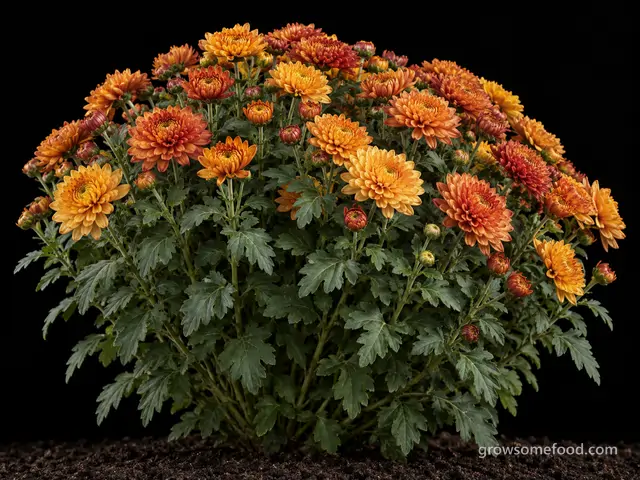
Chrysanthemum
The signature flower of autumn: dense mounds of daisy, pompon, or spider blooms in warm fall colors. The honest secret to a mum that comes back is to plant it in SPRING - the fall 'florist mums' everyone buys rarely survive winter.
Safety notes Ornamental garden mums are not a food plant; some edible-chrysanthemum traditions exist in East Asian cooking, but garden/florist mums are grown for show and shouldn't be eaten. Sesquiterpene lactones in the foliage and sap cause chrysanthemum dermatitis, an itchy rash, in sensitive people - wear gloves. Garden mums are not a source of pyrethrin. Considered toxic to cats, dogs, and horses.
Overview
Chrysanthemums - 'mums' - are the defining flower of fall, blanketing porches and borders in dense mounds of bloom in warm russets, golds, bronzes, purples, and whites just as the rest of the garden fades. They come in a wonderful range of flower forms - daisy, pompon, button, spider, and cushion - and as short-day plants they bloom as autumn nights lengthen, holding color right up to hard frost. They're also fine late-season cut flowers and one of the last nectar sources for bees.
Quick facts
- Height
- 24 inRange: 12–36 in
- Spread
- 24 inRange: 12–36 in
- Cold
- Takes hard frostdamaged below -20°F
- Heat
- Struggles above 90°F
- Life cycle
- Perennial, lives about 5 years
- Soil
- Well-drained
- Water
- Medium
- Plant spacing
- 24 inRange: 18–36 in
When to plant
Nothing is open today. Spring transplanting opens 5 months, Mar 27 to May 8.
- Transplant Mar 27 – May 8 Opens in 159 daysAbout 2 weeks before to 4 weeks after your last frost (Apr 10 here)Divide and replant established clumps in spring as growth resumes - the main way hardy mums are propagated and renewed.
- Transplant Apr 10 – Jun 5 Opens in 173 daysAbout at to 8 weeks after your last frost (Apr 10 here)Plant in SPRING to establish all season so the mum can overwinter - the key to a perennial mum. Fall-planted 'florist mums' usually don't survive winter because they never rooted in.
Frost here: last around Apr 10 (Mar 27 to Apr 24 most years), first around Oct 25. Zone averages, your own yard may run a week or two either way.
Life stages
Establish, grow, repeat
Getting established and returning each season are different parts of the story.
Stage 1 of 4 · Getting established
Year 1 - spring planting to root in
Day 0 to 60 after transplanting
Care at this stage
-
Plant in SPRING (not fall) to overwinter
For a mum that comes back, plant in SPRING and let it root all season - fall-bought 'florist' mums planted in September rarely survive winter because they haven't rooted in. Water steadily to establish, in full sun and well-drained soil.
-
Mulch to help the first winter
A loose mulch after the ground chills protects a spring-planted mum through its first winter; leave the dead stems standing over winter (don't cut back until spring) for extra crown protection.
Months are typical seasonal windows; climate, variety, and plant age can shift them.
Watch out for
5 to know. None are high-risk for Chrysanthemum. 1 is active in October.
AphidsSeverity Medium PestSeason: May–AugDense clusters of tiny insects packed onto shoot tips, flower buds, and the undersides of young leaves.
Chrysanthemums have their own specialist, the chrysanthemum aphid, and the reason to keep colonies down is virus spread as much as the feeding - inspect buds and shoot tips regularly.
Dense clusters of tiny insects packed onto shoot tips, flower buds, and the undersides of young leaves. Curled, cupped, or distorted new growth that never opens properly. A sticky shine on the leaves - and on whatever sits under the plant - that later goes black with sooty mold. Tiny white cast skins left behind where a colony has been feeding. Ants running steadily up and down the stems, which is often the first thing you notice. Mottled, streaked, or misshapen leaves that do not grow out can mean a virus the aphids brought with them rather than the feeding itself.
Knock the colonies off with a hard jet of water and repeat every few days - on most plants that alone ends it. Pinch out or prune off the worst-infested tips rather than treating the whole plant. If colonies keep rebuilding, spray insecticidal soap or horticultural oil directly onto the insects, covering leaf undersides, and repeat weekly until they are gone; treat early or late in the day, and never spray a wilted or heat-stressed plant. Avoid broad-spectrum insecticides - they kill the ladybugs, lacewings, and parasitic wasps that were about to solve the problem for you, and aphid numbers usually come back worse afterward. Anything you spray must be labeled for the plant you are treating; follow that label and observe its pre-harvest interval. On anything you eat, wash leaves, heads, and buds well before use, since aphids hide down in crowns, folds, and tight growth.
Go easy on nitrogen: the soft, lush growth that heavy feeding produces is exactly what aphids breed on. Check new growth once a week through spring and early summer so you catch colonies while they are still small, and rub the first few out with your fingers. Leave flowering plants nearby and skip broad-spectrum sprays - ladybugs, lacewings, hoverflies, and parasitic wasps do most of this work for free, and they only stay if there is something for them to eat. Keep ants off the plant where you can, since they protect aphids from those predators. Water steadily so plants are not stressed, and check any new plant over before you bring it home or move it indoors, since aphids usually arrive on something else.
Aphids are small soft-bodied sap-suckers - green, black, gray, pink, or waxy white, and mostly wingless - that gather in dense colonies on the tenderest new growth: shoot tips, buds, and the undersides of young leaves. They breed extremely fast in mild weather, so a few can become hundreds inside a week. Their feeding curls and distorts soft growth, and the sticky honeydew they excrete coats everything below and turns black with sooty mold. Ants often farm and defend the colonies for that honeydew. A few aphids are normal on almost any plant and a healthy plant shrugs them off; only dense, persistent colonies do real damage, and some aphids also spread plant viruses as they feed.
Aster YellowsSeverity Medium DiseaseSeason: Jun–SepFlowers turning green and deformed, tufted leafy growth from the cone, upright bushy witches'-broom shoots, yellowed stunted plants.
Flowers turning green and deformed, tufted leafy growth from the cone, upright bushy witches'-broom shoots, yellowed stunted plants.
None - it cannot be cured. Pull and destroy infected plants immediately (do not compost) to keep leafhoppers from spreading it to healthy asters and other crops.
Control leafhoppers and remove nearby weedy hosts; keep plants vigorous; there are no resistant fixes, so vigilance and prompt removal are key.
An incurable disease caused by a phytoplasma (a bacteria-like organism) spread by aster leafhoppers. It deforms flowers into stunted, greenish, leafy tufts and causes witches'-broom growth. It has a huge host range beyond asters - many flowers and vegetables are susceptible.
Spider MitesSeverity Medium PestSeason: Jul–SepFine pale stippling or speckling across the upper leaf surface, as though the color had been sandblasted out of it, and later a dull bronze or rusty cast over the whole leaf.
A common late-summer mum problem, especially on stressed plants. Keeping them watered through heat does more than reaching for a miticide.
Fine pale stippling or speckling across the upper leaf surface, as though the color had been sandblasted out of it, and later a dull bronze or rusty cast over the whole leaf. Delicate webbing across leaf joints, shoot tips, and undersides - that comes with a heavy infestation and means you caught it late. Leaves that dry, curl, and drop early while the plant looks thirsty no matter how much you water it. Hold a leaf over a sheet of white paper and tap it: the specks that fall and then start walking are mites. With a hand lens, look on the undersides for the mites themselves, pale or reddish, and their round translucent eggs. Damage that shows up first on the hottest, dustiest, most sheltered side of a plant, or on a pot sitting near a radiator indoors.
Start with water. A strong jet aimed at the leaf undersides, repeated every few days for a couple of weeks, knocks populations down and breaks the cycle - on many plants that alone ends it. On anything that regrows quickly, shearing back badly infested growth resets the plant to clean foliage. If it keeps building, spray insecticidal soap or horticultural oil directly onto the undersides where the mites actually live, and repeat every five to seven days for three rounds: contact sprays do not kill the eggs, so a single application always fails. Anything you spray must be labeled for the plant you are treating - follow the label and observe its pre-harvest interval on anything you eat. Predatory mites are an effective release in a greenhouse or on an indoor plant. Above all, correct the heat, dust, and drought stress that caused it, or the mites simply come back.
Do not let plants get drought-stressed - that is the single strongest trigger, and a plant watered steadily through heat is far less likely to have a mite problem at all. Hose the foliage down, undersides included, during hot dry spells: it knocks mites off, washes away the dust they thrive in, and raises the humidity around the plant for a while. Indoors and under cover, keep the air from going hot, dry, and stagnant, wipe or rinse the leaves occasionally, and keep pots away from radiators and heating vents. Inspect any plant carefully before you bring it indoors for winter or set it among others, since mites almost always arrive on something else. Avoid broad-spectrum insecticides: they wipe out the predatory mites, lacewings, and lady beetles that do most of this work for you, and reliably leave you with a worse outbreak than you started with.
Spider mites are not insects but tiny sap-feeding arachnids, smaller than a grain of salt, and you almost always notice the damage before you notice them. They live on the undersides of leaves and drain the cells one at a time, which is why the leaf goes finely stippled with pale dots before it bronzes and dries. They breed explosively in hot, dry, dusty, still air - a generation can pass in a week at high temperature - so a barely visible population becomes a webbed, bronzed plant within a fortnight. Drought-stressed plants and plants wintered indoors in dry heated air are the classic hosts. Broad-spectrum insecticides make matters worse rather than better, because they kill the predatory mites and lady beetles that normally hold mites in check.
Powdery MildewSeverity Low DiseasenowSeason: Aug–OctRound white powdery spots on the upper leaf surfaces that spread and merge until whole leaves look dusted.
Turns up in cool, muggy fall weather just as the bloom season arrives. Spacing and fall debris cleanup handle it; mostly cosmetic.
Round white powdery spots on the upper leaf surfaces that spread and merge until whole leaves look dusted. It usually starts on the oldest, lowest, most shaded leaves and works upward, so check there first. Look at the undersides too, and at stems, buds, and flower stalks, which get coated as it advances. Leaves that yellow, brown, curl, or go crisp and drop early under the coating. New growth that opens small, crumpled, or twisted where the fungus has reached the shoot tips. On plants where it gets onto the fruit, a dull gray film, russeted or scarred skin, and cracking. Late in the season, tiny dark specks scattered through the white felt - that is the fungus setting up to overwinter on the debris.
Start early: sprays protect healthy tissue, they do not clean up leaves that are already coated. Pick off and bin the worst leaves as soon as you see them, and open the plant up by thinning or pruning so air moves through. On anything that regrows quickly, shearing the whole plant back forces a clean flush and beats spraying. If it keeps spreading, potassium bicarbonate, horticultural oil, or neem applied weekly will hold it - cover both leaf surfaces. Sulfur also works, but it burns the foliage of some plants, should never go on in heat, and must not be mixed with or applied close behind an oil spray. Whatever you use must be labeled for the plant you are treating: follow that label and observe its pre-harvest interval on anything you eat. Do not compost badly infected material. Late-season mildew on a plant that is finishing anyway is usually cosmetic; on a crop still filling out it is worth acting on.
Give plants room. Crowding and still air are the biggest single driver, so space at the full recommended distance, thin seedlings properly, and divide or prune out congested growth until air moves through the plant. Full sun and an open position help; deep shade and a still corner against a wall are where it always starts. Water at the base rather than overhead, and water early in the day so nothing stays damp overnight. Keep plants evenly watered - drought stress at the roots leaves them far more susceptible, even though the fungus itself likes dry air. Go easy on nitrogen, since soft lush growth is the most vulnerable. Where resistant varieties exist for what you are growing, choosing one is the single most effective thing you can do on a plant that mildews every year. Clear infected leaves and stems away at the end of the season rather than composting them.
Powdery mildew is a fungal disease that coats leaves - and often stems, buds, and fruit - in a white-to-gray powder that looks like spilled talcum. It is not one fungus but a large family of them, each fairly specialised to its own group of plants, which is why mildew on one crop rarely jumps to an unrelated one beside it. Unlike most leaf diseases it does not need wet leaves: it thrives on warm dry days followed by humid nights, and it takes hold fastest where plants stand crowded in still air or in shade. The coating blocks light, so heavily covered leaves yellow, brown, and drop early. On many plants that is mostly disfiguring and arrives late enough not to matter; where it strips away the leaves a crop still needed to finish, it costs you size, sweetness, and quality.
Holly Leaf MinerSeverity Low PestSeason: Jun–AugSquiggly white or tan tunnels and translucent blister patches inside the leaves, sometimes with a tiny maggot visible when a leaf is held up to the light, and small clusters of white eggs lined up on the leaf undersides.
Chrysanthemums are a classic host, but the mining is cosmetic here - the flowers are what you are growing, and they are unaffected.
Squiggly white or tan tunnels and translucent blister patches inside the leaves, sometimes with a tiny maggot visible when a leaf is held up to the light, and small clusters of white eggs lined up on the leaf undersides.
Pick off and destroy mined leaves before the larvae mature, and do not compost them - the larva is inside the mine, so removing the leaf removes the insect. Sprays rarely reach it. On a plant that regrows fast, a hard cutback forces clean new growth, and row cover then protects the fresh flush.
Float row cover or fine mesh over the crop from sowing so the adult flies cannot reach the leaves to lay, crush egg clusters on the undersides when you find them, and clear the weed hosts nearby - lambsquarters, chickweed and wild dock are the usual reservoirs. Avoid broad-spectrum sprays, which kill the parasitic wasps that do most of the real control.
The larvae of small flies that tunnel between the upper and lower surfaces of a leaf, leaving winding pale trails and translucent blister-like blotches. Because the larva lives inside the leaf, sprays rarely reach it. On an ornamental or an established plant the damage is cosmetic; on a leafy crop it is a direct hit on the part you eat.
Good & bad neighbors
Plant nearby
-
The definitive fall pairing: asters and mums bloom together as the last big show of the season, share sun and drainage, and both feed late-season pollinators.
-
Overlaps into fall with mums, shares full sun and tough easy culture, and the gold-and-bronze palette suits the autumn border.
- Traditional pairings, thin evidence
-
A classic fall container and bed pairing - the cool-season kale rosettes and mums together carry autumn displays, both thriving in the cooling weather.
-
Blue salvia contrasts the warm mum colors and extends the pollinator season, sharing sun and well-drained soil.
-
Late sunflowers carry pollinators alongside fall mums and add height behind a mounded planting in the same sunny conditions.


Varieties · 9
You pick one when you add Chrysanthemum to your garden. Its days to maturity set your harvest window.
Hardy garden mum (Rubellum, Korean, Mammoth) 5 varieties
Sheffield Pink
A beloved, tough heirloom hardy mum (Chrysanthemum 'Sheffield Pink' / Rubellum type): airy, single, apricot-pink daisy flowers with yellow centers, blooming very late in fall on a graceful spreading plant.
Variety details for Sheffield Pink
Single soft apricot-pink daisy flowers with yellow centers on an airy 2-3 foot plant.
hardy-perennialsingledaisysoft-pinkGenuinely perennial and hardy, more open and natural-looking than the tight cushion mums, and excellent for pollinators. One of the most reliably returning garden mums.
Clara Curtis
A hardy Rubellum-type garden mum with clear rosy-pink single daisy flowers over aromatic foliage, blooming from late summer into fall on a vigorous, dependable perennial clump.
Variety details for Clara Curtis
Rosy-pink single daisy flowers with golden centers on a bushy 2-3 foot plant.
hardy-perennialsingledaisypinkLong-flowering, easy, and a strong pollinator plant - another of the truly perennial mums.
Mammoth
The Mammoth series, bred at the University of Minnesota specifically for extreme HARDINESS (to about zone 3-4) and enormous, self-shaping mounded plants that don't need pinching.
Variety details for Mammoth
Huge, dense, self-mounding cushion plants smothered in fall bloom, very cold-hardy.
hardy-perennialvery-hardycushionlarge-moundThe go-to hardy mums for cold climates, in named forms like 'Red Daisy,' 'Lavender,' and 'Yellow Quill' - the most reliable returning mums for the North.
Florist / exhibition mum (cushion, spider, football) 3 varieties
Spider mum
The dramatic spider-form chrysanthemums, with long, tubular, curling, thread-like petals that spray outward like fireworks (types like 'Anastasia' and 'Fleur de Lis').
Variety details for Spider mum
Large blooms of long, curling, spidery tubular petals radiating outward.
spider-formexhibitionlong-petalscut-flowerSpectacular exhibition and cut flowers; often less winter-hardy than garden mums and grown for show or as annuals.
Cushion mum
The classic dense, double, mounded 'cushion' mums sold everywhere in fall (the typical potted florist mum): low domes packed with fully double flowers in bronze, gold, rust, purple, and white.
Variety details for Cushion mum
Low, tight domes smothered in fully double flowers in warm fall colors.
cushiondoublemoundingfall-displaySuperb for instant fall color but often NOT winter-hardy if fall-planted - plant in spring for the best chance of return.
Decorative / Football mum
The huge single-stemmed decorative chrysanthemums (the 'football mum' of homecoming corsages): one enormous rounded bloom per disbudded stem, in white, gold, and bronze.
Variety details for Decorative / Football mum
One very large, rounded, many-petaled bloom on a single tall stem.
large-floweredexhibitioncorsagetenderGrown by exhibitors and florists (usually disbudded and often as annuals), not typical hardy garden mums.
Other varieties 1 variety
Pompon mum
The small, tightly rounded pompon and button chrysanthemums: firm little globe flowers in profusion, in the full mum color range.
Variety details for Pompon mum
Masses of small, dense, perfectly round globe flowers in warm colors.
pomponbuttonsmall-globecut-flowerAmong the most productive and long-lasting as fall cut flowers and dependable in the garden.
Grower tips
Notes from growers, tagged with the zone they grow in. A person reads every post before it appears.
Nobody has posted about Chrysanthemum yet. The first one usually saves someone a season.
Free account. Your post shows your grower name and zone, never your email.