
Add it to your home screen and it opens full screen: no browser bars, one tap away, and everything stays signed in. Free, nothing to download from an app store.
- Tap the Share button in your browser
- Scroll down and choose “Add to Home Screen”
- Open GrowSomeFood from your home screen
- Open your browser’s menu
- Choose “Add to Home screen” or “Install app”
- Open GrowSomeFood from your home screen
Chokeberry
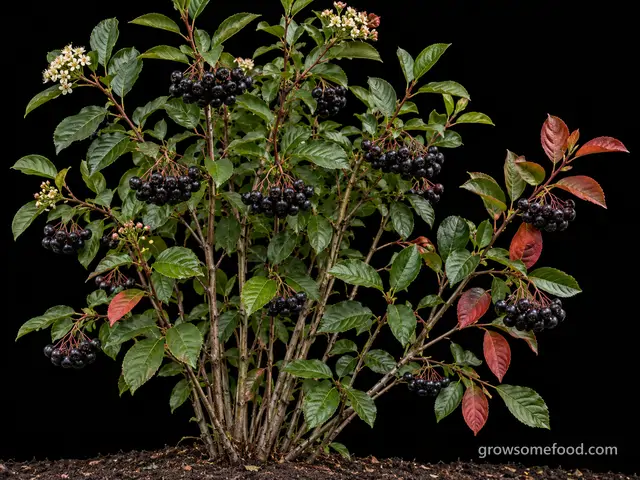
A tough, adaptable native shrub that delivers three things at once: one of the highest-antioxidant fruits known, spectacular scarlet fall color, and easy, nearly pest-free care in sun or part shade, wet soil or dry.
Safety notes Chokeberries are safe and healthy - prized as an antioxidant 'superfruit.' The name warns that the raw berries are intensely ASTRINGENT and mouth-puckering, not poisonous; cooking and sweetening tame them into excellent juice, jam, and baked goods. Do not confuse chokeberry (Aronia, edible) with the unrelated chokecherry (Prunus virginiana), whose leaves and pits are cyanogenic. As with all rose-family fruit, do not eat crushed seeds in quantity.
Overview
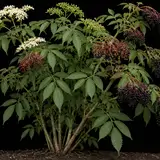
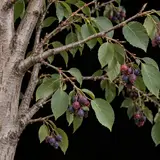
Chokeberry (Aronia) is a native shrub having a well-deserved moment. Its dark berries have become a celebrated 'superfruit' - among the highest in antioxidants (particularly anthocyanins) of any temperate fruit - sold as juice and supplements, yet it grows as an easy, adaptable, and beautiful garden shrub that most people can plant and largely ignore. Black chokeberry (A. melanocarpa) bears glossy black berries; red chokeberry (A. arbutifolia) bears red ones.
Quick facts
- Sprouts in
- 60 daysRange: 30–120 days
- Soil temperature
- 68 °FRange: 60–72 °F
- Height
- 6 ftRange: 3–10 ft
- Spread
- 5 ftRange: 3–8 ft
- Cold
- Takes hard frostdamaged below -40°F
- Heat
- Struggles above 95°F
- Life cycle
- Perennial, lives about 30 years
- Save seeds
- About 150 days after plantingRange: 120–180 days
- Self-sows
- Yes, expect volunteers
- Soil
- Tolerates wet soil
- Water
- Medium
- Plant spacing
- 6 ftRange: 4–8 ft
When to plant
Fall sowing is open for 19 more days. Next: spring, Mar 27 to May 22.
- Direct sow Oct 11 – Nov 8 Open now · 19 days leftAbout 2 weeks before to 2 weeks after your first frost (Oct 25 here)Fall-sow cleaned seed outdoors for cold stratification; germination is slow and seedlings take several years to fruit, so cuttings, suckers, or transplants are far faster.
- Transplant Mar 27 – May 22 Opens in 158 daysAbout 2 weeks before to 6 weeks after your last frost (Apr 10 here)Plant container chokeberry in early spring into moist (even wet) well-drained soil in full sun to part shade; more sun means more fruit and better fall color. It may bear within 2-3 years.
- Transplant Aug 16 – Sep 27 Opens in 300 daysAbout 10 weeks before to 4 weeks before your first frost (Oct 25 here)Fall planting works well in cooler zones; keep watered until dormancy and mulch the roots.
Frost here: last around Apr 10 (Mar 27 to Apr 24 most years), first around Oct 25. Zone averages, your own yard may run a week or two either way.
Life stages
Establish, grow, repeat
Getting established and returning each season are different parts of the story.
Stage 1 of 5 · Getting established
Years 1-2 - rooting in
The first year after planting
Care at this stage
-
Keep evenly moist while establishing
Water a new chokeberry to keep the soil evenly moist through its first two years. It is a wetland-edge shrub that tolerates wet feet and clay and prefers steady moisture, though it is adaptable once established.
-
Mulch and expect suckers
Mulch the root zone to conserve moisture. Chokeberry naturally suckers into a multi-stemmed clump or small thicket - keep the suckers for a bigger, more productive patch, or remove them for a tidier single shrub.
Months are typical seasonal windows; climate, variety, and plant age can shift them.
Harvest
- Berries fully black (black chokeberry) or deep red (red chokeberry), soft, and juicy in late summer to fall
- Fruit comes away easily in clusters; foliage turning brilliant scarlet as the crop ripens
- Pick the berries when fully colored and soft · every 5 days
- Fiery fall color arrives with the fruit
Per plant 2 to 25 lbPicking pick as they ripen
Cook with Chokeberry
Watch out for
3 to know. None are high-risk for Chokeberry. 1 is active in October.
Bird Fruit LossSeverity Low WildlifenowSeason: Sep–NovRipening berries disappearing fast, birds swarming the tree as fruit colors, half-eaten berries and droppings.
Ripening berries disappearing fast, birds swarming the tree as fruit colors, half-eaten berries and droppings.
Net promptly; otherwise accept it as feeding wildlife - which is itself a valid and valuable use of the plant.
Drape bird netting over the tree as the berries begin to color, or plant enough to share; a single small unnetted tree rarely leaves fruit for people.
Birds do eat chokeberries, but because the fruit is astringent they usually take it later than sweeter berries, so competition for a human harvest is far milder than with serviceberry or blueberry.
Drought StressSeverity Low DisorderSeason: Jun–AugWilting on hot afternoons, browning and crisping along leaf edges and tips, premature leaf drop, collapsed flower stems, and thin, stunted growth - showing up first on young plants and on the driest, most exposed side of the planting.
Chokeberry does tolerate drought once established, unlike most plants carrying this warning. What a dry summer costs you is fruit - small, shriveled berries and a lighter crop - plus some leaf scorch on young plants.
Wilting on hot afternoons, browning and crisping along leaf edges and tips, premature leaf drop, collapsed flower stems, and thin, stunted growth - showing up first on young plants and on the driest, most exposed side of the planting.
Water deeply and consistently, then mulch. Mild wilting reverses within a day or two, but a prolonged drought sets a plant back hard and can kill a young one outright. If a plant scorches every summer, the site is wrong - move it to damper ground rather than trying to water it through.
Match the site to the plant: put a moisture-loving species where the ground actually stays damp - a rain garden, pond edge, ditch, seep or low spot - rather than in an ordinary border you intend to keep watered. Mulch to hold moisture and keep the roots cool, water deeply through every dry spell while the plant is establishing, and avoid hot, windy, exposed positions.
Not a pest but a siting problem, and on a moisture-loving plant it is usually the thing that actually kills it. When the soil dries out, leaf edges brown and crisp, foliage wilts and drops early, flowering and fall color are cut short, and growth thins. Hot sun, wind and exposed positions make it worse by pulling water out faster than the roots can replace it. A plant that wants reliably moist or wet ground has no drought tolerance to fall back on, and young or recently planted ones have the least of all.
Leaf SpotSeverity Low DiseaseSeason: Jun–AugSmall brown, dark, reddish or purple-bordered spots and blotches on the leaves during prolonged humid, rainy spells, sometimes enlarging and merging, with premature yellowing or leaf drop on the worst-affected growth.
Chokeberry picks up minor rose-family rusts alongside leaf spots - small orange spots in wet weather - and both are cosmetic on so resistant a shrub.
Small brown, dark, reddish or purple-bordered spots and blotches on the leaves during prolonged humid, rainy spells, sometimes enlarging and merging, with premature yellowing or leaf drop on the worst-affected growth.
Remove badly affected leaves and improve airflow; that is normally the whole of it. The plant flushes clean new growth once the weather turns. Fungicide is seldom warranted for a cosmetic leaf spot on an established plant.
Give the plant airflow - space, thin or prune it rather than letting the growth mat together - avoid overhead watering, and water early in the day so the foliage dries. Rake up and remove fallen leaves, which is where these fungi overwinter, and keep the plant unstressed and properly watered.
A catch-all for the various fungal leaf-spot diseases that blotch foliage in warm, humid, wet weather. They spot and yellow the leaves and sometimes bring on early leaf drop, and they are worst on crowded, shaded or overhead-watered plants and on anything already stressed. On a healthy, well-sited plant they are a cosmetic nuisance that comes and goes with the weather rather than a real threat.
Good & bad neighbors
Plant nearby
-
Two antioxidant-rich native berry shrubs with overlapping culture and superb fall color; both like sun and even moisture, though blueberry needs more acidic soil, so site accordingly.
-
Both thrive in wet, sunny sites like rain gardens and pond edges, combining chokeberry's fruit and fall color with buttonbush's pollinator flowers for a wetland-edge planting.
-
A classic native superfruit pairing for a moist edge or hedgerow - both tolerate wet ground, feed pollinators and birds, and yield antioxidant-rich fruit for juice and preserves.
-
Layered native fruit: serviceberry's early-summer berries and chokeberry's late-summer-to-fall crop extend the harvest and wildlife food across the season in a mixed edible native border.
Varieties · 5
You pick one when you add Chokeberry to your garden. Its days to maturity set your harvest window.
Viking
A leading commercial black chokeberry (A.
Variety details for Viking
Upright shrub with large glossy black berries in heavy clusters and scarlet fall foliage.
cultivarblack-chokeberrylarge-fruitheavy-yieldmelanocarpa) selected in Eastern Europe for large berries and heavy, reliable yields on a vigorous 5-6 foot shrub. The go-to variety for serious fruit production, with excellent juice quality and strong fall color.
Nero
A productive black chokeberry cultivar on a somewhat more compact plant, with large berries noted as slightly less astringent than average and superb antioxidant content.
Variety details for Nero
Compact rounded shrub loaded with big black berries and brilliant red-purple fall color.
cultivarblack-chokeberrycompactsweeterA good choice for a smaller garden that still wants a strong crop.
Brilliantissima (Red Chokeberry)
A selected red chokeberry (A.
Variety details for Brilliantissima (Red Chokeberry)
Upright shrub with abundant bright red berries lasting into winter and fiery red fall leaves.
cultivarred-chokeberryarbutifoliashowy-berriesarbutifolia) grown especially for its heavy set of glossy RED berries that persist into winter and its outstanding brilliant-red fall foliage. More ornamental than the black types; the red berries are edible but even more astringent, best cooked. Red chokeberry is also the species that carries the genus's southern range - it grows down the coastal plain into the Deep South and Florida, where black chokeberry does not occur.
Autumn Magic
A compact black chokeberry selection prized for a tidy habit, good fruit, and exceptionally rich purple-red fall color, making it a strong dual-purpose ornamental-and-fruiting shrub for smaller landscapes.
Variety details for Autumn Magic
Neat compact shrub with black berries and vivid purple-and-red autumn foliage.
cultivarblack-chokeberrycompactfall-colorBlack Chokeberry (Aronia melanocarpa)
The wild black chokeberry species: a tough, suckering native shrub 3-6 feet tall with glossy black superfruit berries, white spring flowers, and brilliant fall color.
Variety details for Black Chokeberry (Aronia melanocarpa)
Suckering native shrub with white flowers, glossy black berries, and scarlet fall foliage.
speciesnativeblack-fruitsuperfruitExtremely hardy and adaptable and the standard for antioxidant-rich aronia fruit; ideal for naturalizing and hedgerows.
Grower tips
Notes from growers, tagged with the zone they grow in. A person reads every post before it appears.
Nobody has posted about Chokeberry yet. The first one usually saves someone a season.
Free account. Your post shows your grower name and zone, never your email.