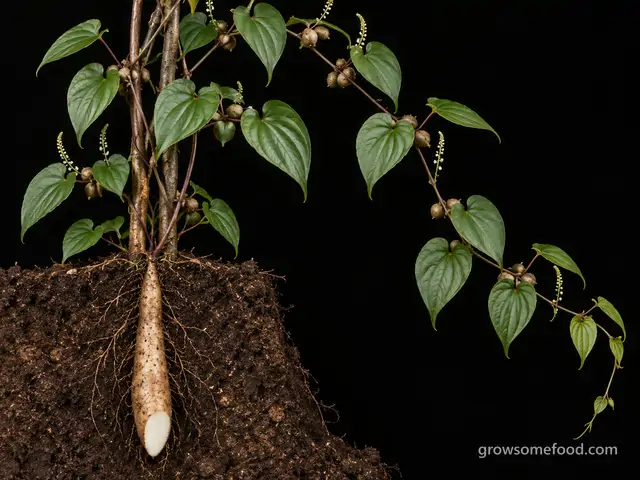
Chinese Yam

Dioscorea polystachya · Dioscoreaceae
Other Perennial Vine Other
Introduced - native to China, Korea, Japan and Taiwan, where it is a long-cultivated food crop; naturalized and invasive across the eastern and midwestern United States
Not recommended to plant. Still sold as 'cinnamon vine' and grown for its nagaimo tuber, but it escapes and is listed as invasive across much of the eastern US, with sale banned in several northeastern states. Its deep, brittle tuber makes an escaped plant effectively permanent. If you must grow it, use a deep container.

Chinese yam is a genuine food crop - the nagaimo of East Asian cooking - so it is not poisonous. Two real cautions. The raw peeled tuber's slime carries needle-like crystals that make many people's hands itch; wear gloves to peel it. Far more important: never eat a wild yam-family tuber or bulbil you have not positively identified. In the South, invasive air potato hangs similar bulbils and the US strain of it is bitter and toxic, and people have been poisoned mistaking the two.

Overview

The 'cinnamon vine' sold since the 1800s, and a real food crop in Asia - but in the eastern US it escapes, smothers shrubs, and reseeds itself from hundreds of little aerial potatoes. Once its deep brittle tuber is in your ground it is close to permanent.

Chinese yam (Dioscorea polystachya) is one of the awkward ones: a plant that is genuinely useful somewhere else. In China, Korea, and Japan it is a long-cultivated crop — nagaimo or yamaimo, the crisp, slippery mountain yam grated raw over rice — and it has been sold in American catalogues since the 1800s as the ornamental ‘cinnamon vine’, for the clove-and-cinnamon smell of its tiny summer flowers.

In the eastern and midwestern United States it does not stay where it is put. It twines up shrubs, young trees, and fences, winding them tight and bending them over, and it colonises stream corridors, floodplain woods, fencerows, and old home sites. It spreads almost entirely by bulbils — small knobbly aerial potatoes that fill the leaf axils in late summer, drop, and sprout — and it holds its ground with a deep, vertical, brittle tuber that snaps when you dig it and regrows from the piece you left. It is listed as invasive across much of its US range and banned from sale in several northeastern states.

So: do not plant it in the ground. If you want nagaimo for the kitchen, grow it in a deep container and strip every bulbil. And if it is already on your property, this entry is about the two things that actually work — collecting bulbils, relentlessly, and treating the foliage late in the season — and about the one that mostly does not: digging.

At a glance

Sun
Full sun · Part sun · Part shade
Water
Medium
Spacing
18–240 in (typ. 60)
Mature height
60–400 in (typ. 180)
Start by
Frost
Hardy
Spread
36–360 in (typ. 120)
Soil
Well-drained
Temperature
Damaged below -20°F · struggles above 100°F
Self-sows
Yes — expect volunteers

When to plant

No planting window on record for this zone.

Life stages

  1. Twining growth (identify & cut) Apr, May, Jun, Jul, Aug, Sep, Oct (yearly)
    • Recognize it: opposite heart-shaped leaves on a slender twiner
      A slim, wiry vine to 15 ft or more, with glossy heart-shaped leaves that are OPPOSITE or nearly so on the stem (sometimes whorled in threes near the base), long-stalked, with 7-9 curved veins running from base to tip and often a squared or slightly lobed base. Stems and leaf stalks are often flushed reddish-purple. The leaf arrangement is the check that matters: air potato's leaves are ALTERNATE, and the native wild yam has alternate leaves and no bulbils at all.
    • Cut vines off whatever they are strangling
      Cut the twining stems at the base and pull them out of shrubs and small trees. This relieves the plants being wound up and shaded out, and it removes the season's bulbils if you get to it before August. It does not kill the yam - the tuber pushes new vines within weeks - so treat cutting as damage control, not removal, and expect to do it repeatedly.
    • Find the neighbours it is coming from
      Chinese yam usually arrives on a property line, from a hedge, an old planting, or a stream corridor upslope. Walk the boundary and the drainage before you plan control: clearing your side while the source keeps dropping bulbils into it is how people spend five years and get nowhere.
    Slender twining vine with glossy opposite heart-shaped leavesReddish stems and leaf stalksShrubs and saplings being wound up and bent overVines re-emerging within weeks of being cut
  2. Cinnamon-scented flowers & bulbil set (the deadline) Jun, Jul, Aug, Sep, Oct (yearly)
    • Tiny white flowers that smell of cinnamon
      In midsummer it hangs small spikes of tiny white or greenish flowers with a distinct cinnamon or clove scent - the reason it was sold for a century as 'cinnamon vine'. The smell is a reliable confirmation if you are unsure of the leaves. It rarely if ever sets viable seed in the US; the bulbils do all the work.
    • Strip the bulbils before they drop - this is the whole game
      From late summer the leaf axils fill with small, knobbly, potato-like AERIAL BULBILS, from pea to marble size (occasionally bigger), tan to grey-brown. Each one that reaches the ground is a new plant. Strip them into a bag before they loosen - late August into September in most of the range - and bag, do not compost, do not dump. One vine can hang dozens. Missing this window costs you a year.
    • If you treat with herbicide, this is the timing
      Late summer, on full green foliage and before the bulbils drop, is when a foliar herbicide moves best into the tuber. Use only a product whose label lists your site, follow that label for rate and protective equipment, and keep it off desirable plants the vine is climbing - cut the vine free and lay it out on bare ground to treat, or cut and treat the stump. Expect several seasons of it regardless.
    Small white cinnamon-scented flower spikesKnobbly pea- to marble-sized bulbils in the leaf axilsBulbils loosening and dropping from late AugustSeedling vines the following spring wherever bulbils fell
  3. Winter die-back (tuber & bulbils survive) Jan, Feb, Mar, Nov, Dec (yearly)
    • Dead vines, living tuber
      Frost kills the top growth and leaves brittle tan stems hanging in shrubs through winter. Underneath, the deep vertical tuber is untouched and the dropped bulbils are lying in the leaf litter waiting for spring. Winter die-back is not control, and the bare stems are actually useful - they show you exactly where every plant is.
    • Winter bulbil sweep
      Rake and sweep the leaf litter under every vine you marked and bag the fallen bulbils. It is tedious and it is the highest-value hour you will spend, because every bulbil collected now is a vine that never happens. Repeat annually - bulbils can sit dormant in the soil for a couple of years.
    • Dig only if you can commit to it
      The tuber runs straight DOWN, often 2-3 ft and sometimes deeper, and it is brittle - it snaps, and any fragment left behind regrows. Digging works on young plants and on a tuber you can excavate whole, and it fails badly on established ones, where a half-dug tuber simply resprouts. If you cannot get the whole thing, do not start; strip bulbils and treat the foliage instead.
    Brittle tan dead vines marking every plantBulbils lying in leaf litterTuber fragments resprouting where a dig was abandoned

Watch out for

Bulbil Spread & Resprouting High DisorderJun, Jul, Aug, Sep, Oct, Nov, Dec

Why it spreads so fast and resists control: each vine produces numerous potato-like aerial bulbils that drop and sprout new plants, spread readily by water, mowing, equipment, and dumped material, and resprout along with the underground tuber - a single missed bulbil restarts the infestation.

Watch for: Bulbils hanging in leaf axils and littering the ground, new vines sprouting from fallen or moved bulbils, and resprouting from the tuber.

Prevent: Collect and bag all bulbils before they drop; never compost or dump bulbils or vines; clean equipment.

Treat: Repeated bulbil collection (before and after drop) plus tuber digging over several years; bag all material for disposal.

Chinese yam's bulbils are small - pea to marble sized, tan to grey-brown, quite unlike air potato's large warty ones - and they loosen from late August into October. They float, so infestations run downstream in lines, and they stay viable in the soil for a year or two, which is why a cleared patch sprouts again. Strip them into a bag before they drop; that one annual job is what stops the infestation expanding.

Deep Brittle Tuber (why digging fails) High DisorderMar, Apr, May, Jun, Jul, Aug, Sep, Oct, Nov

The reason this plant is close to permanent once established: its single tuber runs almost vertically downward, commonly 2-3 ft and sometimes deeper, and it is brittle. Digging snaps it, and any fragment left in the ground regrows, so an abandoned excavation leaves the plant intact and the soil disturbed. Cutting the top growth does nothing to it at all - fresh vines appear within weeks.

Watch for: Vines regrowing within weeks of being cut; new shoots emerging from the site of a half-finished dig; a tuber that narrows and keeps going as you follow it down.

Prevent: Never plant it in open ground - if you want the crop, grow it in a deep container or grow bag where the whole tuber can be lifted.

Treat: Dig only young plants, or established ones you are prepared to excavate whole. Otherwise leave the tuber alone and work on the two things that do move the needle: stripping bulbils every August, and a late-summer foliar treatment on full green leaves with a product whose label lists your site. Expect three to five years.

The tuber is the edible nagaimo, so digging it is not wasted effort in the kitchen sense - but it is not control, and on an established plant you will usually break it.

Twining Smother (ecological harm) Medium DisorderMay, Jun, Jul, Aug, Sep, Oct

The ecological harm: the vine winds tightly around shrubs, saplings, and stems, shading their foliage and physically bending and deforming them, and it builds dense tangles over floodplain and streamside vegetation where it displaces native groundcover and prevents tree regeneration. It is less explosive than the worst smothering vines, which is precisely why it is often left alone until it has taken a whole stream corridor.

Watch for: Shrubs and saplings wound tight and bent over, dense vine tangles along creeks and fencerows, and native groundcover thinning underneath.

Prevent: Never plant it in open ground; cut and treat small infestations early, and deal with a source on adjoining land before clearing your own.

Treat: Cut vines off the plants they are strangling as often as needed, strip bulbils annually, and treat foliage late in the season; replant cleared ground with native vines or shrubs so it is not simply recolonised.

Because it spreads along water, riparian sites are where this does the most damage and where control most often needs a neighbour's cooperation.

Yam Look-alike Confusion Medium DisorderJun, Jul, Aug, Sep, Oct

Three heart-leaved twiners get confused with one another, and the mistake runs in both dangerous directions: a native plant destroyed as an invader, or a toxic bulbil eaten as food. The native wild yam (Dioscorea villosa) is often mistaken for this plant and dug up, and in the South, air potato (D. bulbifera) bulbils - which are bitter and toxic in the US strain - have been eaten by people who thought they had the edible Chinese yam.

Watch for: Heart-shaped leaves on a twining vine: check the arrangement and the bulbils before doing anything. Opposite leaves plus small knobbly bulbils is Chinese yam. Alternate leaves plus large warty bulbils is air potato - toxic, do not eat. Alternate leaves with no bulbils at all is the native wild yam - leave it alone.

Prevent: Identify by leaf arrangement and bulbil size before digging, spraying, or eating anything in this group; the cinnamon scent of the summer flowers confirms Chinese yam.

Treat: If in doubt, do nothing and photograph it for your county extension office. Never eat a yam-family tuber or bulbil you have not positively identified; if a bitter bulbil has been eaten, contact poison control.

The air potato entry in this catalog carries the same key from the other direction, and the native wild yam is the one to protect - no bulbils means no action.

Varieties · 2

Chinese Yam / Cinnamon Vine (Dioscorea polystachya)

Slender twining vine to 15 ft with glossy heart-shaped opposite leaves and small knobbly tan bulbils clustered in the leaf axils.

speciesinvasivedo-not-plantinvasive-vinebulbil-spreadedible-tuberescaped-ornamental

The invasive twiner sold for a century as 'cinnamon vine': glossy opposite heart-shaped leaves with 7-9 curved veins, reddish stems, cinnamon-scented white flower spikes in midsummer, and knobbly pea- to marble-sized aerial bulbils from late summer. Spreads almost entirely by those bulbils; holds its ground with a deep, brittle, vertical tuber that regrows from fragments. Listed as invasive across much of the eastern US and banned from sale in several northeastern states.

Cultivated nagaimo / yamaimo forms

Long, straight, pale-skinned tubers up to 3 ft, crisp and slippery when cut; the vine above ground is identical to the wild form.

cropedible-tubercontainer-only

The same species as grown commercially in Japan, Korea, and China for the kitchen, selected for long, straight, thick tubers - the nagaimo sold in East Asian groceries. Grown in the US it is the same invasive plant, so keep it in a deep container or grow bag rather than open ground, and strip the bulbils every August so none reach the soil. Containers also solve the harvest problem: lifting a 3 ft tuber out of a bag is a job, lifting it out of the ground is an excavation.

Grow

How to recognize it - opposite glossy heart-shaped leaves with 7-9 veins, reddish stems, cinnamon-scented flowers, and small knobbly bulbils in the leaf axils - and how it differs from air potato and the native wild yam.

There are several heart-leaved twiners in the eastern woods and only one of them is this. Work through the checks in order.

Leaf arrangement. Chinese yam leaves are opposite or nearly opposite on the stem — often whorled in threes low down — and this is the single most useful character. Air potato (Dioscorea bulbifera), the far more aggressive southern invader, has alternate leaves. The native wild yam (D. villosa) is alternate too, apart from a whorl at the base.

Leaf shape. Glossy, heart-shaped, 2 to 4 inches, long-stalked, with 7 to 9 prominent curved veins running base to tip, and often a squared-off or slightly lobed base that gives it an arrowhead look. Stems and leaf stalks frequently carry a reddish-purple flush.

Bulbils. From late summer the leaf axils hold small knobbly potato-like bulbils, mostly pea to marble sized, tan to grey-brown. Air potato’s are much larger and warty — golf-ball to fist-sized. The native wild yam has none at all, which is the quickest way to be sure you are not about to dig up a native.

Smell. In midsummer the little white flower spikes smell distinctly of cinnamon or cloves. Nothing else in this group does.

Below ground, a single tuber runs almost straight down, narrow at the top and swelling below, commonly 2 to 3 feet deep and sometimes more. It is brittle. This is the reason the plant is so hard to be rid of, and it is worth knowing before you pick up a spade.

It grows in sun to fairly deep shade, on almost any soil, and is hardy through most of the eastern US — roughly zones 5 to 10. Cold does not stop it.

Propagation & seed saving

Bulbils do essentially all of it: dozens per vine, dropping from late August, sprouting the next spring, and viable in the soil for a couple of years. The deep tuber holds the ground and regrows from fragments.

Chinese yam almost never sets viable seed in North America. Its spread is a bulbil story, and understanding that tells you exactly where to spend your effort.

Through late summer each vine hangs dozens of small aerial bulbils in the leaf axils. From late August into October they loosen and fall. They roll, they wash downhill and downstream, they ride in dumped yard waste and on mower decks and boot treads, and they lie in the leaf litter through winter. In spring each one sends up a vine, and within a season or two that vine is hanging bulbils of its own. Bulbils can also sit dormant in the soil for a year or two, which is why a site that looked clean sprouts again.

The tuber does the other half of the job: it holds the position. It is deep, vertical, and brittle, and a fragment left in the ground regrows. That combination — a spreading unit that travels and a storage organ that cannot practically be excavated — is what makes this plant so persistent on a property.

Which is also the good news, in a way. There is one thing to interrupt: bulbil drop. Strip the bulbils every year before they fall, and the infestation stops expanding while you deal with the plants you already have. Skip a year and you have handed it several dozen new plants per vine.

Care

Control, not care: strip the bulbils every August, cut vines off what they are strangling, treat foliage late in the season with a labelled herbicide, and dig only where you can lift the whole tuber. Plan on several years.

Strip the bulbils. This is the highest-value job and the one with a deadline. Late August through September, before they loosen, run the vines through a gloved hand into a bag and take every bulbil. Then sweep the litter beneath them in winter for the ones you missed. Bag them for disposal — never compost, never dump. Yard waste piles are one of the main ways this plant reaches new properties.

Cut the vines off shrubs and saplings as often as you need to; it relieves the plants being wound up and it removes that year’s bulbils if you are early enough. Do not expect it to kill anything: the tuber pushes fresh vines within weeks, and repeated cutting alone will take many years to exhaust it.

Digging is the tempting one, and mostly a trap. The tuber goes straight down, 2 to 3 feet and often deeper, and it snaps. Any piece left regrows, so a half-finished excavation leaves you with a disturbed hole and the same plant. Dig young plants, whose tubers are still short, and dig an established one only if you are genuinely prepared to excavate it whole. Otherwise leave it and work on the foliage and the bulbils.

Herbicide, honestly. For an established patch, a foliar treatment on full green foliage in late summer, before the bulbils drop, is what moves down into the tuber; glyphosate and triclopyr formulations are the ones commonly used on this plant. Three rules. Use a product whose label lists your site — woodland edge, fencerow, ornamental bed, whatever it is — because the label is legally binding, not advisory. Follow that label for rate, timing, and protective equipment. And because this vine loves stream banks and floodplain woods, anything applied at or near water needs an aquatic-labelled product, and in many states a permit or a licensed applicator. Cut the vine free of desirable plants and lay it on bare ground, or cut it and treat the stump, so you are not spraying whatever it was climbing.

Plan on three to five years, and check the property line first — if the source is next door, agree a plan with your neighbour before you start, or you will simply be catching bulbils forever. Where you clear it, plant something that will hold the ground: native vines like virgin’s bower or coral honeysuckle, or shrubs suited to your site.

In the kitchen

It really is nagaimo - crisp, slippery mountain yam, grated raw over rice or simmered in soups, with edible bulbils (mukago) too. Eat what you remove if you like; just do not let that become a reason to keep it, and never eat a wild yam you have not identified.

Unlike most plants on the do-not-plant list, this one is genuinely good to eat, and there is no reason to pretend otherwise. The tuber is nagaimo or yamaimo — sold in every East Asian grocery, crisp and faintly sweet, with a slippery texture that is the whole point. Grated raw it becomes tororo, poured over rice, soba, or tuna; cut into batons it is stir-fried or simmered in soup, where it turns tender and mild. The little aerial bulbils are eaten too, as mukago, boiled or roasted or cooked into rice.

Two practical notes. Wear gloves to peel it. The raw slime carries needle-fine crystals that make many people’s hands itch and prickle; it is not dangerous and it passes, but it is unpleasant, and rinsing in vinegared water helps. And cook the bulbils rather than eating them raw.

The honest caveat is bigger than either. Never eat a yam-family tuber or bulbil you have not positively identified. In the South, invasive air potato hangs similar-looking bulbils on a similar heart-leaved vine, and the strain established in the US is bitter and toxic — people have been poisoned making exactly this mistake. Opposite leaves and small knobbly bulbils is Chinese yam; alternate leaves and large warty bulbils is air potato; no bulbils at all is most likely the native wild yam, which you should leave alone.

And eating it is not control. The bulbils spread this plant, not the tuber, so a good dinner and an uncollected vine still leaves you worse off in the spring. Harvest what you want — then bag every bulbil you did not eat.

Troubleshooting

The questions people actually arrive with: is this it or the native, why does it keep coming back, should I dig, can I eat it, and how long will this take.

Is this Chinese yam? Slender twining vine, glossy heart-shaped leaves that are opposite (sometimes whorled at the base) with 7–9 curved veins, often reddish stems, small knobbly pea- to marble-sized bulbils in the leaf axils from late summer, and tiny white flowers that smell of cinnamon in midsummer.

Could this be the native wild yam? Yes, and it often is. Dioscorea villosa has the same heart-shaped leaves but they are alternate, and it produces no bulbils whatsoever. No bulbils means leave it alone.

Is it air potato? Only if you are in Florida or the Gulf South, and then look at the leaves and the bulbils: air potato is alternate-leaved with large warty bulbils, and its bulbils are toxic. It has its own entry here.

I cut it down and it came straight back. Expected. The tuber is untouched by cutting and pushes new vines within weeks. Cutting is for relieving the shrubs it is strangling and for removing bulbils, not for killing the plant.

Should I dig it out? Only if you can lift the tuber whole. It runs 2–3 feet down or more and is brittle, and every fragment regrows — an abandoned dig leaves you no better off and the soil disturbed. Dig young plants; on established ones, work on bulbils and foliage instead.

Why do new vines appear in a spot I cleared? Bulbils. They fall, roll, wash downhill, and stay viable in the soil for a year or two, so a cleared patch reseeds itself from what was already lying there — or from a plant upslope or across the fence.

Can I eat it? Yes, the tuber is nagaimo and the bulbils are mukago, both real foods — wear gloves to peel the tuber, cook the bulbils, and see Culinary. But do not treat foraging as control, and never eat a wild yam you have not identified.

Can I grow nagaimo deliberately? In a deep container or grow bag, yes — you get the crop without putting a permanent tuber in your soil, and you can strip the bulbils easily. In the ground, in the eastern US, no.

Is it illegal? Several northeastern states prohibit its sale, and a number of states list it as invasive; check your own state’s regulated-plant list before buying, selling, or moving it.

How long will this take? Three to five years of annual bulbil collection and late-season treatment for an established patch, longer if the source is on adjoining land. Deal with the neighbouring source first if there is one.

History

A staple crop and classical herb in East Asia, imported to America in the 1800s as the ornamental 'cinnamon vine' and as an alternative to the potato after the blight, and quietly naturalized across the eastern states ever since.

In China this plant is old and important. Its tuber, shan yao, appears in the earliest Chinese herbal texts and remains one of the standard tonic ingredients in traditional practice, and it has been eaten as a staple vegetable for as long as anyone has recorded. Japan grows it as nagaimo and yamaimo, and the grated tororo made from it is an everyday food.

It came to the United States in the 1800s on two separate hopes. Nurseries sold it as the ‘cinnamon vine’, a fast, hardy, sweet-scented porch and trellis vine — you can still find it in old catalogue reprints and, occasionally, still for sale. And in the wake of the potato blight, agricultural improvers promoted it as a hardy alternative root crop that would not fail the way the potato had. It grew well and it kept growing, which was rather the problem.

By the twentieth century it had slipped out of the gardens: down stream corridors, along fencerows, into floodplain woods, from Louisiana to New England and west through the Midwest. Because it spreads by bulbils rather than seed, it moved in short hops and along water rather than in leaps, which made it look harmless for decades. It is now listed as invasive across much of that range and banned from sale in several northeastern states — and, quietly, still growing on a great many old home sites, where somebody’s porch vine outlived the porch.

Growing across climates

Hardy through roughly zones 5-10 across the eastern and midwestern US; cold does not check it, and stream corridors are how it travels. Its northern edge is limited more by bulbil ripening than by winter.

Chinese yam is cold-hardy, which is exactly what makes it a different problem from its tropical relative. The top growth dies at frost and the deep tuber shrugs the winter off, so it is comfortable through roughly zones 5 to 10 — from the Gulf states north into New England and west through the Midwest. Hard winters do not clear it; they just shorten its season.

Its favoured ground is moist and disturbed: floodplain forest, stream and river corridors, ditch banks, fencerows, roadsides, and old home sites. Water is its highway — bulbils float and wash downstream — which is why infestations run in lines along creeks and why control on a stream bank almost always means talking to whoever is upstream.

At the northern edge of its range the limit is less about winter survival than about season length: in a short summer it makes fewer bulbils and expands more slowly. That margin is shrinking as growing seasons lengthen. In the warm South it competes with air potato for the same niches and is the less aggressive of the two, but it is the one that reaches far further north.

Wherever you are: the same three habits. Learn the opposite leaf, strip the bulbils every August, and never put this plant in open ground.

No grower tips for Chinese Yam yet — yours could be the first.

Sign in to share what works in your garden.

Connection interrupted

Reconnecting to GrowSomeFood

Keep this page open. We are trying to restore your garden session.

Attempt of . Retrying automatically.

Still offline

Could not reconnect

Your phone may have switched networks or gone to sleep. Try again when the signal is steady.

Session expired

Reload to continue

This garden session is no longer available on the server. Reloading will start a fresh session.