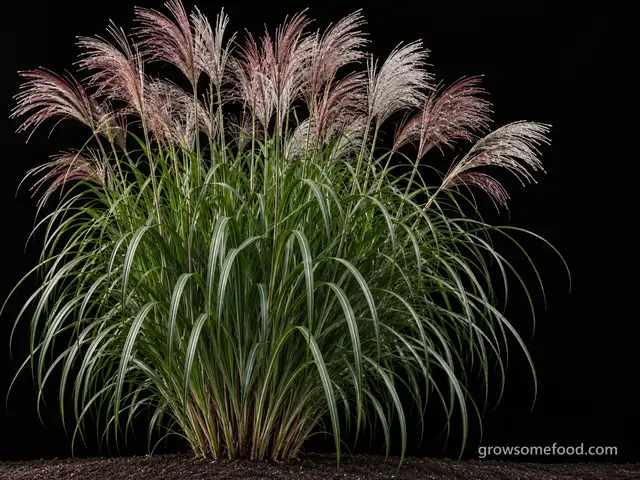
Chinese Silvergrass

Miscanthus sinensis · Poaceae
Other Perennial Grass Ornamental
Introduced - native to eastern Asia (China, Japan, Korea); escaped and invasive through the mid-Atlantic, Southeast, Ohio Valley and parts of the Pacific Northwest
Not recommended to plant. Do NOT plant this. The most-sold ornamental grass in America self-seeds off the property into roadsides, old fields and forest edges, where seedlings revert to a coarse green form. It is a clump-former, not a runner - the escape is by SEED. Its dry winter foliage is also fire fuel.

Chinese silvergrass is not a food or medicine plant, and it is not toxic to people, pets, or livestock. The real safety issue is fire: a mature clump dries to a dense mass of standing dead leaves and plumes that ignites easily and burns hot, so it is a poor choice against a house, deck, or fence in fire-prone country. The leaf edges are finely serrated and will slice skin - wear long sleeves and gloves when you cut it back.

Overview

The silver-plumed ornamental grass in half the front yards in America - and a plant that quietly seeds itself into roadsides, old fields and forest edges, where the seedlings revert to a coarse green weed. It is a clumper, not a runner; the escape is by seed. Never plant it.

Chinese silvergrass (Miscanthus sinensis), sold as maiden grass, zebra grass, porcupine grass and a hundred cultivar names, is probably the most-planted ornamental grass in the United States. It is genuinely handsome: a tall, arching, vase-shaped clump that throws silvery-pink plumes in late summer and stands through winter looking like a piece of weather. It is also, across a large part of the country, an escaped invasive.

The escape route is worth being precise about, because the usual reassurance misses it. Nursery tags say clump-forming, not running — and that is true. It has no rhizomes creeping under the fence. What it has is seed: a mature clump produces plumes full of it, the wind carries it well beyond the garden, and it germinates in roadside gravel, powerline cuts, old fields, stream banks and forest edges. The seedlings do not look like the parent at all — the variegation and banding are cultivar traits that do not come true from seed, so escapees are plain, coarse, green, and eight feet tall. On top of that, a dry winter clump is excellent fire fuel. This entry is here to help you recognize it, decide what to do with the one you already have, and pick a native grass instead.

At a glance

Sun
Full sun · Part sun
Water
Medium
Spacing
36–96 in (typ. 60)
Mature height
48–144 in (typ. 84)
Start by
Direct sow · Division
Frost
Hardy
Spread
36–96 in (typ. 60)
Soil
Well-drained
Temperature
Damaged below -25°F · struggles above 105°F
Self-sows
Yes — expect volunteers

When to plant

No planting window on record for this zone.

Life stages

  1. Spring green-up & summer clump (identify & control) Apr, May, Jun, Jul, Aug (yearly)
    • Recognize it: a tall arching clump with a white midrib
      A warm-season bunchgrass forming a dense, vase-shaped clump four to eight feet tall, with long arching leaves that carry a distinct pale WHITE MIDRIB down the center - the most reliable field mark. Leaf edges are finely serrated and will cut skin. It emerges late, well after cool-season grasses, and expands slowly outward from a tight woody crown. It does not run: there are no rhizomes creeping through the border.
    • Pull escaped seedlings while they are small
      Seedlings show up in gravel, bed edges, gutters, roadside ditches and any thin ground downwind, and they look nothing like the parent - plain green, no variegation, no banding. Pull or dig them in their first year, when the crown is still soft and comes out whole. A three-year-old escapee needs a mattock, and a mature one needs a saw.
    • Walk downwind before you decide it stays put
      Nursery tags say clump-forming, and that is true and beside the point. Before assuming your plant is well behaved, walk the ground downwind of it in early summer - fence lines, ditches, the neighbor's field edge, the powerline cut - and look for plain green seedlings. If they are there, the clump is a seed source, whatever its label says.
    Vase-shaped clumps with arching leaves and a white central midribPlain green seedlings in gravel, ditches and thin ground downwindLate spring emergence, well after cool-season grassesA clump widening but not running
  2. Late-summer plumes (the deadline) Aug, Sep, Oct (yearly)
    • Fan-shaped plumes, silvery-pink to coppery
      From late August the clump throws fan-shaped flower plumes well above the foliage, silvery-pink, coppery or wine-red depending on cultivar, fading to silver-white as they dry. They are the reason people buy the plant, and they are also the seed heads. Early-blooming cultivars have the longest season to ripen seed, which makes them the worst offenders in warm regions.
    • Cut the plumes off before the seed matures
      If you already have the plant and are not ready to remove it, cutting every plume off in early fall - while they are still soft and silky and before they fluff out and dry - is the single most useful thing you can do. Bag the cut plumes into the trash; do not compost them and do not use them in dried arrangements, which is a tidy way of moving seed indoors and then outdoors again.
    Fan-shaped plumes rising above the foliage from late AugustPlumes drying from pink or copper to silver-whitePlumes cut for indoor arrangements (a seed vector)
  3. Seed ripening & wind dispersal Oct, Nov, Dec (yearly)
    • Fluffed plumes mean seed is moving
      Once the plumes fluff open and shed a fine chaff, seed is dispersing on the wind - tens of thousands of seeds from a mature clump, carried well beyond the garden. Whether a given cultivar sets viable seed depends on the cultivar AND the climate: one that never ripens seed in a short northern season may seed heavily in a longer warm one, so a variety's reputation from a colder state does not transfer.
    • Do not compost, chip, or move the plumes
      Bag plume material into the household trash. Composting rarely reaches temperatures that reliably kill grass seed in a home pile, chipping scatters it, and hauling clippings to a brush dump moves the infestation to somewhere nobody is watching. If you are removing the clump entirely, take the plumes off and bag them first, then dig.
    Plumes fluffing open and shedding chaffSeedlings appearing the following spring downwindClippings or plumes composted, chipped or dumped
  4. Standing dry foliage (fire fuel & cut-back window) Jan, Feb, Mar, Dec (yearly)
    • Treat a dry winter clump as fuel, not as winter interest
      Through winter the clump stands as a dense mass of dry leaves and plumes that lights instantly and burns hot. Fire-safety guidance for the home ignition zone discourages ornamental grasses in the first five feet around a structure for exactly this reason. If a clump sits against siding, a deck, a fence or a propane tank in fire-prone country, cut it down early rather than leaving it for the look.
    • Cut back to four to six inches in late winter
      Cut the whole clump to four to six inches in late winter before new growth starts, using hedge shears or a hedge trimmer - tie the clump with twine first and it comes off in one manageable bundle. Wear long sleeves, gloves and eye protection: the leaf edges cut skin. Never burn the clump in place, which is a common and genuinely dangerous shortcut.
    • Winter and early spring are the best times to dig one out
      The dormant clump is easiest to remove: cut it low, then dig the whole crown. Mature crowns are dense and woody and usually need a sharp spade, a mattock, or a saw, and often a second person. Get the entire crown - a surviving fragment resprouts. Fill and mulch or replant the hole, and watch the spot for two seasons.
    Dry standing foliage against siding, decks, fences or tanksWoody crowns too dense for a spade aloneCrown fragments resprouting after removalDead centers in clumps more than three or four years old

Watch out for

Wind-Spread Seed & Escape High DisorderJan, Sep, Oct, Nov, Dec

The core hazard, and the one the clump-forming label distracts from: a mature clump produces plumes carrying thousands of light, silky-haired seeds that the wind moves well beyond the garden, germinating on bare disturbed ground - roadside gravel and ditches, powerline and pipeline corridors, old fields, stream banks and forest edges - where dense stands displace diverse vegetation. Seedlings revert to a plain green, coarse, eight-foot form, so escapees are unrecognizable as the parent. Cultivar fertility varies with the length of the growing season and with cross-pollination, so low-fertility claims do not transfer between regions.

Watch for: Plain green Miscanthus seedlings in gravel, ditches, bed edges and thin ground downwind of a clump; plumes fluffing open and shedding chaff in late fall; established stands along roadsides and utility rights-of-way.

Prevent: Do not plant it. On an existing clump, cut every plume off in early fall while still soft and before it fluffs, and bag the plumes into the household trash - not the compost, not the chipper, not a dried arrangement.

Treat: Pull or dig seedlings in their first year while the crown is soft. Remove garden clumps by cutting and bagging plumes, cutting the top low, and digging the entire woody crown; a fragment resprouts. For escaped stands too large to dig, foliar treatment of actively growing summer foliage with a product whose label lists the site, following that label.

Winter Fire Fuel Medium DisorderJan, Feb, Mar, Nov, Dec

A direct property and safety hazard: through winter the clump stands as a dense mass of dry leaves and plumes that ignites instantly and burns hot and fast, and escaped stands add continuous fine fuel to roadsides and old fields that were previously patchy. Fire-safety guidance for the home ignition zone discourages ornamental grasses within the first five feet of a structure for exactly this reason.

Watch for: Dry standing clumps against siding, decks, fences, propane tanks or parked vehicles; continuous dry Miscanthus along a roadside or field edge near buildings.

Prevent: Do not place ornamental grasses in the first five feet around a structure in fire-prone country. Cut clumps down early rather than leaving them standing for winter interest where ignition risk is real.

Treat: Cut the clump to four to six inches and remove the material; never burn it in place, which is a common and genuinely dangerous shortcut. Wear long sleeves, gloves and eye protection - the leaf edges cut skin.

Miscanthus Mealybug Medium PestMay, Jun, Jul, Aug, Sep

A pest specific to this genus: the Miscanthus mealybug feeds inside leaf sheaths and at the crown, causing stunted, distorted growth, reddish or purple discoloration, and clumps that fail to flower or grow away in spring. Infestations are usually introduced on divisions or nursery stock rather than arriving on their own, and because the insect sits protected inside the sheath, contact sprays do very little.

Watch for: Stunted shoots and shortened internodes, red or purple leaf discoloration, clumps that stop flowering, and white waxy insects tucked inside peeled-back leaf sheaths at the base.

Prevent: Do not accept or pass on divisions from an affected clump - this is a good reason to decline a friend's offer of a Miscanthus division regardless of the invasiveness question.

Treat: There is no reliable home treatment once it is established inside the sheaths. Dig out and dispose of infested clumps rather than dividing and spreading them, and replace with a native bunchgrass.

Center Die-Out in Older Clumps Low DisorderApr, May, Jun, Jul, Aug

A predictable decline rather than a disease: after three or four years the middle of a clump dies out, leaving a green ring around a bare, woody, waterlogged center that flops outward in summer storms. It is the normal habit of the plant, not a sign of anything wrong, and the usual remedy is division - which is also the moment to reconsider whether to keep it.

Watch for: A hollow dead center in a clump older than about three years, a ring habit, and outer stems splaying open after rain.

Prevent: Divide clumps every three or four years, or accept the ring form. Full sun and drier soil delay the flopping.

Treat: Lift and divide in late winter, or take the opportunity to remove the clump entirely and replant with a native bunchgrass. Bag any plume material before you start digging.

Varieties · 3

Chinese Silvergrass (Miscanthus sinensis)

Dense vase-shaped clump of long arching green leaves with a pale white central midrib; fan-shaped plumes above the foliage from late summer, drying silver-white and standing all winter.

speciesinvasivedo-not-plantornamental-grasswind-spread-seedfire-fuelclump-forming

The species and the form escapees revert to: a tall, coarse, plain green warm-season bunchgrass four to eight feet high, with arching leaves carrying a pale white midrib, serrated cutting edges, and fan-shaped silvery plumes from late August. It spreads by wind-borne seed, not by rhizome, colonizing roadsides, ditches, powerline cuts, old fields and forest edges. Identify and control, never plant.

Garden cultivars (Zebra, Porcupine, Maiden, Morning Light, Variegatus, Adagio)

Varies by cultivar: yellow-banded, white-striped, white-edged, fine-textured or dwarf forms of the same arching clump and silvery plume.

cultivarinvasivedo-not-plantornamental-grasswind-spread-seed

The named forms sold everywhere - zebra grass and porcupine grass with horizontal yellow banding, 'Variegatus' and 'Morning Light' with white-striped or white-edged leaves, fine-textured 'Gracillimus', dwarf 'Adagio', fall-coloring 'Purpurascens'. They differ in looks and in how much viable seed they set, but none of those traits comes true from seed, so escapees revert to the plain green species. Low-fertility claims travel badly: seed set depends on the length of your season as well as the variety, and cultivars cross-pollinate with each other and with escaped plants. Same lesson - deadhead what you have, and do not plant more.

Native bunchgrass alternatives

Varies by species - warm-season native grasses with comparable height, movement, seed heads and winter presence.

alternativenativenon-invasiverecommended-instead

Instead of Miscanthus, plant a native bunchgrass that does the same design job and actually feeds something: little bluestem for unmatched fall color, switchgrass or big bluestem for height and winter structure, Indian grass for plumes, prairie dropseed for a fine mounded form, or pink muhly grass for a cloud of pink in the Southeast. Between them they host dozens of native butterfly and moth caterpillars, where Miscanthus hosts almost none. Ask a local native-plant source which are right for your region and soil.

Grow

How to recognize it - a late-emerging vase-shaped bunchgrass with a white leaf midrib and fan-shaped late-summer plumes - and why the clump-forming reassurance on the tag answers the wrong question.

You should not plant this, so what matters is recognizing it, including the escaped form that looks nothing like the nursery plant. The garden plant is a warm-season bunchgrass forming a dense, vase-shaped clump four to eight feet tall, with long arching leaves carrying a distinct pale white midrib down the center — the most reliable field mark, present in every cultivar. It emerges late, well after cool-season grasses have greened up, and from late August it raises fan-shaped plumes above the foliage, silvery-pink to coppery, fading to silver-white and standing all winter. The leaf edges are finely serrated and will slice a forearm.

Cultivars differ in the details and not in the behavior. Zebra grass and porcupine grass carry horizontal yellow bands; 'Variegatus' and 'Morning Light' have white-striped or white-edged leaves; 'Gracillimus' is fine-textured; dwarfs like 'Adagio' stay at three or four feet; 'Purpurascens' colors up in fall. None of that survives a generation: seedlings revert to a plain green, coarse, tall form, which is what you find in the ditch.

And the tag's reassurance — clump-forming, not running — is accurate and irrelevant. The plant does not spread by rhizome, so it will never invade the border. It spreads by wind-borne seed, which does not care about your border at all. The honest test is to walk downwind in early summer and look for plain green seedlings in the gravel and the ditch. If they are there, you have your answer.

Propagation & seed saving

How it escapes: enormous wind-dispersed seed crops from late-summer plumes, seedlings that revert to a coarse green form, and cultivar seed fertility that varies with the climate - so a variety's good reputation in a cold state does not transfer to a warm one.

Everything about this plant's escape runs through seed. A mature clump can carry dozens of plumes, each holding thousands of tiny seeds equipped with silky hairs that catch the wind, and dispersal peaks from October through the winter as the plumes fluff and break up. Seed germinates readily on bare, sunny, disturbed ground — roadside gravel and ditches, powerline and pipeline rights-of-way, old fields, quarry edges, stream banks, and the sunny margins of woodlots — which is exactly the habitat that surrounds most suburbs. Established escapees are long-lived, tough, and produce their own seed within two or three years.

The complication that catches out careful gardeners is cultivar variability. Miscanthus cultivars differ enormously in how much viable seed they set, and several are marketed as low-fertility or effectively sterile. Two things undercut that. First, fertility depends on the growing season as much as the genetics: a late-blooming cultivar whose seed never ripens before frost in Minnesota can ripen a full crop in Virginia or Georgia. Second, cultivars cross-pollinate with each other and with escaped wild-type plants, so a low-fertility variety surrounded by others is a different plant from a low-fertility variety standing alone. A genuinely sterile relative does exist — Miscanthus x giganteus, a triploid hybrid grown for biomass — but it is a different, much larger plant and is not what garden centers are selling under maiden grass.

The plant does also spread by division, in the sense that a crown fragment left in the ground after a removal will resprout. That is a nuisance rather than a mechanism — the landscape-scale movement is all wind and seed.

Care

If you already have one: cut the plumes off every fall before the seed ripens, cut the clump back in late winter, keep it away from structures in fire country, and dig the whole crown out when you are ready to replace it with a native bunchgrass.

Most people reading this already own the plant, so start there. The one habit that matters is deadheading. Cut every plume off in early fall, while they are still soft and silky and before they fluff and dry, and bag them into the household trash. Not the compost heap, which in a home pile rarely gets hot enough to kill grass seed reliably; not the chipper; not the brush dump; and not a vase, because dried arrangements travel and then get thrown outside in January. Deadheading costs ten minutes a year and removes essentially all of the plant's ability to escape.

The rest is ordinary grass maintenance with one safety rule. Cut the clump to four to six inches in late winter, before new growth starts — tie it with twine first and it comes off as one bundle — wearing long sleeves, gloves and eye protection, because the leaf edges cut. Never burn it in place. And treat a dry winter clump as fuel: fire-safety guidance for the home ignition zone discourages ornamental grasses within the first five feet of a structure, so a clump against siding, a deck, a fence or a propane tank in fire-prone country should come out rather than be admired. Old clumps also die out in the middle after three or four years and need dividing, which is the moment most people notice how woody the crown has become.

To remove it properly: take the plumes off and bag them first, cut the top low, then dig the entire crown. Mature crowns are dense and woody enough to need a sharp spade, a mattock, or a pruning saw, and often a helper. Get all of it, because a fragment resprouts, then watch the spot for two seasons for seedlings from the bank. Herbicide is rarely necessary on a garden clump; where an escaped stand is too large to dig, a foliar treatment on actively growing summer foliage is the usual approach, and you must use a product whose label lists the site you are treating and follow that label, which is legally binding. Then plant a native bunchgrass in the hole: little bluestem for the fall color, switchgrass or big bluestem for the height, Indian grass for the plumes, prairie dropseed for a fine mounded form, or pink muhly grass for the cloud of pink. Every one of them supports insects and birds that Miscanthus does not.

Nutrition

Not a food, not toxic, and not much use to wildlife either - it hosts almost no native insects, so it offers a fraction of the food value of the native bunchgrasses it stands in for. Its escaped stands convert open habitat into monoculture and raise fire risk.

Chinese silvergrass is not a food or medicine plant, and it is not toxic to people, pets or livestock — there is nothing to warn you about in that direction. Its relatives are used for biomass and for thatching, and the plant is genuinely useful in that role, but nothing about it belongs in a kitchen.

Its ecological value is the real story, and it is thin. As an Asian grass with no evolutionary history here, it supports very few native insects — almost no skipper or moth caterpillars use it, where the native bunchgrasses it displaces host dozens of species between them. Birds take shelter in a clump and occasionally seed from it, but they get little of the insect food that makes a native grass stand worth having in a yard. In escaped stands the loss compounds: dense Miscanthus converts diverse old-field and roadside vegetation into near-monoculture, and because it stands as heavy dry fuel through the winter, it also increases fine-fuel loads and fire intensity in places that were previously patchy.

Set against that, the swap is easy and loses nothing visually. Little bluestem gives better fall color than any Miscanthus; switchgrass, big bluestem and Indian grass match it for height and winter structure; prairie dropseed beats it for form at small scale; pink muhly grass beats it outright for plumes. They are the same design job done by plants that feed something.

History

Introduced from East Asia in the late 1800s and made a landscape staple by the German nurseryman Karl Foerster and the American New Perennial movement, it was planted by the million before the escaped populations along mid-Atlantic roadsides made the problem obvious.

Chinese silvergrass reached the West from eastern Asia in the late nineteenth century, and for decades it was a curiosity. Its rise came in the twentieth: the German nurseryman Karl Foerster championed ornamental grasses between the wars and selected several of the cultivars still sold today, and from the 1970s the New Perennial movement — and in the United States the designers who brought it into mainstream landscape practice — made grasses a staple of gardens, corporate campuses, and highway plantings. Miscanthus was the flagship. It is tough, fast, drought-tolerant, deer-resistant, spectacular in autumn, and it stands up all winter, which is nearly the whole checklist for a mass-market landscape plant.

By the 1990s the escaped populations were hard to ignore, particularly along mid-Atlantic roadsides and utility corridors, where plain green Miscanthus lines miles of right-of-way that nobody planted. Invasive-plant councils across the mid-Atlantic, Southeast and Midwest have since put it on their lists and many extension programs now recommend against it, though outright sale bans remain rare and it is still stocked almost everywhere; check your own state's invasive-plant list, because the guidance differs and some states have moved further than others. Its arc is the familiar one, with an unfamiliar twist: not a plant that ran, but a plant that seeded, quietly, for thirty years, while everyone repeated that it was well behaved because it did not run.

Troubleshooting

It is a clumper, so how is it invasive? Is my cultivar sterile? What are the green ones in the ditch? How do I dig out a woody crown, and what do I plant instead? The practical answers.

The tag says clump-forming, so how is it invasive? Because it escapes by seed, not by rhizome. It will never run through your border and it will still seed a roadside a quarter mile downwind. Is my cultivar sterile? Probably not, and the claim travels badly: seed fertility depends on the length of your growing season as much as on the variety, and cultivars cross-pollinate with each other and with escaped plants. A variety that sets no viable seed in Minnesota may set a full crop in Virginia. The genuinely sterile Miscanthus x giganteus is a different, much bigger biomass plant, not what is sold as maiden grass. What is the plain green eight-foot grass in the ditch? Very likely a Miscanthus seedling — the variegation and banding are cultivar traits that do not come true from seed. Check for the white midrib. Can I keep mine? If you are going to, then deadhead every plume in early fall before it fluffs, and bag them in the trash. That single habit removes almost all of the risk. Can I compost the plumes? No — a home pile rarely gets hot enough to kill grass seed reliably. Trash them. The middle of my clump died. Normal after three or four years; the crown needs dividing, which is also a good moment to replace it. How do I dig one out? Cut and bag the plumes, cut the top to a few inches, then dig the whole crown with a sharp spade, mattock or saw — woody crowns are heavy, and a fragment resprouts. It is right against the house. In fire-prone country that is the one placement to fix regardless: a dry winter clump lights instantly, and home-ignition-zone guidance discourages ornamental grasses within five feet of a structure. Never burn it in place. What should I plant instead? Little bluestem, switchgrass, big bluestem, Indian grass, prairie dropseed, or pink muhly grass.

Growing across climates

Hardy across roughly zones 4-9, but escaping mainly where the season is long enough to ripen seed - the mid-Atlantic, Southeast and Ohio Valley worst, with expanding problems in the Pacific Northwest. Cold northern gardens see fewer escapes, and that gap is closing as seasons lengthen.

Chinese silvergrass is hardy across roughly zones 4-9, but hardiness and invasiveness are different maps here, and the difference is the whole point. What decides whether a clump escapes is whether the growing season is long enough to ripen seed after an August-to-October bloom. That makes the mid-Atlantic, Southeast and Ohio Valley the worst-affected regions — long warm autumns, abundant disturbed roadside and right-of-way habitat — with serious and growing problems in parts of the Pacific Northwest and scattered escapes through the Midwest and southern New England.

In cold northern gardens, later-blooming cultivars often get frosted before their seed matures, and escapes are correspondingly rarer. That is a real regional difference and worth knowing — but it is a weak defense for two reasons. Seed can still ripen in a warm year, and lengthening growing seasons are steadily closing the gap, so a cultivar that has behaved for twenty years in a northern garden is not guaranteed to keep behaving. It is also the reason a variety's reputation does not transfer between regions: the gardening advice that a particular cultivar is safe usually originated somewhere colder than wherever it is being repeated.

Wherever you are, the practical guidance is the same. Do not plant it. If it is already there, deadhead in early fall without fail, keep dry clumps away from structures in fire-prone country, walk downwind each June to see whether it is seeding, and when the clump next needs dividing, replace it with a native bunchgrass instead.

No grower tips for Chinese Silvergrass yet — yours could be the first.

Sign in to share what works in your garden.

Connection interrupted

Reconnecting to GrowSomeFood

Keep this page open. We are trying to restore your garden session.

Attempt of . Retrying automatically.

Still offline

Could not reconnect

Your phone may have switched networks or gone to sleep. Try again when the signal is steady.

Session expired

Reload to continue

This garden session is no longer available on the server. Reloading will start a fresh session.