Add it to your home screen and it opens full screen: no browser bars, one tap away, and everything stays signed in. Free, nothing to download from an app store.
- Tap the Share button in your browser
- Scroll down and choose “Add to Home Screen”
- Open GrowSomeFood from your home screen
- Open your browser’s menu
- Choose “Add to Home screen” or “Install app”
- Open GrowSomeFood from your home screen
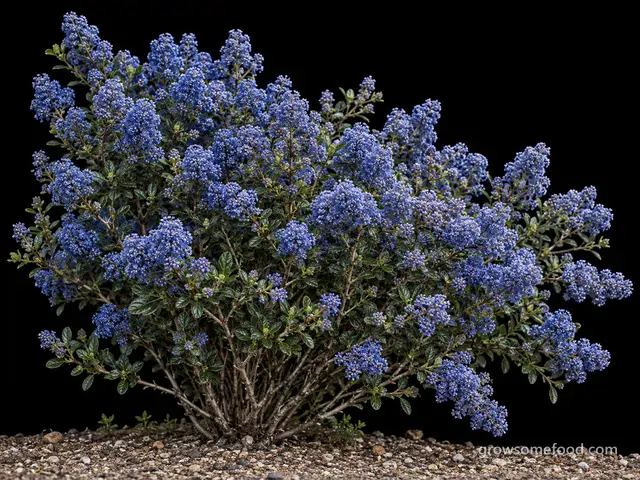
Ceanothus (California Lilac)
The blue of the California spring: a genus of evergreen native shrubs that smother themselves in blue flowers, hum with native bees, host five well-known butterflies, fix their own nitrogen - and die if you water them in summer.
Ceanothus is not a food plant. Its flowers and leaves are full of saponins and lather in water - the old name soap bush - which makes a fair field soap and a poor thing to eat. The root of the eastern New Jersey tea, sold as red root, is a traditional herbal material for qualified guidance, not a garden nibble. Two practical cautions: some buckbrush species carry spine-tipped twigs, so prune in gloves, and chaparral burns hot - keep it clear of the walls of a house in fire country.
Overview
The one thing to knowThis is a genus-level guide: the species and named selections differ so much in size, hardiness and tolerance that the varieties below matter more here than for almost any other plant in the catalog.
Ceanothus (Ceanothus spp.) is the blue of the western spring. Around sixty species grow in North America and the great majority are Californian - chaparral and coastal shrubs that spend a few weeks in early spring smothered in tiny flowers in every blue from powder to deep cobalt, with white and pink kinds too. They run from ankle-high groundcovers that pour over a bank to twenty-foot small trees, most of them evergreen and glossy the rest of the year. This is a genus-level guide: the species and named selections differ so much in size, hardiness and tolerance that the varieties below matter more here than for almost any other plant in the catalog.
For wildlife it is close to unmatched in the West. A ceanothus in bloom is audible - it is one of the best native bee plants there is - and its leaves are larval food for the California tortoiseshell, pale swallowtail, hedgerow hairstreak, spring azure and the big ceanothus silk moth. Quail and other birds take the seed, and the dense evergreen cover shelters nesting birds. It also fixes its own nitrogen, so it thrives on the poor ground where little else will.
The catch is the whole story of this plant: summer water kills it. Ceanothus evolved for a dry summer, and warm wet soil invites the root-rot fungi that finish it off. Plant it where the sprinklers do not reach, resist the hose, and it will look after itself.
Quick facts
- Sprouts in
- 45 days21 to 90
- Soil to sprout
- 65 °F55 to 75
- Life cycle
- Perennial, lives about 15 years
- Height
- 72 in12 to 240
- Spread
- 8 ft3 to 20
- Cold
- Takes light frostdamaged below 10°F
- Heat
- Struggles above 110°F
- Self-sows
- Yes, expect volunteers
Full sun or part sun · low water · well-drained soil · 6 ft apart (3 to 12) · transplant or cuttings
When to plant
Nothing is open today. Fall transplanting opens 3 weeks, Oct 15 to Dec 15.
- Transplant Oct 15 – Dec 15 Opens in 24 daysThe right time in a Mediterranean climate. Plant with or just before the first autumn rains so roots grow all winter and the shrub can face its first dry summer already established.
- Transplant Jan 1 – Feb 28 Opens in 102 daysMidwinter planting still works in mild-winter areas, with a little less root growth ahead of summer. Water new plants through the first dry season, then stop.
- Transplant Apr 10 – May 22 Opens in 201 daysAbout at to 6 weeks after your last frost (Apr 10 here)For the deciduous New Jersey tea (C. americanus) in cold-winter regions, plant in spring after frost. It is far hardier than the evergreen Californian kinds and takes ordinary garden conditions.
Frost here: last around Apr 10 (Mar 27 to Apr 24 most years), first around Oct 25. Zone averages, your own yard may run a week or two either way.
Life stages
One stage to settle in, then three that repeat each year. Windows are typical; your zone and weather move them.
Years 1-2 - rooting in
The first year after planting- WaterWater the first summer or two, then stop for goodevery 2 weeksA new ceanothus needs occasional deep soakings through its first dry summer, and sometimes a second, while the roots go down. After that, turn the water off permanently. More ceanothus are killed by kindness than by neglect - summer irrigation on an established plant is the single most common cause of death.
- ProtectPlant small, plant in fall, plant where the hose cannot reachSet out a small plant (a one-gallon usually overtakes a five-gallon within three years) in autumn, so winter rains settle it in. Choose a spot outside any irrigated lawn or bed, on a slope or raised mound if the soil is heavy, and set the crown slightly high - never deeper than it grew in the pot.
- MulchMulch with gravel or coarse chips, not compostA few inches of gravel or coarse bark keeps the roots cool without holding water against the crown. Pull it back a hand's width from the stem. Skip compost and manure: ceanothus fixes its own nitrogen and rich soil makes soft growth and a short life.
Watch for- Any sprinkler or drip line reaching the root zone
- Sudden wilting on a plant whose soil is damp - root rot, not thirst
- Deer browsing a young plant to a stub
Spring bloom - the blue weeks
Feb to May, every year- InspectListen to it - this is the pollinator peakFor two to four weeks the shrub disappears under tiny flowers and audibly hums with native bees. It is also a larval host for the California tortoiseshell, pale swallowtail, hedgerow hairstreak, spring azure, and the ceanothus silk moth, so expect chewed leaves and leave them alone. Never spray a host plant.
- PruneTip-prune right after bloom - and never into bare woodThe only safe pruning window is the few weeks after flowering. Pinch or shorten soft green shoot tips to shape the plant; that is all. Ceanothus does not resprout from old bare wood, so a hard cut into leafless stems leaves a permanent hole. Shape it a little every year rather than rescuing it later.
Watch for- Bees, butterflies and hummingbirds working the flowers
- Chewed leaves from butterfly larvae (leave them)
- The temptation to shear it hard - do not
Summer - hands off the hose
Jun to Sep, every year- InspectLeave it dry and leave it aloneSummer is the chaparral rest period. An established ceanothus wants no water, no feeding, and no pruning now - warm soil plus moisture is exactly what wakes up root-rot fungi. Some leaf drop and a duller look in September are normal, not a sign it needs help.
- ProtectKeep the base clear in fire countryCeanothus is resinous chaparral and burns hot. In a wildfire-prone area, keep it out of the first five feet around a building, clear dead wood and leaf litter from inside the shrub, and follow your local defensible-space guidance. Site it as a fine plant for the outer garden, not against the siding.
Watch for- Wilting despite damp soil (root rot)
- Hard knobby swellings on shoot tips (stem gall moth)
- Any irrigation overspray reaching the plant
Fall and winter - the growing season underground
Oct to Jan, every year- DoPlant now, while the rains do the workIn a Mediterranean climate this is the real planting season: roots grow all winter in cool, moist soil, so an autumn-planted shrub faces its first dry summer with a root system already in place. It is also when the flower buds are forming, so do nothing to disturb them.
- InspectCheck drainage before the wet monthsMake sure winter runoff does not pond around the crown. A shallow berm diverting water away, or a plant set on a slight mound, is worth more than anything you can spray. Standing winter water is the other half of the root-rot story.
Watch for- Water standing around the base after storms
- Fat flower buds swelling from midwinter (bloom is close)
Watch out for
3 to know. 1 is high-risk: Root Rot. 2 are active in September.
Root RotSeverity High DiseasenowThis is what kills ceanothus, and the trigger is almost always summer irrigation, not rain.
Warm soil plus water wakes up Phytophthora, so an established plant in a lawn, a drip-watered bed, or downhill of either is on borrowed time. Water only through the first dry summer, then stop for good; in a heat wave on an old plant, water deeply at dawn and rarely. Plant on a mound in clay, keep the crown proud and mulch off it, and choose Ray Hartman or Yankee Point where drainage is poor.
Wilting in the middle of the day on a plant whose soil is damp - the classic tell, and the reason people water a rotting plant and finish it off. Leaves yellowing from the bottom up, dull off-color foliage, and growth that stalls for no visible reason. Whole shoots, or one side of the plant, collapsing while the rest still looks fine. Soft, dark, or mushy tissue at the base of the stem or at the crown, sometimes with a sour smell. Lift a failing plant and look at the roots: healthy ones are firm and pale, rotted ones are brown or black and slimy, and the outer layer slips off between your fingers leaving a thread of core behind. Seedlings that topple over at soil level are the same problem, called damping-off.
There is no cure for tissue that has already rotted, so act on the conditions rather than looking for a spray. Stop watering at once and fix the drainage - open up compacted soil, or move the plant to a raised, sharply drained position or a container. Lift a badly affected plant, cut away every soft dark root and rotted section with a clean blade back to firm pale tissue, and replant only the healthy parts into fresh free-draining soil or mix. Often the better move is to give up on the plant and save its offspring instead: cuttings, offsets, or divisions taken from firm healthy growth root readily and give you a clean start. Bin the rotted material rather than composting it, and correct the drainage before you replant, because the rot comes straight back in the same wet spot.
Drainage is the whole defense. Match the plant to the site first - something that wants sharp drainage will not survive heavy clay or a low, water-collecting spot however well you tend it. Where the ground is heavy, plant on a raised bed, berm, or slope, or grow in a container. Set plants at the depth they were already growing, since burying the crown or the root flare is a common cause of rot, and keep mulch pulled back a few inches from the stem base instead of piled against it. Water the soil rather than the calendar: check that the top inch or two is dry before watering again, cut back hard in cool weather and winter dormancy, and never leave a pot standing in a full saucer. Do not plant or dig in soggy ground, and go easy on rich amendments for plants that want it lean. Rotate annual crops, and start with clean healthy plants and fresh mix.
Root rot is not one organism but a group of soil fungi and water molds - Pythium, Phytophthora, Fusarium, Rhizoctonia and others - that sit harmlessly in most soils and only turn destructive when the ground stays saturated. Waterlogged soil drives the air out, the roots suffocate, and the weakened tissue is invaded and goes soft, brown, and stringy. Because the damage is underground you usually see it first as something that looks like drought: wilting, yellowing, stunting, a plant that does not respond to being watered. Overwatering, heavy compacted ground, a low spot that collects runoff, a pot with no drainage or a saucer left standing full, and cold wet soil in winter are the usual causes. Once roots have actually rotted there is no cure - this is a problem you prevent rather than treat.
Deer (browse resistance)Severity Medium WildlifenowCeanothus is preferred browse, not deer-resistant - buckbrush is one of the most important wild deer foods in the West.
Cage a young plant until it is well above browse height; the upright kinds eventually grow out of reach and often thicken up nicely for the early pruning, but groundcover forms stay within reach for life and take the worst of it. Do not feed or water a browsed plant to force regrowth the way you would elsewhere, since that is the one thing this shrub cannot take.
Growth cleanly missing overnight, with the plant browsed back to a level line about as high as a deer can comfortably reach. Ragged, torn stem ends rather than the clean angled cut a rabbit leaves - the single most reliable identifier. Buds and flowers gone while the foliage below is untouched, since deer often take the best part first. Hoof prints and droppings in soft ground near the damage. Repeat visits, with fresh damage each morning once a planting has been found. On young trees, shredded and stripped bark and broken low branches in autumn - that is antler rubbing rather than feeding.
There is no chemical fix, only exclusion and recovery. Get physical protection up immediately after the first damage, because deer return to a known meal, and reinforce or rotate whatever you were relying on before. Most plants regrow from browsing if the crown and roots are intact - feed and water a grazed plant and protect the regrowth while it comes back. What does not recover in the same season is anything whose buds or flowers have been taken, and a young tree whose bark has been rubbed right around the trunk is usually lost. Where deer pressure is genuinely heavy, the honest answer is to fence properly or to grow the plants deer leave alone, rather than to keep replacing losses.
Fencing is the only thing that reliably works. Eight feet is the standard for excluding deer, or two parallel four-foot fences a few feet apart, which they will not jump because they cannot judge the landing. Short of that, cage individual plants: a sturdy wire cage or trunk guard around every young tree, left on until the trunk is thick and the canopy is above browse height, prevents both browsing and antler rubbing and is the single highest-value thing you can do for a young tree. Repellent sprays do help at moderate pressure, but they wash off and deer habituate, so reapply after rain and rotate between different types through the season. Motion-activated sprinklers, scent deterrents, and noise devices work for a while and then stop. Siting matters too: plants close to the house, in daily traffic, and screened behind other planting get browsed less than the same plant out at the boundary.
Deer are the largest garden problem across much of the country, and where pressure is high they set the limit on what you can grow at all. They browse at night and around dawn and dusk, taking tender shoots, leaves, buds, flowers, and fruit within about five feet of the ground, and they come back night after night to anything they have found and liked. Because they have no upper incisors they tear rather than cut, leaving ragged stem ends - that is how you tell deer damage from a rabbit's clean angled cut. In fall, bucks rub their antlers on young trunks and can strip the bark right around a stem, which kills a young tree outright. Palatability varies enormously between plants and between seasons: a herd short of food in late winter eats things it ignores in June, and no plant is truly deer-proof.
Ceanothus Stem Gall MothSeverity Low PestCommon and alarming-looking on garden ceanothus, particularly the fast coastal kinds.
Treat it as a tidiness job, not an emergency, and take it as a hint to stop feeding and watering the plant.
Hard woody swellings on the current season's shoot tips, often several to a branch, with the growth beyond them stunted, twisted or dead. Small round exit holes in older galls. Worst on plants pushing lots of soft new growth - the over-fertilized, over-watered or hard-sheared ones.
Clip galled shoot tips off in late spring while the larvae are still inside and bin them rather than composting. That is the whole control, and it is cosmetic work rather than a rescue - there is no useful spray, and a vigorous shrub carries a fair number of galls without coming to harm.
Grow the plant lean, unfertilized and unirrigated so it makes less of the soft new growth the moth prefers, and avoid hard shearing, which forces exactly that flush. Some species and selections are noticeably less affected than others, so where galls are common locally, ask which ones perform.
A tiny native moth (Periploca ceanothiella) whose larvae bore into new shoot tips and cause the stem to swell into a hard, knobby, spindle-shaped gall an inch or two long. The shoot stops extending at the swelling and may die back beyond it, so a heavily attacked plant looks lumpy and stalls, but the shrub itself is very rarely in danger. It is a native insect on a native shrub and part of the chaparral community rather than an invader.
Good & bad neighbors
First rule: keep Irrigated lawns and watered flower beds apart. Not a plant pairing but a placement rule, and the most useful one here.
Plant nearby
-
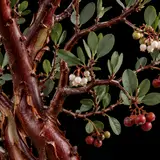
The other backbone evergreen of the chaparral garden and an almost perfect partner: identical no-summer-water needs, and manzanita's winter bloom hands the pollinator baton straight to ceanothus in early spring.
-
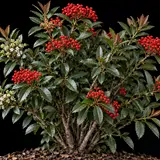
Completes the classic chaparral trio. Toyon flowers in early summer after ceanothus finishes and carries red berries through winter, so the three between them cover pollinators and birds nearly all year on the same dry regime.
-
The obvious underplanting: orange poppies through blue ceanothus in the same weeks of spring, on the same lean dry soil, and the poppies simply go dormant when summer shuts everything down.
-
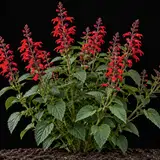
Dry-garden sages share the sun, lean soil and no-summer-water regime, and carry the nectar season on into summer after ceanothus has finished blooming.

Keep apart
-
Irrigated lawns and watered flower bedsNot a plant pairing but a placement rule, and the most useful one here. An established ceanothus inside a lawn, in a drip-irrigated bed, or downhill of either will almost certainly die of root rot within a few years. Keep it at the dry edge of the garden and outside every sprinkler pattern.
Varieties · 7
You pick one when you add Ceanothus (California Lilac) to your garden. Its days to maturity set your harvest window.
Groundcover ceanothus 2 varieties
Yankee Point (Ceanothus griseus var. horizontalis)
Dense low evergreen mat to 3 feet high and 12 feet wide with small glossy leaves and mid-blue flowers.
cultivartoughclay-toleranterosion-controlThe standard groundcover ceanothus and the toughest of the low kinds: a dense evergreen mat 2-3 feet high and 8-12 feet across, covered in medium-blue flowers in spring. Holds banks and slopes, tolerates clay and coastal wind, and puts up with more ordinary garden treatment than most ceanothus - though summer water still kills it.
Carmel Creeper (Ceanothus griseus var. horizontalis)
Low spreading evergreen with broad glossy leaves and short clusters of pale blue flowers.
speciesnativecoastalspreadingThe wild prostrate form of the Carmel coast, a spreading evergreen 1-3 feet tall with broad glossy leaves and pale blue flowers. Excellent bank cover in the coastal fog belt and the source of most low garden selections; less happy inland, where heat and dry air shorten its life.
Upright evergreen ceanothus 4 varieties
Ray Hartman
Tree-like shrub to 20 feet with large glossy leaves and long medium-blue flower spikes.
hybridlargeclay-tolerantinland-adaptableThe most forgiving of the big ceanothus and the best first choice for an inland or clay garden. A vigorous 12-20 foot shrub that can be limbed up into a small tree, with large mid-blue flower clusters over big glossy leaves. Tolerates heavier soil and a little more water than most, and grows fast enough to screen a fence within a few years.
Concha
Arching 6-8 foot mound of tiny dark leaves smothered in deep blue flowers from red buds.
hybridreliabledeep-bluemediumThe workhorse garden ceanothus and probably the most planted of all. A dense arching 6-8 foot mound of small dark leaves that vanishes under deep cobalt flowers opening from reddish buds. Reliable, adaptable across coastal and inland gardens, and long-lived by the standards of the genus.
Dark Star
Arching 6-foot shrub with tiny dark crinkled leaves and intense cobalt-violet flowers.
hybriddarkest-bluestrict-drainageshort-livedThe darkest blue in common cultivation, on a 5-6 foot arching shrub with tiny crinkled leaves. Spectacular in bloom and noticeably fragrant, but the least tolerant of garden conditions in this list - it demands sharp drainage and absolutely no summer water, and tends to be short-lived. Plant it where you can be strict with the hose.
Deciduous ceanothus (New Jersey tea group) 1 variety
New Jersey Tea (Ceanothus americanus)
Rounded deciduous shrub 2-4 feet tall with matte oval leaves and white flower puffs in early summer.
speciesnativecold-hardyprairieThe eastern member of the genus and the answer for cold or humid climates: a tidy deciduous 2-4 foot shrub with rounded puffs of white flowers in early summer, hardy to roughly zone 4 and untroubled by summer rain. A well-known host and nectar plant of eastern prairies and savannas, with an enormously deep root that makes it drought-proof but nearly impossible to move. The source of red root in the herbal trade and of the colonial tea substitute that named it.
Grower tips
Notes from growers, tagged with the zone they grow in. A person reads every post before it appears.
Nobody has posted about Ceanothus (California Lilac) yet. The first one usually saves someone a season.
Free account. Your post shows your grower name and zone, never your email.