Add it to your home screen and it opens full screen: no browser bars, one tap away, and everything stays signed in. Free, nothing to download from an app store.
- Tap the Share button in your browser
- Scroll down and choose “Add to Home Screen”
- Open GrowSomeFood from your home screen
- Open your browser’s menu
- Choose “Add to Home screen” or “Install app”
- Open GrowSomeFood from your home screen
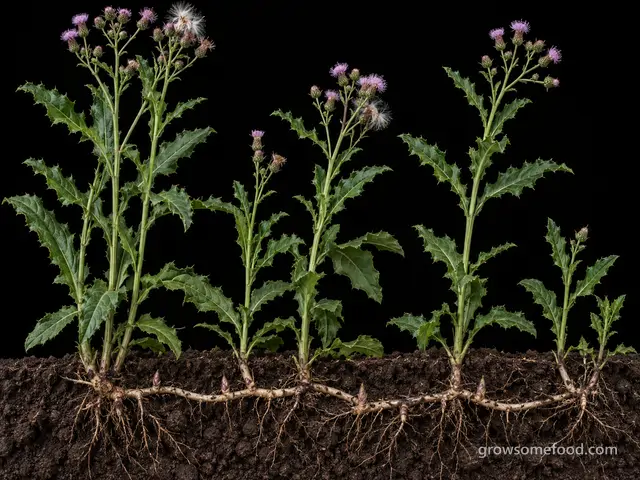
Canada Thistle
Not from Canada and not a native thistle - a Eurasian perennial that spreads underground as one connected colony, is listed noxious in the great majority of states, and is the reason native thistles keep getting sprayed by mistake. Control it by mowing at the bud stage and repeating for years.
Canada thistle is not poisonous, but it is not a food plant either. The spines are sharp enough to draw blood, so wear gloves and long sleeves to cut or pull it. The real toxicity risk is to livestock: thistle foliage can accumulate nitrate in heavily fertilized or drought-stressed stands, and nitrate does not break down in cured hay. If you use a herbicide, choose a product whose label lists your site - lawn, pasture - and follow that label, which is legally binding.
Overview
Canada thistle (Cirsium arvense) is not from Canada, and it is not one of the native thistles that belong in a meadow. It is a Eurasian perennial that took its American name from arriving through French Canadian settlements, and it is now listed as a noxious weed in the great majority of states - one of the most consistently regulated weeds in the country.
Its trick is underground. Canada thistle does not stand as individual plants; it runs a horizontal root system a few feet down that spreads 10 to 15 feet or more a year, sending up shoots along its whole length. A patch you think of as fifty thistles is usually a handful of connected plants, which is why pulling individual stems accomplishes nothing and why every pass with a tiller multiplies it from severed root pieces.
There is a second reason this page exists. Most people cannot tell Canada thistle from the native thistles, and native thistles are genuinely valuable - they are among the best nectar plants in a summer meadow and goldfinches line their nests with the down. The tell is simple and worth memorizing: Canada thistle has smooth, unwinged stems and clusters of small flower heads about half an inch across. Bull thistle, musk thistle, and the native pasture and field thistles have spiny-winged or woolly stems and solitary heads one and a half to three inches across. Check the stem before you reach for anything.
Beating it means depleting the root system: mow at the bud stage and re-cut every three to four weeks through the season, keep the ground densely covered, and expect two to four years of it.
Quick facts
For identification. Not a growing guide.
- Life cycle
- Perennial, lives about 20 years
- Where it grows
- Full sun · Part sun, well-drained soil
- Height
- 40 in18 to 60
- Spread
- 120 in12 to 360
- Cold
- Takes hard frostdamaged below -40°F
- Heat
- Struggles above 100°F
- Self-sows
- Yes. Never let it set seed.
Through the year
How to recognize it in each season.
Spring rosettes (mostly from root buds, not seed)
Mar to May, every year- Recognize it: crinkled spiny leaves in a low rosetteCanada thistle emerges as a flat rosette of crinkled, wavy-edged leaves with spiny margins, dark green above and paler beneath. What tells you it is Canada thistle rather than a seedling of anything else is the pattern: rosettes come up in a loose colony, many feet across, because they are all shoots from one connected root system. A single isolated rosette is far more likely to be a native or biennial thistle.
- Do not till, disc, or rototill the patchCanada thistle spreads from root fragments, and every pass of a tiller cuts the horizontal roots into pieces that each become a new shoot. Repeated tillage is one of the classic ways a small patch becomes a field. If you need to open the ground, do it once and then commit to relentless follow-up cutting, or leave the ground undisturbed and switch to mowing and competition instead.
Key signs- Colonies of spiny rosettes rather than isolated single plants
- Rosettes returning in exactly the same footprint each spring
- Bare or recently tilled ground, where it establishes fastest
Bolting stems (the mowing window)
May to Jun, every year- Check the stem - this is the ID that mattersCanada thistle stems are slender, grooved, and essentially SPINELESS, with no spiny wings running down them. Bull thistle, musk thistle, and most native thistles have stout stems with spiny wings or a dense woolly coat. If the stem is smooth enough to grip through a glove and the plant is part of a colony, you have Canada thistle. That one check saves people from spraying native thistles that are worth keeping.
- Mow at the bud stage, then every three to four weeksMowing works, but only on a schedule. Cut the stand as the flower buds form, before any flower opens, and then re-cut every three to four weeks through the whole season. That timing forces the roots to spend stored energy on regrowth again and again. Extension trials show two to four seasons of disciplined mowing will substantially deplete a stand; one mowing a year does nothing except tidy it.
Key signs- Smooth, unwinged stems bolting to 2-4 feet
- Flower buds forming - the moment to cut
- Regrowth three to four weeks after each cut
Flowers and windborne seed
Jun to Sep, every year- Many small heads, not a few big onesCanada thistle carries clusters of small flower heads only about half an inch across, pale lavender to pink or occasionally white. Bull, musk, and most native thistles carry solitary heads an inch and a half to three inches across. Canada thistle is also dioecious - separate male and female plants - so a colony may flower prolifically and set almost no seed if it is all one sex.
- Cut before the heads fluff, and do not compost themCut flowering stems before the heads open into white down. Heads cut after flowering can still ripen viable seed lying on the ground, so bag them rather than leaving them or composting them. Seed is wind-carried and stays viable in the soil for around 20 years, so preventing seed set is a long game with real payoff.
- If you spray, target the bud stage or fall regrowthSystemic herbicides reach the root system only when the plant is moving sugars downward, which is at the bud stage and again in early fall on regrowth after a late-summer mowing. A common and effective sequence is to mow in midsummer and then treat the fresh rosettes in fall. Use a product whose label lists your site, follow the label rate and any grazing or pre-harvest interval, and do not treat a food bed with a product not labelled for it.
Key signs- Clusters of small half-inch lavender heads
- White thistledown, which means seed is already moving
- The bud stage and fall regrowth - the two windows when systemic treatment works
Winter (the root network is intact)
Oct to Feb, every year- The tops die, the horizontal roots do notTop growth dies to grey stalks after hard frost, but the horizontal root system - running several feet deep and spreading 10 to 15 feet or more a year - is fully alive and packed with the sugars it pulled down in fall. Mark the colony boundary now, because next spring's shoots will come up outside it as well as inside it, and you want to see how far it moved.
- Plan next year's competition, not next year's diggingWinter is the time to plan the thing that actually holds ground against Canada thistle: dense, vigorous perennial cover. In pasture that means fertility and grazing management that favours the grass; in a garden it means a thick cover crop or a closely planted perennial bed. Thistle is a poor competitor for light, and bare ground is what invites it back.
Key signs- Grey dead stalks over a live root network
- Bare ground opening up, which is what the colony expands into
Hazards
Creeping Root System (why pulling fails)Severity High DisordernowThe single most common failure is mowing once a year.
One cut per season does not deplete anything and can stimulate the colony.
Shoots emerging as an expanding colony rather than as scattered individuals; regrowth three to four weeks after every removal; new shoots appearing outside last year's patch boundary.
Deplete the roots: cut or mow at the bud stage before any flower opens, then re-cut every three to four weeks for the whole season, repeated over two to four years. Smother small patches for at least two full seasons. Where herbicide is appropriate, apply a systemic product at the bud stage or on fall regrowth when sugars move downward, using a product whose label lists your site and following that label exactly.
Keep ground densely covered - thistle is a poor competitor for light, and bare or disturbed soil is what a colony expands into. Manage pasture fertility and grazing to keep grass dense and tall.
Canada thistle is one connected plant, not a stand of individuals. Horizontal roots run a few feet below the surface, spread 10 to 15 feet or more a season, and carry buds along their whole length that send up shoots. Removing top growth removes a shoot and leaves the plant, and the roots refill within three to four weeks.
Spread by Tillage and Root FragmentsSeverity High DisordernowA patch that gets denser and wider after cultivation; new colonies appearing where soil was moved or where equipment was used after working infested ground.
A patch that gets denser and wider after cultivation; new colonies appearing where soil was moved or where equipment was used after working infested ground.
Where ground must be opened, do it once and commit to relentless follow-up cutting. Clean tillage equipment before moving to clean ground, and watch any newly disturbed area for a full season.
Do not till, disc, or rototill infested ground. Keep soil, tools, and boots from a colony out of clean areas, and do not pass on perennial divisions lifted from an infested bed.
Root pieces roughly half an inch long regenerate into new plants, so every pass of a tiller, plow, or disc through a colony multiplies it and distributes the pieces evenly across the ground. Moving soil, sharing divisions from an infested bed, and unwashed cultivation equipment all move it between properties.
Noxious-Weed ListingSeverity Medium DisordernowCanada thistle in hay, crop seed, delivered topsoil, or nursery containers - the routes state rules are written to interrupt; and colonies on boundaries, where a neighbour complaint can start enforcement.
Canada thistle in hay, crop seed, delivered topsoil, or nursery containers - the routes state rules are written to interrupt; and colonies on boundaries, where a neighbour complaint can start enforcement.
Follow your state or county weed authority's control requirements and keep records of what you did and when. Your local extension office or weed district can advise on approved programs and any biological-control agents released in your area.
Buy certified weed-free seed, hay, and topsoil where available, and do not sell or give away plants, soil, or hay from an infested area.
Canada thistle is listed as a noxious weed in the great majority of US states, and has been the subject of American weed law since the 1790s. Listing can carry a legal duty to control it on land you own, and restrictions on selling or moving contaminated crop seed, hay, soil, or nursery stock. Check your own state and county list, since listing is what creates any obligation.
Native Thistles Destroyed by MistakeSeverity Medium DisordernowBefore treating any thistle, check the stem and the heads.
Before treating any thistle, check the stem and the heads. Canada thistle: smooth unwinged stems, clusters of heads about half an inch across, growing as a spreading colony. Native and biennial thistles: stout spiny-winged or woolly stems, solitary heads 1.5-3 inches across, growing as scattered individual plants.
If you have already identified native thistles on your ground, leave them - they are not a management problem, and they are among the most valuable pollinator plants a property can have.
Learn the stem-and-head check before any control work, and treat colonies rather than blanket-spraying every thistle in a field or meadow.
Canada thistle's reputation gets North America's native thistles killed. Native thistles are keystone nectar plants for bumblebees, swallowtails, and monarchs, and goldfinches eat their seed and line nests with the down - but most people cannot tell them apart and destroy every thistle on sight.
Nitrate Accumulation in ForageSeverity Medium DisordernowThistle making up a substantial share of a hay cut, especially off heavily fertilized ground or after a drought broken by rain.
Thistle making up a substantial share of a hay cut, especially off heavily fertilized ground or after a drought broken by rain.
Have suspect hay tested for nitrate before feeding it, and follow your veterinarian's or extension forage specialist's guidance on dilution or rejection.
Keep thistle out of hay ground, and avoid cutting weedy stands for forage after drought stress or heavy nitrogen application.
Thistle foliage can accumulate nitrate, particularly in heavily fertilized ground or after drought stress. Unlike some plant toxins, nitrate does NOT break down when the plant is cut and cured, so a thistle-heavy hay crop carries the risk forward into winter feeding. This is a livestock issue, not a hazard to people handling the plant.
Grower tips
Notes from growers, tagged with the zone they grow in. A person reads every post before it appears.
Nobody has posted about Canada Thistle yet.
Free account. Your post shows your grower name and zone, never your email.