
Add it to your home screen and it opens full screen: no browser bars, one tap away, and everything stays signed in. Free, nothing to download from an app store.
- Tap the Share button in your browser
- Scroll down and choose “Add to Home Screen”
- Open GrowSomeFood from your home screen
- Open your browser’s menu
- Choose “Add to Home screen” or “Install app”
- Open GrowSomeFood from your home screen

Camas
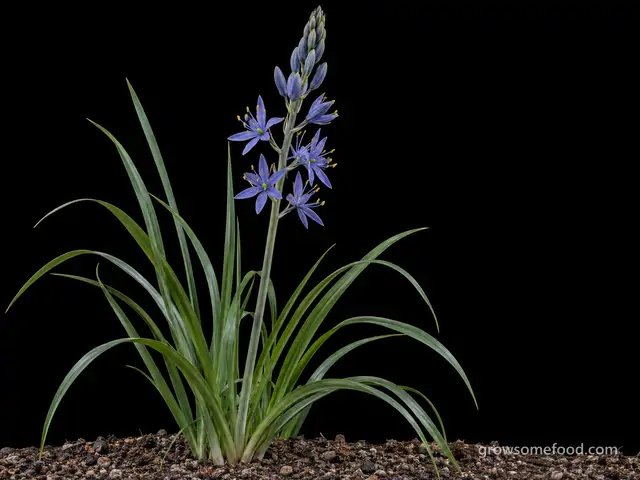
A spectacular native spring bulb whose blue-star spikes once turned Northwest meadows blue - a historically vital First Food, but one with a deadly identical-looking twin, so grow it for beauty and never forage the bulbs.
Safety notes GROW IT, DO NOT FORAGE IT. Camas bulbs were a vital First Food, but they are visually IDENTICAL to death-camas bulbs (Toxicoscordion), a LETHAL plant of the same wet meadows - people have died confusing them. Wild plants separate only in bloom: camas blue, death-camas cream-white. That colour test is for wild meadows; garden great-camas also comes in white. Never dig or eat a wild camas bulb - grow it as an ornamental only.
Overview
Camas (Camassia quamash) is one of the great wildflowers of the American West - a native spring bulb that sends up showy spikes of star-shaped blue to blue-violet flowers over grassy foliage, once so abundant in the wet meadows of the Pacific Northwest that whole 'camas prairies' shimmered blue in bloom and were mistaken for lakes. In the garden it is an easy, beautiful, cold-hardy bulb for moist meadows, borders, and rain gardens, and a superb early nectar plant for bees.
Quick facts
- Height
- 24 inRange: 12–36 in
- Spread
- 5 inRange: 3–8 in
- Cold
- Takes hard frostdamaged below -30°F
- Heat
- Struggles above 90°F
- Life cycle
- Perennial, lives about 15 years
- Self-sows
- Yes, expect volunteers
- Soil
- Consistently moist
- Water
- Medium
- Plant spacing
- 6 inRange: 4–10 in
When to plant
Nothing is open today. Fall planting opens 10 months, Aug 30 to Oct 18.
- Plant tubers Aug 30 – Oct 18 Opens in 314 daysAbout 8 weeks before to 7 days before your first frost (Oct 25 here)Plant bulbs in fall, 4-6 inches deep, in soil that stays moist through spring. Camas is a fall-planted spring bulb; give it a spot that is wet in spring and can dry somewhat in summer, like a meadow, moist border, or rain garden edge.
Frost here: last around Apr 10 (Mar 27 to Apr 24 most years), first around Oct 25. Zone averages, your own yard may run a week or two either way.
Life stages
Establish, grow, repeat
Getting established and returning each season are different parts of the story.
Stage 1 of 5 · Getting established
Fall rooting-in
Day 0 to 45 from planting
Care at this stage
-
Plant bulbs in fall and water in
Plant camas bulbs in fall, pointy-end-up, about 4-6 inches deep and 4-6 inches apart, in soil that stays moist in spring. Water once to trigger rooting. Camas is a bulb of seasonally wet meadows - it wants spring moisture and can tolerate drier summer dormancy.
-
Mulch lightly after planting
A light mulch conserves moisture and buffers freeze-thaw. Camas naturalizes well in meadows, moist borders, and rain gardens where the ground is wet in spring and drier in summer.
Months are typical seasonal windows; climate, variety, and plant age can shift them.
Watch out for
3 to know. None are high-risk for Camas. 1 is active in October.
Gophers & RodentsSeverity Medium WildlifenowSeason: year-roundBulbs disappearing, plants failing to emerge, gopher mounds or vole runs through the bed, and dug or gnawed bulbs.
Bulbs disappearing, plants failing to emerge, gopher mounds or vole runs through the bed, and dug or gnawed bulbs.
Protect the planting with buried wire mesh; replace lost bulbs. In heavy-rodent sites, caged planting is the reliable defense.
Plant bulbs in wire baskets or a gravel-lined hole where gophers and voles are active; interplanting with toxic daffodils nearby can help deter rodents.
Pocket gophers, voles, and other rodents eat camas bulbs underground and can thin or destroy a planting - unlike toxic ornamental bulbs such as daffodils, camas bulbs are palatable to wildlife.
Bulb Rot (Summer Waterlogging)Severity Medium DiseaseSeason: Jun–SepA planting that fails to reappear at all in its season - the commonest symptom and the last one noticed.
A planting that fails to reappear at all in its season - the commonest symptom and the last one noticed. Shoots that emerge thin, yellow and stunted, or start up and then collapse. Clumps thinning year on year in the low, wet corner of a bed while the same bulbs thrive on higher ground. Lift a suspect bulb and look: a healthy one is firm and heavy with clean pale scales, a rotting one is soft, brown or blackened, often slimy between the scales, and smells sour. Roots gone brown and stringy rather than firm and pale. Standing water, or a dark permanently damp patch of soil, over the planting after rain.
Nothing brings rotted tissue back, so the work is triage and drainage. Lift the planting, sort the bulbs, and bin every one that is soft, discoloured or foul-smelling rather than composting it. Keep only bulbs that are firm all through, trim any small damaged patch back to clean tissue, let the cut surfaces dry in the air for a day, and replant into free-draining ground or fresh mix somewhere the water moves away. If the same spot rots bulbs every year, do not replant it - raise the bed, open up the soil, or move the planting and grow something else there.
Drainage does nearly all the work. Plant bulbs in ground that drains freely and never stands in water, and where the soil is heavy plant on a raised bed, a berm or a slope, or grow them in containers - a pot needs an open hole and must never be left standing in a full saucer. Set bulbs at the depth the plant actually wants rather than deeper, and keep mulch pulled back from the neck. Water the soil rather than the calendar, and cut watering right back through dormancy when the bulb is not drawing. Never plant a bulb that is already soft, bruised or mouldy, and do not dig or plant in soggy ground.
Bulb rot is not one organism but a group of soil fungi and water molds - Fusarium, Rhizoctonia, Pythium, Phytophthora and others - that live harmlessly in most soils and turn destructive only when the ground stays saturated. A bulb is a swollen food store with no way to shed water, so once the soil around it is airless the scales suffocate, soften and are invaded, and the whole bulb goes brown, mushy and sour-smelling. Dormancy is the dangerous season: a resting bulb draws almost nothing, so it can sit in cold or hot wet ground for weeks with nothing drying it out. The damage is underground and invisible, so the first sign is usually a clump that simply never comes up.
Slugs & SnailsSeverity Low PestSeason: Mar–MayIrregular ragged holes chewed out of the middle of leaves and along the edges - not the clean-edged cuts a caterpillar leaves.
In the cool, damp conditions camas enjoys they may rasp the emerging leaves and flower spikes, but it is usually cosmetic and outgrown without any help.
Irregular ragged holes chewed out of the middle of leaves and along the edges - not the clean-edged cuts a caterpillar leaves. Seedlings that vanish overnight, or that are cut off at soil level with nothing left behind. Silvery dried slime trails across leaves, soil, pots, and paving in the morning: this is the giveaway that tells you it was mollusks rather than an insect. Chewed pits in ripe fruit, especially where it rests on the ground. Damage that shows up on the lowest, dampest leaves first and gets worse after rain or evening watering. Turn over a board, an upturned pot, or a clump of dense mulch during the day and look for the animals themselves sheltering in the cool underneath.
Hand-picking works and costs nothing: go out an hour after dark with a headlamp, drop what you find into soapy water, and repeat nightly for a week or two - persistence is what wins, not any single product. Shallow beer traps sunk to soil level catch them too, but need emptying and refilling daily to be worth anything. Iron-phosphate bait is the standard control and is far lower-risk around pets and wildlife than the old metaldehyde products, but it is not harmless: many formulations include EDTA, and a dog that eats a quantity of pellets can develop iron toxicosis. Scatter it thinly per the label, never in piles, and keep dogs off a baited bed. Clear fallen foliage and debris in autumn, where the eggs are laid. In a wet climate this is a population you manage each season rather than one you eradicate - and on most established plants light grazing is cosmetic and needs nothing at all.
Take away the daytime shelter first: lift boards and upturned pots, clear piles of debris, keep dense mulch pulled back from crowns and stems, and give crowded plantings enough airflow to dry out. Water in the morning rather than the evening so the surface is dry by the time they come out. Copper tape around containers and raised beds gives them a shock they will not cross, and it is the one barrier that reliably works. Get plants past the vulnerable stage quickly - start seedlings in pots and set them out at a decent size rather than direct-sowing into a cold wet bed, since most plants stop being worth defending once the leaves toughen. Leave the ground beetles, frogs, toads, and ground-feeding birds alone, because they eat mollusks all night for free and broad-spectrum slug pellets kill them too. Where thick-leaved or resistant varieties exist for what you are growing, they take far less damage.
Slugs and snails are nocturnal mollusks that rasp ragged holes in soft leaves, shear off seedlings at ground level, and chew into ripe fruit that touches the soil. They feed at night and in the early morning and spend the day hidden under boards, pots, dense mulch, leaf litter, and low foliage, becoming active in exactly the cool, damp, shaded conditions that suit young plants. Damage is heaviest in wet spells and on tender spring growth: a single wet week can erase a row of seedlings while an established, tough-leaved plant of the same species is barely marked. They lay clusters of small pearly eggs in damp soil and under debris, so a garden with plenty of cover carries a resident population year after year rather than being invaded from outside.
Good & bad neighbors
First rule: keep Death-camas (Toxicoscordion) apart. Not a garden conflict but a lethal safety warning: death-camas grows mixed among wild camas and has identical bulbs.
Plant nearby
-
Camassia and native meadow grassesCamas naturalizes classically among native meadow grasses and forbs in seasonally wet ground; the grasses support the bulbs and mask the dying foliage, recreating its wild camas-prairie community.
- Traditional pairings, thin evidence
-
In a moist part-shaded native planting, sword fern's evergreen fronds fill in around and after camas, hiding the bulb's dying spring foliage while camas provides the spring flower show.
-
A tough native meadow perennial that blooms after camas and shares open, sunny meadow conditions, extending the flowering and pollinator season in a wildflower planting.
Keep apart
-
Death-camas (Toxicoscordion)Not a garden conflict but a lethal safety warning: death-camas grows mixed among wild camas and has identical bulbs. Never let the two be confused, and never dig wild camas bulbs to eat - the plants can only be told apart in flower (camas blue, death-camas cream-white).
Varieties · 3
You pick one when you add Camas to your garden. Its days to maturity set your harvest window.
Common Camas (Camassia quamash)
The classic blue camas of Northwest wet meadows - grassy foliage and spikes of star-shaped blue to blue-violet flowers in late spring, on plants typically 1-2 feet tall.
Variety details for Common Camas (Camassia quamash)
Grass-like basal leaves and spikes of six-tepaled blue-violet star flowers 12-24 inches tall.
speciesnativespring-bulbblue-flowerThe most historically important food-plant species (though not to be foraged), and a superb native ornamental and pollinator bulb.
Great Camas (Camassia leichtlinii)
A closely related, taller native camas (to 3-4 feet) with larger, showier flower spikes in blue-violet, white, or cream, blooming a little later.
Variety details for Great Camas (Camassia leichtlinii)
Tall, robust flower spikes to 3-4 feet with large blue-violet (or white/cream) star flowers.
speciesnativespring-bulbtallerWidely grown as an ornamental and often the easiest camas for gardens; the same forage warning applies to all camas bulbs. Two things to know: this is a different species from the C. quamash this page otherwise describes - it is native only to Washington, Oregon, and California, and it stands taller than the 1-2 feet listed here. And its white and cream forms break the blue-versus-cream colour rule. That rule exists for telling wild camas from death-camas in a meadow; it never applies to a cream-flowered garden Camassia you planted yourself.
Camassia leichtlinii 'Caerulea'
A selected great-camas form with rich, deep blue-violet flowers on tall spikes - one of the most popular ornamental camas selections for its intense color.
Variety details for Camassia leichtlinii 'Caerulea'
Tall spikes densely set with deep blue-violet star flowers.
cultivardeep-blueshowyornamentalGrown purely for garden display and pollinators. Like great camas itself this is C. leichtlinii, a different species from C. quamash, so this page's height and native-range figures run short for it.
Grower tips
Notes from growers, tagged with the zone they grow in. A person reads every post before it appears.
Nobody has posted about Camas yet. The first one usually saves someone a season.
Free account. Your post shows your grower name and zone, never your email.