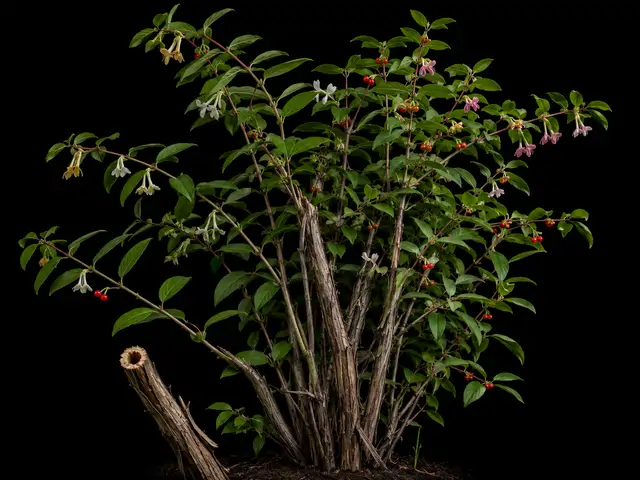
Bush Honeysuckle

Bush Honeysuckle

Lonicera maackii, L. morrowii, L. tatarica and L. x bella · Caprifoliaceae
Other Perennial Shrub Other
Introduced - native to eastern Asia (Amur, Morrow's) and to Eurasia (Tatarian); invasive across the Midwest, Northeast, mid-Atlantic and upper South
Not recommended to plant. Do NOT plant this. Invasive shrub honeysuckles leaf out first in spring and hold their leaves last in fall, shading the woodland floor bare, and birds spread their red berries everywhere. Sale is banned in MA, CT, NH, OH and IL and restricted in WI. Identification and control only.

The red paired berries are not food - they are mildly toxic (saponins) and cause vomiting and diarrhea. This shrub matters most to foragers as the red-berried look-alike for autumn olive: autumn olive has ALTERNATE leaves with silvery-scaly undersides and silver-flecked berries, while bush honeysuckle has OPPOSITE leaves, no silver scales, and hollow pith in older stems. Check leaf arrangement before you eat any red berry, and keep the berries away from children and pets.

Overview

The arching red-berried shrub that fills the understory of half the woodlots in the Midwest and Northeast - first to leaf out, last to drop, and the reason nothing grows beneath it. It is also the toxic look-alike foragers mistake for autumn olive. Never plant it.

Bush honeysuckle is the catch-all name for a group of Asian and Eurasian shrubs — Amur (Lonicera maackii), Morrow's (L. morrowii), Tatarian (L. tatarica) and their hybrid Bell's honeysuckle (L. x bella) — that between them have taken over the understory of a huge share of eastern and midwestern woodlots. They are arching, multi-stemmed shrubs, six to twenty feet tall, with paired tubular flowers in late spring and paired red berries in fall.

Their advantage is timing. They leaf out weeks before native trees and shrubs and hold their leaves weeks after, which steals the spring and fall light that woodland wildflowers and tree seedlings depend on. Under an established stand the ground is bare. Birds strip the berries and plant new shrubs for miles, so it arrives without anyone planting it — though plenty of people did plant it, because agencies handed it out for decades. This entry is here to help you recognize it, tell it from the native shrubs and from autumn olive, and get it out — and to be blunt about the berries, which are mildly toxic and are the single most common red-berry mistake foragers make.

At a glance

Sun
Full sun · Part sun · Part shade · Shade
Water
Medium
Spacing
36–240 in (typ. 96)
Mature height
72–240 in (typ. 180)
Start by
Direct sow · Cuttings
Frost
Hardy
Spread
60–216 in (typ. 144)
Soil
Well-drained
Temperature
Damaged below -35°F · struggles above 100°F
Self-sows
Yes — expect volunteers

When to plant

No planting window on record for this zone.

Life stages

  1. First to leaf out, last to drop (the ID window) Mar, Apr, May, Jun, Jul, Aug, Sep, Oct, Nov (yearly)
    • Recognize it: opposite oval leaves and HOLLOW pith
      A multi-stemmed arching shrub 6-20 ft tall with simple, OPPOSITE, oval leaves that come to a point. The confirming test is to snap or cut a stem thicker than a pencil: invasive bush honeysuckles have a HOLLOW brown pith, while the native shrubs they are confused with have solid white pith. Bark on old stems is grey-brown and shreds in vertical strips. Amur honeysuckle is the tallest and most tree-like; Morrow's is grey-hairy; Tatarian is smooth.
    • Use the green window - it leafs out first and drops last
      The single easiest way to map an infestation is to walk the woods in late March or early April, when the honeysuckle is bright green and everything native is still bare, or again in November, when it is the last green thing standing. That extended leaf season is not a curiosity - it is the mechanism, because it shades the spring wildflowers out during exactly the weeks they need light.
    • Pull seedlings and small shrubs from moist soil
      Seedlings and shrubs up to about an inch at the base pull whole from moist spring soil; a weed wrench or lever tool handles the next size up. Get the root crown, because a snapped stem resprouts. This is genuinely effective work for small infestations and needs no chemicals - but replant or mulch the bare ground you leave, or the seed bank simply refills it.
    Opposite oval leaves on arching multi-stemmed shrubsHollow brown pith in cut stems (the confirming test)Green shrubs in a bare woodland in early spring or late fallBare, unvegetated ground beneath established thickets
  2. Paired tubular flowers May, Jun (yearly)
    • Flowers in pairs from the leaf axils
      In late spring the shrub carries tubular two-lipped flowers in PAIRS from the leaf axils. Amur and Morrow's honeysuckle open white and fade to yellow, so both colors appear at once; Tatarian and Bell's honeysuckle open pink to rose. They are lightly fragrant and bees visit them, which is why people planted the shrub - but every flower pair becomes a berry pair, and every berry is a bird flight away from the next woodlot.
    • Flowering is the deadline for cutting
      If you are going to cut a shrub without treating the stump, do it now rather than after the berries form, so you at least keep this year's seed out of the birds. Cutting alone will not kill it - expect a ring of resprouts - but it stops the seed crop while you plan proper control.
    Paired tubular flowers from the leaf axilsWhite-aging-to-yellow flowers (Amur, Morrow's) or pink (Tatarian, Bell's)Which shrubs are large enough to be seed sources
  3. Paired red berries & bird spread Aug, Sep, Oct, Nov, Dec (yearly)
    • Red berries in pairs, and the autumn-olive confusion
      Berries ripen translucent red (occasionally orange or yellow) in PAIRS at the leaf axils and hang on into winter. This is where foragers get hurt: a red-berried shrub in an old field is often autumn olive, which is edible, and just as often bush honeysuckle, which is not. Autumn olive has ALTERNATE leaves, silvery-scaly leaf undersides, and berries flecked with silver. Bush honeysuckle has OPPOSITE leaves, no silver, and hollow pith. Check leaf arrangement first, every time.
    • Take out the fruiting shrubs first
      Birds move the seed for miles, so the biggest shrubs with the heaviest berry crops are the ones to remove first - clearing seedlings while a fruiting parent stands is wasted work. Bag berry-laden clippings into the trash rather than composting them, and keep the berries away from children and pets; they cause vomiting and diarrhea if eaten.
    Translucent red berries in pairs at the leaf axilsFlocks stripping berries in late fall and winterSeedling carpets under bird perches, fence lines and canopy gaps
  4. Winter structure & the late-season control window Jan, Feb, Mar, Nov, Dec (yearly)
    • Cut-stump treatment in the dormant season
      Late fall through winter is prime removal time: the shrubs are visible and often still leafy while natives are dormant, the ground is firm, and cut-stump treatment works while the plant is moving reserves to the roots. Cut low and treat the fresh surface within minutes. Use a product whose label lists the site you are treating and follow that label - it is legally binding. Near water, the product must be labelled for aquatic sites, and many states require a permit or a licensed applicator.
    • Plan the replanting before you clear
      A cleared honeysuckle thicket leaves bare, shaded, seed-loaded ground that reinvades within two seasons if nothing else claims it. Decide in winter what goes back - native spicebush, arrowwood or blackhaw viburnum, serviceberry, elderberry, chokeberry, or a woodland seed mix - so you can plant into the gap the same season you make it.
    Shreddy grey-brown bark on arching old stemsPersistent red berries on bare twigsResprout rings around stumps cut in a previous yearBare ground where a thicket was removed

Watch out for

Understory Shading (ecological harm) High DisorderMar, Apr, May, Jun, Jul, Aug, Sep, Oct, Nov

The core hazard is ecological, and it works through timing: these shrubs break bud two to four weeks before the native canopy and hold their leaves weeks after it drops, capturing the shoulder-season light that spring wildflowers and tree seedlings depend on. Under an established stand the forest floor goes bare, native regeneration stops, and the woodlot ages out with nothing coming up beneath it.

Watch for: Shrubs green in the woods when everything else is bare in early spring or late fall; bare, unvegetated ground under a dense shrub layer; an absence of tree seedlings and spring ephemerals under an otherwise healthy canopy.

Prevent: Never plant it. Map infestations during the early-spring or late-fall green window and remove shrubs while the stand is young and the understory still has plants worth saving.

Treat: Pull small shrubs by the root crown; cut-stump-treat larger ones in the dormant season with a product whose label lists the site, following that label. Replant and mulch cleared ground the same season, or the seed bank refills it.

Bird-Spread Berries & Resprouting High DisorderJan, Aug, Sep, Oct, Nov, Dec

Why it turns up where nobody planted it, and why cutting rebuilds it: a mature shrub carries many thousands of berries that birds move for miles, the seed germinates readily in deep shade as well as in the open, and cut or mowed stems resprout from the root crown as a ring of vigorous shoots. Seedling density under a fruiting shrub or a favored perch can run into the hundreds per square yard.

Watch for: Seedling carpets under bird perches, fence lines and canopy gaps; new shrubs deep inside closed-canopy woodlots; a ring of stems around a stump cut in a previous season.

Prevent: Remove the largest fruiting shrubs first to cut off the seed supply before working down through the smaller sizes; bag berry-laden clippings into the trash rather than composting them.

Treat: Kill the root crown rather than cutting alone - pull it, or cut low and treat the fresh stump within minutes. Re-walk the site each spring for several years to pull the seedling flush.

Deer Use & Tick Habitat Medium PestApr, May, Jun, Jul, Aug, Sep, Oct

A human-health dimension that is easy to miss: dense honeysuckle thickets provide shaded, humid cover that deer use heavily, and field studies in the Midwest and mid-Atlantic have found substantially higher densities of blacklegged ticks - and higher infection prevalence in them - in honeysuckle-invaded plots than in cleared or uninvaded ones. Removing the shrubs has been associated with reduced tick numbers on the same ground.

Watch for: Heavy deer bedding and trails inside honeysuckle thickets; ticks picked up while working in or walking through dense stands, particularly from late spring through summer.

Prevent: Treat clothing and use repellent when working in stands, tuck trousers into socks, and check thoroughly afterwards. Removing the thicket is itself a long-term reduction measure.

Treat: Clear the thickets and keep the ground planted rather than bare, so it does not revert to shrub cover. Follow standard tick-removal and monitoring practice after any work in a stand.

Toxic Berries & the Autumn-Olive Mix-Up Medium DisorderAug, Sep, Oct, Nov, Dec

A direct hazard with a specific route: the paired red berries contain saponins and cause vomiting and diarrhea if eaten, and this is the shrub most often confused with autumn olive by foragers, since both are scrubby red-fruited shrubs of old fields and edges. The discriminator is leaf arrangement - autumn olive has ALTERNATE leaves with silvery-scaly undersides and silver-flecked berries, while bush honeysuckle has OPPOSITE leaves, no silver anywhere, and hollow pith.

Watch for: Children or pets near red-berried shrubs in fall and early winter; anyone picking red berries in an old field without first checking leaf arrangement.

Prevent: Teach the opposite-versus-alternate check before any red-berry foraging, and remove fruiting shrubs from areas children and pets use.

Treat: If a child eats the berries, contact Poison Control; if a pet does, contact a veterinarian. Remove the fruiting shrubs rather than relying on supervision.

Varieties · 3

Amur Honeysuckle (Lonicera maackii)

Tall arching multi-stemmed shrub with opposite long-pointed leaves, shreddy grey bark, hollow brown pith, paired white-to-yellow flowers, and paired deep red berries persisting into winter.

speciesinvasivedo-not-plantinvasive-shrubbird-spreadtoxic-berrieshollow-pith

The largest and most aggressive of the group, reaching 15-20 ft and becoming almost tree-like, with long-pointed leaves and white flowers aging to yellow. It dominates the understory of woodlots across the Midwest and Ohio Valley, leafing out weeks before the canopy and holding leaves into December. Berries are deep red and heavily bird-dispersed. Identify and control, never plant.

Look-alikes and native alternatives

Native Diervilla: low suckering shrub with yellow tubular flowers and dry seed capsules. Autumn olive: alternate leaves silvery beneath, berries flecked with silver scales.

lookalikealternativenativenon-invasiverecommended-instead

Two look-alikes matter. The native shrubs also called bush honeysuckle (Diervilla lonicera and relatives) are low, suckering, yellow-flowered, produce dry capsules rather than red berries, and have solid pith - leave them alone. Autumn olive shares the red-fruited old-field habit and is edible, but has ALTERNATE leaves with silvery-scaly undersides and silver-flecked berries; opposite leaves and hollow pith mean honeysuckle, and mean do not eat. For a shrub to actually plant, choose spicebush, arrowwood or blackhaw viburnum, serviceberry, elderberry, or chokeberry.

Morrow's, Tatarian & Bell's Honeysuckle (L. morrowii, L. tatarica, L. x bella)

Arching shrubs 6-12 ft with opposite oval leaves and hollow pith; paired flowers white-to-yellow (Morrow's) or pink (Tatarian, Bell's); paired translucent red berries.

specieshybridinvasivedo-not-plantinvasive-shrubbird-spreadtoxic-berrieshollow-pith

The other three invasive shrub honeysuckles, most abundant in the Northeast and northern Midwest. Morrow's is grey-downy with white-to-yellow flowers; Tatarian is smooth with pink to rose flowers; Bell's is their fertile hybrid and is intermediate in every feature, which is why field identification to species is often unsatisfying. All share opposite leaves, paired red berries, hollow pith, and identical control - so you do not need to settle the species to act.

Grow

How to recognize it: opposite oval leaves, paired flowers and paired red berries, hollow pith in older stems, and a leaf season that starts and ends weeks outside everything around it. Plus the two names it shares with plants that are not invasive at all.

You should never plant this, so identification is the point. Look for an arching, multi-stemmed shrub with simple, opposite, oval, pointed leaves; paired tubular flowers from the leaf axils in May and June; and paired translucent red berries from late summer into winter. Old bark is grey-brown and shreds in vertical strips. The confirming test is the pith: cut a stem thicker than a pencil and the invasive honeysuckles are hollow and brown inside, where most native shrubs are solid and white. The species differ in detail — Amur is the tallest and most tree-like with long-pointed leaves, Morrow's is grey-downy, Tatarian is smooth with pink flowers, and Bell's is intermediate — but they are controlled identically, so you do not have to settle the species to act.

Two naming traps are worth clearing up. First, the native shrubs also called bush honeysuckleDiervilla lonicera and its relatives — are perfectly good plants: low, suckering, yellow-flowered, with dry capsules instead of red berries and no hollow pith. Do not tear one out. Second, the red-berry confusion with autumn olive, which is the one that gets people sick. Both are scrubby shrubs of old fields and edges with red fruit in fall. Autumn olive has alternate leaves with distinctly silvery-scaly undersides and berries flecked with silver, and its berries are edible. Bush honeysuckle has opposite leaves, no silver anywhere, hollow pith, and berries that make you vomit. Leaf arrangement takes two seconds and settles it.

Propagation & seed saving

How it spreads: enormous berry crops moved by birds for miles, seed that germinates in deep shade, and stumps that resprout into a ring of stems - which is why cutting alone rebuilds the thicket thicker than before.

Bush honeysuckle spreads overwhelmingly by bird-dispersed seed, and it is very good at it. A mature Amur honeysuckle can carry many thousands of berries, they ripen when migratory and resident birds are feeding heavily, and they hang on into winter when little else is left. Seed passes through and germinates readily — crucially, in deep shade as well as in the open, which is why closed-canopy woodlots fill in from the inside rather than only from the edges. Seedling density under a fruiting shrub or a favored perch can run into the hundreds per square yard.

The second mechanism is resprouting. Cut or mow a bush honeysuckle and it returns from the root crown as a ring of vigorous stems, typically denser than the single shrub you removed. It also layers where low branches rest on soil. This is the reason so many well-meant volunteer workdays leave a site worse off a year later: the cutting was real work, the plant simply treated it as pruning. Effective control has to remove the seed source, kill the root crown, and then hold the ground that clearing opens up — because the seed bank under an old stand will restock bare soil within two seasons.

Care

Control, not care: pull small shrubs by the root, cut-stump-treat larger ones in the dormant season using the late-leaf window, take out fruiting shrubs first, and plant the gap the same season you make it.

For bush honeysuckle, care means removal, and the method should scale with stem size. Under about an inch at the base: pull it. Moist spring soil gives up seedlings and small shrubs whole, and a weed wrench or lever tool handles the next size up. This is real, chemical-free progress on small infestations — just get the root crown, because a snapped stem comes back. Larger shrubs: the standard method is cut-stump herbicide treatment. Cut low, apply to the fresh cut surface within minutes before it seals, and work in the dormant season, late fall through winter, when the plant is moving reserves down and the natives around it are asleep. Use a product whose label lists the site you are treating and follow that label exactly — the label is the legally binding instruction. If you are working in a floodplain, along a stream, or anywhere water stands, the product must be labelled for aquatic sites, and many states require a permit or a licensed applicator for that work.

Two pieces of sequencing matter more than technique. Take the fruiting shrubs first. Clearing seedlings while a berry-laden parent still stands is wasted effort; kill the seed source, then work down through the sizes. And plan the replanting before you clear, because a stripped thicket leaves bare, shaded, seed-loaded ground that reinvades fast. Put something in it the same season — spicebush, arrowwood or blackhaw viburnum, serviceberry, elderberry, chokeberry, or a woodland seed mix suited to your region — and mulch what you cannot plant. Then walk the site each spring for several years pulling the seedling flush. For a large woodlot, your county extension office or a local invasive-plant partnership can usually advise on region-specific timing and, in some places, help with equipment.

Nutrition

Not a food - the berries are mildly toxic to people and cause vomiting and diarrhea. They are not much better for the birds that spread them: honeysuckle fruit is sugary and low in fat, poor fuel for migration compared with the native shrubs it replaces.

Bush honeysuckle is not edible. The paired red berries contain saponins and other compounds that cause vomiting and diarrhea, and while a berry or two is unlikely to do lasting harm, a handful will make a child or a dog genuinely sick. Keep them out of reach, and if someone eats them call Poison Control, or a veterinarian for a pet. The berries are the reason this shrub deserves a page at all for anyone who forages: it is the plant most often mistaken for autumn olive, which is edible. The rule is opposite leaves and hollow pith mean do not eat; alternate leaves with silvery undersides and silver-flecked fruit mean autumn olive.

The wildlife story is more interesting than it looks. Birds eat the berries eagerly, which is often cited as a benefit — it is not. Honeysuckle fruit is high in sugar and low in fat, and research comparing it with native fruits has found it a poor energy source for birds building reserves for migration; birds feeding heavily on it can also end up with visibly redder plumage from its pigments. Meanwhile the shrub replaces the native fruit — dogwood, viburnum, spicebush, elderberry — that is fat-rich and actually fuels the flight. Add the bare, shaded ground beneath a stand, where the spring wildflowers and tree seedlings used to be, and the ecological ledger is clearly negative. The most nutritious thing this plant can do for wildlife is be replaced by natives.

History

Introduced from Asia and Eurasia through the 1800s as hardy ornamental hedging, then distributed by the millions for wildlife food, erosion control and highway screening well into the 1980s - the plantings that seeded the invasion are still standing.

These shrubs arrived as ornamentals: Tatarian honeysuckle from Eurasia in the 1750s, Morrow's and Amur honeysuckle from eastern Asia through the 1800s, all valued as tough, fast, hardy hedging with pretty flowers and heavy fruit. That would have been bad enough, but the real damage came later. Through the middle of the twentieth century, conservation and highway agencies propagated and distributed them by the million for wildlife food and cover, erosion control, strip-mine reclamation, and highway screening. Improved selections were released specifically for the wildlife-planting market, and the shrub was still being recommended in some programs into the 1980s.

Every one of those plantings became a seed source, and the birds did the rest. By the 1990s bush honeysuckle was recognized across the Midwest and Northeast as one of the most abundant invasive shrubs on the continent, and the agencies that once handed out seedlings now run removal programs. Several states have since banned its sale — Massachusetts, Connecticut, New Hampshire, Ohio and Illinois among them — and Wisconsin restricts it; the rules differ by state and sometimes by species, so check your own list. The pattern is by now familiar from autumn olive, multiflora rose and Callery pear: tough, fast and good for wildlife turned out to describe an invader.

Troubleshooting

Is it the invasive one or a native? Can I eat the berries? Why did it come back as ten stems? Why is the ground bare? The practical answers, including the autumn-olive discriminator and why clearing without replanting fails.

Is this an invasive bush honeysuckle? Opposite oval leaves, paired tubular flowers, paired red berries, shreddy grey bark, and — the confirming test — hollow brown pith in stems thicker than a pencil. If it is green in early April when the woods are bare, that is close to diagnostic. But my field guide says bush honeysuckle is native. Both are true: the native Diervilla shrubs share the common name. They are low and suckering, with yellow flowers, dry capsules rather than red berries, and solid pith. Do not remove those. Can I eat the red berries? No — they are mildly toxic and cause vomiting and diarrhea. If you were reaching for them thinking autumn olive, check the leaves: alternate with silvery undersides and silver-flecked fruit is autumn olive; opposite leaves and hollow pith is honeysuckle. How do I remove it? Pull anything up to about an inch thick from moist soil, root crown and all; cut-stump-treat larger shrubs in the dormant season. I cut it and now there are ten stems. That is what cutting alone does — it resprouts from the root crown. Treat the stump, or pull the crown out. Nothing grows under it. Correct, and that is the main harm: it leafs out first and drops last, so it takes the light the spring wildflowers need. I cleared it and it came straight back. The seed bank under an old stand refills bare ground within two seasons — plant and mulch the gap the same season you clear it. What should I plant instead? Spicebush, arrowwood or blackhaw viburnum, serviceberry, elderberry, or chokeberry.

Growing across climates

Invasive across roughly zones 3-8, worst in the Midwest, Ohio Valley, Northeast and mid-Atlantic; extremely cold-hardy, shade-tolerant, and indifferent to soil - its edge is phenological rather than climatic.

Bush honeysuckles are invasive across roughly zones 3-8, with the heaviest infestations in the Midwest and Ohio Valley and severe problems through the Northeast, mid-Atlantic and upper South. They are extremely cold-hardy — Tatarian and Morrow's run well into the northern plains and New England — and they tolerate almost any soil, from dry roadside fill to floodplain silt. Amur honeysuckle is the most aggressive through the warmer, moister center of that range.

Their competitive edge is phenological rather than climatic, which is worth understanding because it is also the control window. They break bud two to four weeks before the native canopy and hold green leaves weeks after it drops, capturing light in the shoulder seasons that spring ephemerals and tree seedlings need. That advantage grows in regions with long, mild shoulder seasons, and it gives you a selective opportunity: late fall and early spring foliar treatment, when the honeysuckle is the only green thing in the understory, targets it while natives are dormant. Wherever you are in its range, the practical guidance is the same — walk the woods when everything else is bare, map the green, take the fruiting shrubs first, and plant what you clear.

No grower tips for Bush Honeysuckle yet — yours could be the first.

Sign in to share what works in your garden.

Connection interrupted

Reconnecting to GrowSomeFood

Keep this page open. We are trying to restore your garden session.

Attempt of . Retrying automatically.

Still offline

Could not reconnect

Your phone may have switched networks or gone to sleep. Try again when the signal is steady.

Session expired

Reload to continue

This garden session is no longer available on the server. Reloading will start a fresh session.