Add it to your home screen and it opens full screen: no browser bars, one tap away, and everything stays signed in. Free, nothing to download from an app store.
- Tap the Share button in your browser
- Scroll down and choose “Add to Home Screen”
- Open GrowSomeFood from your home screen
- Open your browser’s menu
- Choose “Add to Home screen” or “Install app”
- Open GrowSomeFood from your home screen
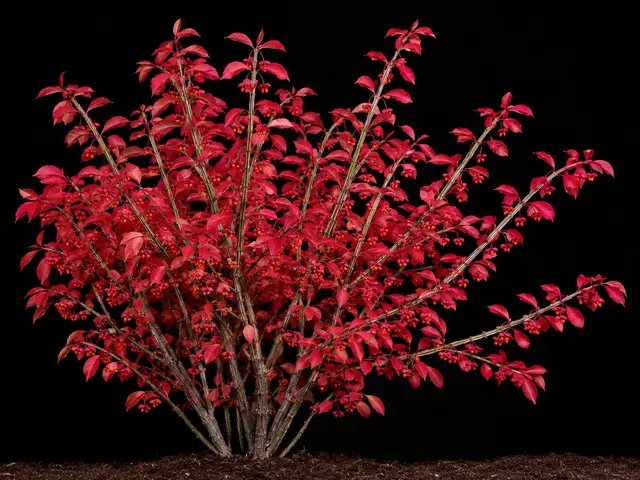
Burning Bush
The scarlet parking-lot hedge of the last fifty years, now banned from sale across most of New England. It seeds into woodland shade in carpets, and its fall color - the only reason anyone plants it - is bettered by half a dozen natives that also feed birds.
Burning bush is not a food plant and its fruit is not safe to eat. Like other Euonymus, the orange-red seeds and their pink capsules contain irritant and cardioactive compounds; a child who eats them typically gets vomiting, diarrhea, and stomach cramps, and larger amounts can affect the heart. Keep fruit away from small children and call Poison Control if any is swallowed. The leaves and bark are not edible either. Handling the shrub is harmless - gloves here are for comfort, not safety.
Overview
The one thing to knowBurning bush (Euonymus alatus, more usefully called winged euonymus) earns its name for about two weeks a year, when the entire shrub turns a fluorescent scarlet-pink that nothing else quite matches.
Burning bush (Euonymus alatus, more usefully called winged euonymus) earns its name for about two weeks a year, when the entire shrub turns a fluorescent scarlet-pink that nothing else quite matches. That fortnight built an industry. It is tough, shade-tolerant, deer-tolerant, shears into any shape, and asks for nothing, so it went into commercial landscapes, foundation plantings, and highway medians across the eastern half of the country by the million.
The problem is what happens after the color. Those inconspicuous spring flowers become thousands of small pink capsules that split to reveal orange-red seeds, birds strip them through late fall and winter, and the seed germinates readily in full woodland shade - which is the trait that makes this shrub genuinely dangerous rather than merely weedy. It does not need a disturbed edge. Walk an eastern woodland downwind of an old planting and you will find a carpet of burning bush seedlings under the canopy, hundreds per square yard, with no tree seedlings coming through them.
Sale is now banned in Massachusetts, New Hampshire, Maine, Connecticut and Vermont, other states have it on invasive lists and are moving the same direction, and it remains freely sold across much of the Midwest and mid-Atlantic. This entry is for identifying it (the corky wings on the twigs give it away in any season), removing it, and choosing one of the natives that does the fall color better.
Quick facts
For identification. Not a growing guide.
- Life cycle
- Perennial, lives about 40 years
- Where it grows
- Full sun · Part sun · Part shade · Shade, well-drained soil
- Height
- 8 ft4 to 15
- Spread
- 8 ft4 to 15
- Cold
- Takes hard frostdamaged below -30°F
- Heat
- Struggles above 100°F
- Self-sows
- Yes. Never let it set seed.
Through the year
How to recognize it in each season.
Spring leaf-out (the wings are the ID)
Apr to Jun, every year- Recognize it: corky wings on green stems, leaves in opposite pairsThe name to use is winged euonymus, because the wings are the whole identification. Young green stems carry two to four flat, corky ridges running lengthwise, like fins - you can feel them with a thumb, and they are there in every season including winter. The leaves sit in opposite pairs (most shrubs are alternate), are elliptical, finely and evenly toothed, and turn from dark green to scarlet. Nothing else in an eastern woodland has winged twigs and opposite toothed leaves together.
- Pull seedlings while the ground is softSeedlings and small plants have shallow, fibrous roots and come out by hand in moist spring soil - a bag and half an hour under a mature shrub will take out hundreds. This is the cheapest control there is and the one most people skip. Work outward from the parent plant, since that is where the carpet is thickest, and check under fences, hedges, and perch trees for the outliers birds planted.
Key signs- Corky wings on green twigs - the year-round identifier
- Carpets of seedlings under and downwind of a mature shrub
- Seedlings appearing deep in woodland shade, far from any planting
Inconspicuous spring flowers
May to Jun, every year- Tiny green flowers you will probably never noticeBurning bush flowers are small, flat, four-petaled and yellow-green, tucked under the foliage in twos and threes. They are genuinely inconspicuous, which is part of why people are surprised the shrub seeds so heavily - there is no showy bloom to warn you a fruit crop is coming. Every flower becomes a capsule, and a mature shrub carries thousands.
Key signs- Small yellow-green four-petaled flowers under the leaves
- Heavy flowering on open-grown shrubs, which predicts a heavy fruit crop
Scarlet fall color and splitting fruit
Sep to Nov, every year- The fall color, and the fruit hiding behind itThis is the fortnight the plant was bought for: the whole shrub turns fluorescent scarlet-pink, earlier and more uniformly than almost any native. Look past it at the fruit - small rosy-pink four-lobed capsules that split open to show one to four seeds wrapped in a bright orange-red fleshy aril. Those arils are what birds strip, and every one is a seedling somewhere else.
- Cut-stump the big shrubs now, while reserves are moving downLate summer through leaf drop is the effective window for cut-stump treatment, when the plant is moving sugars toward the roots and carries herbicide down with them. Cut low, treat the fresh surface immediately - within minutes, before it seals - and bag any cut material carrying fruit rather than piling it at the wood's edge. Removing fruiting shrubs first shuts off the seed supply for everything downwind.
Key signs- Uniform fluorescent scarlet-pink fall color, usually well ahead of native shrubs
- Rosy capsules splitting to reveal orange-red seeds
- Birds working the shrub in late fall and early winter
Winter (still identifiable by the wings)
Dec to Mar, every year- Winter ID: run a thumb along the twigBare burning bush is one of the easiest woody plants to name in winter. The corky wings stay on the green-brown twigs year-round, the buds and twigs are strictly opposite, and stems are squarish in cross-section because of the ridges. Older trunks lose the wings low down, so check the young growth at the tips.
- Dormant-season removal and basal-bark workWinter is good for the physical work - digging out mid-sized shrubs, cutting large ones down, and clearing dense thickets while you can see what you are doing. Basal-bark treatment of small stems also works in the dormant season. Cutting alone will not kill it: expect vigorous resprouting from the stump unless the cut is treated or the root crown is dug out.
Key signs- Corky-winged, squarish, opposite-budded twigs
- Resprouts from stumps cut in earlier seasons
- Fruit still hanging into early winter on heavy croppers
Watch out for
4 to know. 3 are high-risk: Scale & Sooty Mold, Shade-Germinating Seedling Carpets, Woodland Thicket Invasion (ecological harm). 4 are active in September.
Scale & Sooty MoldSeverity High PestnowEuonymus scale is the one thing that reliably disfigures this shrub: white cottony males and dark brown pear-shaped females crusting the stems, with yellow stippling and leaf drop as it builds.
Heavily sheared hedges in still, shaded air are the classic victims. It is a good argument for removing the plant rather than for spraying it - especially since the native replacements are not hosts.
Rows of small brown, tan, black, white, or waxy bumps along stems, twigs, leaf midribs, and leaf undersides that do not brush off but can be scraped loose with a fingernail. A sticky shine on the leaves - and on the floor, table, or path beneath the plant - that later turns black with sooty mold. Ants running steadily up and down the stems, since they farm and defend scale for that honeydew; often the first sign anything is wrong. Yellowing leaves, weak thin growth, and dieback of individual branches or canes that are heavily encrusted. On fruit crops, scale covers and sooty mold directly on the fruit. Check the leaf undersides and the shaded inner wood, which is where colonies build up unseen.
Horticultural oil is the main control: it works by smothering, so it has to coat the insects thoroughly - stems, twigs, and leaf undersides - and it usually needs repeating, because the waxy covering shields them and no single pass reaches everything. On deciduous woody plants a dormant-season oil smothers the overwintering stage while the leaves are out of the way, and timing a growing-season spray to the crawler stage, when the young are mobile and uncovered, is far more effective than spraying settled adults. On a small plant or a light infestation, scrub or wipe the scales off by hand, or dab them with a cotton swab of rubbing alcohol. Prune out and destroy badly encrusted wood rather than trying to save it. Wash off the sooty mold once the scale is gone - it lives on the honeydew, not on the plant, and stops once the supply does. Anything you spray must be labeled for the plant, and oils can burn delicate foliage, so test first.
Inspect. Look over leaf undersides and stems regularly - on a crop you pick, every harvest is a scouting chance - and check every new plant thoroughly before you buy it, plant it, or set it beside anything else, because scale almost always arrives on a plant rather than flying in. Quarantine new houseplants for a few weeks. Keep plants unstressed and not over-fertilized, since soft, forced growth is what populations build on. Prune for airflow and light to open up the shaded inner growth where scale hides, and prune out heavily infested wood as routine maintenance - on anything that gets a hard annual pruning, that alone removes most of any buildup. Leave the lady beetles, lacewings, and parasitic wasps alone, since they normally keep scale down to nothing, and keep ants off the plant where you can, because ants protect the colonies from those predators. Indoors, avoid hot, dry, still winter air.
Scale insects are sap-suckers that spend most of their lives immobile, fixed to a stem, twig, or leaf underside beneath a waxy or shell-like cover. They look far more like bumps, blisters, or crusty encrustations than like insects, which is why an infestation is usually well established before anyone notices it. Soft scales excrete large amounts of sticky honeydew that drips onto everything below and grows a black sooty mold - and those blackened leaves are often the first thing a gardener actually sees. Armored scales produce no honeydew but sit under a hard shield that protects them from most sprays. They spread as tiny mobile crawlers in the weeks after hatching, which is the only stage that moves and the only stage that is easy to kill. Populations build on stressed plants, on crowded shaded growth, and above all on plants kept indoors in dry, still air over winter.
Shade-Germinating Seedling CarpetsSeverity High DisordernowDense, uniform, ankle-high seedlings under and downwind of a mature shrub, and in woodland interior with no other disturbance.
Dense, uniform, ankle-high seedlings under and downwind of a mature shrub, and in woodland interior with no other disturbance. Winged twigs on knee-high plants deep in shade. Absence of tree seedlings and spring wildflowers through the carpet.
Hand-pull seedlings and small plants in moist soil; they come out. Remove the fruiting parent shrubs to shut off the seed supply, then keep walking the site each spring for several years, since neighboring plantings will keep re-seeding you.
Do not plant it, including the dwarf and 'sterile' cultivars, and remove any existing shrub before it fruits. Pull the seedling flush every spring while it is small - an hour with a bag beats a day with a saw later.
The mechanism that makes this shrub a forest problem rather than a hedgerow weed. Burning bush seed germinates readily in full woodland shade, which most invasive shrubs cannot do, so bird-dropped seed establishes under a closed canopy far from any planting. The result is a continuous carpet of seedlings - often hundreds per square yard under and downwind of a mature shrub - that suppresses tree seedlings, spring ephemerals, and native shrubs and quietly stops the woodland regenerating.
Woodland Thicket Invasion (ecological harm)Severity High DisordernowA continuous winged-twigged shrub layer under forest canopy or along a woodland edge.
A continuous winged-twigged shrub layer under forest canopy or along a woodland edge. Shrubs fruiting heavily in deep shade. Blazing scarlet patches visible from a distance in a woodland in October - the easiest way to map an infestation.
Dig out the root crown of small and mid-sized shrubs, or cut low and treat the fresh stump immediately with a woody-plant herbicide from late summer to leaf drop, when reserves are moving downward; basal-bark treatment of small stems works in the dormant season. Use a product whose label lists the site you are treating and follow that label - it is legally binding. Near a wetland, ditch, or streambank, an aquatic-labelled product is required, and in most states a permit or a licensed applicator as well. Cutting without treating produces a denser, multi-stemmed shrub.
Remove ornamental plantings, which are the seed source; take out the largest fruiting shrubs first; and replant with natives so the cleared ground is not simply re-invaded.
Where the seedlings grow up, burning bush forms a dense shrub layer that displaces native understory across eastern and midwestern forests, roadsides, old fields, and stream corridors. It tolerates deep shade, poor soil, drought, road salt, and deer browsing, so almost no site condition limits it, and it fruits heavily even in shade. The mature thicket casts dense summer shade of its own, and the low-value fruit it offers birds is poor substitute for the native shrubs it replaced.
Toxic Fruit and SeedsSeverity Medium DisordernowThis is not the same fruit type as a true berry: it is a four-lobed capsule opening to arils.
Worth knowing when reading a red-berried-shrub identification list, where burning bush is usually lumped in with actual berries.
Split pink capsules and loose orange-red seeds on the ground under a hedge, in a play area, or in a stroller path from fall into early winter.
If a child or pet swallows fruit or seeds, call Poison Control (1-800-222-1222 in the US) or a veterinarian and follow their advice; do not induce vomiting on your own initiative. Take a piece of the plant with you if you seek care, since the winged twig identifies it instantly.
The permanent fix is removing the shrub, which is worth doing anyway. Short of that, clear fallen fruit from play areas, and teach children the general rule that no berry or seed from a landscape shrub is food.
Euonymus fruit is poisonous, and burning bush is usually planted at the front of a house where small children play. The rosy capsules split to expose seeds wrapped in a bright orange-red fleshy aril that looks appetizing and sits at toddler height. The seeds and surrounding tissue contain irritant and cardioactive compounds; ingestion typically causes vomiting, diarrhea, and abdominal cramping within a few hours, and larger amounts can affect heart rhythm. The genus is the old European spindle tree, long known as poisonous to children and livestock.
Grower tips
Notes from growers, tagged with the zone they grow in. A person reads every post before it appears.
Nobody has posted about Burning Bush yet.
Free account. Your post shows your grower name and zone, never your email.