
Add it to your home screen and it opens full screen: no browser bars, one tap away, and everything stays signed in. Free, nothing to download from an app store.
- Tap the Share button in your browser
- Scroll down and choose “Add to Home Screen”
- Open GrowSomeFood from your home screen
- Open your browser’s menu
- Choose “Add to Home screen” or “Install app”
- Open GrowSomeFood from your home screen

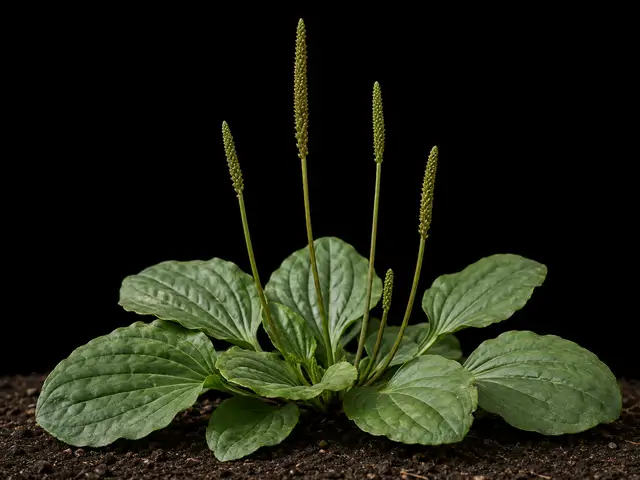
Broadleaf Plantain
The humble lawn 'weed' underfoot everywhere that's actually free food and a genuine first-aid plant - young greens, psyllium-like seeds, and the classic crushed-leaf poultice for stings and bites.
Safety notes The leaves are safe, edible, and non-toxic, and the crushed-leaf poultice is a classic folk remedy for stings and bites. The seeds are a psyllium-type fiber. Take them with a full glass of water - with too little liquid they swell and can block the throat or gut. Do not use them if you have any difficulty swallowing or a history of bowel narrowing, and keep them two hours apart from other medicines. Allergic reactions to psyllium are rare but real. Forage only from unsprayed ground.
Overview
Broadleaf plantain (Plantago major) is one of the most common plants in the world - the tough, flat rosette of broad, ribbed leaves you'll find in almost any lawn, sidewalk crack, path, or trodden patch of ground. Most people dismiss it as a weed, but it's a perfect 'learn what a plant really is' plant: it's edible (young leaves cooked or raw, and seeds that are a close relative of commercial psyllium fiber) and it's a genuinely useful first-aid herb.
Quick facts
- Sprouts in
- 14 daysRange: 7–21 days
- Soil temperature
- 68 °FRange: 60–75 °F
- Height
- 8 inRange: 4–16 in
- Spread
- 10 inRange: 6–14 in
- Cold
- Takes hard frostdamaged below -40°F
- Heat
- Struggles above 100°F
- Life cycle
- Perennial, lives about 5 years
- Save seeds
- About 80 days after plantingRange: 60–110 days
- Self-sows
- Yes, expect volunteers
- Soil
- Well-drained
- Water
- Low
- Plant spacing
- 10 inRange: 6–14 in
When to plant
Nothing is open today. Spring sowing opens 5 months, Mar 27 to May 22.
- Direct sow Mar 27 – May 22 Opens in 159 daysAbout 2 weeks before to 6 weeks after your last frost (Apr 10 here)If growing it on purpose, surface-sow seed (it needs light) in spring on any average soil; far more often it simply arrives on its own and needs no sowing.
Frost here: last around Apr 10 (Mar 27 to Apr 24 most years), first around Oct 25. Zone averages, your own yard may run a week or two either way.
Life stages
Establish, grow, repeat
Getting established and returning each season are different parts of the story.
Stage 1 of 4 · Getting established
Seedling rosette
Day 0 to 45 from sowing
Care at this stage
-
Barely any care needed
Plantain is a tough survivor of compacted, poor, trodden ground - it needs essentially no care once it germinates. If you're growing it on purpose, just keep a new sowing moist until it forms its low rosette.
-
Recognize the rosette
It forms a flat ground-hugging rosette of broad, oval, strongly ribbed leaves (5-9 parallel veins) - the young leaves of this stage are the best for eating.
Months are typical seasonal windows; climate, variety, and plant age can shift them.
Harvest
- Young, tender rosette leaves (spring through fall) for eating and poultices
- Brown, ripe seed spikes in summer for psyllium-like seed
- Strip the seed spikes for psyllium-like seed · weekly
- Prolific self-sowing
Picking pick as they ripen
Watch out for
2 to know. None are high-risk for Broadleaf Plantain. 1 is active in October.
Herbicide / Pollution ContaminationSeverity Medium DisordernowSeason: Mar–OctPlants growing in treated lawns, sprayed beds, pastures or croplands, along busy or polluted roadsides, or anywhere the ground around them looks suspiciously weed-free.
Plantain's whole habit is lawns, paths and roadside verges, which makes it one of the most likely wild greens to have been sprayed. The patch in a tidy, weed-free lawn is exactly the one to leave alone.
Plants growing in treated lawns, sprayed beds, pastures or croplands, along busy or polluted roadsides, or anywhere the ground around them looks suspiciously weed-free. Yellowed, twisted or distorted growth on neighboring plants is a sign something has been sprayed recently.
Do not harvest a contaminated plant - there is no washing this off, and no way to tell by looking. The plant itself is fine, so the answer is simply to choose a different site.
Only forage from ground you know has not been treated with herbicides or pesticides, and stay well back from busy roadsides. Ask before harvesting on land you do not manage. If you are not sure, grow your own patch, or gather only from a clean site you have watched across a full season.
A risk to the forager rather than to the plant. This species grows in lawns, gardens, pastures, croplands, field margins, paths and roadsides - exactly the places that get sprayed with herbicides and lawn chemicals, or that collect road pollution and runoff. The plant itself is harmless; what can make it unsafe to eat is where it has been growing.
Aggressive Self-Seeding & SpreadSeverity Low DisorderSeason: Jul–SepRipe seed heads or stalks shedding onto the ground, and a flush of volunteer seedlings coming up well beyond where the parent plant stood - most obvious in the first weeks of the plant's growing season.
Each seed spike sheds hundreds of sticky seeds that travel on shoes and mower wheels. Cutting the spikes before they ripen limits it, and a dense lawn resists it. The rosettes are taprooted, so dig them while the soil is moist.
Ripe seed heads or stalks shedding onto the ground, and a flush of volunteer seedlings coming up well beyond where the parent plant stood - most obvious in the first weeks of the plant's growing season.
Hoe or hand-pull volunteers while they are small and before they set seed - the existing seed bank will keep germinating for several seasons either way, so this is an ongoing job rather than a single fix. Where the volunteers are themselves edible, harvesting them is the easiest control, but only ever eat or grow on a seedling you can positively identify.
Cut, deadhead or harvest the seed heads before they ripen and shatter, which is far easier than dealing with what they drop. Where the plant is grown deliberately, keep it in defined rows or a contained bed so that volunteers are obvious, and site it only where naturalizing is welcome.
Not a pest but a management issue. This plant sets and sheds seed prolifically, so anything left to ripen builds a persistent seed bank in the soil and returns as a heavy flush of volunteers the following season. Much of that seed stays viable for years, which is why one season of letting it go can take several seasons to undo.
Good & bad neighbors
Plant nearby
-
The two most famous edible lawn 'weeds' - both foraged for nutritious greens and both indicators of a lawn's conditions; a natural pairing in any wild-food or foraging patch.
- Traditional pairings, thin evidence
-
Both are common tough lawn plants; clover fixes nitrogen and feeds pollinators while plantain offers food and medicine - a diverse, low-input 'lawn' supports more life than turfgrass alone.
-
Another tough, drought-tolerant plant with a wound-herb tradition; both persist in lean, trodden ground and share a first-aid folk history.

Varieties · 2
You pick one when you add Broadleaf Plantain to your garden. Its days to maturity set your harvest window.
Broadleaf Plantain (Plantago major)
The common broad-leaved plantain: a flat rosette of oval, strongly ribbed leaves with leafless seed spikes, in lawns and paths everywhere.
Variety details for Broadleaf Plantain (Plantago major)
Ground-hugging rosette of broad, oval, parallel-veined leaves with narrow upright seed spikes.
speciesperennialbroad-leavesedibleEdible young leaves, medicinal poultice, and psyllium-like seeds. Tough and self-sowing.
Narrowleaf Plantain (Plantago lanceolata)
A different species, not a cultivar of broadleaf plantain: the narrow-leaved 'ribwort' or buckhorn plantain, with slender lance-shaped ribbed leaves, tall stalks, and short bullet-shaped flower heads.
Variety details for Narrowleaf Plantain (Plantago lanceolata)
Rosette of long, narrow, ribbed leaves with short bullet-shaped flower heads on tall stalks.
speciesperennialnarrow-leavesedibleSimilar uses (edible young leaves, the same poultice medicine) and foraged the same way, but its upright habit and different seed head mean the rosette-and-spike harvest notes here only partly fit. Listed as a secondary noxious weed in some states (Iowa among them) - identify it where it volunteers rather than sowing it.
Grower tips
Notes from growers, tagged with the zone they grow in. A person reads every post before it appears.
Nobody has posted about Broadleaf Plantain yet. The first one usually saves someone a season.
Free account. Your post shows your grower name and zone, never your email.