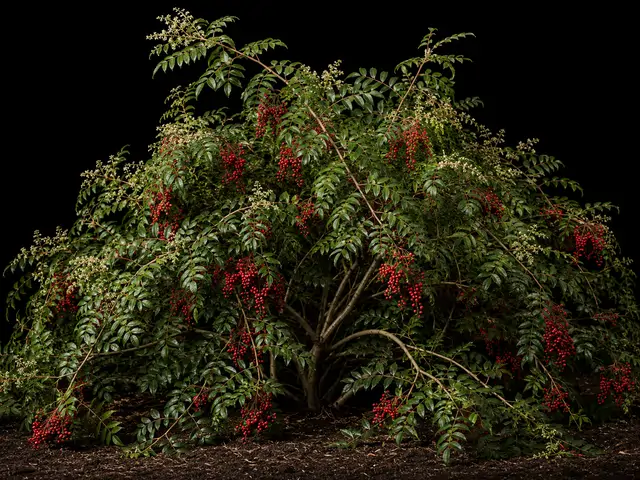
Brazilian Pepper

Brazilian Pepper

Schinus terebinthifolia · Anacardiaceae
Other Perennial Shrub Other
Introduced - native to Brazil, Paraguay and northern Argentina; the most widespread invasive plant in Florida, and invasive in Texas, Hawaii, California and Puerto Rico
For identification only — don't plant. Never plant this - in Florida it is illegal to. Brazilian pepper is on the Florida Noxious Weed List, so introducing, possessing, moving or selling it requires a permit, and Texas prohibits it as well. This entry is for identification and control only.

Brazilian pepper is in the poison ivy, cashew and mango family and behaves like it: sap and crushed foliage raise an itchy rash in sensitive people, so cut it in gloves, sleeves and eye protection. NEVER burn it - the smoke severely irritates eyes and airways. Flowering stands set off sneezing and headaches. The red berries are not food; in quantity they cause vomiting and diarrhea, so keep children and pets away. Pink peppercorns come from this genus - do not harvest your own.

Overview

Florida holly, Christmasberry - and the most widespread invasive plant in Florida, on the state Noxious Weed List. It forms impenetrable evergreen thickets, birds spread its red winter berries everywhere, and its sap and smoke irritate skin and airways.

Brazilian pepper (Schinus terebinthifolia) is the arching, evergreen, red-berried shrub that has taken over more of Florida than any other introduced plant — several hundred thousand acres of pine flatwoods, hammock edge, mangrove fringe, canal bank, roadside, and abandoned farmland, much of it in dense stands with almost nothing else growing underneath. It was sold for decades as “Florida holly” and “Christmasberry” for exactly the feature that made it dangerous: heavy clusters of glossy red berries at Christmas, which birds eat and carry for miles.

It is now a listed noxious weed in Florida — introducing, possessing, moving, or selling it requires a permit — and Texas prohibits its sale and distribution as well; it is also invasive in Hawaii, California, Arizona, and Puerto Rico. This is not a plant anyone offers for planting, and this catalog never will. What people actually need is the other half: how to recognize it, how to get rid of it, and how not to hurt themselves doing it. That last part is real. Brazilian pepper is in the same family as poison ivy, cashew, and mango; its sap raises a rash on sensitive people, its smoke is genuinely dangerous to breathe, and a big flowering thicket makes people downwind sneeze.

At a glance

Sun
Full sun · Part sun · Part shade
Water
Medium
Spacing
60–300 in (typ. 144)
Mature height
96–420 in (typ. 240)
Frost
Tender
Spread
96–480 in (typ. 240)
Soil
Tolerates wet soil
Temperature
Damaged below 25°F · struggles above 100°F
Self-sows
Yes — expect volunteers

When to plant

No planting window on record for this zone.

Life stages

  1. Seedling flush on bare ground Jun, Jul, Aug, Sep (yearly)
    • Watch cleared and disturbed ground after the summer rains
      Seedlings come up in waves once the summer rains start, wherever soil is open and sunny: cleared lots, fill and spoil piles, canal and ditch banks, fence lines, citrus and tomato ground gone out of production, road shoulders, and the edges of mangrove and hammock. They come up under bird perches too, so check under wires, fence posts, and shade trees.
    • Pull seedlings while the roots still come out
      A seedling under a foot tall pulls cleanly from wet soil, roots and all, and that is by far the cheapest control this species offers. Wear gloves - the sap can raise a rash. Once a plant is a couple of years old the root will snap and resprout, and you are into cutting and stump treatment instead. Walk the same ground every few weeks through the wet season rather than once a year.
    Waves of seedlings on cleared, filled, or graded ground after summer rainSeedling lines under fences, wires, and perch treesYoung plants along canal banks and ditch edges
  2. Thicket growth & the turpentine smell (identify & control) Mar, Apr, May, Jun, Jul, Aug (yearly)
    • Recognize it: compound leaves on a winged stalk that smell of turpentine
      Brazilian pepper is an evergreen shrub or leaning small tree, usually many-stemmed and arching into an impenetrable tangle. The leaves are alternate and COMPOUND, with about 5 to 13 (usually 7 to 9) oblong, finely toothed leaflets set along a reddish central stalk that is often narrowly winged. Crush a leaf and it smells strongly of turpentine or pepper. True hollies, which it gets called, have simple undivided leaves.
    • Cut and treat - never cut alone, and never burn it
      A plain cut produces a ring of vigorous sprouts from the stump and roots. Cut low and treat the fresh stump surface within minutes, or basal-bark stems under about four to six inches, using a product whose LABEL lists the site you are treating and following that label exactly. Wear gloves, sleeves, and eye protection against the sap. Do not burn cut material - the smoke is a serious respiratory irritant.
    Alternate compound leaves, 5-13 toothed leaflets, reddish often-winged leaf stalkStrong turpentine or peppery smell from crushed leavesArching, many-stemmed thickets closing over open ground
  3. Small white flower sprays (fall) Sep, Oct, Nov (yearly)
    • Sprays of tiny white flowers - and which plants are female
      In fall the plant carries branched sprays of very small white flowers. Brazilian pepper is dioecious - male and female flowers are on separate plants - so only some of the plants around you will carry berries. Those female plants are the seed source worth taking out first. Flowering stands are also when people report sneezing, watery eyes, and headaches downwind of a big thicket.
    • Mark the female plants now for removal
      It is far easier to sort males from females while flowers or fruit are showing than in spring. Flag the female plants and plan their removal before the berries ripen and the birds move them. If a large stand is beyond hand work, this is the point to talk to your county extension office, your water management district, or a licensed applicator.
    Branched sprays of tiny white flowers in fallOnly some plants flowering as females - the future berry producersSneezing, eye irritation, or headaches near a big flowering thicket
  4. Red berries at Christmas & bird spread Jan, Feb, Dec (yearly)
    • Dense clusters of glossy red berries in midwinter
      Female plants ripen dense clusters of small, glossy, bright red berries through December and January - the reason it was once sold as Florida holly and Christmasberry. This is the easiest time of year to spot it from a road or a canal bank. It is also when the damage is done: robins, mockingbirds, catbirds, and raccoons eat the berries and scatter the seed for miles.
    • Do not cut or harvest berries - and never move fruiting material
      Do not gather the berries. They are not a home spice crop, they can trigger reactions in anyone sensitive to cashew, mango, or poison ivy, and in Florida moving the plant at all is restricted under the noxious weed rule. If you must cut a fruiting plant, bag the fruiting tops and dispose of them under local rules rather than piling, chipping, or hauling them somewhere else.
    Dense clusters of glossy red berries from December into FebruaryFlocks of birds working a fruiting thicketNew seedlings appearing far from any known plant the following summer

Watch out for

Evergreen Monoculture (ecological harm) High Disorderyear-round

The core hazard is ecological: Brazilian pepper builds dense evergreen thickets whose arching, layering limbs close over the ground and shade it to bare litter, converting pine flatwoods, hammock edge, abandoned farmland, canal banks, and mangrove fringe into effectively single-species scrub. Native shrubs disappear, and the insects, birds, and lizards that depend on them go with them.

Watch for: Impenetrable arching evergreen thickets with bare ground beneath; native shrubs and groundcover thinning out at the thicket edge; whole fence lines, ditch banks, or old fields turning into one species.

Prevent: Never plant it - and in Florida it is a listed noxious weed. Pull seedlings while they are small, and remove fruiting plants in the neighborhood, not just on your own lot.

Treat: Cut-stump or basal-bark treatment on-label to kill roots, working from the fruiting females outward, then several years of follow-up on sprouts and seedlings; replant natives to hold the ground.

Several hundred thousand acres of Florida are in this condition, which is why the state has spent decades and large sums on control and, since 2019, on host-specific biocontrol insects.

Bird-Spread Berries & Hard Resprouting High DisorderJan, Feb, Mar, Apr, May, Jun, Jul, Aug, Sep, Dec

Why it reaches everywhere and resists removal: female plants ripen thousands of red berries in midwinter that birds and raccoons carry for miles, seeding fence lines, perch trees, canal banks, and cleared ground; and any plant that is cut or damaged answers with a ring of vigorous sprouts from the stump, roots, and layered limbs, so cutting alone leaves a denser thicket than before.

Watch for: Lines of seedlings under wires, fences, and perch trees; new plants far from any known parent; rings of fast sprouts around old cut stumps; limbs rooting where they touch soil.

Prevent: Remove berry-bearing female plants first to shut off the seed; bag fruiting cut material and dispose of it under local rules rather than piling, chipping, or hauling it; never move the plant, which Florida restricts anyway.

Treat: Kill the roots: cut low and treat the fresh stump within minutes, basal-bark stems under about four to six inches, or treat regrowth foliage - always with a product whose label lists your site, following that label. Near water, use an aquatic-labelled product and expect to need a permit or a licensed applicator.

Sorting male from female plants is far easier while flowers or fruit are showing, so fall and winter are the right time to survey and flag.

Sap Rash, Smoke & Pollen Irritation Medium Disorderyear-round

A direct hazard to the person doing the removal. Brazilian pepper is in the poison ivy, cashew, and mango family, and its sap and crushed foliage raise an itching, blistering contact rash in sensitive people. Burning it is worse: the smoke severely irritates eyes and airways and can cause real breathing trouble. Large flowering stands are also reported to cause sneezing, watery eyes, and headaches downwind.

Watch for: Itching or a rash on forearms and hands hours after cutting; eye and throat irritation while working in a thicket or near a fire; hay-fever-like symptoms near a big stand flowering in fall.

Prevent: Wear gloves, long sleeves, and eye protection to cut it, and wash up afterward. NEVER burn cut material or standing plants. Work upwind, and avoid heavy pruning of flowering stands if you react to them.

Treat: Wash skin promptly with soap and water and treat as contact dermatitis; flush eyes with clean water. Get medical attention for a severe rash, facial or eye involvement, or any breathing difficulty after smoke exposure.

People with cashew, pistachio, mango, or poison ivy sensitivity are the most likely to react, and should let someone else do the cutting.

Berry Toxicity (children, pets & the pink-peppercorn question) Medium DisorderJan, Feb, Mar, Dec

The bright red berries look like food and are not. Eaten in quantity they cause vomiting, diarrhea, and stomach pain, and because the plant is in the cashew and mango family, people sensitive to cashew, pistachio, mango skin, or poison ivy can react to the fruit. Pink peppercorns sold as a spice come from this genus through a commercial supply chain - that is not a reason to harvest your own, and Florida restricts moving the plant at all.

Watch for: Clusters of glossy red berries at child height on a yard or fence-line shrub in midwinter; dogs mouthing fallen fruit; birds gorging and behaving erratically under a fruiting plant.

Prevent: Remove fruiting plants where children and pets play, and do not harvest the berries for any use. Teach children the general rule: no berry goes in the mouth without an adult naming the plant.

Treat: If a child or pet eats more than a taste, call Poison Control or your veterinarian; treatment is supportive, for vomiting and dehydration. Seek care immediately for anyone with a known cashew, pistachio, or mango allergy.

This is the most common reason a Florida homeowner searches this plant in December - the berries look exactly like a holly's, and the shrub was sold under that name.

Varieties · 3

Brazilian Pepper (Schinus terebinthifolia)

Leaning evergreen thicket-former to about 25 feet; alternate compound leaves of 5-13 finely toothed leaflets on a reddish winged stalk; sprays of tiny white flowers in fall; dense clusters of small glossy red berries in December and January.

speciesinvasivedo-not-plantnoxious-weedbird-spreadskin-irritantevergreen-thicket

The listed noxious weed: an arching, many-stemmed evergreen shrub or small tree with compound toothed leaves on a reddish, often winged stalk that smell of turpentine, white fall flowers, and dense clusters of glossy red berries in December. Birds carry the seed for miles and cut stumps sprout hard. On the Florida Noxious Weed List, so introducing, possessing, moving or selling it requires a permit, and prohibited in Texas - identification and control only.

Native alternatives for Florida and the Gulf Coast

Varies by species - native evergreen shrubs and small trees with berries, flowers, and wildlife value suited to the subtropical Southeast.

alternativenativenon-invasiverecommended-instead

Plant these instead. For an evergreen screen or thicket: cocoplum, myrsine, wax myrtle, or Simpson's stopper. For red winter berries and the birds that come with them: dahoon holly or yaupon holly, both true natives with the look Brazilian pepper was sold for. For flowers and pollinators: firebush or Walter's viburnum. A local native-plant nursery or your county extension office can match these to your soil, salt exposure, and space.

Peruvian Pepper (Schinus molle) - the other pink-peppercorn tree

Graceful weeping tree with drooping branchlets and narrow willow-like leaflets; small pink-red fruits in hanging clusters.

relatedinvasivedo-not-plantwest-and-southwest

The close relative planted across California, Arizona, Texas and Hawaii as an ornamental shade tree, and the main commercial source of pink peppercorns. It is easy to tell apart - weeping habit, and much narrower, willow-like leaflets - and it carries the same family allergy risk. It is invasive in parts of California, Hawaii and the Southwest and is not a safe substitute for Brazilian pepper; where you want a small ornamental tree, ask for a regional native instead.

Grow

How to recognize it: an evergreen, many-stemmed, arching shrub with alternate compound leaves of 5-13 toothed leaflets on a reddish, often-winged stalk, turpentine-scented when crushed, with white fall flowers and glossy red December berries.

Nobody should plant Brazilian pepper and in Florida nobody legally may, so identification is the whole job. It is an evergreen shrub or leaning small tree, usually 10 to 25 feet, almost always many-stemmed, with limbs that arch out and root-tangle into a genuinely impenetrable thicket. The leaves are alternate and compound, with roughly 5 to 13 leaflets — most often 7 or 9 — that are oblong, finely toothed along the edge, and set along a reddish central stalk that is often narrowly winged. Crush one and it smells strongly of turpentine or black pepper. That smell plus the winged leaf stalk is the fastest confirmation in the field.

It flowers in fall, in branched sprays of tiny white flowers, and because male and female flowers are on separate plants, only some of the thicket carries fruit. Female plants ripen dense clusters of small, glossy, bright red berries in December and January. The name “Florida holly” is the usual source of confusion, and it is easy to settle: true hollies have simple, undivided leaves, never compound ones. Its close relative Peruvian pepper (Schinus molle), planted in California and the Southwest, has a weeping habit and much narrower leaflets. Understanding its biology explains the rest of this page — evergreen and shade-casting, tolerant of drought and flooding and brackish edges, spread by birds over long distances, and quick to sprout from any cut stump.

Propagation & seed saving

How it spreads: female plants set huge crops of bird-dispersed red berries that germinate on any open ground, and cut or damaged plants resprout hard from stumps, roots, and layered limbs - so a plain cut multiplies it.

Brazilian pepper spreads first and foremost by seed carried by birds. A mature female plant sets thousands of berries; robins, catbirds, mockingbirds, and other fruit-eaters gorge on them through the winter and drop the seed across the landscape, which is why seedling lines appear under wires, fences, and perch trees far from any parent plant. Raccoons and other mammals move seed as well, and water carries it along canals and tidal creeks. The seed is short-lived compared with many invaders — most of it does not persist for years in the soil — but the annual rain of fresh seed is so heavy that this makes little practical difference until you have removed the fruiting plants in the whole neighborhood.

It also holds ground vegetatively. Cut it and the stump and roots throw up a ring of vigorous sprouts; the arching limbs layer where they touch soil, so a thicket creeps outward on its own; and damaged plants come back faster than the seedlings around them. Add a dense evergreen canopy that shades out almost everything beneath it, and stands become effectively single-species and self-maintaining. That combination — long-distance bird dispersal plus hard resprouting — is why control has to shut off the seed source and kill the roots at the same time, and why cutting alone reliably makes a stand thicker than it was.

Care

Control only: pull seedlings, cut-stump or basal-bark treat anything larger (it resprouts), take out fruiting females first, use an aquatic-labelled product with permits or a licensed applicator near water, and never burn it.

Match the method to the size. Seedlings under a foot pull cleanly from wet soil, roots and all — the cheapest control this plant offers, and worth walking for every few weeks through the wet season. Anything larger needs the roots killed: cut it low and treat the fresh stump surface within minutes, or use a basal-bark application on stems under about four to six inches, or treat regrowth foliage. Whatever product you use, it must be one whose label lists the site you are treating, and you must follow that label — rate, protective equipment, buffers, and restrictions are all legally binding, and the label is the only reliable instruction sheet for the product in your hand.

Water changes the rules. Brazilian pepper grows on canal banks, ditch edges, tidal creeks, and mangrove fringe, and treating a plant standing in or over water is a different job: it requires a product specifically labelled for aquatic sites, and in Florida such work commonly requires a permit and often a licensed applicator, particularly on public land, in wetlands, or in mangroves, which have their own protections. Contact your water management district, county extension office, or the state before you start — do not treat a shoreline plant with a general-purpose landscape product.

Sequence the work: take out the berry-bearing female plants first, then the males, then keep after seedlings and sprouts for several years. Bag fruiting cut material and dispose of it under local rules rather than piling, chipping, or hauling it elsewhere; Florida restricts moving the plant at all. Never burn it — the smoke is a serious respiratory irritant. Wear gloves, long sleeves, and eye protection throughout. Then replant natives that do the same jobs better: cocoplum, Simpson's stopper, myrsine, wax myrtle, firebush, Walter's viburnum, or dahoon and yaupon holly for red winter berries without the invasion.

Nutrition

Not a food, and not a home spice crop: pink peppercorns come from this genus but through a regulated trade, and the fruit can trigger reactions in anyone sensitive to cashew, mango or poison ivy. Ecologically it is a near-total loss.

The question this page gets is a fair one: are these the pink peppercorns? Sort of, and the answer is still no. The pink peppercorns sold as a spice come from this genus — mostly the Peruvian pepper Schinus molle, and in part from Brazilian pepper — through a commercial supply chain with its own sourcing and handling. That is not a licence to strip the berries off the shrub in your yard. Because these plants sit in the cashew and mango family, people sensitive to cashew, pistachio, mango skin, or poison ivy can react to the fruit, sometimes badly; eaten in quantity the berries cause vomiting and diarrhea; and in Florida the plant is a listed noxious weed you are not free to gather and move in the first place. This catalog therefore records no edible part for it. Keep children and pets away from the fruit, and if someone eats a quantity of it, call Poison Control.

Ecologically it is close to a total loss. Dense evergreen stands shade the ground to bare litter, chemically and physically suppress what tries to come up, and convert pine flatwoods, hammock edge, and abandoned farmland into single-species scrub. Mangrove fringe and tidal edges are invaded as well, and displaced native shrubs take their insects, and the birds and lizards that eat those insects, with them. The berries do feed birds through the winter — which is precisely the mechanism of its spread, not a redeeming feature. Removing it and putting cocoplum, myrsine, wax myrtle, or a native holly in its place is among the highest-value swaps a South Florida yard can make.

History

Brought to Florida in the 1800s and sold as ornamental 'Florida holly' well into the twentieth century, it exploded across abandoned farmland - and is now the target of one of the largest and longest invasive-plant control programs in the country.

Brazilian pepper arrived in Florida in the 1800s as an ornamental and was still being sold and planted as “Florida holly” well into the twentieth century, valued for evergreen foliage and a heavy crop of red berries in time for Christmas. It found in South Florida a climate close to home and no meaningful controls, and it took off in the middle of the century, particularly across land that had been farmed and abandoned — the most-cited case being the Hole-in-the-Donut, a block of former farmland inside Everglades National Park that turned into a near-solid Brazilian pepper forest and has since become one of the largest and costliest habitat restorations in the United States.

The response has been long and expensive: it was added to the Florida Noxious Weed List, making it unlawful to introduce, possess, move, or sell without a permit, and public agencies have spent decades and enormous sums cutting, treating, and re-treating it. Since 2019, Florida has also released host-specific biological control insects — a thrips, and later a leaf-galling psyllid — that damage Brazilian pepper and appear to be slowing it in some areas. Biocontrol is a long game and it will not clear a fence line for you. The arc is the familiar one: a shrub planted for its Christmas berries, spread by the birds that ate them, and now a permanent line item in the state budget.

Troubleshooting

Confirm it (compound toothed leaflets on a winged reddish stalk, turpentine smell, red December berries), never burn it, cut and treat rather than cut, get a permit and an aquatic-labelled product near water, and replant natives.

Is this Brazilian pepper or a holly? Hollies have simple, undivided leaves. Brazilian pepper has compound leaves — 5 to 13 toothed leaflets along a reddish, often narrowly winged stalk — and crushed leaves smell of turpentine or pepper. Red berries in December on a compound-leaved evergreen shrub is your answer. Is it legal to have on my property? Florida lists it as a noxious weed and restricts introducing, possessing, moving, and selling it; the practical reading for a homeowner is that you should be removing it, not moving or sharing it. Check the current state rule and your county's guidance. Can I burn the brush pile? No. The smoke is a serious eye and airway irritant. Bag and dispose of it under local rules. I cut it and it came back thicker. Expected — cut stumps and roots sprout hard. Cut low and treat the fresh stump immediately, or basal-bark small stems, always on-label. It is growing on my canal bank or in mangroves. That is aquatic work: you need a product labelled for aquatic sites, and in Florida usually a permit and often a licensed applicator, especially near mangroves. Call your water management district or extension office first. I got a rash cutting it. Same family as poison ivy and cashew; wash with soap and water, treat as contact dermatitis, and wear gloves, sleeves, and eye protection next time. Can I use the berries as pink peppercorns? No — allergy cross-reactivity, real toxicity in quantity, and a legal restriction on moving the plant. What should I plant instead? Cocoplum, Simpson's stopper, myrsine, wax myrtle, firebush, Walter's viburnum, or dahoon or yaupon holly.

Growing across climates

A frost-limited subtropical invader (roughly zones 9-11): dominant through central and South Florida and the Gulf Coast, held back by hard freezes to the north, and creeping upward as freezes become rarer.

Brazilian pepper is a subtropical plant, comfortable in roughly zones 9 to 11, and cold is the only thing that has ever seriously limited it. It dominates central and South Florida, runs along the Gulf Coast into Texas, and is invasive in Hawaii, coastal and southern California, parts of Arizona, and Puerto Rico. Hard freezes kill young plants and knock back mature ones, which is broadly why it thins out through north Florida and does not hold the lower Southeast the way it holds the peninsula.

Within that range it is remarkably indifferent to conditions. It grows in sand, muck, limestone rock, and fill; tolerates drought once established and standing water for periods; handles salt spray and brackish edges well enough to invade mangrove fringe and tidal creek banks; and thrives in full sun while persisting in shade. Disturbance is its accelerator — abandoned farmland, fill and spoil, graded lots, canal banks, and storm-damaged ground all fill with it. Two trends push it further: fewer and milder hard freezes extending its northern edge, and more frequent storm disturbance opening ground for it. The guidance does not change: never plant it, learn the winged leaf stalk and the turpentine smell, take out fruiting plants first, treat rather than merely cut, and get the right permits and an aquatic-labelled product before you touch anything standing in water.

No grower tips for Brazilian Pepper yet — yours could be the first.

Sign in to share what works in your garden.

Connection interrupted

Reconnecting to GrowSomeFood

Keep this page open. We are trying to restore your garden session.

Attempt of . Retrying automatically.

Still offline

Could not reconnect

Your phone may have switched networks or gone to sleep. Try again when the signal is steady.

Session expired

Reload to continue

This garden session is no longer available on the server. Reloading will start a fresh session.