Add it to your home screen and it opens full screen: no browser bars, one tap away, and everything stays signed in. Free, nothing to download from an app store.
- Tap the Share button in your browser
- Scroll down and choose “Add to Home Screen”
- Open GrowSomeFood from your home screen
- Open your browser’s menu
- Choose “Add to Home screen” or “Install app”
- Open GrowSomeFood from your home screen
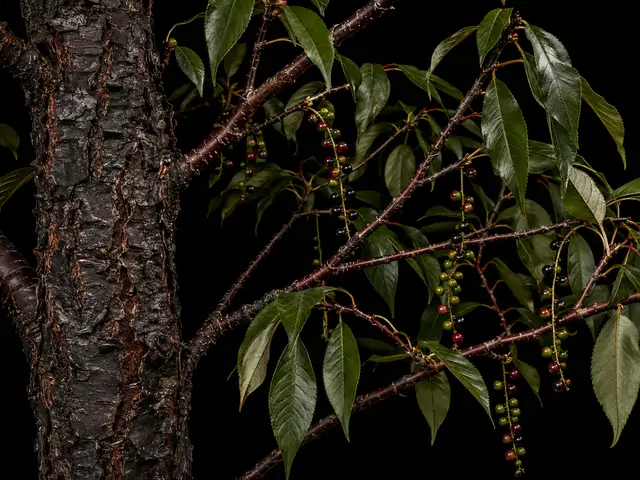
Black Cherry
A fast, handsome native forest tree that feeds more caterpillars than almost anything except oak, drops genuinely good jelly fruit, and produces America's finest cabinet wood - with one hard rule: its wilted leaves kill livestock.
Ripe black cherry FLESH is edible; nothing else on the tree is. Leaves, twigs, bark and the PITS carry cyanogenic glycosides - cook the fruit whole and strain the pits out, never grind or blend them. WILTED foliage is the killer: wilting concentrates the cyanide, and a storm-broken limb dropped into a pasture can kill cattle, sheep, goats or horses within an hour. Black cherry is a leading cause of livestock poisoning in the eastern US - keep every pruning and fallen limb out of grazed ground.
Overview
Black cherry (Prunus serotina) is the largest native cherry in North America and one of its most useful trees. It grows fast for a forest hardwood - 50 to 80 feet, occasionally over 100 - carries drooping white flower racemes in late spring, hangs with small glossy black cherries in August, and turns clear yellow to orange-red in fall. Its mature bark is unmistakable, breaking into thick dark scaly plates that everyone eventually describes as burnt cornflakes.
Ecologically it is a heavyweight. Prunus ranks with oak and willow among the keystone host genera of North America, feeding hundreds of species of native caterpillars - eastern tiger swallowtail, red-spotted purple, coral hairstreak, cecropia and promethea silk moths, and the tent caterpillars everyone knows - and those caterpillars are the protein that nesting songbirds must have. The fruit then feeds dozens of bird and mammal species through late summer, and the wood is the American black cherry that has been the premier native cabinet timber for three centuries.
Then there is the warning, and it is not a footnote. Every part of this tree except the ripe flesh is cyanogenic, and wilted foliage is far more dangerous than living foliage. A limb broken into a pasture in a summer storm, or a pile of prunings tossed over a fence, can kill cattle, sheep, goats, or horses within the hour. Black cherry is a leading cause of livestock poisoning across the eastern United States. Grow it - it is a superb tree - but site it deliberately and dispose of what you cut.
Quick facts
- Sprouts in
- 90 days30 to 180
- Soil to sprout
- 55 °F40 to 70
- Life cycle
- Perennial, lives about 120 years
- Seed to save
- About 110 days after planting90 to 130
- Height
- 60 ft30 to 90
- Spread
- 40 ft20 to 60
- Cold
- Takes hard frostdamaged below -40°F
- Heat
- Struggles above 100°F
- Self-sows
- Yes, expect volunteers
Full sun or part sun · medium water · well-drained soil · 35 ft apart (20 to 60) · direct sow or transplant
When to plant
Fall transplanting is open for 6 more days. Next: fall, Oct 4 to Nov 15.
- Transplant Aug 16 – Sep 27 Closes in 6 daysAbout 10 weeks before to 4 weeks before your first frost (Oct 25 here)Fall planting suits cold and temperate zones - the roots keep working after leaf drop. Water until the ground freezes and mulch the root zone.
- Direct sow Oct 4 – Nov 15 Opens in 13 daysAbout 3 weeks before to 3 weeks after your first frost (Oct 25 here)Clean the pulp off the pits and fall-sow outdoors so winter supplies the long cold stratification the seed needs. Slow and variable, and around a decade to first fruit - a naturalizing method rather than a fruit-growing one. Protect from rodents.
- Transplant Mar 20 – May 22 Opens in 180 daysAbout 3 weeks before to 6 weeks after your last frost (Apr 10 here)Set out a young bare-root or container tree as soon as the ground is workable. Choose the site for its distance from grazed ground and from your cherries and plums before you choose it for anything else.
Frost here: last around Apr 10 (Mar 27 to Apr 24 most years), first around Oct 25. Zone averages, your own yard may run a week or two either way.
Life stages
One stage to settle in, then three that repeat each year. Windows are typical; your zone and weather move them.
Years 1-3 - young tree
The first year after planting- ProtectSite it away from pasture, paddock and corral - permanentlyDecide this before you dig, because you cannot fix it later. Black cherry foliage is cyanogenic and wilted leaves are the dangerous form, so the tree must not overhang or drop limbs into any ground grazed by cattle, sheep, goats or horses. If you keep animals or border someone who does, put real distance between them and the tree, and remember that a canopy 40 feet up drops branches a long way in a storm.
- ProtectKeep it well clear of cherries, plums and peachesBlack cherry is a wild host of black knot, the fungus that deforms and kills stone-fruit wood. If you grow cherries or plums, put several hundred feet between them and any black cherry, and plan to cut knots out of the wild tree every winter.
- WaterWater deeply through the first three summersweeklyBlack cherry grows fast for a forest tree once established, but a young one needs steady moisture in its first seasons. Water deeply in dry spells rather than sprinkling, then leave it alone - a mature tree is genuinely drought-tolerant.
- MulchMulch wide, keep it off the trunkA broad ring of wood chips protects the shallow roots and thin young bark from mowers and string trimmers and holds moisture through establishment. Pull the mulch back a few inches from the bark.
Watch for- Grazed ground within reach of a falling limb - move the tree, not the fence
- Deer browsing and buck rub on young trunks
- Tent caterpillar egg bands on bare twigs in winter
- String-trimmer damage to thin young bark
White racemes (late spring)
Apr to Jun, every year- InspectDrooping white flower clusters open after the leavesBlack cherry blooms late for a stone fruit - narrow, drooping 4-6 inch racemes of small white flowers opening after the leaves are out, which is why it rarely loses a crop to late frost. The flowers feed a long list of native bees, small butterflies, and flies, and the tree is one of the better mid-spring nectar sources in an eastern woodland.
- InspectCheck the branch forks for tent caterpillar tentsSilk tents appear in the branch forks as the leaves open, and black cherry is the tent caterpillar's favorite tree. Pull small tents out by hand in the morning while the caterpillars are inside. An established tree refoliates and is fine either way - but gather the stripped, wilting leaves and any pulled branches out of grazed ground.
Watch for- Native bees and small butterflies working the racemes
- Silk tents in the branch forks as the leaves open
- Late bloom dodging the frosts that ruin orchard cherries
Cherries ripening (late summer)
Aug to Sep, every year- HarvestPick when the fruit is glossy black and softevery 3 daysRipe black cherries are pea-sized and turn from red through dark red to glossy near-black, soft enough to squash between finger and thumb. Strip whole racemes into a bucket from branches you can reach. Red fruit is not ripe - it is sour and astringent. Most of the crop hangs 40 feet up and belongs to the birds; treat whatever you can reach as a bonus.
- ProtectClear every broken branch out of grazed groundIf you break or cut branches while picking, gather them up and dispose of them where no grazing animal can reach. Wilting is what makes the foliage lethal, so a heap of cut branches on the wrong side of a fence is far more dangerous than the growing tree.
Watch for- Birds clearing the crop within days of it darkening
- Purple-staining fruit drop on paving, cars and decking below
- Broken branches left where livestock can reach them
- Fruit still red - it is not ripe yet
Fall color & winter dormancy
Oct to Mar, every year- PrunePrune in dry winter weather and cut out every black knotLate winter in dry weather is the time. Take out dead, crossing, and storm-damaged wood, and hunt down every black knot - the hard, coal-black, warty swellings encircling twigs - cutting 4 to 6 inches below each one and sterilizing the blade between cuts. Bag or burn the wood. Never leave prunings lying where a grazing animal can reach them.
- InspectScrape off tent caterpillar egg bandsHard, shiny, dark egg bands wrapped around pencil-thick twigs are easy to spot on bare wood, and one band removed in February is a whole colony that never appears. Prune or scrape them off while you are pruning anyway.
- InspectPull volunteer seedlings before they get awayBirds scatter black cherry seed across an entire neighborhood, and seedlings come up in beds, fence lines, and hedges everywhere. They pull easily at a few inches and become a real job at a few feet, so walk the yard each winter and take them out while they are small.
Watch for- Black knots standing out on bare twigs - the easiest time to find them
- Egg bands encircling pencil-thick twigs
- Volunteer seedlings in beds and fence lines
- Storm-broken limbs, especially over grazed ground
Harvest
- Fruit glossy and near-black rather than red, and soft enough to squash between finger and thumb
- Whole racemes strip off easily in one pull
- Birds working the tree hard - which usually means you are already late
- Pick when the fruit is glossy black and soft · every 3 days
- Clear every broken branch out of grazed ground
Per plant 1 to 40 lbPicking pick as they ripen
Watch out for
6 to know. 1 is high-risk: Cyanide Poisoning of Livestock (Wilted Foliage). 3 are active in September.
Cyanide Poisoning of Livestock (Wilted Foliage)Severity High DisordernowThis is the single most important thing to know about black cherry, and it is a siting decision rather than a maintenance one.
The classic case is a summer storm dropping a limb into a paddock overnight. If you keep or border livestock, plant the tree somewhere else and walk your fence lines after every blow.
Wind-broken or storm-thrown branches lying inside a pasture, paddock or corral - by far the most common way this happens, because the canopy of a mature tree reaches a long way over a fence. Piles of fresh prunings or brush tossed over a fence line. A tree growing along a fence where animals can browse the lower branches. Foliage that has been frosted or drought-wilted while still within reach. In an affected animal: sudden distress, rapid labored breathing, staggering, collapse, and bright cherry-red mucous membranes and blood, progressing to death within an hour. Dead animals near a black cherry with no other explanation should be treated as a suspected cyanide case.
There is no home treatment for a poisoned animal - cyanide poisoning moves too fast, and survival depends on a veterinarian giving specific antidotes within minutes. Call a veterinarian immediately, move the remaining animals off the area, and remove the source. The realistic response is entirely preventive: control where the tree grows relative to stock, and control where the cuttings go. For people, if pits have been crushed into a batch of juice or preserves, discard the batch rather than trying to judge how much is too much, and contact Poison Control if anyone has consumed a quantity of crushed pits.
Site the tree so this cannot happen, and judge the distance by where a 40-foot limb lands rather than by where the trunk stands. Never plant black cherry overhanging or adjacent to grazed ground, and fence stock well back from existing trees rather than relying on animals to avoid it. Gather every pruning and every wind-broken limb and dispose of them where no grazing animal can reach - burn or haul out, never dump over a fence. Walk fence lines after every windstorm through the growing season, which is the single most valuable habit if you keep animals. Do not turn hungry animals into an area with black cherry in it, since hunger is what makes them eat something they would normally leave. In the kitchen, cook fruit whole and strain the pits; never grind, blend or crush them.
Black cherry leaves, twigs, bark and pits contain cyanogenic glycosides that release hydrogen cyanide when the tissue is damaged. The critical fact is that WILTING dramatically raises the risk: leaves on branches broken by wind, cut in pruning, browsed and left hanging, or frost-damaged are far more dangerous than leaves on an intact growing plant. Ruminants are most vulnerable because rumen conditions release the cyanide efficiently, and cattle, sheep and goats have died from a single feed of wilted cherry brush; horses are also at risk. Onset is fast - often within 15 to 60 minutes - and animals are frequently found dead with no observed illness. Black cherry is among the leading causes of plant-related livestock death in the eastern United States. For people the hazard is far smaller but real: it is the reason pits must be strained out of cooked fruit rather than ground into it.
Deer (browse resistance)Severity Medium WildlifenowDeer browse black cherry heavily and are not harmed by it the way livestock are - wild deer handle the foliage routinely at the amounts they take.
Cage or tube a young tree for its first several years, because browsing and autumn buck rub are the two things most likely to kill it before it gets above head height.
Growth cleanly missing overnight, with the plant browsed back to a level line about as high as a deer can comfortably reach. Ragged, torn stem ends rather than the clean angled cut a rabbit leaves - the single most reliable identifier. Buds and flowers gone while the foliage below is untouched, since deer often take the best part first. Hoof prints and droppings in soft ground near the damage. Repeat visits, with fresh damage each morning once a planting has been found. On young trees, shredded and stripped bark and broken low branches in autumn - that is antler rubbing rather than feeding.
There is no chemical fix, only exclusion and recovery. Get physical protection up immediately after the first damage, because deer return to a known meal, and reinforce or rotate whatever you were relying on before. Most plants regrow from browsing if the crown and roots are intact - feed and water a grazed plant and protect the regrowth while it comes back. What does not recover in the same season is anything whose buds or flowers have been taken, and a young tree whose bark has been rubbed right around the trunk is usually lost. Where deer pressure is genuinely heavy, the honest answer is to fence properly or to grow the plants deer leave alone, rather than to keep replacing losses.
Fencing is the only thing that reliably works. Eight feet is the standard for excluding deer, or two parallel four-foot fences a few feet apart, which they will not jump because they cannot judge the landing. Short of that, cage individual plants: a sturdy wire cage or trunk guard around every young tree, left on until the trunk is thick and the canopy is above browse height, prevents both browsing and antler rubbing and is the single highest-value thing you can do for a young tree. Repellent sprays do help at moderate pressure, but they wash off and deer habituate, so reapply after rain and rotate between different types through the season. Motion-activated sprinklers, scent deterrents, and noise devices work for a while and then stop. Siting matters too: plants close to the house, in daily traffic, and screened behind other planting get browsed less than the same plant out at the boundary.
Deer are the largest garden problem across much of the country, and where pressure is high they set the limit on what you can grow at all. They browse at night and around dawn and dusk, taking tender shoots, leaves, buds, flowers, and fruit within about five feet of the ground, and they come back night after night to anything they have found and liked. Because they have no upper incisors they tear rather than cut, leaving ragged stem ends - that is how you tell deer damage from a rabbit's clean angled cut. In fall, bucks rub their antlers on young trunks and can strip the bark right around a stem, which kills a young tree outright. Palatability varies enormously between plants and between seasons: a herd short of food in late winter eats things it ignores in June, and no plant is truly deer-proof.
Black KnotSeverity Medium DiseaseBlack cherry is one of the wild hosts that orchard guidance means when it says to remove wild cherry from the vicinity.
A big tree tolerates knots for years, but it seeds the disease into every cultivated cherry and plum nearby, so if you grow stone fruit, cut every knot out each winter or keep the two well apart.
Olive-green, corky swellings on new growth that harden and turn coal-black and warty, encircling twigs and branches; worst on wood 1-2 years old.
Prune out and destroy all knots annually - this sanitation is the core control. Fungicide sprays from bud break through early shoot growth help in high-pressure orchards but don't replace cutting out the knots.
Cut out every knot 4-6 inches below the swelling during dormant winter pruning, sterilizing the saw between cuts and burning or bagging the wood; plant more-resistant varieties; and remove wild cherry and plum nearby, which harbor the disease.
The signature disease of plums and cherries in the eastern US and Canada: a fungus (Apiosporina morbosa) that forms hard, black, crusty, warty swellings that encircle and girdle twigs and limbs, deforming and eventually killing branches. Left unchecked it takes over a tree over a few years.
Tent CaterpillarsSeverity Medium PestBlack cherry is the primary host - the roadside trees draped in silk each spring are almost always this one.
Two extras matter here. The stripped leaves the caterpillars drop are wilting cyanogenic foliage, so clear them out of grazed ground. And in horse country, tent caterpillars feeding on black cherry are the documented cause of mare reproductive loss syndrome; keep pregnant mares away from black cherry through an outbreak spring.
Dense white silk tents in the crotches of branches from the moment the leaves open, growing larger week by week as the colony expands. Bare, stripped twigs radiating out from each tent while the rest of the tree still has leaves. Hairy caterpillars massed on the tent surface in the morning and evening and out feeding in between. Hard, shiny, dark egg bands wrapped around pencil-thick twigs, visible on bare wood all winter - the easiest time to find and remove them. Frass and shed skins accumulating below the tents.
Pull the tents out by hand in the early morning or evening while the caterpillars are inside, wearing gloves, and drop the whole mass into soapy water. On a small tree this alone is a complete solution. For a heavy infestation on a young plant, Bt (Bacillus thuringiensis) applied to the foliage the caterpillars are feeding on works well and spares beneficial insects, but it only affects small caterpillars, so timing is early. On an established tree, doing nothing is a legitimate choice: it refoliates and moves on. Anything you spray must be labeled for the plant you are treating.
Look for the egg bands on bare twigs through the winter and prune or scrape them off - one band removed in February is a whole colony that never appears. Then check branch forks weekly from the moment the buds break, because a tent found small is trivially dealt with. Leave the birds, parasitic wasps, and predatory beetles alone; they take a heavy toll on tent caterpillars and are the reason outbreaks collapse on their own. Do not attempt to burn tents out of a tree - it does more damage to the tree than the caterpillars ever would.
Tent caterpillars build conspicuous silk tents in the branch forks of cherry, chokecherry, apple, plum and related trees in spring, and feed outward from them on the new leaves. Eggs are laid in a hard, shiny, dark band encircling a twig in summer and hatch just as the buds open the following spring, so the caterpillars arrive exactly when the foliage is softest. Colonies grow fast and a heavy year can strip a small tree completely by early summer. The damage looks alarming and is genuinely ugly, but a healthy established tree refoliates within a few weeks and suffers no lasting harm; repeated defoliation over several consecutive years is what weakens a plant. Populations run in multi-year cycles, so a bad spring is often followed by another and then by several quiet ones.
Japanese BeetlesSeverity Medium PestBlack cherry is one of the beetles' most preferred trees, and the top of the canopy can go brown and lacy by mid-July.
On an established tree it is cosmetic, and spraying a plant grown to feed hundreds of caterpillar species defeats the purpose of having it. Hand-pick on a young or small tree only.
Clusters of shiny metallic beetles massed together on the upper, sunniest foliage and down inside open blooms, heaviest on warm sunny afternoons from around late June. Leaves reduced to lace, with the veins left intact and the tissue between them gone - unmistakable, and quite different from the ragged chewing of a caterpillar. Ragged, chewed petals and blooms that never open properly. Beetles that let go and drop straight to the ground when you disturb the plant. Feeding damage on ripening fruit, on the plants they also take fruit from. Whole branches going brown and lacy at the top of a plant while the shaded lower growth stays untouched.
Persistent morning hand-picking into soapy water is the most effective home control there is, and on a vigorous established plant the damage is usually cosmetic and needs nothing else. Neem deters feeding rather than killing, and has to be reapplied. For heavy pressure, spinosad or a targeted insecticide labeled for the plant will work - but time any spray away from bloom and apply it at dusk to protect bees, and observe the pre-harvest interval on anything you eat. On flowering plants, some gardeners simply shear the blooms off for a couple of weeks and let the plant rebloom once the wave has passed, which removes the lure as well as the damage. Young plants and young trees are the ones worth defending: a mature tree or an established vine tolerates several weeks of leaf loss without lasting harm.
Hand-picking is genuinely the main defense in a home garden. Go out in the cool of the morning while the beetles are sluggish, hold a tub of soapy water underneath, and knock them in - they drop when disturbed, so most fall straight into it. Do it daily through the flight: because the beetles call each other in, taking them off early stops a plant becoming a beacon. Do not put pheromone or lure traps anywhere near the garden - they demonstrably pull in far more beetles than they catch. And do not count on lawn grub control: milky spore has performed poorly and inconsistently in field trials across most of the US, and treating your own turf does not reduce the adults feeding on your plants, because they fly in from surrounding properties. Where it is practical, row cover or netting through the peak flight excludes them outright. Otherwise riding out the six-to-eight-week wave is a legitimate strategy, since most established plants absorb the damage.
Japanese beetles are metallic green-and-copper beetles about half an inch long that emerge in early summer and feed for six to eight weeks. They feed in aggregating masses - one beetle's feeding releases a scent that draws in more - so a plant goes from untouched to covered in a couple of days. They chew the soft tissue between the leaf veins and leave the veins standing, so the leaf ends up as a brown lace skeleton, and they shred open flowers and sometimes ripening fruit as well. They work the sunniest upper parts of a plant on warm afternoons. The white C-shaped grubs spend the rest of the year in turf and pasture soil eating grass roots, and the adults then fly in from wherever they hatched, which can be some distance away.
Birds & WildlifeSeverity Low WildlifenowOn a black cherry the birds are the point, not the problem - feeding robins, waxwings, thrushes and grosbeaks is half the reason to plant one, and netting a 60-foot tree is not a thing.
Pick from the low branches and let the canopy go. The side effect is seedlings scattered across the neighborhood, which is a weeding job rather than a harvest one.
Fruit disappearing from the outermost, most exposed parts of the plant first, and from the top of a tree where you cannot reach anyway. Single neat pecks and gouges in ripening fruit, with several fruits sampled rather than one eaten through - the classic sign that it was birds rather than an animal. Heads of grain or seed going visibly lighter and emptier as they ripen, with hulls and chaff scattered underneath. Freshly sown seed vanishing off the surface of a bed before it germinates. Bird traffic in and out of the plant picking up as the crop colors, and birds waiting on nearby wires and branches. Wasps arriving at the pecked and split fruit shortly afterward.
There is no treatment once a crop is being taken - only protection and timing, so the answer is to get netting on and to pick what is ready. Reflective tape, flash ribbon, spinners, and decoy predators do work, but only for a few days at a time: birds habituate fast, so move and rotate them and never rely on them as the main defense for a crop you care about. Cut and gather grain or seed heads a little early, at firm dough, and finish drying them under cover instead of leaving them standing for the flocks. Plant a little extra, or a decoy crop the birds prefer, and accept sharing anything that crops heavily. On a wild or foraged patch, fruit going to birds and small mammals is the point of the plant rather than a problem to solve.
Net, and net early. Bird netting draped over a frame or hoops so it stands off the fruit, with the edges closed at ground level, is the only thing that reliably works at harvest scale - and it has to go on before the crop starts to color, because once birds have found the food they are far harder to displace. Keep fruit trees small enough that netting them is actually feasible; that decision gets made years earlier, at planting. Bags of mesh, organza, or paper slipped over individual heads, clusters, or prize fruit protect a small crop without netting the whole plant. Then shorten the exposure: pick promptly and completely rather than leaving ripe fruit hanging as a lure, clear split and dropped fruit that draws birds and wasps alike, and where a crop can finish off the plant, harvest a little early and ripen or dry it under cover. Rake in or cover broadcast seed so it is not lying in plain view.
Birds find ripening fruit and seed before you do. Robins, waxwings, starlings, catbirds, jays, sparrows, finches, blackbirds, and doves all work a garden, and the pressure arrives in a narrow window - the last days before harvest, when sugar rises, color changes, and the crop softens or the grain hardens. A flock can strip a small planting in a day or two, and birds that only peck rather than take whole fruit still leave wounds that rot or draw wasps. Squirrels, chipmunks, and other wildlife usually turn up on the same crop at the same time. This is competition rather than disease: the birds are not harming the plant, and a big tree or a heavy-cropping bush often has enough for everyone - but on a small planting it can be the difference between a harvest and none.
Good & bad neighbors
First rule: keep Pasture, paddocks and grazed ground apart. The most important siting rule on this page and not a plant-to-plant conflict at all.
Plant nearby
-
The two top host genera in eastern North America growing together. Oak and cherry between them support more caterpillar species than any other pair of trees you could plant, which is the whole basis of a bird-supporting yard - give each of them room.
-
Another fast native that fruits at the same time and is preserved the same ways - cooked, never raw. Together they make a productive wildlife hedgerow at the edge of a black cherry's canopy.
-
Layers the fruiting season for birds - serviceberry in June, black cherry in late August - and adds a small flowering understory tree beneath a big cherry canopy. Both are rose-family plants, so watch for black knot moving toward stone fruit rather than into the serviceberry.
-
A native understory shrub that thrives in the light shade beneath a black cherry and hosts spicebush swallowtail, building the layered woodland structure that makes a host tree far more useful than it is standing alone in lawn.
- Traditional pairings, thin evidence
-
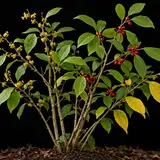
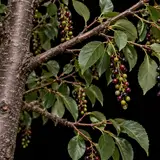
The close relative people confuse this tree with. Black cherry is a large single-trunked forest tree with scaly plated bark; chokecherry is a suckering thicket 8-20 feet tall. Both are cyanogenic in exactly the same way and carry the same livestock warning, so learning the pair together is worth doing.
Keep apart
-
Pasture, paddocks and grazed groundThe most important siting rule on this page and not a plant-to-plant conflict at all. Black cherry foliage is cyanogenic and wilted leaves are the lethal form, so the tree must not overhang or be able to drop limbs into ground grazed by cattle, sheep, goats, or horses. Judge by where a falling limb lands, not by where the trunk stands.
-
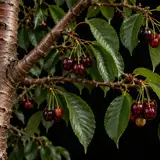
Black cherry is a wild host of black knot, which spreads readily into cultivated cherries and deforms and kills their wood. Standard orchard guidance is to remove wild cherry from the vicinity, so do not deliberately plant one near your fruit trees.
-
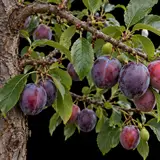
Same problem as cherry - black knot moves from wild black cherry into plums and kills the wood. Keep several hundred feet between them, and cut every knot out of the black cherry each winter if you have both.
Varieties · 4
You pick one when you add Black Cherry to your garden. Its days to maturity set your harvest window.
Black Cherry (Prunus serotina)
Tall straight tree with dark scaly plated bark, drooping white flower racemes, and hanging clusters of glossy black cherries.
speciesnativekeystonehost-plantThe wild eastern species: a fast, straight forest tree 50-80 feet and occasionally over 100, with drooping white racemes after leaf-out, small glossy black cherries in late summer, clear yellow-to-red fall color, and the unmistakable dark scaly plated bark of a mature trunk. The premier American cabinet timber and one of the top caterpillar host trees on the continent. Every toxicity rule on this page applies to it.
Southwestern Black Cherry (var. rufula)
Small to medium canyon tree with narrower leaves carrying rusty hairs along the midrib beneath.
varietynativesouthwestmountain-canyonThe Arizona and New Mexico mountain variety, sometimes called escarpment or Gila black cherry. A smaller tree of canyons and mountain drainages, adapted to Southwestern heat, sun, and seasonal drought, with rusty hairs along the leaf midrib that give it its name. For a Southwestern gardener this is the black cherry to plant - an eastern seed source is poorly matched to that climate. Same fruit, same wildlife value, same cyanogenic cautions.
Capulin (var. salicifolia)
Semi-evergreen tree carrying larger, sweeter dark cherries in loose clusters.
varietylarge-fruitsubtropicaldessert-fruitThe Mexican and Andean variety, cultivated for centuries as an actual dessert fruit - noticeably larger, sweeter cherries on a semi-evergreen tree, sold in markets from Mexico to Peru. It is the one form of black cherry genuinely grown for eating fresh. It needs a frost-free or near-frost-free climate and is rarely available from US nurseries outside the far South and California; the same rule about never crushing the pits applies exactly as it does to the wild tree.
Alabama Black Cherry (var. alabamensis)
Small shrubby tree with thick, densely hairy-backed leaves on sandy upland sites.
varietynativesoutheastsandy-soilA Southeastern variety of sandy uplands and coastal plain woods from Alabama and Georgia into the Carolinas, smaller and shrubbier than the northern tree, with thicker leaves and dense hair on the leaf undersides. A good regional choice on poor sandy ground in the Southeast, where it does the same wildlife work at a size that fits a yard better than a full-sized forest black cherry.
Grower tips
Notes from growers, tagged with the zone they grow in. A person reads every post before it appears.
Nobody has posted about Black Cherry yet. The first one usually saves someone a season.
Free account. Your post shows your grower name and zone, never your email.