Add it to your home screen and it opens full screen — no browser bars, one tap away, and everything stays signed in. Free, nothing to download from an app store.
- Tap the Share button in your browser
- Scroll down and choose “Add to Home Screen”
- Open GrowSomeFood from your home screen
- Open your browser’s menu
- Choose “Add to Home screen” or “Install app”
- Open GrowSomeFood from your home screen
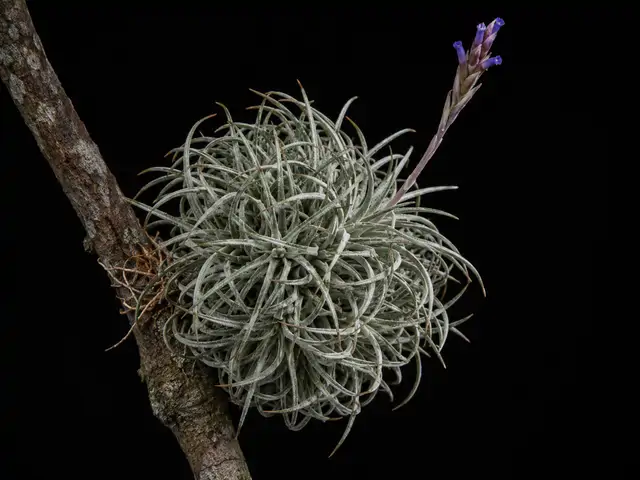
Ball Moss
Ball moss is a harmless native air plant, not toxic and not a parasite - it does NOT feed on the trees, wires, or fences it perches on. It is frequently and wrongly blamed for killing branches; in reality it is only a passenger. It is grown or simply tolerated as a curiosity, not eaten.
Overview
The tidy gray-green tuft-balls perched in Southern branch-forks and on wires - a harmless native air plant that grows ON trees with no soil, and the classic case of a plant unfairly blamed for killing the trees it merely sits on.
Ball moss (Tillandsia recurvata) is the neat, grayish-green ball of wiry leaves you see wedged into branch-forks, clustered along twiggy limbs, and even lined up on power lines and fences across the warm South and Southwest. Like its famous cousin Spanish moss, it is not a moss at all - it is a flowering plant, a bromeliad, and a relative of the pineapple.
And like Spanish moss, it is an epiphyte: it grows entirely on the surface of branches, wires, and other supports, with no soil and no feeding roots. What look like roots are just holdfasts that grip the perch; the plant takes all its water and minerals from humidity, rain, and airborne dust through the silvery scales covering its leaves. This is the heart of ball moss's story - and the heart of its bad reputation. Because it thrives on the bare, dying twigs of a thinning tree, it is constantly blamed for killing branches it is only sitting on. In truth it is a harmless passenger, and up close - especially when it sends up its small violet-blue spring flowers - a genuinely charming little air plant.
At a glance
- Sun
- Part sun · Part shade · Shade
- Water
- Medium
- Spacing
- 3–12 in (typ. 6)
- Mature height
- 3–12 in (typ. 6)
- Start by
- Division
- Frost
- SemiHardy
When to plant
No planting window on record for this zone.
Life stages
- Settling onto a perch day 0–90 from transplant
-
Wedge a tuft into a branch fork or onto a wireThere is no soil and no planting. Tuck a ball-moss tuft into a rough branch crotch, tie it loosely to a limb or wire, or set it where its wiry pseudo-roots can grip. Those root-like holdfasts anchor it only - they take up nothing. Rough bark, twiggy branches, and even utility wires and fences all work.
-
Keep the air humid while it grips onevery 4 dBall moss absorbs water and minerals from humidity, rain, and dust through silvery surface scales - it has no functioning roots for feeding. In humid air it needs nothing; in dry air, mist it periodically while its holdfasts take hold over the first weeks to months.
Tuft falling before it grips (re-seat it more securely in a fork)Staying dull and dry in low humidity (mist it) -
Wedge a tuft into a branch fork or onto a wire
- Slow tuft growth Mar, Apr, May, Jun, Jul, Aug, Sep, Oct (yearly)
-
Let the ball fill out - it needs nothingBall moss grows slowly into a tidy gray-green ball of narrow, curving, scaly leaves, six inches or so across, greenest in the warm humid season. It feeds itself from the air; there is nothing to water into soil, nothing to fertilize. Simply let it sit and thicken, and enjoy the oddity of a plant that grows on nothing.
-
Rain and dew do the work; mist only when dryevery 6 dIn humid climates rainfall and dew supply all its moisture. In dry spells or dry indoor air, an occasional misting keeps it soft and green. It grips harmlessly and asks for no root zone at all.
Tufts multiplying along a branch or wire over the yearsGray, static, crisping growth = too dry or too exposed -
Let the ball fill out - it needs nothing
- Spring flower spikes Apr, May, Jun (yearly)
-
Watch for the little violet-blue flowersBall moss is a flowering bromeliad, kin to the pineapple. In spring it sends up slender wiry stalks topped with small, tubular, violet-blue to purple flowers - surprisingly pretty for such an overlooked plant. Papery seed capsules follow, releasing tiny plumed, wind-borne seeds that start new tufts on nearby bark and wires.
Thin flower stalks rising above the tufts in springFluffy plumed seeds catching on rough bark and wires -
Watch for the little violet-blue flowers
Watch out for
Hard Freeze Damage Disorder LowJan, Feb, Dec
Spanish moss is only semi-hardy; a hard freeze much below the mid-teens F browns, damages, or kills exposed festoons, which is what limits it at the cold (zone 8) edge of its range.
Watch for: Blackened, brittle, or grayed-out moss after a severe cold snap, worst on the most exposed strands.
Prevent: In marginal cold zones, keep some moss in a sheltered spot (under canopy, near a wall); it is a non-issue in frost-free coastal zones.
Treat: Leave it - surviving strands regrow in warm weather, and re-drape healthy pieces to restart. No fix for freeze-killed portions but recovery from survivors.
Drought & Dry-Air Stress Disorder LowMar, Apr, May, Jun
Because it drinks from the air, Spanish moss simply cannot thrive in dry air - in low humidity it stays gray, crisp, and static, and eventually dies back, the main reason it fails outside the humid South.
Watch for: Persistently gray, brittle, non-growing moss that never greens up, in dry climates or dry indoor air.
Prevent: Site it in humid, airy, part shade; in dry climates mist it several times a week and avoid hot, exposed, sun-baked spots.
Treat: Increase humidity and misting; move it to a shadier, moister location. It revives and greens quickly once it gets regular moisture.
Wrongly Blamed for Tree Decline Disorder Lowyear-round
Not a threat from the plant but a threat to the plant (and to trees): ball moss is routinely misdiagnosed as a tree-killing parasite and needlessly sprayed or stripped. It is a harmless epiphyte that accumulates on already-declining, shaded deadwood - correlation, not cause.
Watch for: Heavy ball moss on thinning, dying inner branches - a sign the tree is stressed for OTHER reasons, not that the moss is the cause.
Prevent: Understand the biology before acting: it takes nothing from the tree. Address the tree's real stressors (drought, disease, shade); leave the moss.
Treat: No chemical treatment is warranted for the tree's sake. If desired purely for looks, hand-pick tufts or prune out deadwood; expect regrowth from surrounding seed sources.
Good & bad neighbors
Varieties · 1
Effectively a single wild form: firm gray-green balls of narrow, curving, scale-covered leaves a few inches across, perched in branch-forks and on wires from the humid Southeast into the warm Southwest. There are no garden cultivars - it is grown, when at all, as the wild species. Spring brings slender stalks of small violet-blue flowers.
Grow
You don't plant it - you perch it. Wedge a tuft into a branch fork or tie it to a wire in humid, part shade and let its holdfasts grip. No soil, no pot, no roots; humidity and airflow are everything.
Growing ball moss means abandoning the idea of planting. It has no feeding roots and needs no soil, so instead of digging you simply set a tuft onto a perch: wedge it into a rough branch crotch, tie or wire it loosely to a limb, fence, or trellis, and let its wiry holdfasts anchor it in place over the coming weeks. In the wild it colonizes the shadier, twiggier interior branches, plus wires and fences, so almost any rough support in the right climate works.
Give it part shade (it tolerates quite a bit of shade), warm temperatures, and humid, moving air - humidity is the master factor, because it drinks from the atmosphere. In its humid native range, rain and dew do everything; in drier air, mist it now and then. Never pot it or fertilize it like a soil plant. It grows slowly, thickening into a firm gray-green ball and multiplying into new tufts over the years. Get it humid air and a rough perch and it essentially takes care of itself.
Care
Almost none required. Keep it humid and airy, mist in dry spells, and leave it be - it has no roots to water and no soil to feed. Removal is a chore, not a treatment.
Ball moss may be the lowest-maintenance plant you can 'grow,' because there is essentially nothing to do. It has no roots to water and no soil to amend or feed; it pulls water and minerals from the air. Do not pot it, bury it, or fertilize it. The only conditions that matter are humidity and air circulation: muggy climates supply everything, while in dry air an occasional misting keeps it green rather than gray and crisp. Too little humidity leaves it dull and static; being kept constantly soggy and airless can rot it - so airflow both waters and protects it.
Many people meet ball moss not wanting to grow it but wanting it gone from a valued tree. Because it is harmless, removal is optional and mostly cosmetic - and it is a labor, since it grips firmly and reseeds readily from surrounding trees. Hand-picking or pruning out heavily-tufted deadwood tidies a tree, but there is no need to 'treat' it as a disease. The kindest care, for the plant and the tree alike, is usually to leave it alone.
Propagation & seed saving
It spreads itself. Move a tuft to a new perch and it carries on, and its tiny plumed spring seeds ride the wind and dust onto fresh bark and wires - which is exactly why it seems to appear everywhere.
Ball moss propagates with almost no effort. The direct way is division: lift a tuft (or a cluster of the small offset 'pups' a mature plant forms) and set it onto a new perch, where it simply continues growing - no rooting-in period in soil, because there is no soil. Each tuft is a self-contained plant.
In nature it relies on its tiny plumed seeds. After the spring flowers, papery capsules split and release minuscule feathery seeds that drift on the wind and dust and snag on rough bark, twigs, wires, and fences, germinating right there on the surface. This wind-borne seeding is why ball moss seems to 'appear' throughout a neighborhood and steadily colonize new branches - and why removing it from one tree rarely keeps it away for long if surrounding trees carry it. For a curious gardener, though, starting a specimen is as easy as tucking a tuft into a fork and waiting.
Nutrition
Not food - but a striking example of a plant that lives on air. It gathers all its water and minerals from rain, dew, and dust, and it can even fix nitrogen, taking nothing from its perch.
Ball moss is not eaten and yields no crop; it is grown (or simply tolerated) as an ornamental curiosity. Its 'nutrition' is the fascinating part: with no soil and no feeding roots, it absorbs water and dissolved minerals from humidity, rain, and airborne dust through the fine scales (trichomes) coating its leaves. Remarkably, ball moss is even thought to fix its own nitrogen with the help of associated microbes, making it especially self-sufficient - one reason it can thrive on a bare wire with no organic matter anywhere near it.
Because it feeds only on the atmosphere, it takes nothing from the tree, wire, or fence it sits on - the whole basis for its (undeserved) reputation as a tree-killer collapses here. Ecologically, its tufts offer shelter and nest material for small birds and a home for tiny invertebrates, and its spring flowers offer a little nectar. It feeds no human, but it demonstrates, about as clearly as any plant can, that a green thing can make its whole living from the air.
History
Long a familiar sight - and a long-standing scapegoat - across the warm South and Southwest, ball moss has been studied and argued over for decades, with science repeatedly clearing it of the tree-killing charge.
Ball moss has been a fixture of the warm South and Southwest for as long as people have watched its live oaks and mesquites, and for nearly as long it has been on trial. Homeowners and even some arborists have blamed it for the death of branches and whole trees, and there have been repeated pushes to spray or strip it. But university and extension research - notably long study in Texas - has consistently reached the same verdict: ball moss is an epiphyte, not a parasite, and does not kill healthy trees. The confusion is understandable: ball moss favors the shaded, dying inner branches of a thinning canopy, so it accumulates on deadwood and gets blamed for the decline it merely accompanies.
Compared to Spanish moss, it never became a commercial crop, but it shares the same bromeliad family and the same air-plant lifestyle, and it has long fascinated botanists as a model of the epiphyte way of life (and even nitrogen fixation). Today, as interest in native plants and air plants grows, ball moss is increasingly seen less as a nuisance to eradicate and more as a harmless, self-sufficient native worth understanding - and its small violet flowers worth a closer look.
Troubleshooting
The main 'problem' is a myth - ball moss does NOT kill trees. Real issues are minor: it dulls and crisps in dry air, can rot if kept soggy and airless, and dies back in hard freezes.
'Ball moss is killing my tree!' This is the number-one concern, and it is not true. Ball moss is an epiphyte with no roots into the tree; it takes no water or nutrients from it and only perches on the bark. It congregates on the shaded, weak, and dying inner twigs of a tree that is thinning for other reasons (age, drought, disease, shading), so people see heavy ball moss on failing branches and reverse the cause and effect. Decades of extension research confirm it does not kill healthy trees. Removing it is cosmetic, not curative; if you dislike the look, hand-pick tufts or prune out the deadwood, but there is no need to spray or panic.
Dull, gray, crisp, not growing: too dry or too exposed - it wants humid, shadier air; mist it. Blackening or rotting: kept too wet in stagnant, airless conditions - improve air circulation and let it dry between wettings. Winter dieback: a hard freeze below the mid-teens F can damage or kill exposed tufts at the cold edge of its range. It keeps coming back after removal: expected - neighboring trees rain wind-borne seed onto your bark and wires; there is no permanent 'cure,' which is one more reason to make peace with a harmless plant.
Growing across climates
A plant of warm, humid air across the southern tier - from the humid Southeast to warm parts of the desert Southwest (zones 8-11) - limited by hard freezes and truly arid air rather than by soil.
Ball moss ranges across the warm southern tier of the country, from the humid Southeast into warmer parts of Texas and the desert Southwest, roughly zones 8-11 - a slightly tougher, more drought- and heat-adaptable air plant than Spanish moss. Humid Southeast and Gulf (zones 8-10): it thrives on ample humidity, rain, and dew, colonizing oaks and many other trees freely. Warm Southwest (parts of Texas and Arizona): it persists even in surprisingly dry country by capturing dew, fog, and humid spells and gripping mesquites, wires, and shaded branches - a testament to how efficiently it harvests atmospheric moisture. Cold and truly arid limits: hard freezes below the mid-teens F damage it, and genuinely bone-dry air with no dew starves it of moisture, so those, not soil, set its edges.
Because it lives on airborne moisture and grips a bare perch, its distribution follows humidity, dew, and winter minimums rather than soil type - it can flourish where nothing could root, and fail where the air is simply too dry or too cold.
No grower tips for Ball Moss yet — yours could be the first.
Sign in to share what works in your garden.