Add it to your home screen and it opens full screen — no browser bars, one tap away, and everything stays signed in. Free, nothing to download from an app store.
- Tap the Share button in your browser
- Scroll down and choose “Add to Home Screen”
- Open GrowSomeFood from your home screen
- Open your browser’s menu
- Choose “Add to Home screen” or “Install app”
- Open GrowSomeFood from your home screen
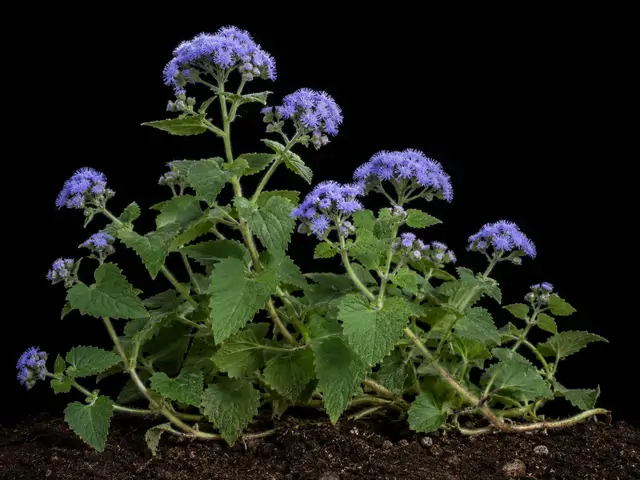
Blue Mistflower
Blue mistflower is a non-toxic native ornamental and pollinator plant, not a food crop. Like its boneset and Eupatorium relatives it contains bitter compounds and is not eaten; keep it out of the kitchen. Its main practical caution is horticultural, not chemical - it spreads aggressively by rhizome and seed. No special handling precautions; not notably toxic to pets, though not for consumption.
Overview
A native 'hardy ageratum' that veils itself in fuzzy powder-blue flowers all fall and swarms with butterflies - genuinely lovely, and genuinely aggressive: it spreads fast by rhizome and seed, so plant it where it can roam or plan to contain it.
Blue mistflower (Conoclinium coelestinum, once Eupatorium coelestinum) offers something rare among native perennials: true powder-blue flowers. Its fuzzy, ageratum-like clusters - hence the names 'wild ageratum' and 'hardy ageratum' - cover the plant in a soft blue haze from late summer well into fall, an unusual cool note among the season's golds and purples, and one that draws clouds of monarchs, butterflies, and native bees at a key late window.
The honest catch is in its vigor. Blue mistflower spreads aggressively, both by running rhizomes and by prolific self-seeding, and in moist, rich ground it can colonize quickly and crowd tidier neighbors - which is why it's flagged as a plant to grow with intention. In the right place - a wild border, a moist meadow, a rain garden, a spot where a spreading groundcover of blue fall flowers and butterflies is exactly what you want - it's a delight. In a small, formal bed it will test your patience. Give it room to run, or edge, deadhead, and divide to keep it honest.
At a glance
- Sun
- Full sun · Part sun · Part shade
- Water
- Medium
- Spacing
- 12–24 in (typ. 18)
- Mature height
- 18–36 in (typ. 30)
- Start by
- Direct sow · Transplant · Division
- Frost
- Hardy
- Germination
- 10–35 days (typ. 20) @ 65–75 °F (typ. 70)
- Start indoors
- 5–8 wks (typ. 6) before transplant
When to plant
Zone 7a typical frost: last Apr 10 · first Oct 25
Life stages
- Year 1 - rooting in day 0–50 from transplant
-
Keep evenly moist to establishevery 6 dBlue mistflower likes moist soil in sun to part shade. Water a new plant to establish; it takes off quickly - and then spreads, so decide up front whether to let it colonize or to contain it.
-
Site it where spread is welcome - or edge itThis plant runs by rhizome and self-sows freely. Give it a wild, moist area where it can naturalize, or plant it against a hard edge (path, lawn, or buried barrier) if you want it contained from the start.
Fast rhizome spread and self-sown seedlings (the main thing to manage)Wilting in dry, hot spots (it wants moisture) -
Keep evenly moist to establishevery 6 d
- Spring & summer growth Apr, May, Jun, Jul (yearly)
-
Pinch in early summer for a bushier, shorter plantPinch or cut the stems back by a third in late spring/early summer to make the plant bushier, shorter, and less floppy, with more flowers - it responds well and blooms just as heavily in fall.
-
Watch the edges and pull runnersThis is the season to keep its spread in check: pull up rhizome runners creeping past its bounds, and remove unwanted self-sown seedlings while they're small and easy.
Runners and seedlings expanding the patch (pull to contain)Powdery mildew or leaf spot in humid crowdingAphids on new growth -
Pinch in early summer for a bushier, shorter plant
- Late-summer & fall bloom Aug, Sep, Oct (yearly)
-
Enjoy the blue haze - and deadhead to limit seedingFuzzy, powder-blue ageratum-like flower clusters cover the plant in a soft blue haze through fall - unusual and lovely among the season's golds and purples. Deadhead spent flowers before they set seed if you want to reduce self-sowing (this also keeps it blooming).
-
Watch the pollinators swarmBlue mistflower is a superb late-season pollinator plant, mobbed by monarchs, other butterflies, native bees, and skippers when it blooms. Leave plenty in flower for them.
Clouds of butterflies and bees on the flowers (the point)Seed set (deadhead to limit spread) -
Enjoy the blue haze - and deadhead to limit seeding
- Cut-back & winter Jan, Feb, Mar, Nov, Dec (yearly)
-
Cut back and divide to containCut spent growth back for winter (or leave a little for interest and cover). Late winter/early spring is the time to divide and, importantly, to dig out and pull back the rhizomes to keep the colony within bounds.
-
Remove strays before they root deeperDig out runners and volunteer seedlings that have wandered where you don't want them - it's far easier now than after they establish.
The colony widening well beyond its space (divide and pull back hard)Volunteer seedlings -
Cut back and divide to contain
Watch out for
Aggressive Spread (into lawns) Disorder MediumMay, Jun, Jul, Aug, Sep
Not a pest but the reason it's called a weed: wild violet spreads by rhizome and by prolific self-seeding (including forcibly ejected seed from hidden summer flowers), naturalizing into lawns and beds and resisting easy removal.
Watch for: Expanding patches in the lawn and self-sown seedlings appearing around established plants.
Prevent: Embrace it as a native groundcover, or contain it with edging and a dense competitive lawn; hand-dig including the rhizomes to remove it.
Treat: Dig out whole plants with rhizomes (it resists many broadleaf herbicides); repeated removal and thick turf reduce it, but acceptance is often the easiest path.
Aphids Pest LowMay, Jun, Jul
Small soft-bodied sap-suckers clustering on tender tips and buds, excreting sticky honeydew.
Watch for: Colonies on new growth and flower buds, sticky residue, curling shoots, attending ants.
Prevent: Avoid excess nitrogen; encourage ladybugs and lacewings (zinnia flowers help feed them).
Treat: Hose off or use insecticidal soap. Rarely serious on vigorous zinnias.
Powdery Mildew Disease LowJul, Aug, Sep
The defining zinnia disease: a fungal white powdery coating that spreads over leaves in humid or crowded conditions, worst in late summer. Rarely kills but disfigures foliage and weakens the plant.
Watch for: White dusty film starting on lower leaves and climbing, leaves yellowing and dropping beneath the blooms.
Prevent: Wide spacing, base (never overhead) watering, full sun and airflow; grow resistant series (Profusion, Zahara) where it recurs every year.
Treat: Remove the worst leaves, improve airflow; potassium bicarbonate, neem, or sulfur sprays slow it. Cutting flowers off healthy upper growth keeps the display going regardless.
Good & bad neighbors
Varieties · 3
A garden selection chosen for a somewhat more compact, floriferous habit than the wild type, with the same powder-blue fall flowers and butterfly appeal - though it still spreads and needs the same containment. A slightly tidier option for a managed planting.
The wild blue mistflower: fuzzy powder-blue ageratum-like flower clusters covering 1.5-3 foot plants from late summer into fall, over triangular toothed leaves. An outstanding late pollinator and butterfly plant - and a vigorous spreader by rhizome and seed, best where it can naturalize.
An occasional white-flowered form of blue mistflower, offering the same fuzzy clusters and butterfly value in soft white rather than blue - uncommon in the trade, and just as vigorous a spreader as the species.
Grow
Sun to part shade and moist soil suit it; it's easy to the point of aggressive, so the real decision is placement - give it room to spread, or plant it against a hard edge and plan to contain it.
Blue mistflower is about as easy to grow as a plant gets - the challenge is keeping it in bounds, not keeping it alive. It thrives in sun to part shade and moist, fertile soil, and is a natural for rain gardens, pond edges, damp meadows, and low spots; it tolerates ordinary garden soil too but spreads fastest where it's moist and rich. It takes real shade better than most fall bloomers, and is fairly heat- and humidity-proof.
Because it runs by rhizome and self-sows freely, the key growing decision is placement. Give it a wild, contained, or naturally boggy area where a spreading blue groundcover is welcome, or plant it against a hard boundary - a path, a lawn edge you'll mow, or a buried barrier - if you want it held in a bed. Starting it in a drier, leaner spot slows its spread somewhat. Whatever you choose, go in expecting to manage its enthusiasm rather than coax it along.
Care
The main 'care' is containment - pull runners and seedlings, deadhead to limit seeding, and divide to renew and control it; pinch in early summer for a bushier plant, and water in dry spells.
With blue mistflower, care means containment. Through the growing season, pull up rhizome runners that creep past its bounds and remove unwanted self-sown seedlings while they're small - both are easy when young and a nuisance once established. Deadhead the spent flowers before they set seed to cut down on self-sowing (which also prolongs bloom), and divide the clump in spring both to renew it and to dig out excess spread.
The plant itself is nearly carefree otherwise: pinch or cut it back by a third in early summer for a bushier, shorter, less floppy plant with more flowers, and water in dry spells (it wilts and looks poor in drought). No feeding is needed - rich soil only fuels its spread. Watch for a little powdery mildew or leaf spot in humid crowding and minor aphids, neither serious. Grown where it can roam, it needs almost nothing; grown in a bed, it needs a firm, regular hand.
Harvest
No food harvest - it's grown for flowers and, above all, for butterflies. Its late-season blue bloom is one of the best pollinator resources of fall; cut a few stems, but the soft clusters are short-lived in a vase.
Blue mistflower isn't a food plant; it's grown for its flowers and its exceptional wildlife value. It makes a passable but short-lived cut flower - the soft, fuzzy clusters don't hold as long as firmer daisies - so it's better enjoyed in the garden than the vase.
Its real 'harvest' is ecological, and it's outstanding. Blooming in late summer and fall, blue mistflower is a magnet for monarchs and other migrating butterflies, native bees, and skippers, offering abundant, accessible nectar right when pollinators need to fuel up for winter and migration - it's frequently one of the busiest plants in the fall garden. So leave the mass of bloom for the butterflies. It's not a seed or forage crop, and its spreading habit means there's never a shortage of flowers to spare for the pollinators.
Storage
Nothing to store as food; you'll rarely need to save seed (it self-sows abundantly), and the plant persists and spreads by rhizome, returning vigorously each spring.
There's nothing to store as food, and little reason to save seed - blue mistflower self-sows abundantly on its own, so you're far more likely to be removing seedlings than sowing them. If you do want seed for a new area, collect the fluffy ripe seed heads in fall and store cool and dry to sow after winter cold; but expect volunteers wherever the parent grows.
As a vigorous, rhizomatous perennial, the plant 'stores itself' underground: it dies back each winter and returns strongly each spring, expanding its colony year to year. That means a planting perpetuates and enlarges itself with no help - the storage question for blue mistflower is really the containment question. Divisions and rooted runners lifted in spring or fall transplant with ease (perhaps too much ease).
Propagation & seed saving
It propagates itself all too readily - divide the spreading clump or lift rooted runners, and it self-sows freely; you'll almost never need to start it deliberately from seed.
Blue mistflower is one of the easiest plants to propagate - the harder task is stopping it. Division and simply lifting rooted rhizome runners are the standard methods: dig the spreading clump in spring or fall, separate rooted pieces, and replant - each takes readily. Because it runs constantly, there are always divisions to be had.
It also self-sows so freely that seedlings appear on their own around any established plant, ready to transplant while young. Deliberate seed sowing is rarely needed, but the seed germinates easily after winter cold if you want to start a new patch elsewhere. Soft stem cuttings root, too. The practical upshot: you'll never struggle to make more blue mistflower, and you should share divisions and pull seedlings freely - propagation is effortless, and restraint is the real skill with this plant.
Nutrition
Not a food plant - it's a bitter Eupatorium relative, not eaten - but ecologically it's a standout late-season nectar source for monarchs, migrating butterflies, and native bees.
Blue mistflower isn't eaten - it's a bitter member of the boneset and Eupatorium alliance, grown as an ornamental, not a food or (unlike some relatives) a notable herbal plant. Keep it out of the kitchen.
Its value is entirely ecological, and here it excels. Blooming abundantly in late summer and fall, blue mistflower is one of the best late-season nectar plants for pollinators: it's a favorite of monarchs and other migrating butterflies, native bees, and skippers, providing easy, plentiful nectar exactly when insects are fueling up for migration and winter. Its rapid spread means it can quickly form a large, nectar-rich patch that supports substantial pollinator activity. As a tough, adaptable, moisture-loving native, it delivers exceptional fall pollinator support for essentially no care - the very vigor that makes it a management challenge is also what makes it such a generous wildlife plant. It feeds the food web, not the gardener.
History
A wildflower of eastern moist ground long known as 'wild ageratum' for its resemblance to the bedding annual, related to the bonesets, and embraced (with caution) as a valuable but assertive native pollinator plant.
Blue mistflower is a familiar native of moist meadows, streambanks, ditches, and floodplains across the eastern and central United States, its powder-blue fall flowers a common sight in damp, sunny ground. Because those fuzzy blue clusters closely resemble the popular bedding annual ageratum, it long went by the folk names 'wild ageratum' and 'hardy ageratum' - a hardy, native, perennial stand-in for the tender annual. It was once classed in Eupatorium alongside the bonesets and joe-pye weeds, and is sometimes called 'blue boneset,' before botanists moved it to the genus Conoclinium.
Traditionally it was more a wildflower of the countryside than a cultivated garden plant, valued casually for its unusual blue color. In the modern native-plant and pollinator-gardening era it has been embraced for its outstanding late-season butterfly value and rare true-blue fall color - but always with the honest caveat that has followed it into every good plant guide: it spreads, and it must be sited and managed accordingly.
Troubleshooting
The defining 'problem' is its aggressive spread - contain it by pulling runners and seedlings, deadheading, edging, and dividing; wilting means it needs moisture, and floppiness is fixed by an early-summer pinch.
It's taking over the bed: the expected challenge - blue mistflower spreads by rhizome and self-seeds heavily. Pull up runners and seedlings while small, deadhead before seed set, edge it against a path or lawn or a buried barrier, and divide/dig it back each spring; in a small formal bed, consider growing it in a sunken container or choosing a tidier plant. In a wild, moist area, simply let it colonize. Wilting, poor growth, scorched leaves: too dry - it's a moisture lover; water it and site it in damp ground. Floppy, sprawling stems: pinch or cut back by a third in early summer for a bushier, sturdier plant, and give it enough sun. White powdery leaves or leaf spots: powdery mildew or fungal leaf spot in humid crowding - improve airflow; usually cosmetic. Sticky new growth with small insects: aphids - hose off; minor. Few flowers in deep shade: give it more sun for heavier bloom.
Growing across climates
Hardy across the eastern and central U.S. (zones 5-10) and thoroughly at home in hot, humid, wet-soil conditions; warmth and moisture only make it spread faster, so containment matters most in mild, damp climates.
Blue mistflower is broadly adaptable and thrives in exactly the warm, moist conditions much of its range offers. Zones 5-6: hardy and vigorous, dying back to the ground and returning each spring; cold winters can slow its spread a little. Zones 7-9 (much of its heartland): excellent - it revels in hot, humid summers and moist soils, delivering its full late-season blue display and top butterfly value, and spreading fastest here, so containment matters most. Zone 10 / Deep South: at home in warm, wet ground, where it can be especially assertive. Hot, humid regions: a real strength - it shrugs off humidity and wet soil that trouble many perennials. Drier or cooler sites: it grows more slowly and stays more restrained, so gardeners wanting its beauty with less spread may find lean, drier ground and colder zones more manageable. Everywhere, its limits are cultural (it wants moisture and sun) rather than climatic - and the warmer and wetter the site, the more its vigor needs a firm hand.
No grower tips for Blue Mistflower yet — yours could be the first.
Sign in to share what works in your garden.